Kicking and Screaming (1995)

4 02 2014

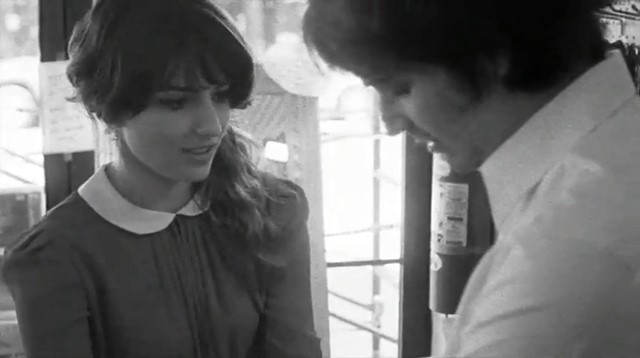
I guess some context is in order here. I just graduated from college a little over a month and I haven’t made any progress with what you might categorize as the rest of my life. I include this introduction because it is the very sensation that stands as an obstacle to the individuals in Noah Baumbach’s Kicking and Screaming. It’s a movie about being unable to move on from college and even though I am, comparatively speaking, only a recent graduate, the anxiety brought on by an aimless existence resonates so deeply it’s a little unfair. I’ll argue there’s more to the film than just “oh, this seems familiar” but I won’t ignore that part of the film’s sting comes from my own proximity to the situation. It’s a movie about where I am in life right now and if that sounds corny, be reassured that it’s not a life or death situation. Instead, it’s just an annoying and upsetting one.

1

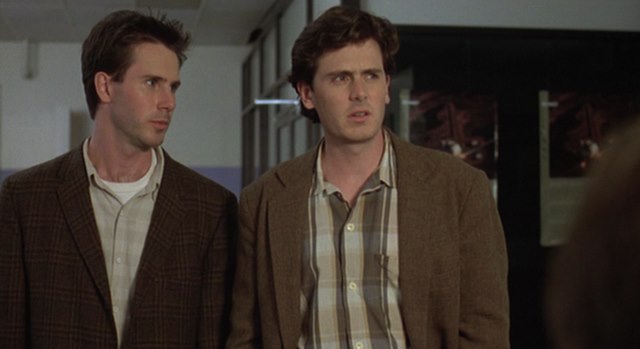
Grover, Max, Skippy, and Otis have all graduated from college. However, they have particular plans afterwards. Otis seeks to continue his education through grad school but the one hour time difference between New York and Milwaukee seems too much for him. Grover also has plans, moving to Brooklyn with his girlfriend, Jane. However, this all dissolves when she informs him that she’s also continuing her education and doing so in Prague. The two effectively breakup leaving the four guys with nothing much to do but sit around, get drunk, and feel anxious about their lack of a future.
2

The presence of Chris Eigeman as Max alone invites some comparison to Whit Stillman’s work and Baumbach’s script seems to operate using the same type of clever verbal explosions. If there’s an observable difference, it’s that Stillman’s dialogue, while sad and aching underneath the surface, lacks the immediate poignancy of Baumbach’s. There’s an almost tragic self-loathing in every line here, one that announces a character’s unrest in the text itself but is intentionally masked by the character’s own  delivery of such dialogue. The characters that populate Baumbach’s world desperately want to cry out and announce their malaise. That’s far too dramatic and probably a little unattractive so instead, everyone casually floats their sadness to the surface. Throwing it into an ocean of witty dialogue like a life preservation vest, hoping that one of their friends will save them. Of course, everyone here is trying to stay afloat so little can be done to save their friends, who begin to resemble mere acquaintances anyway. Perhaps the metaphor is forced, but my point remains the same: the humor of characters is a self-preservation technique. They use it to mask their fears, which they secretly want to talk about at length.
3

Superficially, Kicking and Screaming is about being unable to move on, from college in particular. This doesn’t seem like the most revolutionary idea or concept but it is one that Baumbach frames in way that captures the anguish of the transition. Otis, for example, is unable to attend grad school because of a one hour time difference. His complaint seems trivial and childish (the latter characteristic repeatedly reinforced by his wardrobe consisting only of pajama tops) but the humor of his protest resembles something real and tragic. We inevitably build routines in our lives, ones that in all likelihood, we will have to break. The reality of this break is a harsh one as it suggests something deeply uncomfortable. When I moved out of my apartment following graduation, I couldn’t help but cry. It seems weird in retrospect. Sure, I have plenty of wonderful memories and even as I write this, I think fondly of  living there. On the other hand, I knew such an existence was temporary. This knowledge is the very thing that Otis, as well as Max, Grover, and Skippy want to delay. They successfully construct a reality that isn’t productive or helpful, but does resemble the routine they followed for years. It doesn’t feel particularly good, either but it’s not nearly as uncomfortable as trying to break out from the mold.

4

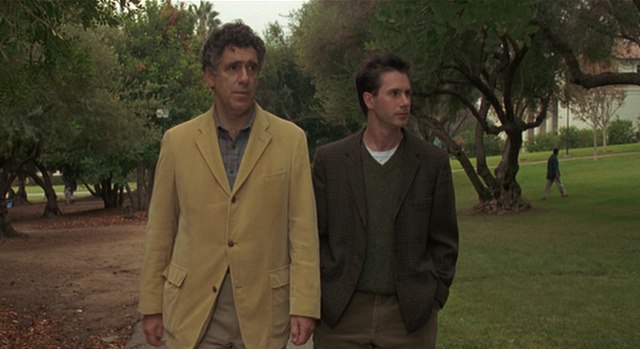
One might see the protagonists as helpless, simply because they won’t help themselves. Grover has an opportunity for an internship with the New Yorker, he’s interested, but not ecstatic. Nothing materializes out of this opportunity. Max doesn’t show any interest in pursuing a profession and gets involved with a seventeen year old girl. Skippy tries to go back to school, but the result is him just badgering Miami, his girlfriend losing patience for him and the entire group. They can’t help themselves because helping yourself is something that no one has constructed an idea about. Nobody knows what moving on looks like so nobody tries to move on. Chet, the character whose been in college longer than anyone, suggests the way to make God laugh is to have a plan. His skepticism towards having a life plan is not unfounded, but it might be the sort of thing that motivates Grover and company. They, like myself, don’t bother with a plan because they are already skeptical of it ever being successful. There’s not some sage wisdom that the film reveals in this moment, because Grover did have a plan and it didn’t work so he gave up on it. The alternative suggested is not exactly positive. The moment is a red herring, a glimpse into Chet’s own aimless but not the filmmaker trying to communicate his ideas through one character. When discussing your own life, you can’t really speak in such absolutes.
5

The film ends with a flashback. One of Grover telling Jane how he wished they were an older couple so they could openly embrace without the influence of modern dating etiquette. The scene seems disconnected from the rest of the film’s extensive portrait of post-grad lethargy. It all works together, in my opinion. More importantly, I find this moment in communication with the rest of Baumbach’s oeuvre. Frances Ha includes a similar scene in which Frances drunkenly describes a singular moment she seeks in a relationshipThe Squid and the Whale has Laura Linney wistfully explaining to Jesse Eisenberg the moment they shared involving the titular diorama at the American Museum of Natural History. I’m not sure if I can connect all three of these sequences together in a cohesive way. There are, however, united by some yearning. The suggestion that we actually could construct an ideal moment, be it one in the future or one from the past. We’re not utterly hopeless because we can see a beautiful future, but it’s just really difficult to figure out how to get there in the first place. 

6


Karumen kokyo ni kaeru / Carmen Comes Home (1951)

29 01 2014

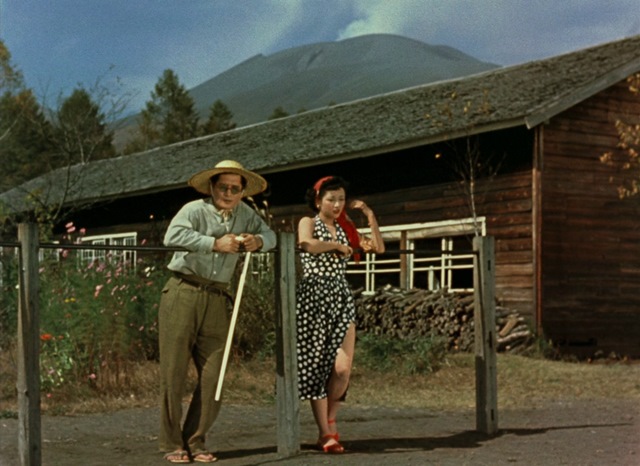
With its instance on being lighthearted and charming, it’s difficult for one to critically evaluate Keisuke Kinoshita’s Carmen Comes Home without sounding like a kill joy. It’s a gloriously photographed film, Japan’s first in color, but the novelty of the photography eventually weighs on the actual content. While I frequently criticize Kinoshita for forcing the pathos in his films, he doesn’t even bother to try here in this film. There’s the same, drippy melodramatic tearjearker touches one comes to expect from him, but the tone of the experience is too jovial for that to make the film feel particularly overwrought. Instead, the probably here lies in his complete lack of interest in his characters. His ambition is not nearly as great as it is in a film like Twenty-four Eyes, but the result feels similarly empty.

1

Lily Carmen is a famous dancer in Tokyo. However, the locals in her hometown recall fondly her days as a youth. Her father, who experiences some difficulty walking, is ashamed of his daughter’s profession. The fact that she’s never returned home is preferable to him, as he shows no interest in ever confronting her about what he understands to be a dirty profession. Carmen and her friend, Akemi Maya arrive in the village to much fanfare. However, Carmen’s father is still resistant to speaking with her. He intentionally hides whenever the two girls gleefully announce their presence. Upset with his refusal to listen to her, Carmen and Maya decide to put on a show for the entire village. They do it in the name of the art of dancing, but the villagers are attracted by the potential for nudity.

2

Kinoshita’s script paints with rather broad strokes, establishing a binary immediately between rural and urban life. To his credit, we never see Carmen and Maya’s life in Tokyo so all of this characterization of city life might be a inward critique of the small village’s own ignorance of it. On the other hand, that would be giving Kinoshita too much credit when he continually sympathizes and places himself with the perspective of the villagers. It’s the same characterization made in Murnau’s Sunrise. The city and its materialism represents evil and decadence. The rural village is return to the simple, idyllic life that we should aspire towards. To Murnau’s credit, he critiqued this himself in his own film, City Girl, which paints both spaces as having their strengths and weaknesses. The reality comes in what you yourself do with the space your given, which sounds like some neoliberal “pull yourself up by the bootstraps” rhetoric, but it’s not. To be more blunt, this type of binary isn’t exactly false (farm life is different from city life, sure) but it is instead represented in such a one-dimensional way that it becomes characterization tools for the actual characters in the film.

3

There is an awful lot to like in the titular character, Lily Carmen. Of course, Hideko Takamine is fantastic in a role that requires her to channel a bubbly personality, one that would seem to be the antithesis to the women she played in most of Mikio Naruse’s films. One important similarity would be the connection of sexwork, always at least happening on the periphery in Naruse’s world, if not in the center. Naruse’ stoic, broken (physically and mentally), and sad women immediately register as worthy of our attention and sympathy. Carmen, however, is constantly trying to earn this and its because Kinoshita’s script limits her in some sort of obstacle course that seems designed with the intention to only see her fall and have us laugh at the conceited big city girl. She repeatedly refers to her work as a dancer as art but that word is greeted with only smirks and giggles by the men of the village, all of whom’s condescension Kinoshita aligns with. Like the men of the village, he sees this art as merely smut and Maya and Carmen as victims of a society that thrives off of such work. Any pride they take in their profession is unmasked and pulled out to the center of a horny public who classifies their pride as stupid.

4

In the end, Carmen and Maya do put on a show for the village and yes, they willingly display their bodies in a crowded makeshift theater. This final act doesn’t really tie things up. Carmen’s father accepts the money made from his daughter, but he still sees it as tainted. The blind music teacher who Carmen once loved gets back his accordion because the new owner, still drunk from the show, gives it away in an act of good will via personal intoxication. Most importantly, Carmen and Maya control their show, controlled their sexuality, and can now happily return to their normal lives in the city. It all feels a bit too cute, especially when the consequences are kind of amazing. Carmen’s father still sort of hates her, and Kinoshita glossing over this detail is weirdly poignant. Also, Carmen’s lyrics celebrating the “dapper man beside me” are matched visually with only her female best friend. It could be a celebration of personal independence in a world whose foundation is in heterosexual coupling.

5

The conclusion still feels cheap and unearned, if not uninteresting. Maybe there is something feminist about Kinoshita’s discourse here, but the conclusion is only reached through the most simplistic and contrived of manners that I hesitate to connect with his work as truly revolutionary, or hell, even interesting. He provides an intriguing narrative for his protagonist, but there’s not enough of her. Instead, the film ends with a weirdly fascist sentiment, celebrating the blind Mr. Taguchi as the model Japanese citizen, because of his commitment to the military during the war.  Carmen’s unrequited love for him is ignored and instead, the village, perhaps a shade less conservative, can move with its typical routine. There’s a subtext here, however illusive, that evokes something absolutely heartbreaking. Kinoshita’s ignorance of it isn’t transgressive, but instead an oversight by a filmmaker who was more interested in the easiest elements of his scenario. It’s a shame, someone as driven and likable as Lily Carmen probably deserved a better director.

6


Short Term 12 (2013)

23 01 2014

Before I even watched Short Term 12, I knew what I was probably going to think of it. That’s not to say that my response was already pre-formed, but instead that the makeup of film such as this is so typical, that my feelings towards such films tend to be uniform. An arty, independent film with a big name actress that looks a bit better than the rest of independent cinema. Oh, and it’s also about troubled teenagers, which sounds like a dismissive category, but when such depictions are done right, they’re easy for me to love. I figured I would have to wrestle with a certain sentimental or cathartic hitting me and clashing with what might not actually be a good film. This is a worthy effort, there’s a lot to admire, but good intentions aren’t invincible and the film’s subtext seems like a problem that can’t be ignored.

1

Grace and Mason are both counselors are a foster-care facility. They’re passionate, thoughtful, and seemingly experienced authoritative figures. The conflicts of the day are many, but their reserved nature balances the chaos of the establishment. The two live together and there is implications that their romance isn’t exactly new. They aren’t married, but they live in a spacious house and their closeness suggests that such a step would not be far away. In the mean time, Grace is pregnant and she intends to have it terminated. Back at the foster-care facility, fifteen year old Jayden arrives. A sarcastic and cynical 15 year old girl and a frequent victim of self-harm. She puts a wall against Grace, but the two eventually bond, instigating Grace herself to finally open up about her own past.

2

As I’ve hinted at already, there’s something very inviting about Short Term 12. Aesthetically, it’s not exactly groundbreaking, but the conventional “realistic” aesthetic (ie steadicam/shaky handheld camera) is given a visually boost here. Yes, there’s a lot of out of focus closeups that aren’t particularly inspired but visual style is a least a tad above just typical middlebrow Hollywood fare. One could argue that an “uglier” style (think the similarly-themed Manic) might be beneficial to building an atmosphere that is, above all else, unpredictable. The film’s tonal shifts are intentionally abrupt and I think poetic, yet not intrusively so is a good fit here. Basically, I like the look achieved here, although it’s nothing new nor is it especially impressive. It’s nothing more than “nice” looking, but it shouldn’t be anything more.

3

Cretton’s problems as a filmmaker begin when he forces psychology into his characters. One of the most dramatic sequences in the film involves a standoff between Grace and the facility’s manager. He’s allowed Jayden to return to her father, who Grace has discovered to be abusive. The dialogue here might be cringe-worthy in someone’s else hands, but Brie Larson delivers the line “she told me the only way she knew how” with a force that forgoes any reservations about sincerity. The discourse of this sequence is about the difficulty in communicating something as traumatic as abuse. Opening up isn’t easy, yet Cretton himself seems to draw the motivations of his characters to these hacky psychological reasonings. He contradicts himself by saying there’s an easy for anxiety and unrest, and even worse he suggests there’s a way to cure it.

4

Gregg Araki’s Mysterious Skin ends with the film’s protagonists, Neil and Brian finally reconnecting some fifteen plus years after being sexually abused. Neil holds Brian and explains his thoughts via voiceover, ” I wanted to tell Brian that it was over now and that everything would be okay. But that was a lie, plus I couldn’t speak anyway. I wish there was some way to go back and undo the past.” Araki’s ending is cathartic and transcendent without accepting the idea that the trauma that abuse of this kind brings is not someone can just overcome. Cretton, on the other hand, attempts to cure Grace through catharsis. She meets up with Jayden and the two triumphantly smash his car with a baseball bat. The moment is moving and certainly we can celebrate the release of all that built up pain, but the reality is that the pain hasn’t been released. I’m supportive of them beating the shit out of an abusive father’s car, but you wake up from that and the suffering of memories can come back and hit you. Cretton doesn’t allow for this and instead, his film suggests that Grace has completely moved on and is ready to start a family.

5

The cathartic car-smashing sequence comes right before a montage that, as artfully done as it is, has the ideological content of a Hallmark film. The music builds up Grace’s accomplishment, and we see her and Mason at the doctor. Viewing her fetus’ heartbeat, tears streak down her face and without a word, we understand that she will happily continue along with the pregnancy. The superficial anti-choice politics of such a sequence isn’t the problem on its own. Instead, the bigger problem comes with its proximity to a scene confronting real child abuse. The film frames Grace terminating her pregnancy alongside her father abusing her. The juxtaposition is sappy and eye-rolling, not to mention sort of disgusting. I can ignore some boring anti-choice subtext in an art film, but to frame that choice as the equivalent to her own abuse is, well, dumb. It’s ultimately just another mark against an already flawed enough film. I’m not exactly mad about it, just kind of disappointed that it goes the easiest route possible.

6


The Color Wheel (2011)

21 01 2014

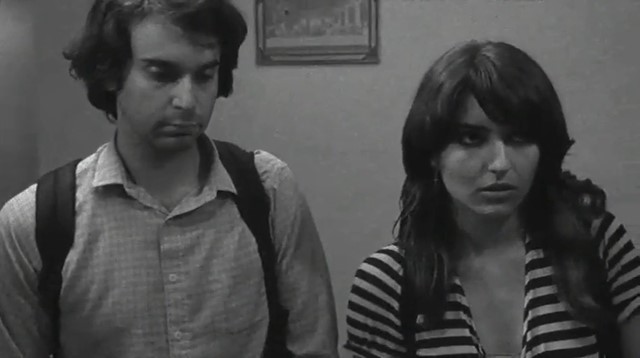
Maybe it wouldn’t be unwise to start a review of The Color Wheel by contextualizing my generation as especially cynical. Generational characterizations tend to be stupid, thinly veiled insults thrown from our elders, but cynicism is at least reflected in the attitudes of young American filmmakers. Let’s not dance around the word: mumblecore. There, I said it. The Color Wheel looks like it could be tagged with such a term, but doing so would ignore the discourse of what the genre or movement constituted. Yes, it’s a film about young people but its distance eventually becomes the thing that pulls an audience in closely, perhaps too close for comfort. It’s a film that acknowledges the work that came before it, but also suggests that attempts to find the profound in the banal have yet to be successful. I hesitate to call it a masterwork, but it already feels like an important movie.

1

JR breaks up with and moves out of her professor’s apartment. She enlists the help of her brother, Colin, to help move her stuff of the apartment. The two don’t particularly get along. They seem repulsed by each other, and Colin’s claims that their parents don’t care about JR seem true enough to sting. JR is critical of Colin for his lack of aspiration. He has a unremarkable job and lives with their parents, still. His stability is sad, but JR’s lack of it is equally upsetting. Separated from her professor, she doesn’t actually have anywhere else to live and her dreams of becoming a television anchor seem illogical. After moving her stuff out, the two get invited to a party hosted by childhood friends.

2

It seems like an oxymoron to claim that the mumblecore movement ever had any iconography since it clashes with the original logistics of making such a film. Still, I would claim that there are icons of the movement and they’re mostly white, middle class, 20-somethings. The adjectives listed by Bill Sage in Hal Hartley’s Theory of Achievement, incidentally set in Brooklyn, acted as a guideline for constructing the ideal protagonist of such a film. There is a little resistance to this in The Color Wheel but it be a mistake to claim filmmaker Alex Ross Perry has simply followed the mold. Filmmakers will continue to be interested in what they can relate to, so inevitably we get a ton of independent filmmakers making movies about this very limited group of people. That’s the excuse at least, but Perry deserves credit for making a film that acknowledges this convention and criticizes it.

3


Interestingly, none of the reviews I’ve read have seemed to focus on JR and Colin’s casual racism. Why would they? It’s not suppose to be a big deal. This is, unfortunately, how a lot of white people talk now a days, but it is interesting that their “ironic” racial humor is grounded in an experience that has no diversity. The only confrontation the two have with race physically is in Jim Crow-era figures in an antique shop. They’re not repulsed but amused by the offensive nature of the products. Later Colin compares his perception to black women to gay men’s perception of all women. The audience of such a film, which likely matches that of its characters, is not going to be particularly offended by these moments but their placement seems more than just casual banter to me. The world Perry shows, despite incorporating  Boston and New York City, is entirely white. However, it might be the first of these such films to realize this limitation and call attention to it. How can Colin even make such a statement about black women when there’s none in his social circle? The film is unified by the idea that JR and Colin have closed themselves off from the rest of the people in their group. Those outside of it don’t even stand a chance.

4

There isn’t a profound commentary on race relations nestled away here, but instead a dull pain that pokes at you reminding you of its painfully white context. The social interactions that alienate JR and Colin and eventually lead them into the film’s jarring (yet also fitting) conclusion is one birthed of separation itself. The party they attended is, of course, all white but more importantly populated with sharply dressed individuals who impress each other with their promising careers. JR and Colin are  lost something reflected in the surreal and cruel manner in which Colin is treated. Immediately upon entering the party, a man pours wine in his shirt pocket as if to mark him as fuck up. While much of recent American independent cinema has foundation in characters who are struggling. This suggestions sounds weird, but these typical protagonist find solace in their broken hearts. Their concerns tend to be failed romances and the constant effort of moving on. In this context, one must look at the end of The Color Wheel as the opposite. Sure, mumblecore was inspired by the rhetoric of Ray Carney and the uncomfortable nature of truth, but this truth has repeatedly been represented as awkwardly fumbling your words in front of cute girls. It resonates but seems inconsequential, an almost fetishization of the banal.

5

The tensions in The Color Wheel seem to build up like an infection, until Perry finally takes a needle and pokes at the area, letting the puss run out. This illustration is gross, but it kind of underscores the sensation of the film’s incestuous finale. On a formal level, the sequence is astonishing, a single take of JR constructing an alternate universe in which Colin is a teacher. All of the unpleasant parts of JR and Colin’s personalities become their tragic fall. Throughout the film, JR articulates herself in a stylized, sarcastic voice. One that attempts to remove any sincerity from the discourse. It has built a wall, protecting the two from the outside forces that seem to do nothing more than hurt them, but in the process it has shut out the possibility of them connecting with anybody else. Their embrace is jarring, sure, but also the only logical step for two people so actively opposed to reaching out. Perry says American cinema needs to be more cynical, but I think the word he’s looking for is pragmatic. He’s deromanticized the films that his echoes and in the process, shows something really ugly. I’m still partial to the life-affirming quality of Aaron Katz’s Quiet City, but Perry elegantly articulates why reverie is not always good.

6


Barcelona (1994)

20 01 2014

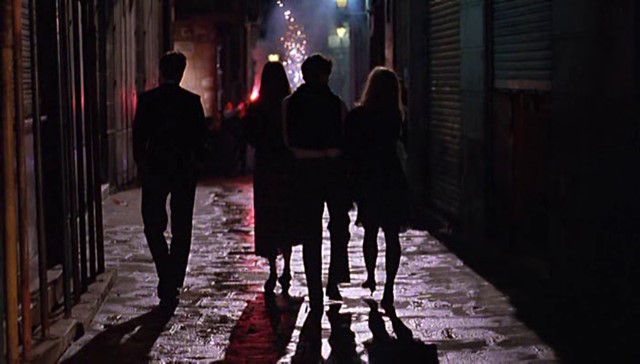
The frustrating part about discussing Whit Stillman’s films is that, inevitably, adjectives like “charming” and “likable” come to my mind. They also populate most of what I’ve read about him. The limitation here is that his films can only be seen through this language, and the experience is this just something that is pleasant and nothing more. Barcelona is indeed charming and very funny, but a film’s humor or its charm can’t be divorced from the emotional connection you make with it. The language around Stillman suggests something light and frivolous and while the lives of his protagonist seem to be that of great privilege and little consequence, there is something urgent and sad happening in their lives. In a way, I’ve found that both this and Metropolitan are sneaky films.

1

Ted is a salesman for a Chicago-based company working in Barcelona. He’s not exactly outgoing. His cousin, Fred, arrives unannounced. Fred is a bit more outgoing, but being an officer for the US Navy becomes an invitation for rude behavior from locals. Additionally, Fred is remarkably sensitive to this ill will, which complicates things when both become involved with local women. Ted falls for Montserrat, who is still somewhat involved with an outspoken yet sleazy newspaper writer. Fred is involved with Marta, who doesn’t seem to be particularly honest in her attentions.

2

Working from the skeletal narrative of Barcelona, one could fine plenty to criticize. The fact that Fred and Ted’s foreign treatment is given serious attention might give one the impression that Stillman is sympathetic to their situation. In a way, he is, but not to the degree that the characters themselves feel slighted. Moving on from there, we get a story about male friendship following that of failed heterosexual romances. These things typically are boorish, trying to further validate the gendered differences that heterosexual relationships illuminate, but never providing any insight into why they are that or where they come from. Stillman’s approach is different, though. The hurt of a mean woman who just won’t love you is not redeemed by the “true” companionship of another good male friend. I mean, on paper, that’s what happens to Fred and Ted but their growth doesn’t come at the expense of another character. The most important trait I have found in all of Stillman’s films is that his characters are all flawed, weird, and complex, but he cares for them.

3

More important than these character’s flawed personalities is the fact that they’re not presented as such. Sure, they are imperfect characters but hesitate with this description because I feel like it evokes the rhetoric used to talk about a filmmaker like John Cassavetes. You can imagine Ray Carney saying something similar, but in this case, he’s talking about it in the context of raw and frank emotional intensity. Stillman’s world is the opposite, the flaws of his characters aren’t made a point of, instead, it’s almost as though the filmmaker just accepts them as an inevitability. The power of his film comes from getting so familiar and comfortable with these “flawed” characters that the very things that even their annoying features become admirable. It doesn’t absolve of them of personal critique, but it does validate all of their experience as worthwhile. Stillman is a man so the slant is obviously towards his male protagonists, but the periphery characters also matter to him. Their existence is not to justify certain actions or progress a story along.

4

With the setting changing from Manhattan to Barcelona, Stillman’s aesthetic begins to more closely resemble that of Eric Rohmer. I think Stillman is operating on a same field, anyway, and least in his perceptions about relationships. If there’s a difference, it’s that Rohmer seems to explore the things that make relationships function and eventually fail. Stillman is more singular, perhaps explore the inner struggle of his character, but such word choice suggests something much heavier than his films. It’s important to stress that he’s funny and again, it works with everything else he manages to achieve. He hasn’t made a poignant film that is funny, but instead one that resonates in part because of its humor.

5