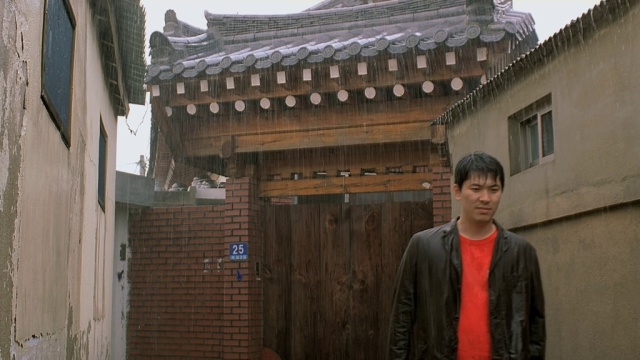
“Gallons of ink and miles of typewriter ribbon expended on the misery of the unrequited lover; not a word about the utter tedium of the unrequiting.” – Tom Stoppard, The Real Thing
At the outset of his career, every project from Hong Sang-Soo showed an ever-increasing need for narrative experimentation. His first film, 1996’s The Day a Pig Fell in a Well, starts us out on a rather uncomplicated tract. There we have four characters, narrating four perspectives taking place in the same world. The follow-up The Power of Kangwon Province drops us, unsuspectingly, into the fallout of a break-up, yet this doesn’t become evident until the very end. His third film A Virgin Stripped Bare by her Bachelors is his boldest narrative experiment of this early stretch. It tells the story of a relationship, but it does so twice – a structure that operates somewhere in-between Kurosawa’s Rashomon and Hartley’s Flirt.
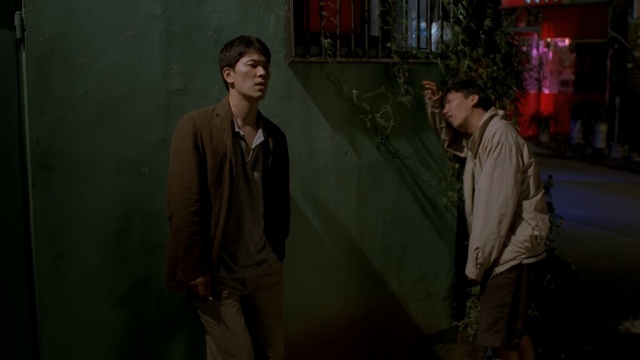
It would make sense, based on this chronology, that Hong’s fourth film, Turning Gate, would follow this accelerating experimentation, but it finds our auteur at as a sort of narrative impasse. Of his early run, Turning Gate, is exceptionally straightforward. Our protagonist, Gyung-soo, is an out of work actor. His most recent project has flopped and worse, his payment has been deferred. He gets a late night phone call from an intoxicated acquaintance Seong-wu, who convinces him to come to Chuncheon. Gyung-soo surprises Seong-wu when he takes him up on the drunken offer, and eventually the two run into Myung-soo, a woman who has long harbored a crush on Gyung-soo.
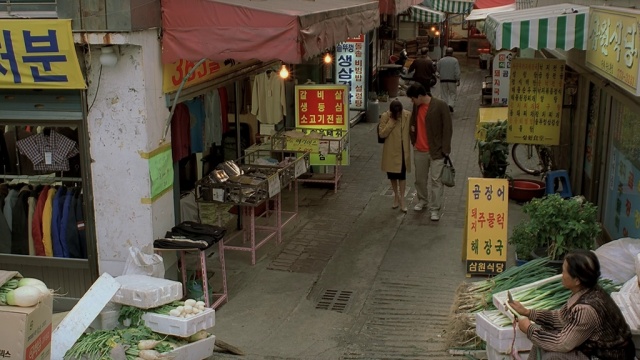
Gyung-soo makes quick work of Myung-soo’s attraction. The two end the night of drinking by crossing a comically dangerous four-lane highway to spend the evening in a kitschy motel. The two make love. Myung-soo confesses she loves Gyung-soo, but he cannot lie to her. The experience has been a strictly physical one for him. Even in rejecting Myung-soo’s desperate love, there is something a bit more tender to Gyung-soo compared to the male characters we’ve seen in previous Hong films, not to say of the massively toxic male individuals we are to be introduced in the Hong films to come. He is not necessarily a good man. I’m not sure such a person exists in Hong’s world nor would any attentive viewer of his films crave such a presence – but he is at least honest and lacks the drunkenly cloying manipulations of other Hong men. When Myung-soo calls him on the phone and asks him to return the proclamation of love back to her he simply retorts, “No” causing her to hang up.
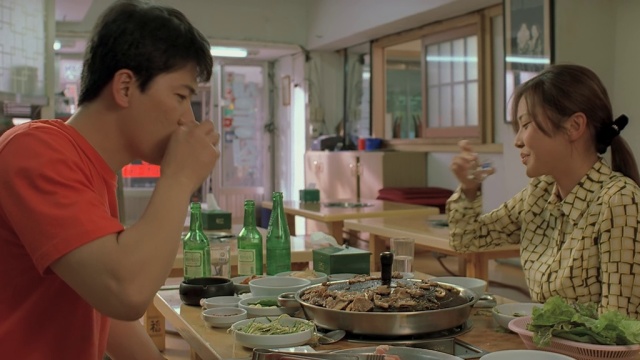
A lot of these interactions wouldn’t register as comedic necessarily if Hong’s static camera, a hallmark of the earliest part of his career, wasn’t so unflinching. I personally mourn this aesthetic slide, and it seems that while Hong’s career has progressed, the growth of his interpersonal insights have come at a cost. Under this theory, I can suggest that Turning Gate succeeds much because it offers the best of both worlds – the beauty of actual 35mm film as opposed to digital, combined with the insightfulness that grew as Hong’s career blossomed into what it is today.