The Boob (1926)

2 01 2013

I guess everybody has to start somewhere, and this even applies to the great William A. Wellman. This early effort does show shades of his genre greatness, but it’s mostly a flighty romantic comedy that never really gets any legs. It kind of just spirals towards a finale that never really feels earned, or even interesting. The characters are flat and stock, but the film is actually watchable through Wellman’s own creative decisions. He tries to make the action interesting, though this playful experimentation is the opposite of the economic touch he would showcase in his best film. It’s an interesting entry for Wellman, but probably only for people who find him interesting in the first place.

1

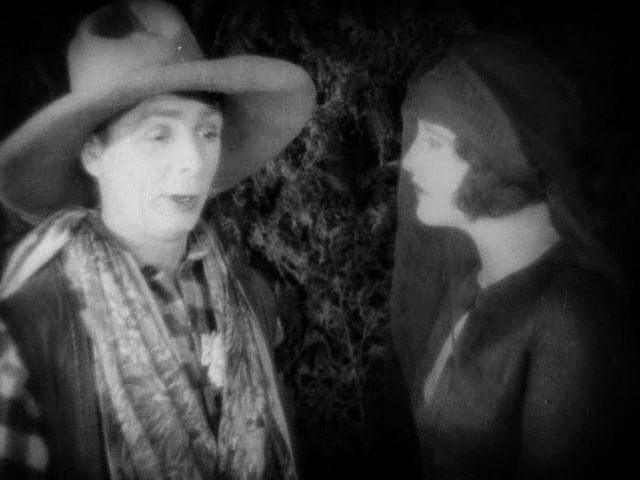
Peter Good is hopelessly in love with his childhood sweetheart, Amy, but she’s not at all interested. Her affections are dedicated to city slicker, Harry Benson. Peter decides to become a detective in order to impress Amy, specifically going after bootleggers. Coincidentally, Harry invites Amy to The Booklovers, a club disguised as a library. It turns out Harry is a bootlegger, and Peter, now dressed in a ridiculous cowboy getup, sees this as the perfect opportunity to win Amy over.

2

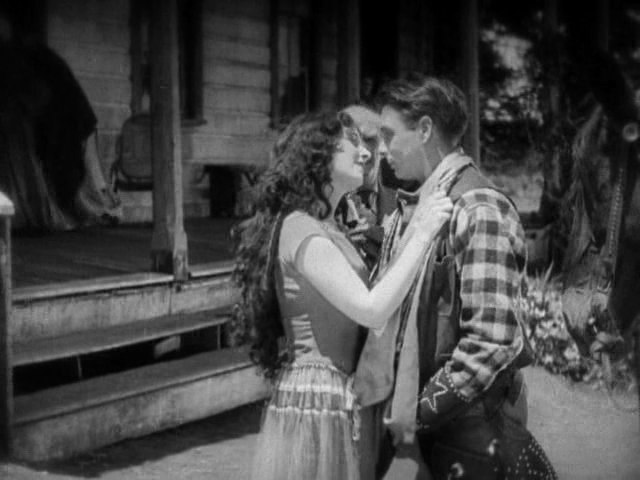
The film’s best moments seem to be when Wellman shifts the focus away from his goofy protagonist. Peter Good (note the last name) is supposed to be a lovable oaf, but the lovable part never seems to come through. His affections for Amy are inexplicable, understandably I guess, considering this is meant to be a light-hearted comedy, but when he finally “wins” her over in the film’s final minute, it seems completely undeserved. Amy quickly condemns her relationship with Harry, which has seemed stable for the other 59 minutes, and proclaims her new found love for Peter. The screen fades to black and the audience can’t feel particularly warm for spending such time with vapid characters.
3

The comedy, although obviously tied to its time, does redeem some of the offensively stupid character developments. There’s a clever extended bit with Hank Mann, a frequent collaborator with Chaplin, that seems like an anticipation of Jacques Tati. Of course, his character is completely disconnected with the main story and with the film’s short running time, it seems like a waste. I guess it’s important because it actually gives the film some humor (more just “clever” bits) but the sequence seems to run a little too long. Another counterpoint would be that this sequence doesn’t include the character of Peter, which makes it much better than most of the film.
4

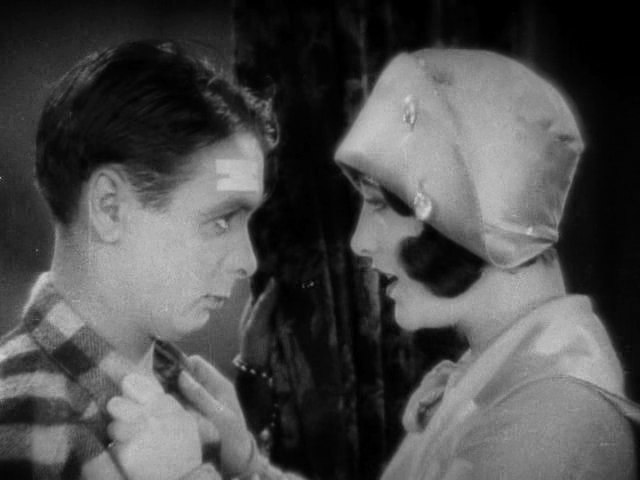
Joan Crawford makes a short appearance here, and it seems that her presence is what sparked a renewed interest in this film. Her performance is nothing impressive, though she acts George Arthur (last seen in Josef von Sternberg’s The Salvation Hunter) off the screen. In the film’s conclusion, she shows her appreciation for Peter with a kiss on his head, which makes him go crazy. Their potential relationship seems like the foundation for a logical happy ending but Amy (Gertrude Olmstead) sees this. She’s calm and collective for 58 minutes but then becomes hysterical, crumbling under the influence of the protagonist’s intended “good guyness.” It’s a really cheap payoff, but a fitting one, I guess.
5

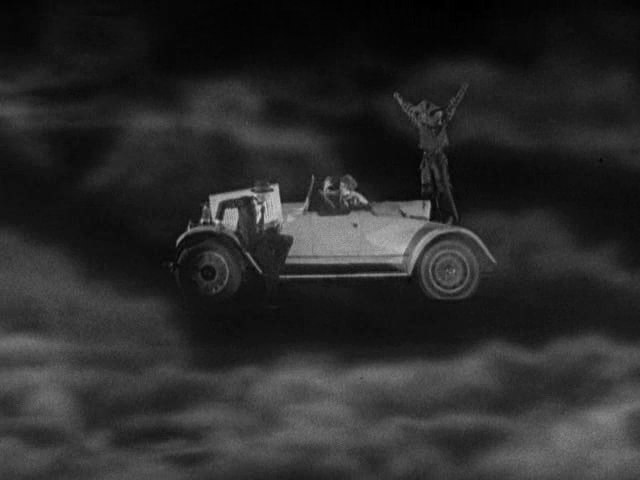
One’s enjoyment of the film might be dependent on how much you can enjoy this type of humor. Maybe if you can somehow convince yourself that the protagonist is interesting and worth rooting for (he really isn’t and I can’t stress this enough), you can squeeze even more out of it. The most interesting element is Wellman’s formal experimentation. He starts this immediately with lengthy slow motion shots that are meant to be a comedic depiction of a dog licking up whiskey. There’s a clever “dream” action sequence that takes place in the sky, which is gimmicky but a nice break from most of the proceedings. It seems like Wellman had a lot of fun making this movie, and that’s probably the best thing anyone can say about this film. Unfortunately, he doesn’t manage to let us in on his enjoyment.
6


Watakushi-tachi no kekkon / Our Marriage (1961)

29 12 2012

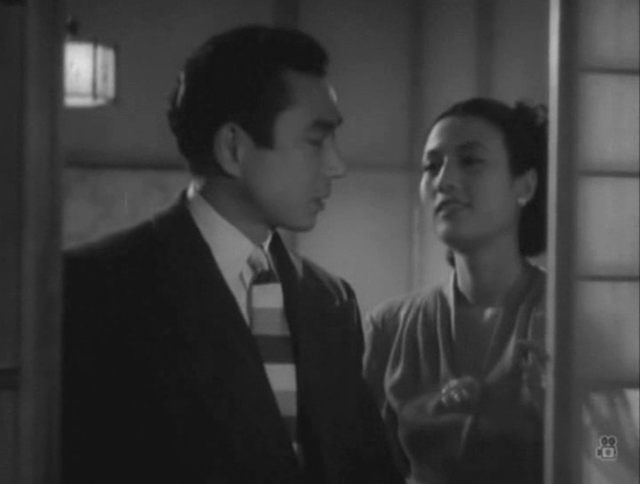
One of Shinoda’s earliest features (he made Dry Lake earlier in 1961, and Koi no katamichi kippu from 1960 is listed as his debut) and one of the best from the little I’ve managed to see. It probably helps that although he still manages to work within the tradition of the Japanese New Wave, the content here doesn’t seem that disconnected from what he and filmmakers like Nagisa Oshima were supposedly rebelling against. The title itself seems like it could very well come from either Ozu or Naruse’s filmography. The film itself isn’t really fleshed out enough to stand alongside the works of those two filmmakers, but it is a wonderful attempt by a youngster at making something far more mature.

1

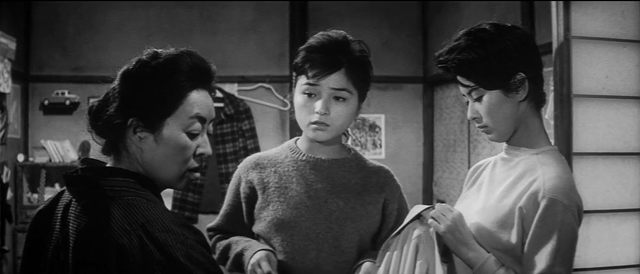
Keiko (Noriko Maki) and Saeko (Chieko Baisho) are sisters working desk jobs at the local factory to help keep their family afloat. Their father’s fishing business seems to be a day away from it’s demise. Despite both of them being in their twenties, they are the main source of income for their impoverished family, which bothers Keiko a great deal. She meets a childhood friend one day, who manages to sustain a life within the city just by being a flirty girl. This isn’t the ideal solution for Keiko, but when she’s introduced to a potential suitor, she takes note of his healthy income. Meanwhile, Saeko is pulling strings to make her sister fall in love with their coworker at the factory, Komakura.

2

For all of Shinoda’s technical strides, the biggest selling point here might be the fabulous cast. Chinese native Noriko Maki, who would later appear in Ozu’s An Autumn Afternoon and not much else, is excellent here. Eijirô Tôno, who frequently collaborated with Kurosawa and Ozu, is a wonderful fit for a father trying to maintain control of his household. His pained facial expressions are the perfect compliment to the beautifully photography documenting his sad attempt at income. His fishing business is likely going to end, and his desperation is never explicitly mentioned,  but it is evident.

3

The best performance belongs to Chieko Baisho, who is probably less familiar to most. She made a career as Yoji Yamada’s muse, his own Setsuko Hara so to speak. She’s much different here than in Yamada’s films, where she frequently plays quiet but powerful independent women. This is not the case here, as she’s filled with youthful idealism that motivates her in playing matchmaker for her sister. Unlike Keiko, she believes that people can be happy without money. The two discuss this frequently, and it’s Shinoda’s intention to imply that there’s not a black and white answer. We see a seemingly happy but impoverished couple’s relationship dissolve right in front of the two sisters, but then Keiko herself is extremely upset by the behavior of her socialite friend.

4

There’s a lot to chew on here, more so than one might expect from a film with a running time of just 69 minutes. As mentioned before, there isn’t really enough there for this to feel like it even comes to close to the best Japanese domestic-driven dramas of the 50s and 60s. It’s just a quick character study, and it’s sort of imitating a more complicated one. The performances are fantastic, though, and it’s Baisho specifically who shines. Shinoda only does a few playful things with the camera,  which shows some maturity especially compared to the hyper and kinetic early efforts of Oshima and Yoshishige Yoshida.

5


The beautiful photography is the work of Masao Kosugi, who would later work with Shinoda on Pale Flower and  Assassination  (both 1964), and it gives us some wonderful images. The sequence in which Keiko confronts Komakura is particularly stunning. The performers say and emote little, but the thickness of the atmosphere manages to heighten the tension. The wonderful garbage-laced landscapes manage to perfectly compliment the more deliberately framed compositions that take place inside.

7


We only get a glimpse of this world (barely more than an hour) but it’s a distinct experience. The recently reviewed The Angry Street purposed an interesting “what if?” to Naruse’s career had he focused his intentions on genre. Likewise, this film shows Shinoda using his talents for a domestic drama, which is a hundred times more interesting than the angst-driven, gangster-lite films he and his comrades were making for most of the early 60s. I might be in the minority here, but I think I would have preferred for him to make more films like this one.

6


Ikari no machi / The Angry Street (1950)

28 12 2012

It’s generally accepted that Naruse’s golden era started in 1950. Even if one does love this film and the others that came out in 1950, this isn’t exactly true. This film has very little in common with the films that would make Naruse celebrated throughout the 1950s to the end of his career in 1967. Instead, this is something close to Naruse’s attempting a genre picture. It’s not a complete failure but it’s not a runaway success, either. Ultimately, Naruse’s interest in “human drama” pushes the direction of the content into an area between a film noir and a domestic drama, which makes the plot itself seem somewhat melodramatic.

2

Sudo and Mori are two college pals trying to make some quick money while attending the University of Tokyo. The two have formulated something of a plan, in which they seduce women, which leads to these women giving them enormous amounts of money. Mori begins to develop some guilt about his means of income, especially when he is confronted by Sudo’s sister, Masako who is completely unaware of how the two of them make their money. He tries to change Sudo himself, but it turns out Sudo is more concerned with balancing the three women he’s receiving funds from, but things take a turn for the worst when he finds himself involved with an older woman who has mob ties.

3

There’s a lot of interesting peripheral stuff going on here, away from the fact that this is essentially Naruse doing noir. He would return to the genre well later with Hit and Run and Stranger Within a Woman, which were both released in 1966. There’s some hint at economic stuff, as the two leads laugh off the claims of their comrades that they’re privileged. In reality, Sudo and Mori are that exactly, but the two see their complicated system of manipulating women into romance as actually being “hard work.” Sudo’s neglect of his own family leads to his elderly mother taking up a job, something she tries to keep from the rest of the family.

4

In a way, the most unique thing about this entry from Naruse is not that it is so male-driven but rather that it is so mean-spirited. Well, not mean-spirited from his own perspective but rather that of one of the central protagonists. It’s good that Mori eventually sees the fault of his ways, but it seems a little ridiculous that he acquires such a calm and wise tone, with the exception of his emotional breakdown in the film’s climax. This is far too quick of a character development, and his attitude shift seems to come from his romantic feelings towards Sudo’s sister, Masako. Maybe he really loves her, but with what we’re given about him, do we really trust him? His flip in morality is wonderful, but one can’t help but feel more concerned for Masako.

5

On the flip side, the sequences with Sudo are dull, not for any technical fault on Naruse’s part. This is a logical link between his earlier more energetic work and his “calmer” stuff of the 50s and 60s. Unfortunately, Sudo himself is just a dud. He’s stubborn and stupid, yet manages to fascinate at least three different women. When he finally gets what’s coming to him, the payoff feels justified and nice, but punishing such a simplistically “bad” and hateful character is such an easy move, and one that is usually found outside of Naruse’s work. Still, the film manages to be an enjoyable piece of genre, one which makes one wonder how Naruse might have fared had he devoted his career to such films. As it is, I like the route he choose much more, but this deviation from his usual material is both welcome and entertaining.

6


The 39 Steps (1935)

20 12 2012

Hitchcock’s British period is a bit of a blind spot for me, and I’ll readily admit that in all likelihood, I won’t be able to bring much insight into these films, but I’ve decided to write about this one anyway. It’s close to being my favorite of his, but I get the impression that if I dive deeper into his earlier period, I’ll have similar positive experiences. I’m not going to use this space to launch into an attack on one of the most canonized filmmakers of all-time, especially since I don’t hate him. Most of Hollywood work, though, with the exception of North by Northwest, has always left me cold. This is probably because it came before I ever had any appreciation for genre, but that’s another story entirely.

1

This is a classic “wrong man” setup that has become something of Hitchcock’s trademarks. Richard Hannay meets Anabella Smith and he takes her to his place following her request. She warns him that she’s being watched and needs to stay the night. He wakes up to find a knife in her back. Hannay becomes the suspect, which leads him to being chased all over Scotland. It turns out Anabella’s murder came from the orders of Professor Jordan, who wanted to prevent her from releasing information. Hannay’s fugitive run leads him to Pamela. She becomes literally attached to him with hand cuffs, which leads to a romantic getaway.

2

The story here is pretty complicated, and there was a time when I would have criticized him for such a ridiculously intricate plot. To his credit, though, it unfolds naturally. Surely, the story itself is ridiculous enough just in its content, but this seems like complaining that the Bible is too religious. It’s these sort of stories that make up Hitchcock’s personality and it’s his legacy for making these movies not seem convoluted. It’s especially impressive here as such a complicated story is confined within the 85 minute running time. Hitchcock’s wit seems even sharper when the rest of the elements are building up so quickly.

3

Most of this fast-talking “witty” dialogue can be hit or miss, and most of the biggest punch-lines seem too close to Hitchcock’s pen to actually feel like the natural thoughts of the performers. For someone who finds himself in the unluckiest of situations, Hannay seems to have an equally potent level of wit and improvisation. He adapts maybe a little too quickly to the enormous curve ball that is the story. Cary Grant seemed (charmingly) stupid at first when put in a similar situation in North by Northwest but that film obviously has the time to extend that character’s learning curve. Donat’s performance as Hannay is charming, of course, but almost mechanically so, too much seems to contributed from Hitchcock’s pen (or Ian Hay’s) that the performance could have been delivered from anybody.

4

From my own limited experience with earlier Hitchcock, I struggle to not compare it to the American genre films of the time. The biggest difference might be in what I just mentioned: too much in the script, and not enough in the actual performance, stripping the film away from some vitality. It’s still wonderfully entertaining. It’s not calculated tone seems actually very screwball in nature. Indeed, the sequence with Hannay and Pamela running around in the middle of Scotland bears a striking resemblance to the extended outdoors scene in Bringing Up Baby. Once again, I think there’s “more” to the characters, because the form requires the filmmaker to flesh them out. The couple here is a bit more dull and their romantic potential seems like just another bizarre circumstance. Still, this a wonderfully crafted and economic thriller. It’s hard to get too angry about its faults.

5


Sanshiro Sugata (1943)

18 12 2012

Kurosawa’s surprisingly inventive debut seems to have been buried beneath the power of the director’s legendary oeuvre. It’s not perfect by any means, but it is a more than competent first film, showcasing the director’s appreciation of genre cinema. His influences are obvious, but it’s safe to say that Ford and Walsh never choose something as deliberately stylish as this. The performances aren’t fantastic (though I did watch this after a heavy dosage of Naruse) but they service the film, which is arguably driven by Kurosawa’s virtuoso technical talents. It’s too short yet also not as economic as the works it was inspired by, but it’s perfectly enjoyable action film.

1

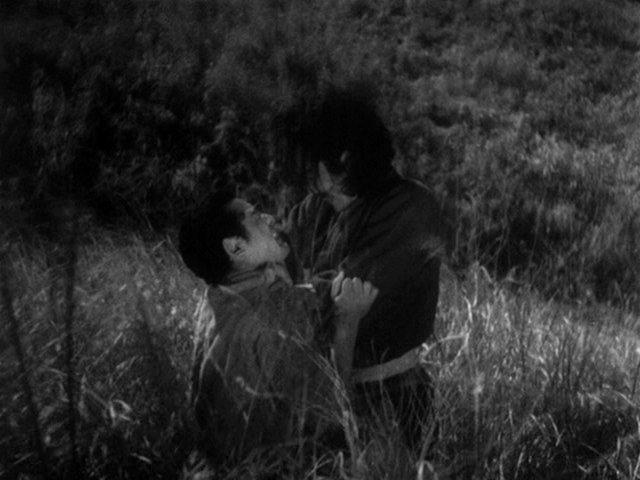
The titular character arrives in town, with little exposition. He’s there to learn judo, but his stubborn and childish behavior make him an unlikely student of the art. His teacher, Yano, initially refuses to take him in, but Sanshiro’s hard-headed attitude eventually wins out. He turns out to be a wonderful student, and his progress becomes evident when he accidentally kills an opponent in a tournament. He’s quickly mythologized, but his focus shifts to Sayo, who he finds out is the daughter of his next opponent, Hansuke, a celebrated teacher of jujitsu. Sayo’s affections are also desired by Higaki, who requests a fight with Sanshiro in the mountains.

2

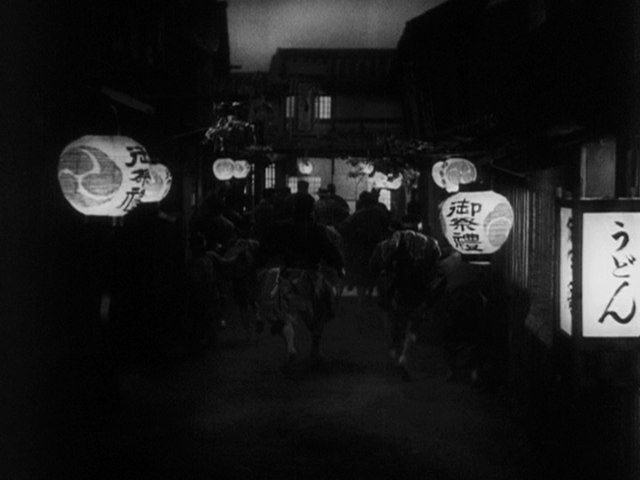
The story seems to be a little complicated, though it flows with much ease in Kurosawa’s hands. This is sort of problem, in all honesty, because the character development isn’t handled all that well. It’s worth noting that 17 minutes are missing from the current preferred cut of the film, but I don’t think any footage could flesh out the simplistic characterization of Sanshiro when we are first introduced to him. He is stupid and impulsive, traits that manifest in fantastic sequence in which he runs around a city looking for anyone willing to participate in the fight. The sequence is staged beautifully, with a symmetrically composed shot of an alley way cut juxtaposed with a complete 180 reverse shot. This is a simplified description but it’s a bit like if Ozu was an action director and had a dolly.

3

The previously described scene encapsulates Kurosawa’s debut, and to me, it’s somewhat representative of even his most celebrated work. The characters are put together in a clunky fashion, and resemble cartoons, but they are composed in an excellent way. It’s truly a shame that Kurosawa’s career started with the circumstances of the war. His vision was obviously edited to fit the government’s wishes (as it was here) or his talents were used to make pure propaganda, which is the case with his second film, The Most Beautiful. I say this because there’s an exciting energy here that one frequently finds in a filmmaker’s early years.

4

On the other hand, Kurosawa would have plenty of breaks throughout his career. His success was and is completely unexpected and far outside of the realm that anyone in Japan at the time could have envisioned. It’s often explained that Kurosawa’s international success may have been a contribution of his passion for western culture. This isn’t exactly correct as his biggest influences, Ford and Renoir, were crucial influences to earlier Japanese filmmakers. Kurosawa’s enormous success might have been in his distinct iconography, which of course categorizes him as a genre filmmaker. An effort like this is more in tune with the genre giants of Hollywood at the time than his later, more celebrated films. It’s an impressive and entertaining debut, a smaller scale sample of what was to come.

5