Silver Lode (1954)

15 08 2013

So here’s a better example of what made Allan Dwan so vital: a tight, but energetic western that runs around 80 minutes. Sure, its allusions to McCarthyism are fairly obvious, but this actually works in the film’s favor Unlike the more acclaimed High Noon, which this film is forever linked to, Dwan doesn’t dwell on his social commentary. It’s there and it’s easy to read, but he hasn’t turned away from the genre. In a way, it makes the allegory more powerful: he hasn’t sacrificed any action to reinforce the message. The result is a film that flows so fast and effortlessly that it will take multiple viewings to truly appreciate everything that is jammed into it.

1

It’s July 4th and Dan Ballard is getting married to Rose Evans. The ceremony is interrupted by one Ned McCarthy, a US Marshal who has a warrant for Ballard’s arrest. McCarthy’s motivation is personal, he claims that his brother was shot in the back by Dan. The ceremony is put on hold and McCarthy grants Ballard’s two hours of freedom. With the time allotted, Ballard attempts to find evidence to prove his own innocence. The townspeople quickly turn on Ballard, and begin to question their previous idea about him.

2

The narrative trajectory isn’t exactly remarkable. Ballard ends up being the wrongly accused man who has to fight against all the skeptics, sometimes even literally. The plot isn’t what sells a film like this, though. It is instead how much meat Dwan is able to slam into such a tight film. This isn’t to say the film is heavy on action because it isn’t, but it feels like there’s enough here for three films from another director. The form seems to be so in service of the storytelling that it’s easy to miss some of the more virtuoso moments Dwan has with the camera, but that’s a sign of truly effective filmmaking.
3

The script is a pretty clear allegory for America’s Red Scare to the point that the film’s villain is named McCarthy. This seems sort of sloppy and lazy, but it shows that has Dwan has his priorities right. A film that would devote too much energy into its allusions would feel too out of sync with any genre, but it fits partly because Dwan is able to deliver something that still feels like an action film. It isn’t a self-consciously “serious” message film. Instead,  the ideology seems to come from the story playing out, rather than being jammed into its wiring.
4

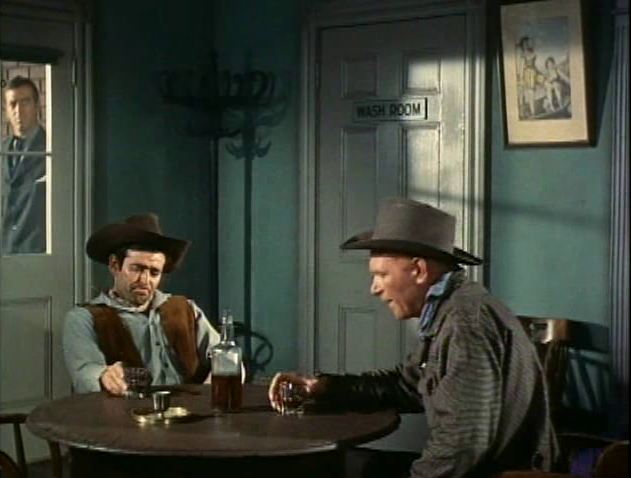
For all of the film’s obvious allusions to the paranoia of 1950’s America, there is something that still resonates today. People here are constantly peering through windows. John Alton’s wonderful and jarring color cinematography frames a voyeur in the foreground and the object of their gaze in the background. This is good for introductory level psychoanalytic film theory, but even better is just the beauty in the depth of the images. Despite the limitations of the academy ratio, there seems to be layers of activity in almost every frame, perhaps the perfect visualization for Dan Ballard’s state. There’s always someone behind him to scrutinize his behavior.

5

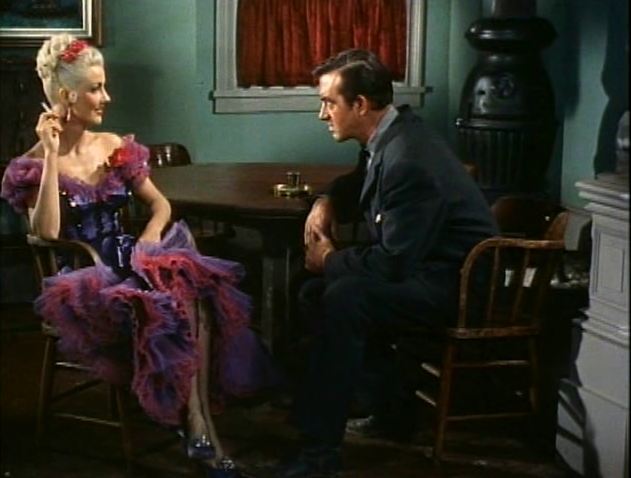
The most impressive thing about Silver Lode is how many wonderful individual moments Dwan manages to sandwich in-between the story. Ballard has a moment with an old flame, Dolly, which is so typically Hollywood from a narrative perspective but feels legitimate under his control. Any jaded cinephile will know how a film such as this one ends, but it says something that Dwan is still able to place some uncertainty in the viewer. That’s really the hallmark of any great genre film, but its always something of a surprise when you run into something that truly energizes you. It’s not that Dwan has made a film that will make one forget about the academic part of cinema. He made one that is a blast and can be appreciated only further with it.

6


La notte brava / The Big Night (1959)

14 08 2013

At the risk of lionizing him, I find it hard to say directly negative things about Pier Paolo Pasolini. Even when I don’t like one of his films, I find something so fascinating and engaging about what he’s working through within his art. To be blunt, he’s sloppy and earnest, but that has translated to some of the deepest experiences I’ve ever had while watching a film. Basically, some of the traditional “problems” a filmmaker might run into are things I find vital in Pasolini’s work. I explain all this with the intention that while watching this film (which he wrote, not directed) I had a bizarre feeling: it was good, but it was boring.

1

Young, impulsive, and in need of cash, Scintollone and Ruggeretto steal rifles with the intention of selling them. To keep themselves from looking too suspicious, they pick up two prostitutes, Anna and Supplizia. Along the way, they run into Bella Bella, who knows a contact who might be interested in the guns. They run into another prostitute, Nicoletta. The gang decides a trip to the country side, but the three men know quite well that they’re going to ditch the women once they get there. Their plan seems to work perfectly until they later realize that there money is gone.

2

The setup here is actually sort of nice, but I don’t know how much mileage you can get out of the grossest type of young person, especially when there’s nothing exciting formally going on. Director Mauro Bolognini has a few impressive photographic moments, but the film’s visual style feels too functional. It might be easier to overlook if the characters themselves weren’t so predictably unpleasant. No one is nearly as terrible as Franco Citti’s character in another Pasolini-penned project, Una vita violenta. Pasolini’s characters are never particularly wonderful individuals, but the negative qualities of many of the young men here seem to be matched in their dullness.

3

There are hints at something more interesting than just watching a bunch of assholes go on a bender. In fact, that’s sort of perversely fascinating because it suggests Pasolini’s attitude towards people was so abhorrent. He’s actually sort of graceful when dealing with the women here. All of the main women are prostitutes and the ones we meet later on are framed around their sexual potential for the men in the film. It sounds simplistic, but Pasolini provides isolated moments of true heartbreak where they realize the difficult nature of their sexual agency. The contemplation is so fleeting, which makes it even sadder, as the introspection is usually interrupted by one of the men gleefully mocking them.

4

Part of what makes Pasolini so consistently compelling is that there’s so much to chew on in all of his work, but there’s hard to mine much from this film’s subtext. Combined with the similarly disappointing Una violenta vita, I’m resigned to the idea that his earliest scripts just weren’t as interesting. There’s youthful angst and that can go a long way, but it feels so static and unremarkable here. I can’t see anyone but hardcore Pasolini heads, such as myself, finding much of interest here. It’s not a terrible movie, just one that feels too safe and calculated, especially when it came from a pen with so much exciting potential.

5


The Man I Love (1947)

13 08 2013

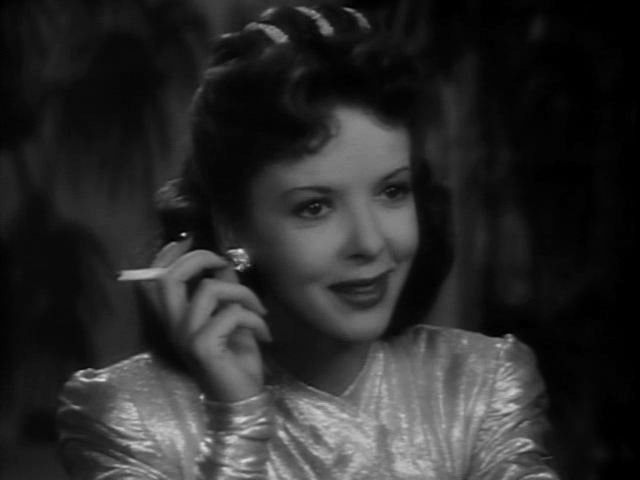
I find it worth mentioning that my motivation for seeing this particular film was not because of Raoul Walsh. He might be the best director the dream factory ever produced, but my personal flame for him has died down as of late. Instead, I was hooked by the idea of Ida Lupino walking over creepy men. The film satisfies that craving, and it actually unfolds in a fairly confident manner. However, when certain noir elements narrative elements begin to force their way into the narrative, the movie loses its footing. Perhaps, it’s fitting that Lupino’s presence motivated my viewing, as she’s the real highlight here. She almost carries the film all on her own into being something great, but the film crumbles under the weight of its own complicated story.

1

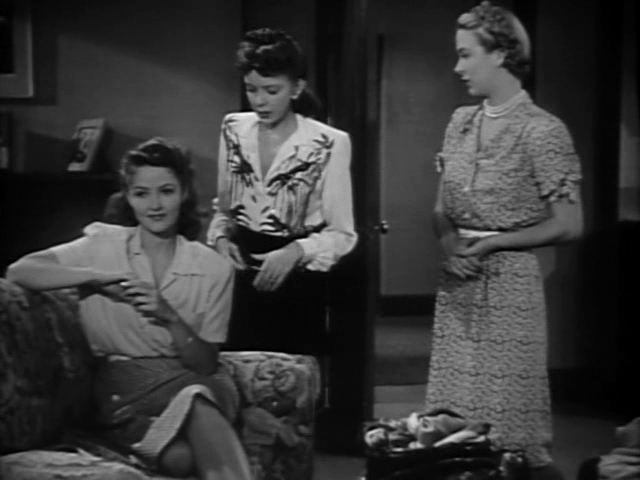
Petey Brown, exhausted by her hectic life as a nightclub singer in New York City, visits her family in Long Beach for Christmas. This isn’t exactly a relaxing getaway, as she’s greeted by two sisters, Sally and Virginia. The former is trying to fight off the advances of her obnoxious club-owner boss, Nicky. Her husband, a veteran of the Second World War, is hospitalized for an especially nasty case of PTSD. Petey seemingly brings the family together, but in the process becomes mixed up with Nicky’s business. Around the same time, she falls really hard for San, a quiet piano player.

2

In every bit of writing I’ve come across regarding the film, there is some insinuation that it is structured around the idea that no personal feelings are shared. Sally has a thing for her married neighbor, John but he’s far too attached to his promiscuous wife, Gloria. Petey only has strong feelings for San, but because of his past, he’s unable to love her. Nicky is interested in any woman he sees, and fittingly, all women are uninterested in him. It’s the sort of tragic setup that plays out nice when it is all suggested and hinted at as it is for the film’s first two acts.

3

Walsh’s talents aren’t especially noticeable here. The film’s visuals are functionally noir-esque, but this isn’t his most exciting film from a technical perspective. In a way, the straightforward aesthetic works in the film’s favor. For most of the running time, it rolls along quite confidentially and the exposition that is given is done so quite gracefully. There’s shades of Naruse’s When a Woman Ascends the Stairs in the story here, but Walsh treats the script in a very Narusian fashion, at least for a good forty minutes or so. It’s hard to describe what it is exactly, but I would say that with the exception of the flashback scene in the hospital, Walsh isn’t concerned with making sure the audience is on the same page as him.

4

Let’s be honest here, though, this wouldn’t be a movie without Ida Lupino. She’s brilliantly cold here, especially when she fights off the aggressive advances of Robert Alda. To risk sounding hyperbolic, I probably could have watched 90 minutes of her just rejecting him because the way she does it is so gracefully mean. Her anger is justified, of course, but the script channels her disgust into something empowering – both to the characters and anyone who can put themselves in her place. Unfortunately, the film drifts away from these interactions and into something a bit less interesting but the film is such a curiosity, that a viewing is totally necessary.

5


While Paris Sleeps (1932)

12 08 2013

Allan Dwan’s reputation as filmmaker, like many of the American genre titans of his time, is linked to economy. A word that can be used to describe a lot of things, but in this particular circumstance, it means an economy of storytelling. It’s a term that’s perhaps overused when describing action directors of the classic era, but here’s an instance of Dwan working outside of the genres he’d become known for said economy. At only 61 minutes, there isn’t really enough there for this film to feel like a master work, but there’s still something there. The classic cycle for both westerns and noirs were years away, but one can find artifacts of both in this early effort.

1

Jacques Costard, a veteran of the First World War, escapes from prison in an effort to reunite with his family. He escapes but finds out his wife has recently passed on. In a letter, she explains to him that their daughter, Manon, doesn’t remember him and believes he died in combat. Manon’s situation is similarly grim: unable to pay rent she unknowingly gets involved with a pimp. Jacques has to save her, but has to keep his identity from his daughter a secret.

2

While the film does have its own unique charm (it infamously contains a sequence in which a police spy in thrown into an incinerator!) it kind of feels a little too tired from a thematic standpoint. There are interesting things about McLaglen’s Jacques, who seems to be a warmup for the Gypo Nolan character in John Ford’s The Informer. The most interesting of which is his inability to tell Manon that he’s her father. There seems to be a theme throughout the film of men hiding and disguising their motivations, as well as their feelings. It might seem ponderous when Jacques sheds a tear, but it at least suggests that all the men here are putting on something of a performance.

3

The dire tone of the film actually works against its “uplifting” ending. Jacques saves his daughter and she gets to start a new life with her musician boyfriend, Paul. In reality, Paul is something of a creep. The three main men in the film vary in likability, but they’re all ultimately trying to control Manon. Julot, the pimp, is ultimately trying to control her for his own profit and despite some superficial charm, he is obviously coded as a “bad guy.” Paul is a bit more dynamic, but perhaps unintentionally so. He presents himself as the gentlemen antithesis to Julot, a nice boy who truly cares about Manon and loves her. Maybe he does, but he exhibits behavior of a pretty miserable spouse. The couple’s big quarrel scene paints him as both manipulative and pathetic.

4

Paul’s negative qualities might be the byproduct of Basil Woon’s script, which tries to play to the pathos of hard city life. It isn’t entirely successful, and one could argue that Dwan is to blame here. The visuals are nice and functional, but the poetic touches don’t bother with the typical Paris iconography. This might speak to Dwan’s sensibilities, though, as reoccurring shots of the city’s famous landmarks would be a cheap trick, one that lesser filmmakers have resorted to using.

5


Bara kassen / Battle of Roses (1950)

4 08 2013

Who’s to say there was anything wrong with Mikio Naruse in 1950, but his output from this year presents a major stylistic difference from the rest of his work in the decade. He’s still working in the same thematic territory here, but the results feel like American B-pictures. That’s not to say they are bad or look cheap, but instead that they match the sensationalist tone of such a picture. The content in films like this one and White Beast fits the presentation, but the result ends up feeling a little cheap. These films are Naruse at his loudest, but also his sloppiest. They’re perversely entertaining when viewed, but lacking in the power of his best films.

1

Satomi’s husband dies while his cosmetics company is in the middle of a embezzlement investigation. Satomi inherits the company, but quickly loses it due to her husband’s debts. She joins a rival company and finds herself in charge. Meanwhile, her younger sisters, Hinako and Chisuzu, continue to struggle with their love lives. Hinako is blackmailed into marrying Satomi’s rival, which Satomi sees as an act of rebellion. Chisuzu, the youngest of the three, is star-struck and becomes infatuated with a local pimp because of his ties to the film industry.

2

Having to write a plot synopsis for this film is quite a headache, the exposition is plentiful and Naruse moves it along very quickly. Even if he were to pad things out, the story would still be frustrating simply because it is too much. It’s amusing, to me at least, that someone could accuse a more typical Naruse film of being boring on the grounds that the plot is too thin. Here, we have too much plot and film begins to feel like something of a chore. Perhaps, to the film’s benefit, it begins to resemble a conventional Hollywood melodrama, complete with sharp musical cues and ellipses that skip the “boring” parts.

3

I still find something very vital in Naruse’s films from 1950. They’re not great, and probably not even good, but they introduce a different presentation of his themes. This film in particular (paired with White Beast) represents the subtext of Naruse’s world being presented as text. In reality, these characters are too thin and simple to be the subjects of the filmmaker’s detailed portraits. Instead, they act out the ideology that is hinted at in better films. For example, one of the sisters has a particularly frank discussion with her boyfriend about the patriarchy and another talks about her sexual agency.

4

This all sounds really exciting to read, and it’s absolutely joyous to watch but the film never elevates itself beyond these moments where the performers seem to become mouth pieces. It’s a pretty classic example of showing compared to telling, the women here are telling about their oppression but the showing feels less like pathos and more like the narrative mechanics of a melodrama. It’s not that one will struggle to feel for the sisters, it’s that one will struggle to believe in their reality. To his credit, Naruse tries, but the film’s origins as a newspaper serial (written by a man) are highly visible. It’s another curiosity for Naruse fans and even non-fans might be charmed by it’s slickness, but it feels a little hollow.

5