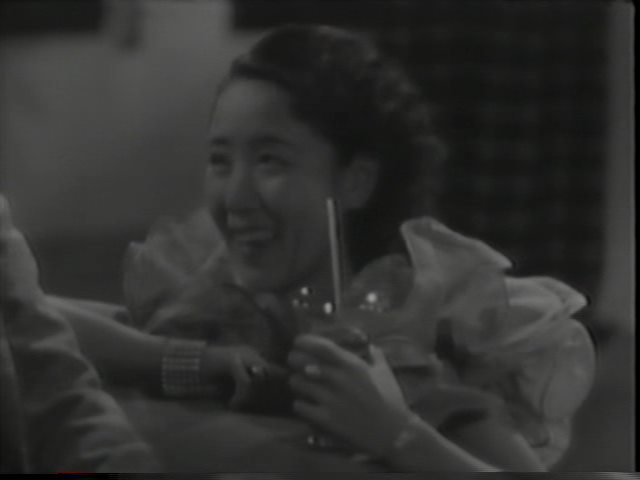
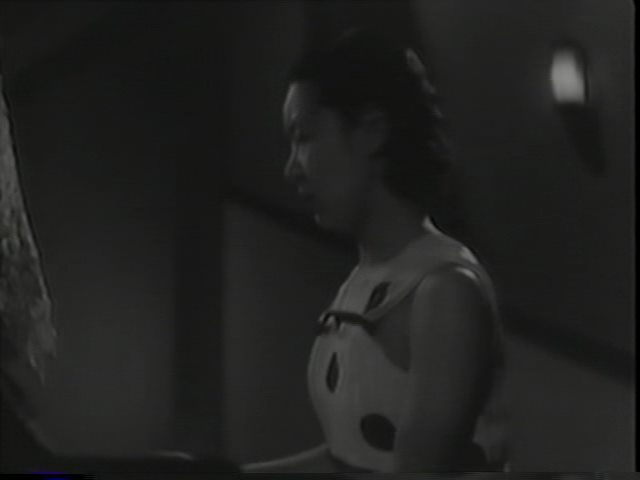
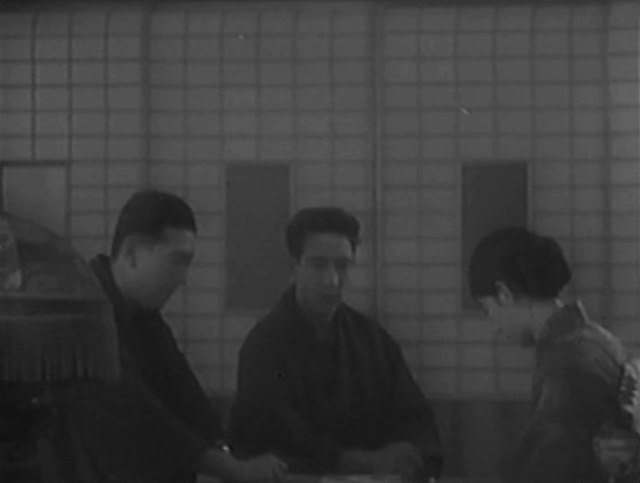
Nanatsu no umi: Zempen Shojo-Hen / Seven Seas: Virginity Chapter (1931)

4 01 2015

Ambitious projects such as the Seven Seas one would not be the norm for Hiroshi Shimizu, at least for what survives from him. The peaceful, quiet, but equally heartbreaking phenomena that occurs in his best films (Mr. Thank You and Ornamental Hairpin, to name just two) is boisterous and tragic. At least, that is the case for this film, the first entry in the two-part series. The technical bravado that runs through all of his work is present, yet it seems to take on a completely new meaning in the context of a film that is more dramatic on the surface (which comes from its literary origins, surely) yet demonstrates something very specific and unique about Shimizu’s abilities as a filmmaker.

1

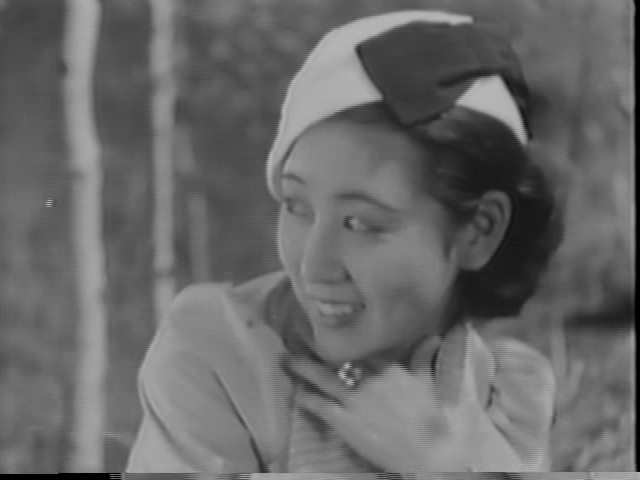
Yumie is a working class girl engaged to Yuzuru. She gets invited to a party put on by her fiance’s parents, but she initially ignores the request. She’s busy, and has better things to do. She submits to the family’s pressure, though and at the party she meets international playboy Takehiko. Takehiko falls hopelessly in love with Yumie, at least that is how he explains his possessive behavior around her. Yumie quickly feels uncomfortable and leaves, but the next day, he proudly declares his love for her, which makes her visibly but she tries to console him. Playing off of her good will, Takehiko is able to take advantage of Yumie. The repercussions of his act begin to disintegrate what was once a promising family.

2

With this first part of the series being titled “Virginity Chapter” it is tempting to assume that the main dramatic conflict revolves around it. While Yumie’s chastity does play a part in the drama, the reality is less her “indiscretion” (and it seems problematic to call it that) and rather the responses of those around her. Her father is heartbroken, to the point that he feels validated in violently tossing her away when she crawls to him crying for help. Yumie has not “slipped” but rather has been pressured, with Takehiko’s threats of violence, into sexual activity. Despite some characters’ insisting that Yumie is at fault, she has become a victim of sexual violence. As is the case even today, her experience, her very own pain is the thing used to denigrate her.

3

The “Virginity Chapter” ends with the suggestion that Yumie will accept the potential nightmare of becoming Takehiko’s wife. She acknowledges the pain, but her face suggests a potential scheme. She might not have an elaborate plan for revenge, but as Takehiko’s object (and I think it’s important to use the word object here, as Takehiko clearly doesn’t care about her as a person) of desire, she suddenly has some control. To be anything short of the unreasonable expectations would frustrate him, let alone openly defying his orders. Her tragedy has given her the opportunity to be in control. It’s a revolutionary thought, though one can criticize this for providing a dramatic shift that absolves Yumie of her past trauma. If this all sounds like a little too much for a Shimizu film, it’s important to remember this pain and this violence was always lurking in the corners of his protagonists’ past.
4


Suzaki Paradaisu: Akashingô / Suzaki Paradise Red Light (1956)

25 12 2014

If one is to know anything about filmmaker Yuzo Kawashima, it’s that he served as a mentor to the much more celebrated Shohei Imamura. After providing backup for Yasujiro Ozu and Kinuyo Tanaka, Kawashima was the last director Imamura took orders from. Unlike Ozu and Tanaka, there isn’t as much written about Kawashima so the impulse is to engage through his work and its connection with Imamura. This isn’t a completely useless exercise, but it does limit us. Perhaps it is most helpful to begin with what Kawashima and screenwriter Toshiro Ide (a frequent Naruse collaborator) manage to do here. Maybe it won’t strike us especially original and new on the surface, but their conversation that comes from it is unique.

1

Tsutae and Yoshiji are an unemployed couple pondering their fate on the center of the bridge. They’re reached a literal and figurative crossroads, all options for a “normal” life seem to have been exhausted. Tsutae schmoozes her way into a job as a barmaid at an establishment run by an old acquaintance, Otuku. Yoshiji isn’t entirely accepting of his girlfriend’s role, in particular its proximity to sex work. He doesn’t entirely know Tsutae’s past, but he knows he doesn’t want her “falling back” into those old ways. Otuku manages to get Yoshiji a job as a noodle deliveryman, where he is befriended by a Tamako, a gentle woman that seems eager to get close to him. All this happens while Otuku’s runaway husband returns with the intention of resuming his role as a father.

2

I can imagine a certain type of cynical viewer watching the opening fifteen minutes of this film and rolling their eyes at the prospect of yet another Japanese film from the 1950s dealing with some variation of sex work. 1956 alone also gave us Naruse’s Flowing and Mizoguchi’s Street of Shame. The irony, of course, is that in 1956, Japan’s anti-prostitution laws were looming. As always, it feels necessary to distinguish between forms of sex work in Japan, the women here are closer to Mizoguchi’s “prostitutes” – a word that I hesitate using just because of the violence it inflicts on its targets, but they occupy a different place in society as the geishas in Naruse’s Flowing. The geishas, at least in a superficial way, are more “respectable” even as they are subjected to just as much ill will from men.

3

Tsutae in Suzaki Paradise Red Light doesn’t occupy either position, though the space she occupies is marked with the more scrutinized prostitutes of Mizoguchi’s film. Although the viewer never sees her doing anything beyond pouring drinks, her place of business, because it is in Suzaki, is marked as being lower. It’s this marking that bothers Yoshiji, because neither he nor us learns about Tsutae’s past, we are teased about it, invited to imagine a existence in which she did have to sell her body to make money. He sees himself (and men in general) as being necessary for women in order to protect them from such a life, yet Tsutae becomes a barmaid because Yoshiji’s ideas for making money has left them with absolutely nothing. He sees this as failing his patriarchal duty. He bundles up this frustration, which leads to his obsessive outbursts that threaten to ruin their relationship entirely.

4

The films ends with the two’s reconciliation. Just like the beginning, they stand on a bridge and wonder how they’ll make a life together. Tsutae, sensing the frustration she’s caused her boyfriend, tells him that he gets to pick where they go next. It’s easy to read this ending as a confirmation of the same patriarchal values that Yoshiji fails to live up to, but I hesitate to accept this. I think the reality is instead that Tsutae, perhaps out of convenience, has stayed in this relationship. She does so because it is slightly more pleasant than the life she saw working as a barmaid, even as it did provide her with some financial comfort. Maybe she’s terrified of change, and thus, she accepts a familiar reality, the one which was introduced to us in the beginning of the film. The opacity of her decision benefits the film, maybe it lacks “logic” yet it seems more grounded to reality. It’s sad and unfortunate for Tsutae, but who are we to question her choice?

5


Kokuhakuteki joyûron / Confessions Among Actresses (1971)

18 12 2014

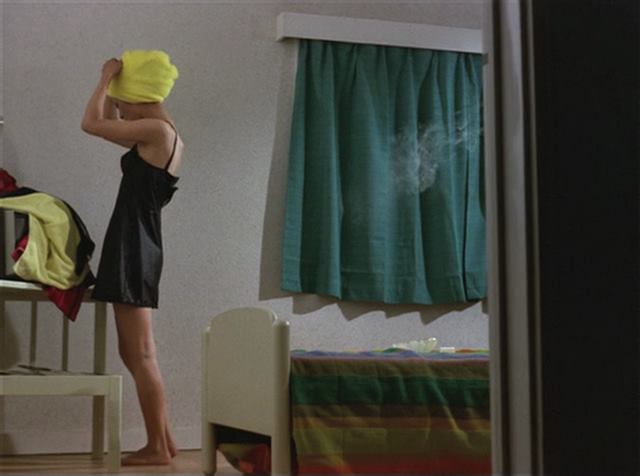
Throughout his career, Yoshishige Yoshida frequently worked with his wife Mariko Okada. The two built a relationship, at least cinematically speaking, that seemed deeply intimate, with a transparency that sometimes felt like a pen’s tip breaking their paper. Perhaps they both operate too openly, but whatever the case, it yielded some of the most exciting and aesthetically advanced films from Japan during the 1960s. Here, though, he decided to go even deeper, executing a film that directly confronts both reality’s contribution to fiction as well as performativity in its relation to gender. Yoshida has crafted a melodrama filled with hysterical women, but he’s pulled the (figurative) camera back further and in the process revealed the context in which we engage with these ideas of melodrama. Considering it gender connotation, the term might be completely irrelevant.

1

Kyoko Ichimori, Aki Kaido, and Makiko Isaku are all famous actresses playing in the same movie. Though we never see them together until the very end, we are taught to understand that the three are connected not just by a film, but by a shared trauama. For Kyoko, it’s a reoccurring dream in which she sees her husband cheating on her with …perhaps her assistant? Or maybe somebody else entirely, and maybe the dream is actually a sequence in the aforementioned film? Makiko is haunted by a failed double suicide with a lover, who may or may not have been her father. Aki, like Kyoko also has suspicions about her husband, but her anxiety is brought on by a memory of her friend’s assault.

2

I was listening to a recent interview with Jacqueline Rose about her new book Women in Dark Times. The book focuses on three extremely different women, all of whom are united (at least in Rose’s narrative) but their ability to make their suffering known in resourceful ways. One of these women is Marilyn Monroe, whose status as a “feminist icon” is often contested, but Rose makes a crucial observation about Monroe’s performance. She suggests their heightened “ditzyness” was her own way of undermining the content. A “fuck you” to the writers for creating such a vapid character and to those in casting who saw such a vapid character as a natural fit for her image. I mention all of this because it reverberated in my brain through Confessions Among Actress, here are three women whose “success” as performers might have be charged by their real life experiences. This isn’t anything new, but Yoshida’s suggestion is that women who are dramatic performers are discredited as they navigate in the real world. Their suffering is seen as trivial because they are so flighty on screen.

3

Yamada’s dialogue seems to echo these sentiments, with constant reminder from the few male characters that they see the problems of the women as something laughable. Weirdly enough, all the men in the film must defer to the women, if only because of their elevated status as celebrities. It is this celebrity status that provides men with their skepticism, although that is ultimately wrongheaded. Early on, Kyoko’s agent tells her that “Only what can be seen on the exterior is real with actresses” but then the film goes on to rally against this. In a way, such a simplified idea might have a grain of truth. Many believe that a great actor (and Mariko Okada and Ineko Arima are indeed great) can convey something underneath their gestures and dialogue. But in the public sphere, it is the surface that becomes the only reality and thus, the trauma of all three women here is ignored because of their public image.

4

While the meta quality provides us with many of material to ponder, but Yamada’s real talent has always been his compositions. His earlier films showcase the grace and sophistication of Antonioni, while punctuating scenes with a camera that is ever on the move, looking for evocative tactile imagery. He visuals remain sensualist here, but he is less willing to let his camera roam around his character endlessly, though he does that exactly from time to time. More frequently, he retreats to precise compositions that recall Ozu, yet suggests a completely different way of seeing bodies. Ozu provided portraits, while Yoshida (at least here) seems to be on a mission to discover new ways of creating an architecture with his characters. It visualizes the malleability of an actress, and her dehumanization that results from it.

5


Charulata (1964)

14 11 2014

In this, my second encounter with Satyajit Ray’s beloved Charulata, I’ve already stumbled upon more than a couple reviews that, although they praise the film, they also suggest a potential disconnect in the film’s historical context. There are indeed Indian literary references in the film that are guaranteed to confuse a western audience, but getting hung up on these specific references seems to miss what should already be apparent. Yes, Charulata is lyrical and mesmerizing but one can’t separate Charu’s personal turmoil from India’s political climate. I hesitate to call the film a meditation on the idea of “a modern woman” in India because it suggests a cold, detached framing of its protagonist. On the contrary, it is Ray’s nearly sentimental compassion for Charu that makes the film’s political insights all the more trenchant.

1


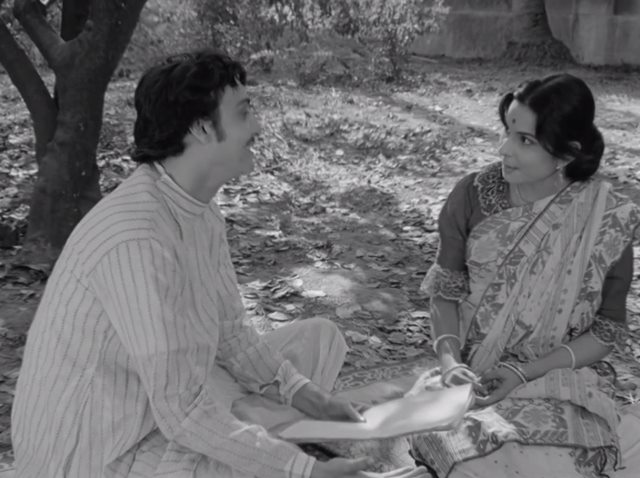
Charu is married to Bhupati, a busy newspaper editor. In fact, he’s so busy that he has no time for his wife. She embroiders a handkerchief for him, and he is stunned that she has the time to do such a thing. In reality, Charu has plenty of time, but nothing in particular to do. Bhupati, finally sensing his wife’s unrest, recruits Manda, his sister-in-law, and Amal, his cousin, to keep her company. Amal and Charu, despite their initial reservations about each other, begin to bound over a mutual appreciation of literature. Their own writing becomes a foundation for a playful rivalry, which soon threatens to take a more romantic turn.

2

While Charulata is a film about unrequited love, I think the viewer that sees the film as being primarily concerned with such emotions, is missing a lot. There is something beautiful in how Ray is able to ingrain a very instinctual, perhaps even melodramatic, love triangle into a film that is a political meditation. As seems to be a reoccurring theme on this blog, I find it a false move to suggest that the film’s political discourse can be viewed separately from its its discourse of passion. The two are inherently connected, constantly informing the suggestions of both. Without the potential for an affair, there is nothing about Charu’s own exclusion from a life of very serious and very literary-minded men.

3


The connection seems like a reach but I thought of Alex Ross Perry’s recent film, Listen Up Philip, more than once here. That film, to be brief, is a self-critical approach to the construction of serious white men of literature. The men in Charulata are not actually white, of course, but they do aspire to whiteness. British politics is of far greater interest than Charu, herself. Bhupati tells Amal about an opportunity to study in England and Amal’s eyes become filled with childlike wonder. “The land of Shakespeare?” he asks Bhupati as if hypnotized by the artistic potential to be found in the truly modern, truly progressive western Europe.

4


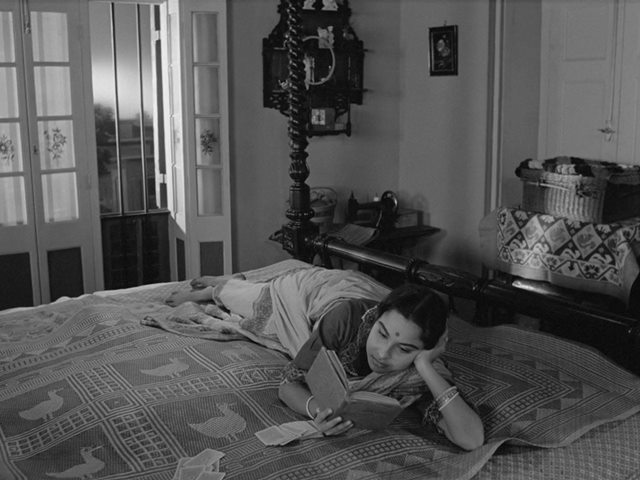
The irony of the above scene is immediately evident as we see Bhupati and Amal (both of whom, I think it is important to mention, are likable and sympathetic men) not just socially mobile but in an environment that encourages their creativity.  Charu, on the other hand, is in a more limited position. Yet, she seems to be just as creative and intelligent. She can never escape the halls of her exquisitely decorated house, though. This is an idea that Ray visualizes in the film’s nearly silent opening. She grabs a pair of opera glasses and observes men working outside, suggesting to us that she (and the film itself) has switched the gaze, completely reordering an important gender power dynamic. After that, though, she is lost. She can only gracefully float around the space she’s contained in and nothing more. Despite all the privilege and comfort that comes from being married to a middle class man, she is still a woman and she is still limited in her social movement.

5

It’s hard to efficiently articulate all the ground that Ray covers in this film. This is perhaps his most beautiful film, even though it is bound entirely to a house that was constructed in a studio. At times, this seems like the logical visual progression of Renoir, simple rooms become overwhelming triumphs of architectural designs, beautiful compositions that despite the awe they inspire in us, also visually reinforce the idea that Charu still feels small. Maybe the film’s most important moment, to me at least, comes about thirty minutes in. Amal and Manda have both arrived to keep Charu company. Amal tries to begin a conversation on literature, one which Manda is not properly equipped. Instead of buying into Amal’s attempt to separate the two women by their perceived intelligence, Charu refuses his baiting of a “smart discussion” and instead offers up a writer who Amal finds pedestrian. “How original” he cries in protest, to which Charu replies “how can you expect me to be original?” Amal wants Charu as an “interesting and smart woman” in his own construction, he’s not able to accept her as an entire person, one who could perhaps surpass his intelligence. Just look at his response to Charu’s own writing. Charu stands in defiance to our western, white, and male framing of intelligence. She’s a marvel of a person, just as Ray’s film is a marvel to look at, but just as important, she is active political resistance with a tender heart, one that beats loudly and breaks violently.

6


Shindo: Zempen Akemi no maki / The New Road (1936)

10 11 2014

By nature of the accepted and limited discourse on Japanese film in the 1930s, this wonderful effort from Heinosuke Gosho becomes a film about modernity. This sounds like bad judgement on my part, situating the conversation on the film in something I identify to be the problem. However, there is something crucial in how the western world constructs an idea of modernity, especially when its averting its gaze on a country like Japan. As recently discussed in a post on Yasujiro Shimazu’s So Goes My Lovethe conversation on modernity is informed by an almost willful disregard for historical context, an engagement that only sees the modernity of a character as charismatic and exciting as Kinuyo Tanaka’s Akemi as society’s exception. She is “progressive” but further inspection shows us that she is not progressive in a way that would help inform a rhetoric of colonial intervention.

1

Akemi is the oldest daughter of a rural but well-off family. She receives some pressure to continue dating a rather dull businessman, but as she hopelessly carries that doomed relationship, she’s really focusing on Ippei. The two enjoy long hikes in the mountains, an activity affordable for Ippei because he’s a business owner and part-time pilot. Meanwhile, Akemi’s cousin, Utako is busy harboring a crush of her own, an attractive young artist named Toru. He offers her a life that would escape her traditional upbringing, by moving the couple to the city and providing opportunities for visits to France. Toru’s own cosmopolitan schedule creates distance between the two, but Akemi is able to spot these developments as Toru taking advantage of Utako.

2

It would be a mistake to talk about The New Road without bringing up the power of Kinuyo Tanaka’s performance as Akemi. Tanaka’s entire career is punctuated with roles that could be described in a similar way, but Gosho and screenwriter Kogo Noda (who frequently collaborated with Ozu, of course) cast her in an entirely new light. Instead of the suffering mother or the transcendent martyr who catapults the pain of Mizoguchi’s work. She’s bubbly here, full of energy, and her life, similarly, seems to be limitless. Of course, here’s where the reality of her character comes into play. Gosho’s world  seems to be populated by comfortably middle-class youths, the lack of perceived “melodramatic” elements here might be a function of Akemi’s own privilege. And yet, like Oharu, Tamaki, or any other Mizoguchi protagonist, Akemi still manages to wrestle with her place in society. Sure, she’s elevated by her economic standing, but within that, she is ignored by men who she intellectually towers over.

3


To clarify, this is not a film about a smart woman casually accepting her place in the middle of dumb men maintaining their power. Everyone here, perhaps benefiting from their social standing, is  well-educated. More importantly, Akemi never falls into the structure of a conventional heterosexual relationship. Sure, she longs for and has feelings for Ippei, but even if one qualifies their interactions as dating, they’d have a hard time passing it off as typical courting. This is not Hollywood’s type of romantic comedy, where the woman, for whatever reason, has to use her wits to get an oaf to fall for her. Instead of becoming Japan’s Jean Arthur, Tanaka delivers a performance that is something new entirely. Within the two relationships depicted, she somehow manages to gain control. At the risk of selling Gosho’s visuals short, this is entirely Tanaka’s film and it is fueled by her excitement.

4

Even as the witty woman, the one who has a leg up on the fellas, Akemi resists many of the cues of the modern woman. In truth, modernity can mean any number of incredibly vague things but critically, there is a preference to see these hints visually. Akemi doesn’t inhabit this limited construction of modernity because she’s not interested in the city, in the academic pursuits of her male peers, or the pictures of European actresses on the wall. In the film’s most memorable sequence, she scoffs and is genuinely unimpressed by a European woman whose framed visage is Ippei’s most prized decoration. Within seconds, she both embodies and perfectly dismisses the discourse that the west chooses to attach to their engagement with women in Japanese film. She doesn’t need to be like the west, the white, the “modern” she’s already above all of those things.

5