Four Nights of a Dreamer (1971)

23 03 2020

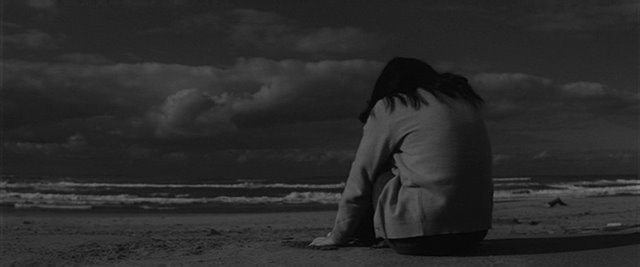
In the two weeks since America has shut down, walking has re-emerged as a hobby of mine. I had a passion for it when I was younger, but it has since been replaced with other physical activities. Biking and going to the gym were given top billing, and walking backed down to what it is to many people: the most primitive form of transportation. Obviously, the circumstances are anything but ideal but walking as an activity has become an inspiration for much thinking, especially when there is no destination or goal in sight. The protagonist in Robert Bresson’s Four Nights of a Dreamer has a similarly peculiar relationship with walking: he wanders. He glances at attractive women, follows them leisurely, and then backs off when something else catches his eye. As Bresson’s most humorous film, I’m going to make some leap to say that he has unlocked some deeply embedded truth about humanity. Instead, Jacques’ walking is bitterly in step with ours. He walks, despite not having anywhere to go and nothing much to do.

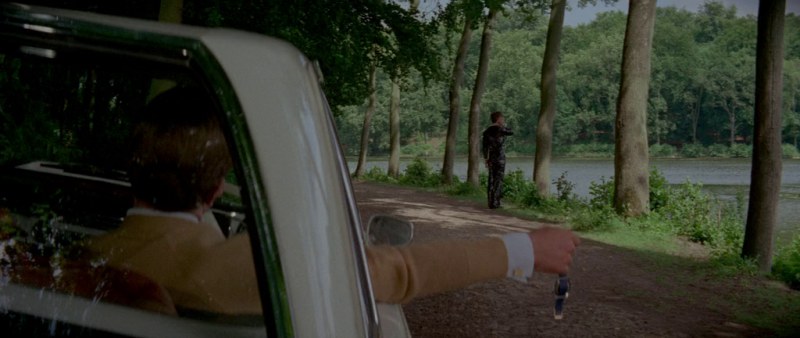
One night, while aimlessly wandering about Paris, Jacques happens upon Marthe, who is about to throw herself off the bridge. He manages to talk her down, and the two begin to talk about their lives. As Jacques himself admits to Marthe, “I have no story.” He tells her his non-story. He lives alone, and paints. He starts several different projects but doesn’t seem to complete any. When a friend from art school comes to visit him, the two barely seem to recognize each other. Jacques nods his head to signal “no” when this acquaintance asks to come in, but then says yes. The acquaintance then launches into a monologue about art. The seriousness that many newcomers to Bresson grant him sight unseen is here twisted into something amusing. The austerity of the cinematic language is the syntax of the joke here, if you will.

Marthe follows with her story, which has a bit more information than Jacques. She lives with her mother, who rents out a spare room in the house to a lodger. She makes a remark to her mother that all the lodgers are male and suggests that her mother’s intentions are to find a husband for her daughter. Marthe and the lodger becomes lovers, but only fleetingly so. While declaring her love for him, the lodger informs Marthe has he to leave for the United States to start a graduate program at Yale. He promises to return to her in a year, if she is still willing. Back in the present, that year has passed. The lodger has returned from America, but he hasn’t contacted Marthe. This was the context of the suicide attempt where Jacques first met her.

In retelling her romance with the lodger, Marthe tells of an incident where he invited her and her mother to a film premiere. Marthe is disgusted by the film, a simplistic romance punctuated with grotesque violence. Marthe’s disgusts is not reflective of Bresson, though. He takes some glee in this short parody. The film’s presumed protagonist is killed in a shootout, but before he takes his last breaths, he retrieves a photograph of his lover and says goodbye with one last kiss. While the tone is humorous, again, it’s hard not to also think of the similarly sentimental conclusion to Bresson’s own Pickpocket. The parody here never reaches the point of moral superiority, as there’s a familiarity on the part of the filmmaker himself. Tellingly, Bresson’s next film Lancelot of the Lake, also bears some resemblance to the short parody film, but this time in the cartoonish violence.

I’ve resisted using the word “parody” up until this point because I do think there are some negative connotations that I can’t wrestle away from the word. Still, there are parodic elements in this film, more so than any other Bresson film. Parody doesn’t inherently mean to mock, because I’m not sure such a tone was within Bresson’s grasp, nor do I think it was of interest to him. Jacques’ aimless wandering is itself something of a parody itself. To be out at night is something against societal norms. The ideal capitalist subject is in bed and preparing themselves to be a good laborer for the next day’s nine to five. In his book, Nightwalking, Matthew Beaumont goes deep on this dynamic and traces it back to the Middle Ages. The night walk is the territory of the criminal first and foremost, but also of the cultural interlopers that might rub against such a personality. In a way, the aimless wander at night is deemed criminal because the act of nightwalking makes a parody of law enforcement. As Beaumont says, “To nightwalk is to enact a malign parody of the watchman’s patrol; to nightwatch is to enact a malign parody of his supervision or surveillance of the community and its individuals.” One of the ironies here is that Jacques’ nightwalking and nightwatching actually delivers him to perform a civic good: he saves Marthe.
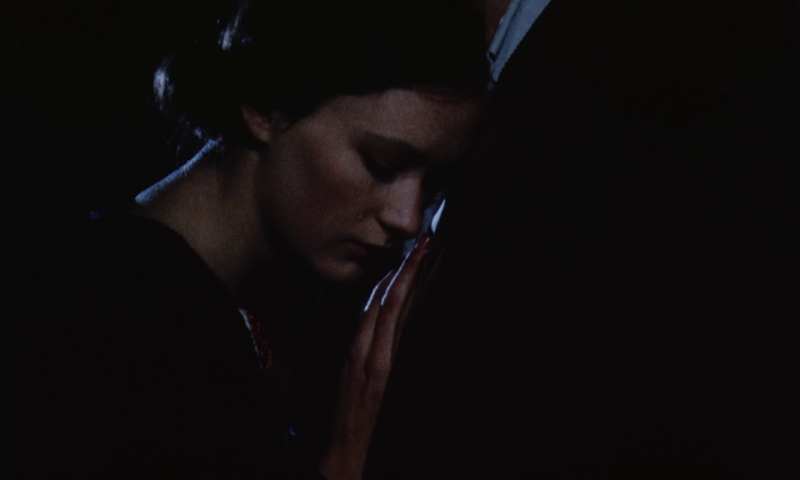
The dreamer referred to in the film’s title is most likely Jacques. This is character, after all, the dreamer in the film’s source text, Dostoevsky’s “White Nights.” At one, Dostoevsky describes said character as neither man nor woman, but instead as “a creature of the neutral gender.” In the text, our dreamer has his head so much in the clouds, so lost in reverie, that he is constantly playing a game of self-deception. In the film, it works for both Jacques and Marthe. They’re both playing a game on their own hearts. This is not a tragedy to Bresson, the way it might have been to Visconti, but it still hurts. Bresson lets the pain flow, as Marthe and the lodger walk into the night. Jacques returns home, likely to move on to another dream. They’ve both fallen in love with an ideal, rather than an actual person. As Marthe says, “That’s stupid.”



Red River (1948)

17 03 2020

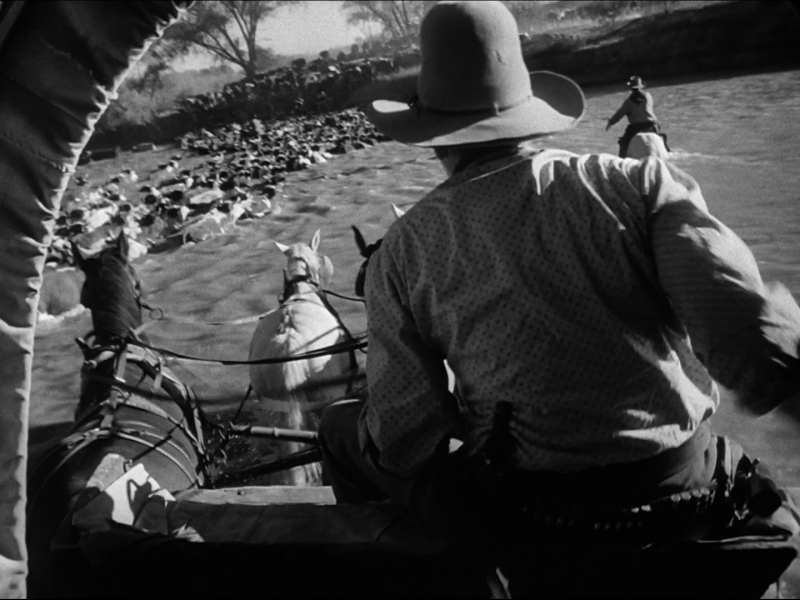
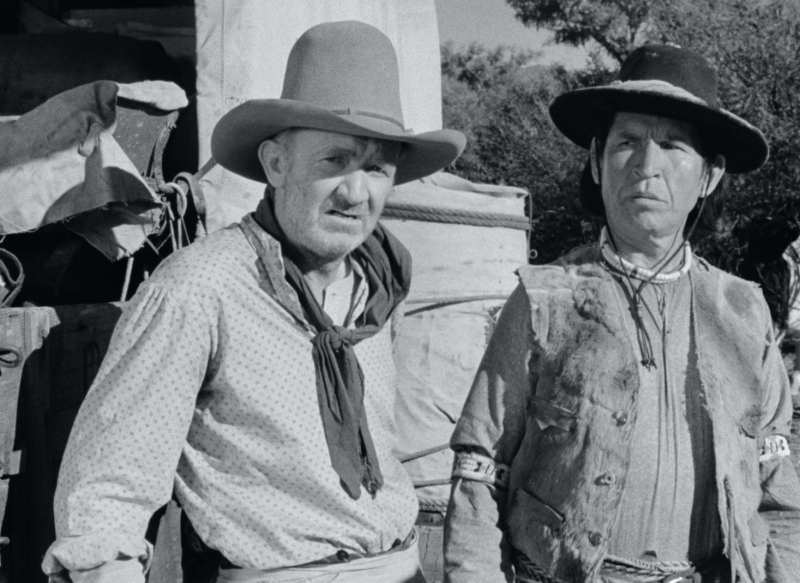
In 1884, a journalist named Charles Fletcher Lummis traveled from his then home of Chillicothe, Ohio to Los Angeles, California. Absurdly, he accomplished this by foot. Upon his arrival, he was immediately appointed as City Editor for The Los Angeles Times. During those times, LA was yet to be the global city it is recognized as today. The boom would begin roughly twenty years later, as if almost triggered by Lummis’ arrival. (It wasn’t.) Howard Hawks’ beloved Red River opens similarly. Thomas Dunson (John Wayne), along with Nadine Groot (Walter Brennan), defect from their cattle drive headed to California. They reverse course to Texas, to pursue Dunson’s dream of opening a cattle ranch.

Along the way, they run into Matthew Garth (Montgomery Clift). Upon seeing the wide expanse of Texas land, Dunson is stunned, “Water and grass….and plenty of it.” To which Garth replies, “who does it belong to?” Not missing a beat, Dunson claims it for himself. Seconds later, he disposes of a Mexican ranch hand and tells another to inform his boss that the land now belongs to him. 14 years passed, and Dunson’s dream has come true, to an extent. He has established a cattle ranch in Texas, but the end of the Civil War has left the South deeply impoverished. Dunson decides to move his entire cattle empire to Abilene, Kansas.

The main tension at the core of Red River is the relationship between Thomas Dunson and his adopted son, Matthew Garth. Because this is a western, there is much talk of “rugged individuality” and the dueling masculine forces at play appear to be participating in a staring contest to determine who is more stubbornly committed to their principles. In the film’s opening, Dunson leaves behind a cattle drive to California. The driver’s leader protests, “you signed a paper” to which Dunson replies in Wayne’s iconic and stoic voice, “I signed nothing.” The Dunson-Garth drive to Abilene, Kansas has similar deserters, but their fate is far worse. Dunson himself uses the same line, “you signed a paper” but when he’s challenged on this, he doesn’t let the deserts go. Instead, he kills them.

While the main tension in the film is the dichotomy present in Dunson and Garth’s relationship, their twinned masculinities seem to be developed independently. There’s a lot of writing about the film that seems to flatten the relationship to a father-son relationship, but that simplifies and maps over the complications they each individually face in coming to terms with their principles. They are both stubborn, perversely so, something that Hawks makes a mockery of in the film’s hyped-up final showdown. Leading up to this, we are taught to buy into their individualism. It is seen as admirable, perhaps even sage and noble. This nobility slowly dissipates, even so that Dunson resembles a would-be villain in a more conventional film.

Dunson’s inconsistent politics regarding defection from cattle drives also relates to a Western (that’s Western world, not the genre) individualism. He leaves behind a cattle drive for his own dreams. He is fueled by love, and also by a desire that greatly resembles manifest destiny. The land, the profits, the cattle, the women – they all belong to Dunson, if only because he has a deeper drive than anyone else. That’s how he can justify deserting a cattle drive, and then later shooting the potential deserters of his own cattle drive. This principle is chipped away at, as it is constantly challenged not by Garth alone, but by everyone else around Dunson. His principles which once seemed noble, become absurd and tyrannical so quietly that the eventual mutiny is endorsed by the audience themselves. The noble, individualistic hero falls because of his hubris.

Hawks doesn’t end the film on this note, though. Garth’s perspective takes over after the drive abandons Dunson. He becomes a hero, by default, and Dunson the villain. Garth picks up a love interest, Tess, but leaves her behind in a bittersweet moment of longing, the same Dunson left behind his lover at the film’s opening. A student of dramatic filmmaking would understand this decision, but it is kind of preposterous in reality. Tess eventually follows Dunson to meet up with Garth in Abilene. She gets there early and throws herself at Garth before the built-up standoff. The standoff comes, no guns are drawn, but instead Garth and Dunson fight with their fists. Tess quickly interrupts, disgusted by the childish confrontation, “What a fool I’ve been, expecting trouble for days when anybody with half a mind would know you two love each other.” The high drama quickly dissipates, and it becomes yet another balloon Hawks has deviously poked with a needle.


Two for the Road (1967)

18 04 2019

It has been quite some time since I’ve written much of substance on film, be it here on elsewhere. For better or worse, life has gotten in the way in the past two years, and while I’ve still maintained a diet of cinema, I’ve basically taken a break from thinking about it critically. The only film during this period that legitimately inspired me to almost come back to this was First Reformed, a film which effortlessly balances the pragmatic cynicism that is the destruction of our planet with the hope for some sort of revolutionary change. The dire rubs up against the triumphant, but the final note is a sour one. Two for the Road, which could be described as Stanley Donen’s most experimental film but shouldn’t be declared as it, strikes a similar chord. It is both misanthropic and playful, accurately portraying the oscillation between sweetness and bitterness that happens in a relationship.

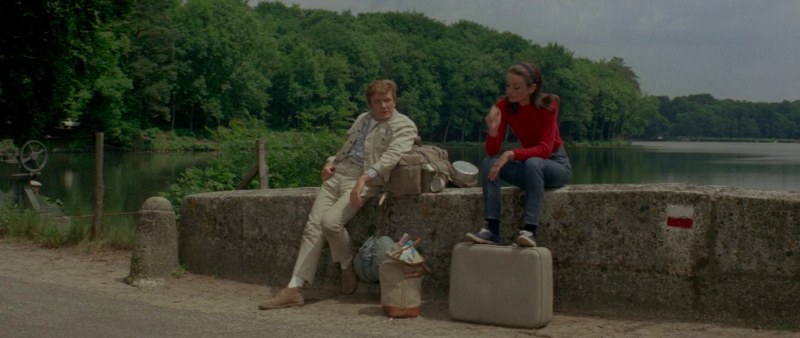
Henry Mancini’s swooning romantic score opens up an artful title card sequence, which eventually gives way to an equally romantic image: a wedding. The newlyweds in questions don’t look particularly happy, though. This exact observation is made by a woman passing by in a car. She is Joanna Wallace (Audrey Hepburn) and she directs the remark to a man, Mark Wallace (Albert Finney) who we can quickly identify as her husband. He somberly adds, “why should they be happy? They’re married.” Mark and Joanna are about to begin a vacation, but there’s very little excitement between the two of them. The pre-flight drink they share is met with an astonishing amount of indifference. They don’t hate each other, although they will both say so later on, and they don’t love each other either, though they will also say that later on. Instead, they treat their traveling as another chore. Their present-day flight passes over the past, where the two first met. Back then, Mark was also losing his passport and Joanna was also still finding it for him. The film immediately announces a playful interpretation of time.

All of Two for the Road operates with the temporal understanding as the sequence described above. By situating most of the actions on a literal road, Donen and screenwriter Frederic Raphael, brilliantly set themselves up to bend with time. Sequences aren’t arranged or driven by the limitations of time, but instead are connected through space. At one point, Mark remarks “If I ever have a car, I’ll never pass a hitchhiker” while a car passes by him. The driver of that car is him in the future blissfully ignoring some hitchhikers in the same location. The collections of moments that make up the film, then, are not even related by the emotions shared between the two lovers.

In fact, the most brilliant moments of Two for the Road come when a moment of intense romantic happiness is punctuated by one of two things: the couple’s aforementioned indifference towards each other or an outright disdain for each other. The characters themselves position the timeline of the relationship at twelve years, which provides ample time to show the highs and the lows that occur in a relationship. Saying a relationship has “ups and downs” sounds like a cliché recited by an armchair therapist, but there’s a truth to it, albeit a shallow one. What Donen challenges here, then, is the very nature of what romantic love looks like in cinema. Although Two for the Road is not as outright self-reflexive as Godard’s similarly bitter romantic road movie Pierrot le fou, it does meditate on the understanding of love we have in cinema. Since most of our first examples of romance are ones on screen, the ones we eventually dream for ourselves are shaped by these depictions.

Cinema shaping our understanding of love is likely not a healthy thing, since most popular depictions of love fit within a three-act structure. There is the meeting, the turmoil, and the eventual overcoming of it. The temporally loose nature of Two for the Road’s structure bears a closer resemblance to the reality, since we’re never quite sure what “stage” of the relationship we are witnessing. We get the impression that the most bitter moments are towards the end but there is hostility shared in the beginning as well. Henry Mancini’s score often plays under the bickering, reminding us of what once there. Two for the Road eventually ends on a hopeful note, perhaps too hopeful for my liking, but it doesn’t underdo the rest of the film, which exposes the nature of relationships. They are hard work, and sometimes hopelessly so. But sometimes they are worth it.


Hikô shôjo / Delinquent Girl (1963)

31 08 2017

In 1962, Kirio Urayama released the brilliant Foundry Town, a late shomin-geki that effortlessly weaves labor and Korean-Japanese relations into the rich tapestry of a studied family drama. Released by Nikkatsu, a production company associated with slick and energetic crime dramas, Urayama’s film is a rare breed. It lacks the fervor and chaos one may read into anything adjacent to the Japanese New Wave. At the same time, it would be unwise to pin him down as old-fashioned, even if that would bring him into contact with Naruse and Ozu, two of the greatest filmmakers ever. Delinquent Girl, made only a year later, brings him closer into contact with something that resembles the New Wave’s concerns. A film about unruly youth and their agitated politics, its surface is not far from something like Cruel Story of Youth. Yet it switches up a melodrama with exploitative potential into a sympathetic, albeit broadly drawn, study.

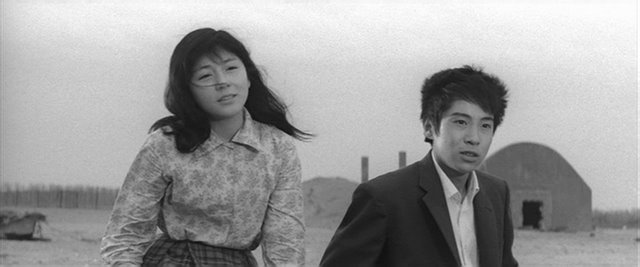
Saburo returns from city life in Tokyo to his rural hometown. There, he is reminded of the resistance he faced during a period of youthful organization. His parents and siblings are equally confused by his inability to find steady work. In particular, his conservative brother, sees this idleness as inseparable from a leftist politics and an urban life. Saburo befriends Wakae, a young girl whose academic struggles are greatly overshadowed by the way the townspeople use her.

Wakae’s potential is seen by Saburo alone, who undergoes an attempt to Pygmalion her into an intellect like himself. He tries to finance her scholarly life, but she uses the money to attend to her more immediate needs. His reservations about her are buoyed by the endless gossip around town. Her reputation is constantly under attack, and despite Saburo’s own history of facing the town’s ire, he cannot completely believe Wakae.

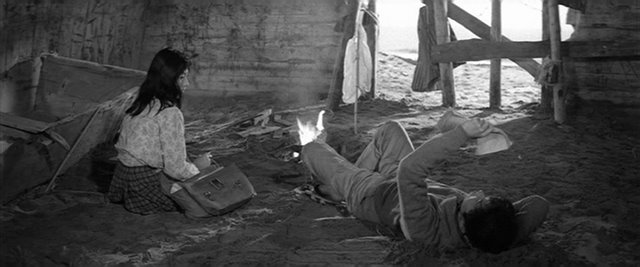
Urayama sets up a melodramatic love story, a would-be apprenticeship between the titular “bad girl” and the optimistic scholar returning from the big city. Everything is drawn broadly here. The ridicule that Wakae faces seems stretched out for a fifteen year old girl. Yet, the film establishes that she’s already spent most of her life with her youth undervalued or unseen by those surrounding her. The implication of past sex work sets up a bulletproof explanation for a population of lecherous drunks that Wakae ignores in favor of the “new life” that Saburo’s interest promises. If the film unfolded in such a way, I would roll my eyes and dismiss it. But it switches from a set-up where Saburo is a master then lover to one where he is woefully unprepared to provide for Wakae. He might love her, but love is not enough for the forces bearing down on the couple. Their repeated misses with each other might read to some as graceless narrative developments, but they flesh out a romance that is initially lacking in explanation.

The film’s crucial shift, that from Saburo’s perspective to Wakae, suggests that the opening thirty minutes are a red herring. This is not a triumph of romance, but a continuation of Wakae’s hardships. Life of Oharu might be a helpful reference point here, but Uriyama does not linger in the tragedy of his heroine’s continuing disappointments. Unlike Oharu, Wakae moves on, steadily and with the hope provided by her youth. Saburo, who we once thought was our hero, becomes another detail in her life of hardship. To be skeptical of their romance is not to be skeptical of Uriyama himself, who wants us to question the impulse to buy into a relationship that seems to be tainted from the start. In cinema, it is not always right to fall in love.


Dni zatmeniya / Days of Eclipse (1988)

4 08 2017

Regarding the films of Aleksandr Sokurov, an acquaintance of mine one emphasized the idea that his films are “not bound to Earth.” For whatever reason, this phrase has always stuck with me. There’s a precedent for this in art film, of course. Filmmakers like Ingmar Bergman and Andrei Tarkovsky often looked up to the heavens and towards a life after this one. I think this phrase, “films not bound to Earth” probably stuck with me more because of its poetry. I kept returning to that it while watching Days of Eclipse. While it is not an entirely untrue description, I find the reverse equally accurate. In other words, Days of Eclipse is deeply bound to Earth and invested in exploring its finite quality.

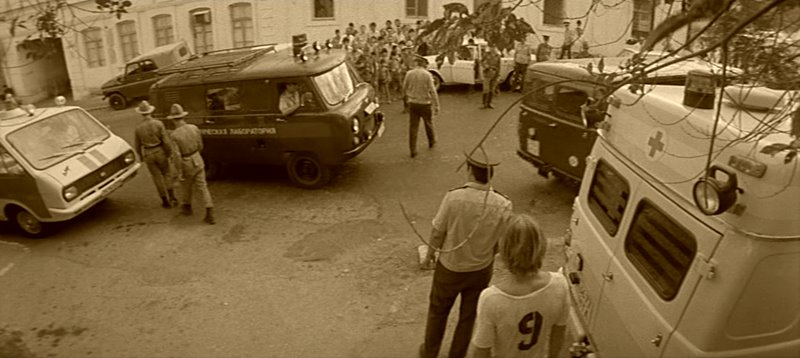
Sokurov opens his film with an overhead shot of a desolate Turkmenistan town. Complimented by a saturated sepia filter, one is hit by the dry heat of the landscape. Housing is visible, but family units seem bunched up together, as if they are trying to blanket themselves from the dead, unoccupied space that dominates it visually. The camera’s acceleration express discomfort. This is the territory most of us only dare to inhabit through the filter of Orientalist anthropology. We can’t actually stay here. Alas, the camera plummets into the ground. In this instance, Sokurov’s film is quite literally “bound to Earth.” More importantly, we are stuck in a village destined to vanish in the haze of its stiff climate.

The crash of the camera is followed by a extended montage of the town’s people. They are often elderly, sometimes grotesquely malnourished, and always displaying the bruises of the inseparable twin forces of climate and poverty. When I first saw Days of Eclipse years ago, I particularly loved this sequence because it reminded the edgy budding cinephile I was of Harmony Korine’s Gummo. In that film, a disaster from the past has reshaped the space of a city’s inhabitants. By extension, it has also reshaped their lives. In Sokurov’s film, there is no one disaster from the past. Instead, it is a natural disaster occurring, the disaster that is our current geological age. It should be emphasized that none of this “natural” even as it pertains to nature. Malyanov is a physician and in this context, represents the idealism of science. Perhaps he and it (“it” being science) can find a solution, but his devotion runs into countless obstacles.

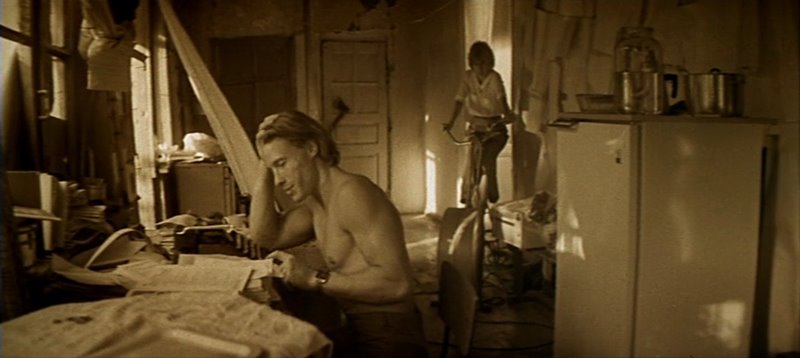
Unlike GummoDays of Eclipse ties its attention towards one individual. The aforementioned Malyanov is our hero, and he is an impressive one. He is youthful, optimistic, and strikingly handsome. It is unclear how long he has been in this village and why he continues to stay. The film’s first line of dialogue is him, perhaps jokingly, informing us that he is on vacation. He is endlessly reminded that he can and should return to Russia. His research is also unclear, but he maintains that he is invested in the region. Despite this, he seldom leaves his house, never interacts with the locals, and accomplishes little. The strangeness of the space overwhelms him, and he is also bogged down by the inseparable forces of poverty and heat, although he gets more relief from it than the townspeople do.

With Malyanov’s perspective privileged, we never reach beyond the surface of the “everyday life” of the other people in the town. When they are present, Malyanov is usually not far off, drifting aimlessly around a local congregation and gazing at them in bewilderment. We are treated to a few more montages resembling the one in the previously described opening. For a film in which the camera often lingers on its protagonist, it seems all too eager to speed through the surrounding population. On the surface, this is a criticism. Arkady and Boris Strugatsky set the film’s source text, Definitely Maybe, in Saint Petersburg. Sokurov has relocated the action to rural Turkmenistan. As a drama about the end of the world, or as I prefer to describe it, a world-ending drama, one would not be without evidence to suggest Sokurov’s move as Orientalist fantasy.

Yet, Malyanov never becomes the European hero to the repressed and darker third-world. Russia’s historical identity is in flux. Today, we now know it as Europe. Cultural imaginations of race or ethnicity can be, at the same time, tightly enforced and vaguely understood. An enormous continent was once Asia, but now it is Europe. In Days of Eclipse, we are in a timeline when the Soviet tentacles stretch towards and sap the energy and resources of places like Turkmenistan. The landscapes has been redesigned to fit the iconography of Soviet’s historical heroes and yet it has also been left behind. It speaks to Sokurov’s power that he can communicate this relationship in one shot, and then extend this imagery by lingering on the spatially-induced heartbreak felt by Malyanov’s closest friend, Vecherovsky. He was forced out of Russia with his mother and father, both of whom he never sees because “they live on the other side of town.” His anguish, it should be said, occurs in the film’s most impressive interior space, a spacious house that his parents left for him before they moved.

It is not all that novel a concept to link science fiction with climate politics. If anything, it has become increasingly unavoidable. Middle-brow Hollywood films, financed by the pockets of industry liberals, make enough noise at the box office to demand a return to the well. Smart mainstream critics can single out these films as “interesting” and speaking to our specific moment. They make the rising tides and record heat-waves the thrilling catastrophes they already are, hinting at the urgency with which we should approach this epoch. In real life, we linger. Like Malyanov, we sit in our rooms, curious for the answers, but unproductive. The reserve energy of the youth is surpassed by a deteriorating landscape that doesn’t even make our leaders blink. Days of Eclipse does not play to our fears of a dystopian future, but instead captures the lassitude of our present. Sokurov’s wide-angle lens fits every inch of beauty possible in the neglected spaces. He has made a movie tenderly bound to Earth, speaking to its beauty and pain in the same breathe. As a result, those rising tides and record heat-waves are not thrilling, but heartbreaking.