Man’s Favorite Sport? (1964)

21 07 2010

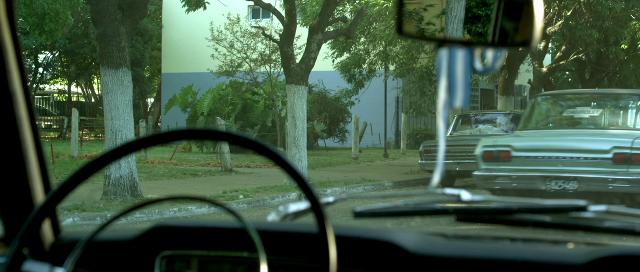
Call it unfair, but I’m afraid from here on out I will subconsciously compare any Howard Hawks comedy to his masterpiece, Bringing Up Baby. It’s even more difficult to avoid here seeing as how this is something of a remake (stuck up, organized man falls for messy, outgoing women) and also reuses a few gags. In a way, it’s actually better than Hawks’ much more praised original as it seems easier to believe and far less chaotic. Of course, both of those things are part of that film’s charm, but this manages to maintain that energy and channel into something similarly absurd but much less difficult to believe. I don’t think realism was ever really a priority for Hawks in these such films, but it still appeals to me. This is the gentle and more easygoing version of Bringing Up Baby, sort of warm-up, but not exactly inferior.

Rock Hudson fills in for Cary Grant and the underused Paula Prentiss (familiar to me for her role in Born to Win) fills in for Katherine Hepburn. Of course, the story arrives at the same destination as its more recognizable cousin, but it takes a very different route. Rock Hudson is Roger Willoughby, a well recognized expert on fishing yet he has never gone fishing in his life. His employer invites him to a fishing tournament and well, you get the picture. Prentiss is Abigal Page and she introduced with her friend Isolde Mueller (a new character all together – played by Maria Perschy) and she causes “nothing but trouble” to quote Willoughby.

I’m not sure if Prentiss is exactly a more pragmatic actress than Hepburn but her seduction (inadvertent and intricate) seems less like a farce. No, the lack of realism in Bringing Up Baby wasn’t a negative but the less “crazy” turns here seem to work in favor of the film’s simple and more believable tone. The fact that she’s teamed up with an equally attractive pal certainly doesn’t hurt. Another change is in the role of main male protagonist’s fiancee. In Bringing Up Baby, she is cold and heartless and participating in the marriage only for professional reasons. When she cuts her ties with Grant, we don’t particularly feel bad for her. She wasn’t in love so she’s not heart broken.

Here, the consequences are more tragic. Hudson’s fiancee is given a little screen-time but it is almost all devoted to her catching Hudson in awkward scenarios which imply infidelity but are simple accidents. Sure, she never gives her beau time to explain himself but even if she did, she wouldn’t have believed him. Though her role is short and arguably insignificant, I can’t help but feel more for her much more than I did for Grant’s strictly business wife-to-be.

It’s the small little differences that make me love this film. I’m not sure if said differences are “better” per se, but I do know that I am able to appreciate this film beyond the novelty of being an update of an old favorite. It stands on its own, albeit it with the structural support of its canonized sibling. Again, it’s easy-going and fun to watch, definitely a relaxing experience, yet still an amusing one.


Monkey Business (1952)

12 07 2010

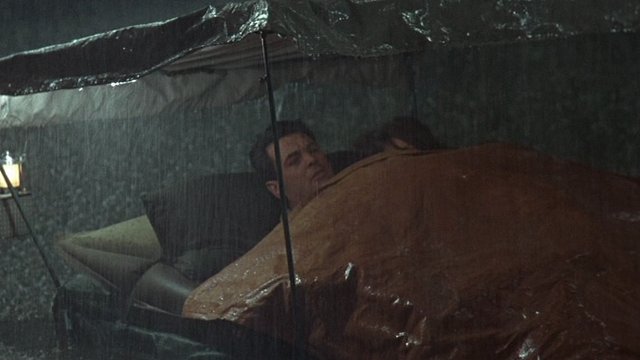
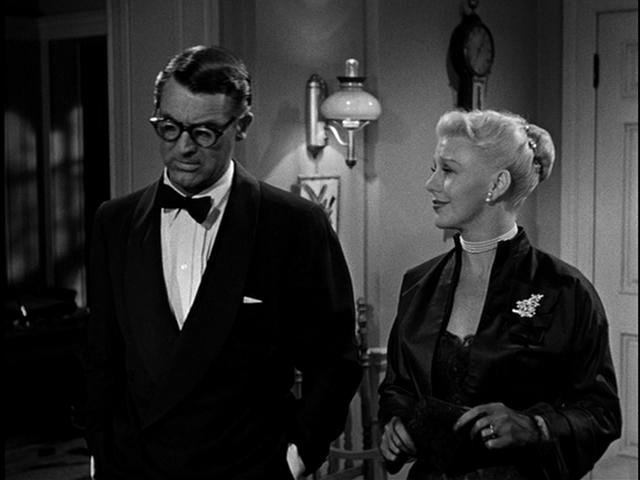
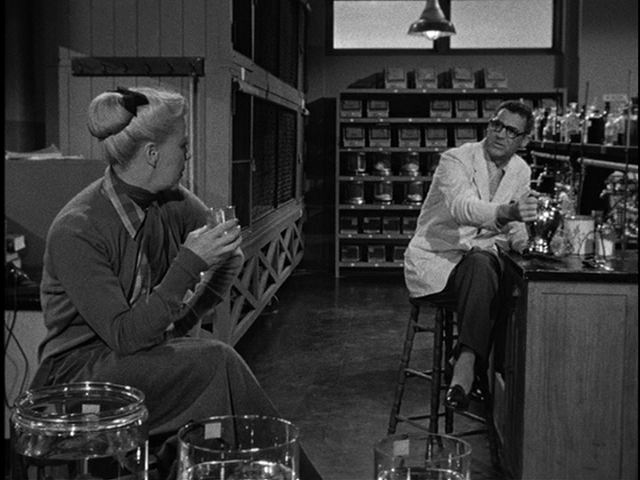
Cary Grant does something of a reprise of his role in Bringing Up Baby here and Howard Hawks is obviously trying to one up his own antics of that film, but it all ends up a little bit short of that movie. It’s still a lot of fun and one can’t really fault Hawks for being able to produce something so zany and goofy without peering off the side of complete insanity. I’m sure the term “controlled chaos” has been used to describe the comedy of Hawks in the past, but it fits so well. There’s a restraint to all the craziness here, and it’s quite impressive to feel that Hawks is still in complete control even after the script begins to read like the dwellings of a mental patient.

Where as Bringing Up Baby takes a believable enough scenario and pushes it to the furthest extreme of the natural world, this movie begins with a concept that is completely out of this world (the development of a “youth serum”) and just playfully bounces along inside its own fantasy world for the entire running time. That isn’t to sell the film short, it’s still great fun, but it lacks the spontaneity found in the chaos of the aforementioned film. Again, we still have chaos, but this is a more noticeable example of that “controlled chaos” I mentioned earlier.

At the risk of getting way too analytical, I’ll admit that in terms of actual space, this is a more open film. There’s actual scenes that are shot outdoors and not just in a “outdoors” set but that’s not really fair to either film. Neither of them are photography-driven movies. Sure, Hawks had an eye for excellent composition in his more “serious” works (despite his claim that he didn’t) but the examples for it here are few and very fleeting. This one looks a little better just by default as it came during the time when black and white film stock looked it’s very best in America cinema, but basically, I’m saying this is a non-factor in both films.

What is a factor, though, is the writing. The screenplay here has been penned by Ben Hecht (worked on Stagecoach), Charles Lederer (His Girl Friday), and I.A.L Diamond (Some Like It Hot) — I’d venture to guess that these three developed the original script for the 1931 version of the film, of which I have not seen, and then in 1952, Hawks himself looked after and maybe made a rewrite or two. This is all important because it reflects the culture of a 1930’s comedy (I’m hesitant to drop the word screwball) and thus, the film feels like it is a product of the 1930s. The fact that the story involves two seminal 1930s Hollywood stars, Ginger Rogers and Cary Grant, dramatically reverting back to their ways of youth implies that Hawks was more aware of things then he’d like to admit.

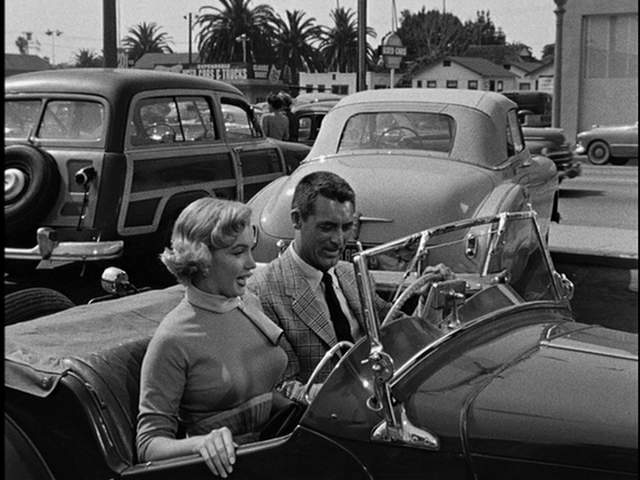
It’s a 1930s comedy (again, “screwball” territory, I suppose) masked in the makeup of a 1950s production. Sure, Marilyn Monroe’s performance as the clueless secretary seems entirely to be a product of the 1950s, but that’s a small thing – though as I said with Gentlemen Prefer Blondes, it could launch an entire series of feminist theory. As a whole though, the film is a call back to Rogers’ and Grant’s (and one could argue, Hawks’) golden years. It’s a nice tribute to the era that spawned it, but Bringing Up Baby this is not.


Bringing Up Baby (1938)

6 07 2010

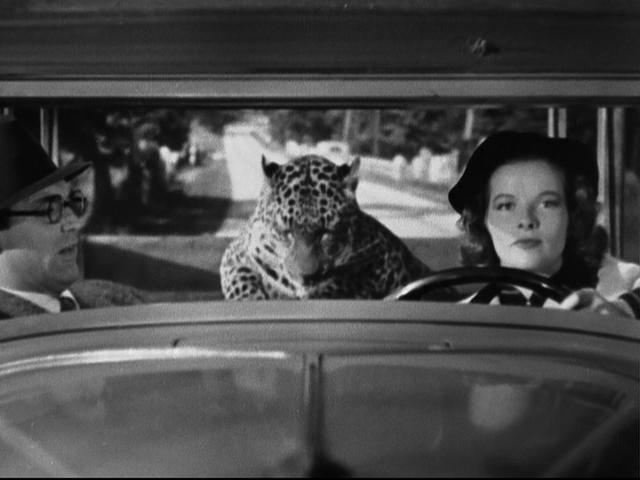
Oh, where does one begin with this movie? It’s Howard Hawks personified and maybe his best work overall. It’s absolutely crazy yet in the most delightful way possible. Screwball comedy has become an overused genre classification that lumps in every comedy from the 1930s into one group, but this truly is a “screwy” movie which sounds more like a criticism than a compliment. Usually when I describe something as “zany” it’s not intended as positive, but this movie is the definition of zany yet it manages to work on every level. Fast-paced, absurd, and relentless, Bringing Up Baby is one of those special films that seems to blow by any type of characterization or restraints.

Hawks was never one for creating extremely rich characters, no, it’s usually people defined by two or three (at the most) personal traits. Here, Cary Grant is the scatterbrained professor, a genius in his field of study, but completely clueless when it comes to human interaction. He is very straight-laced and conservative, which is why his character clashes so much with Katherine Hepburn’s. It all starts when she uses is ball in the middle of a golf game that Grant’s character is participating in only to schmooze Alexander Peabody into donating to the museum. Things go bad, then they get worse. That’s how almost the entire film works, a situation is introduced, some type of failure in communication occurs, and everything that could go wrong – does.

Describing this movie as “silly” would be understatement. Grant’s character, Dr. David Huxley describes his interaction with Hepburn’s Susan Vance as “a series of misadventures” and that’s before the really crazy stuff starts. That sounds like it was read directly from a synopsis on the back of a DVD, but such writing points to the fact that film is somewhat aware of itself. It’s not a super self-reflexive, self-conscious piece in the vein of post-60s Godard but it still manages to poke fun at itself while maintaining it’s frivolous nature and also, perhaps most surprisingly, obtain some type of substance in the romance.

Dr. David Huxley is set up for a very professional wedding with a co-worker, she does not even accept the  idea of a “honeymoon” though he seems fine going along with this. It seems that it is only for the benefit of his career as his idea that they could still “kind of” be a legitimate couple suggests a longing for a real relationship that is suppressed by his stuffy career. That’s why Susan Vance is perfect, she’s the opposite of Huxley (this is not groundbreaking stuff here, obviously) but still has those same “scatterbrain” tendencies and that’s what draws them together. It takes Huxley the entire film to finally admit that he enjoys spending time with Susan. He resists her carefree charm until it breaks him and (literally) destroys his work.

Apparently, the original script for the film indicated a running time somewhere in the realm of three hours. Sure, Hawks’ rapid-fire pacing could have shortened that a little but still, it’s that all out tone that separates the film from all of its comedic brethren. There’s so much to digest, so much to take in within this messy, messy world that rewatches seem mandatory. The fact that Hawks could create such a unique comedic experience and have it go unmatched for over 70 years is enough proof that this film deserves all the attention it gets. If one manages to watch this film without cracking even the slightest smile then there’s no hope for them in this world. It sounds hyperbolic and it is, but it’s hard to not get infected by the joy surging from every frame.


Un chapeau de paille d’Italie (1928)

1 07 2010

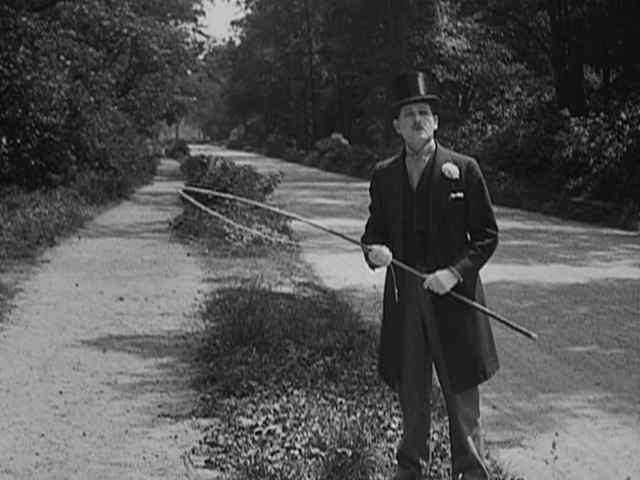
This is the earliest full-length film I’ve seen of Rene Clair but as his sound films would later do, this demonstrates that his “modern detractors” didn’t really know what they were talking about. Sure, this film, like almost all of Clair’s work can be described as light and frivolous, but those terms don’t exactly mean that it’s a work devoid of any artistic merit. On the contrary, once again I find Clair’s humor (as silly as it is) to be the perfect compliment to his cinematic design. This isn’t a revolutionary work in terms of film-making, but it really shouldn’t be. It’s an artist honing his skills, which I guess would lead me to consider this something of a warm-up to his later films.

I think Clair had numerous fascinating ideas about how to implement sound, but of course, you can throw those out the window here. I suppose on that level alone, this film feels a lot less experimental than even the earlier Paris qui dort which at least has the whole sci-fi element to hang its hat on in the terms of “uniqueness.” This is a step in the right direction from that film, but it’s still sort of a unifying piece (at least in my eyes) to his work of the early 1930s.

There’s not much to note here aside from being a “very Clair” type of film, but I do think the critical response from Clair’s native France has always been something of interest. He’s always been viewed as a primitive and old-fashioned director whose roots lie more in literature than cinema. I mention this only because this particular film is based on a novel, and the idea of reworking a novel into cinema was something that Clair was generally against. This all sort of makes sense in the realm of the film because there’s a literary tone to it, but it manages to capture Clair’s preference for visuals over word. It’s a wordy comedy, but there’s not many inter-titles. A good way to pass some time on the morning of one’s birthday.


El secreto de sus ojos (2009)

27 06 2010

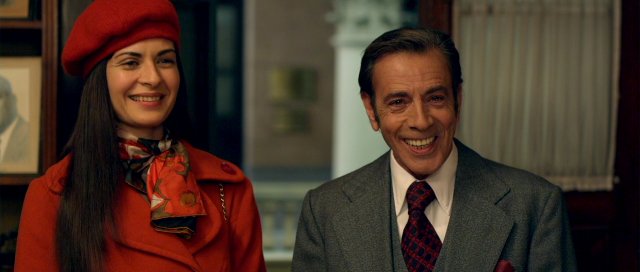
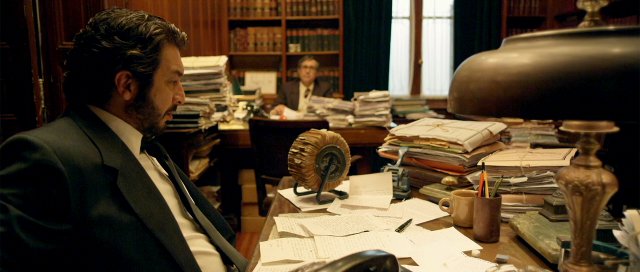
A pretty solid movie that had a chance to be a bit more than the mere suspense/thriller it’s advertised as, but it ends up falling a little bit short. In the end, it’s a nice piece of genre cinema that has frequent introspective and arty touches. There’s plenty of Hitchcock fodder thrown around but it’s done in a manner that is very elegant, and seems more organic and less forced than simplistic plot devices. I guess there should be a lot of credit given to the actors as everyone seems to inhabit their own space and maintain an equal level of importance.

I’m not familiar with Juan Jose Campanella’s work at all (thought if this film is any indication, it would be wise of me to fix that) but I did find it somewhat amusing to see that he had directed multiple episodes of the two Law and Order spinoffs as the earliest sequences of this film recall the “glory years” of the original series. There’s no denying know that we’re seeing something of a simulation of Jerry Orbach and his deadpan, no-nonsense style of observing in several characters. While we never get the same level of back story (understandable since Campanella didn’t have years to flesh out his characters) we still see similar tragic shades.

The most obvious shade of tragedy is that of the film’s central protagonist, Benjamin Esposito. Now retired and living alone, Esposito decides to devote his time to dramatizing a rape and murder investigation that haunted him several years ago. It becomes evident over time though that the investigation’s emotional power over him wasn’t just from the crime itself but the frustration and longings he held for his co-worker, Irene Hastings. In a wonderful touch, Esposito is hopelessly in love yet manages to overlook and ignore any advances made by Irene. As one of the characters says, he’s simply waiting for a miracle.

I mention this little complex between Esposito and Hasting because it is one I can personally relate to and one that isn’t explored enough in films. Usually the “hopeless romantic” reads every potential advance and follows it to no end. However, Esposito fails at this. He’s deeply in love with Irene but that doesn’t mean he’s able to comprehend the significance behind every conversation he has with his crush. In other words, just because one is oblivious doesn’t mean they don’t care.

Eventually and perhaps, inevitably, the story refocuses its gaze to the progression of the actual investigation. I don’t want to ruin anything, but the final thirty minutes or so are a total waste. It made sense as I sat in a theater surrounded by elderly folks who oooh’d and awww’d at every plot point that the film would take far too much time to tie up each and every loose end. Personally though, I’m able to forgive the film for its final indulgence in to the more conventional storyline when there’s plenty of poignant and heartbreaking moments surrounding the “progression.”