Dirty Mary Crazy Larry (1974)

10 01 2011

I guess this is somewhat like Two-Lane Blacktop. I mean both movies have two men, a girl, and a car but uh, that’s about it. Where Hellman’s classic is an subtle and endlessly watchable journey through Americana, this is more of a goofy little road movie. It’s a little funny, but it’s mostly forgettable. Both films are obviously products of their time, at least in content, but the same applies for pretty much everything about this film. It’s so seventies with Peter Fonda  hamming it up and Susan George being quite possibly the least interesting female lead I’ve ever seen.
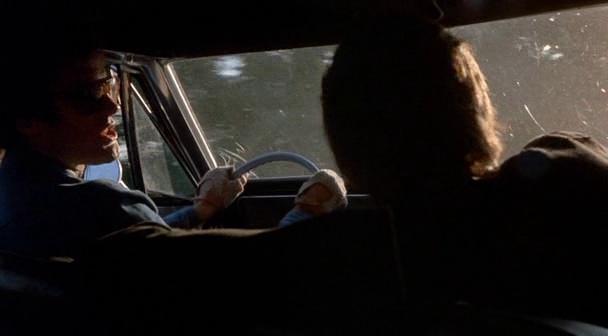
The story is pretty simple, which I don’t mind, but it is pretty much built upon the idea of a never-ending car chase. Since this is the case, the movie ends up feeling more than a little hollow. It’s merely chase after chase with extremely obvious attempts at “memorable” dialogue. In fact, every other thing that Peter Fonda says is clearly trying to break into the American consciousness. It’s really a silly goal for a film that seems like it should be grounded and more understated. Adam Roarke provides this to some extent, but his characters just ends up seeming useless, except to create unnecessary drama between the two men towards the film’s ending.
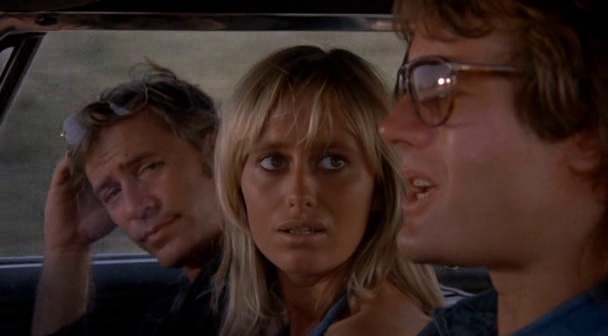
The ending creates another problem all on its own. I admire the fact that it happens so abruptly but ultimately it makes the experience feel a little pointless. Sure, the film is trying to be self-contained and I admire that in some regard, but the characters’ vices and faults are not so much endearing or even interesting as much as they are annoying. Peter Fonda chuckles to himself a lot and hates women. Susan George gets upset about this hate, and Adam Roarke just sort of sits there in all of his deadpan glory. I don’t mean to make this movie out to be a complete failure, but mentioning it in the same breath as Two-Lane Blacktop is just unfair to both movies. It’s a nice little movie, but not likely to set anyone’s world on fire.



Le clan des Siciliens (1969)

7 12 2010

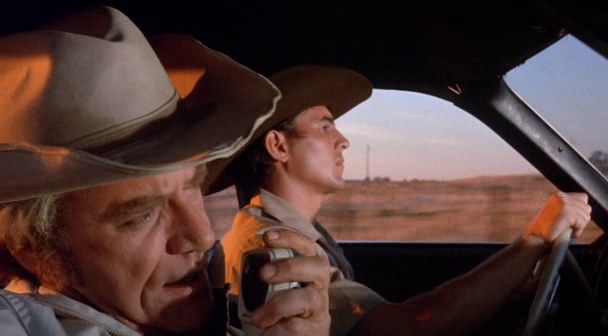
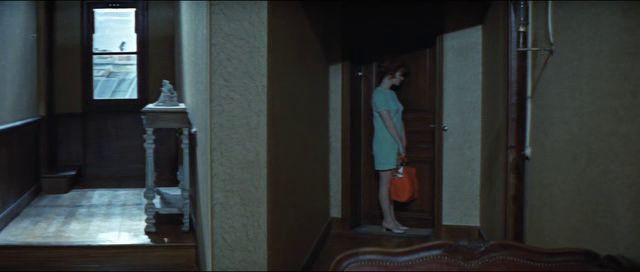
Well, this is pretty much what you’d expect from a mainstream French action-crime drama from the late 1960s. This is probably a criticism for many, and maybe it is for me too. Still, I enjoyed the hell out of this for what it was worth. The main selling point is the presence of two of France’s biggest stars of all-time, Jean Gabin and Alain Delon. They’re delightful together, even though they very seldom share space in the same shot here. It’s a nice way to spend two hours, but it is far from being the best work of anyone involved. Another big name here is Ennio Morricone whose score is serviceable, yet still kind of silly at times. (What’s with the “boing” sound effect?) This is pretty much how I’d describe the film as a whole too. It works for what it is, a pretty run of the mil thriller that just happens to have a wonderful cast. It looks sort of nice too, but in a far conventional way.

This review is really just an excuse to post these pictures that I had laying around.


The Shopworn Angel (1938)

16 11 2010

Sure, this is a seemingly much more conventional than Potter’s crazier and more herald Hellzapoppin’ but it’s still pretty unique in its own way. While it plays out in a very predictable yet charming way, it’s really the ending that makes this stand out.  A majority of the film’s resonance comes from said conclusion which strays from the conventions of the genre, while simultaneously trying to emulate them. As with Hellzapoppin’, Potter seems to take a great joy out of playing against the expectations of the audience members. As far as classic Hollywood is concerned, there was no other filmmaker who had this kind of handling with the subversive.

James Stewart plays Private William Pettigrew, a Texas-born simpleton who is sent to New York for training. There, he inadvertedly gets a ride with theater star, Daisy Heath (Margaret Sullivan) who he convinces to be his “pretend girlfriend” if only for the approval of his friends. They catch on to his lies and begin to probe further, which forces him and Daisy to think up a bigger back story. They continue to “pretend to fall in love” until the actual thing begins to take the foreground.

I’m not sure there’s a more obvious sign to the audience that two people are going to be a couple than if one asks the other if they can be a “pretend relationship.” From the moment Stewart first greets Sullivan we know they’re going to be holding each other eventually. It doesn’t really plague any of the drama, though, as it’s not in Stewart’s courting of Sullivan that we’re interested, but rather her hiding from the man with who she is actually involved. Sam Bailey has his suspicions, but even with his lurking eye, he is never seen as a villain. Instead, he is merely a man that has unfortunately gotten tangled up in Daisey’s complicated love life and his endless but platonic support following her marriage to Pettigrew is more than admirable.

In a way, it’s a little bizarre that Bailey (played here by Walter Pidgeon, pre-How Green Was My Valley) actually does more for Daisey than Pettigrew. Sure, Pettigrew’s martyrdom is pointed out, but his feelings towards Daisey seem to be a little one-sided. Meanwhile, Daisey herself just can’t bear to break Pettigrew’s little heart so she continues to play dumb. When Bailey confronts her about her potential infidelity, she replies in claiming that she is “More like a mother” to Pettigrew.

If it was intended that Daisey would sacrifice her freedom for Pettigrew to have something to look forward to after the war (I guess surviving isn’t enough?) then the film is a bizarre mix of pro-war propaganda and domestication. The latter doesn’t really fit since the film concludes with Daisey in her normal profession: a performer. Instead, I merely see it as finding a seldom fond mix of irony and tragedy. Not in the O Henry/Rod Serling sort of way, but one in which forces us to confront a reality that happens all the time. Maybe I’m giving Potter too much credit here, though, but even then, this odd and charming piece of romance deserves more than the title of being the precursor to The Shop Around the Corner.


Human Desire (1954)

16 11 2010

If a film is directed by Fritz Lang and shot by Burnett Guffey (In a Lonely Place) it is most likely going to look fantastic. Sure, you’re likely to get your fair share of shot/reverse shot conversations and other irritating tropes of the time, but you’re guessing this is going to be filled with images that will ingrained into your brain for a long time. Well, you’re right. The opening two minutes or so here, which is completely devoid of dialogue, produces some of the greatest Antonioni-esque compositions to ever come before the director’s own work. It’s convincingly modern, much like most of the films from the later cycle of noir.

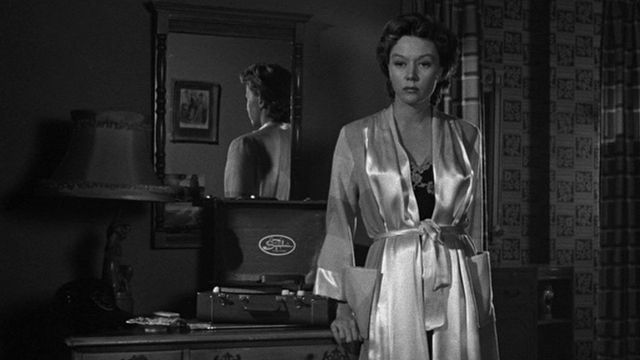
From there on, everything sort of falls apart. Sure, Glenn Ford and Gloria Grahame are great together, having already done so in Lang’s The Big Heat from the previous year. They both embody your standard principles of noir protagonists. Ford is a rugged and quiet drifter-type, perhaps still reeling from the effects of the war in Korea. Grahame has those standard femme-fatale features yet is actually sort of less sinister and more sympathetic than one would anticipate. The film’s story comes from the Emile Zola’s novel, La Bête Humaine, which translates into English as “The Human Beast.” I haven’t read the book so I can’t speak for Zola, but I do know that Renoir’s film of the same name portrays the lead female interest as something of a beast.

Sure, titles tend to be the concerns of the marketing department, but I can’t help but think the subtle change was a deliberate attempt on Lang’s part to distance Grahame’s character from the usual style of evil seductresses that were invading the screen at the time. Sure, she is seductive and there’s a lot about her that’s left up to the audience’s imagination, but we are still able to see her vulnerable side. More importantly, it erupts in front of Ford. He knows how fragile she can be, which makes his predicament all the more complicated.

So what’s the problem exactly? A noir with slight humanist tone sounds like the best thing ever. I wouldn’t disagree, but there’s too much dead space in between the Arty (with a capital a) sequences from the others that just filler to get us there. Lang is a master at composing and Guffey exists on a similar level when it comes to capturing images, but there’s something about the film, when it’s all put together that doesn’t quite make everything fit like it should. Maybe there’s too much talking. While there is more quiet moments than most noir, it still isn’t quiet enough as it should be. This sounds preposterous, but the writing seems to be constantly walking a thin line between “clever” noir dialogue and being something more contemplative. It’s not quite one but it’s not quite the other.

I don’t mean to gang up on the writing in particular, but it really does sink what should be a great vehicle into merely a very good one. While Grahame definitely flesh out her character, there’s not enough to actively care about her trouble. Maybe this is really a strength, that we never know if she’s as dangerous as she could be, but it does seemingly make things easier for Ford. He has an equally attractive and much less problematic female waiting for him. Why is he so conflicted? It seems like the movie got so caught up in fitting certain conventions that in certain cases, it forgets to include a justification. As it is, Human Desire is so close to being Lang’s masterpiece, but it’s also not. It should be mandatory viewing for anyone who considers themselves a fan, but like a great deal of his American work, the ambition in Lang’s vision seems like too much for Hollywood.


Flirt (1995)

15 11 2010

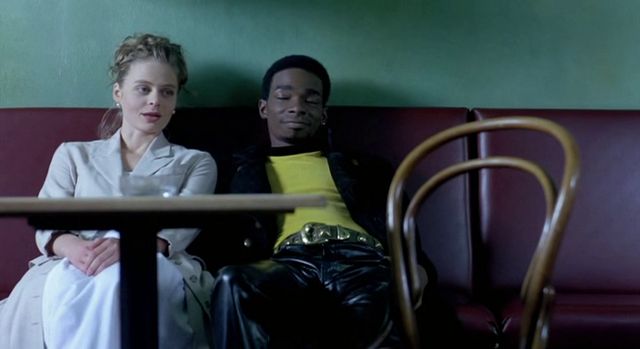
One story – told three times with only the slightest of differences. This is Hartley at his most experimental, his most deadpan, his most philosophical, but still extremely playful. Perhaps the Godard comparison is a little overused, but it fits all too well here. His characters border on being mouthpieces, which is usually a problem for me, but considering the stilted, deadpan delivery it only enhances the absurdity touched upon throughout all of the Hartley films I’ve seen. His performers never even attempt realism, instead they deliver each line as though they are reading the script for the first. For some reason, this is kind of amusing to me, which is odd considering it might be less acceptable when it’s in a film written by Alain Robbe-Grillet.

To Hartley’s credit, he does seem to be conscious of this type of humor. His wit is dry, but never condescending. In some ways, this is his most accessible work. At the very least, the first segment is a great introduction. It features a slew of his reoccurring performers (Martin Donovan, Parker Posey, Bill Sage) whose star power can maybe push even the least patient film watcher through the film’s first third. Additionally, this is the content at it’s most fresh state. It might be cheating to say since the point of the film is to observe the difference made between the three stories, but it definitely feels best when heard for the first time.

The slight differences found in the two segments that follows are meant to be minor shifts from the dialogue, but for me, the most interesting element comes from the difference in composition to the related lines. For example, Bill Sage’s description of what he’s thinking about in the hospital is read over a sensualist close-up of a nurse’s face, meanwhile Dwight Ewell’s similar speech is made over an extended panning shot. As it is, Ewell’s speech seems to lack the tension of Sage’s but maybe visuals aren’t the only justification of this, maybe it’s the element of repetition.

The third time around, the film sort of loses its momentum. This might be a fair assessment since it is essentially the third retelling of the story within an hour, but it definitely is the least memorable of the three. Maybe it wouldn’t be a terrible idea to watch it separately, but as someone who buys into Hartley’s intended experiment (albeit for only two segments) I have to feel a little disappointed. If there’s any saving grace in the Tokyo section it’s that the great music and beautiful visuals of the previous two segments remain in tact. Maybe that’s the whole theory and Hartley has outsmarted us all, or something.