Il vangelo secondo Matteo (1964)

1 03 2011

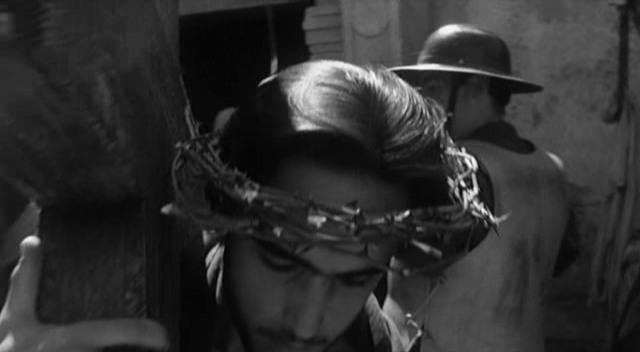
At the very least, one has to give Pasolini credit for making a story arc as familiar and overplayed as that of Jesus be somewhat gripping and interesting, especially considering the fact that he’s dealing with his entire life. We get the immaculate conception, the crucifixion and everything in between. All the lore of the miracles, the disciples, the unintentional provocation of the world are all photographed in a rather matter of fact manner. There’s an obvious poetry in all of Pasolini’s setups, though. The camera seems to gravitate around all the actors even as others recite extended monologues, all of course coming from the source material. It’s an odd experience, that’s for sure, and like pretty much all of Pasolini’s work, seems like it shouldn’t work at all yet somehow does.

It’s a pretty good idea to at least have some sort of appreciation of Pasolini’s career (in film or elsewhere, which I guess would just be poetry) because his style is so potentially polarizing. He’s been called amateurish and shaky, but to me, that is all part of his charm. Sure, those aren’t the qualities that any filmmaker wants to be defined by, but the “messy” nature of Pasolini’s film career makes his work feel all the more personal. In this case, it is especially important since the story of Jesus seems so impersonal and I don’t mean this as a slight to any religious organizations or religious people. The story concerns the savior of mankind, but Pasolini forms a portrait of a revolutionary that just happens to be the most important one in the history of the world.

I think the single most remarkable aspect of this film is that it essentially tries to create its new language. Sure, the cinema verite approach is not, at least on paper, totally revolutionary, not even in Pasolini’s own oeuvre, but how it’s connected with content that is almost exclusively poetic and/or romantic is sort of brilliant. Sure, there really isn’t a need to focus in on the miraculous nature of Jesus’ life, but when it comes to his extended monologues, which almost bring the film to a screeching halt, those poetic touches do wonders. Sure, a lot of the movie is just people walking around and in all honesty, Pasolini was not nearly as fantastic at photographing landscapes as his fellow countrymen Antonioni, but there is an odd beauty in close-up faux-steadicam shots of people’s faces.
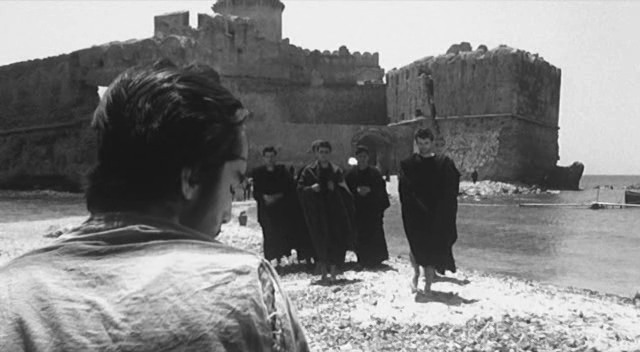
Perhaps there’s a little of Korine here too, which I guess could be enough to turn enough people away, but that’s sort of a fair warning. There’s these odd little sequences that are surreal and sort of grotesque, the leper is one of the first things that comes to mind, but there’s also the spontaneous moments like Jesus’ angry tirade at the expense of a village market. It’s funny, but the movie’s best moments are the ones that seem the least memorable. Somehow, I think that a good representation of the movie as a whole. Sure, you get the big stuff, but it’s Pasolini’s little touches that elevates it beyond being an adaptation.



Morte sospetta di una minorenne (1975)

21 02 2011

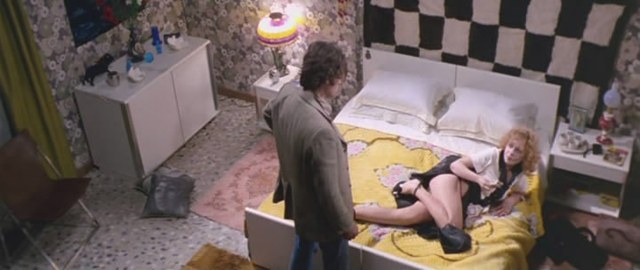
It’s been a very, very long time since I’ve last encountered Sergio Martino. Since then I’ve developed a theory that although he was an extremely skilled filmmaker, he was always held back by his content. This is never more evident than it is here in which he takes a pretty ridiculous story, complete with noir-inspired conventions and terrible music, and dissects it with his otherwise fantastic aesthetic. While it is a bit upsetting to see such obvious talent wasted on the b-film level projects he devoted his career to, I think there’s actually a charm to them. It’s bizarre to see some of the most groundbreaking technical work for the time masked underneath some pretty pedestrian narratives.

I’ll give the story here some credit: it’s pretty confusing at first. It’s not nearly as elliptical as it should be, but the opening is stitched together in a way that immediately separates Martino from most conventional action/horror/whatever other genre you can place this film in directors. Unfortunately, this makes the moment in which the story’s skeleton becomes visible even more laughable. Our protagonist, seemingly out of nowhere, becomes detective Paolo Germi. His intricate (to say the least) plan to discover the killer of a woman he met at a dance hall slowly begins to unfold, along with the help of his comic relief sidekick, Giannino.

Another jarring element, aside from just the general lack of tremendously interesting happening on the screen, is the music which seems like it was written for a silly detective TV show. It’s hard to fully embrace Martino’s brilliant command of montage when it is being overwhelmed by such dreadful music. It’s another case of the film selling itself short: it has this terrible devoted noir detective complex guiding the story, but there seems to be something more in detective Germi. It’s in his eyes in the opening scene at the dance hall, which I guess is to help contribute to the surprise of finding out he is a detective later on. At the point, he becomes merely a chess piece of justice, a hero without any depth but with all the traits that the genre has already ascribed to him. It sounds a lot worse than it is considering the fact that it only takes about fifteen minutes to realize the movie isn’t going to be some significant artistic statement, not even for Martino’s standards. It’s a piece of popcorn entertainment, but its just one that happens to be expertly crafted.


Kynodontas (2009)

2 02 2011

I wish I could go back in time and give this movie to myself about five years ago. Since such technology doesn’t exist, I just have to enjoy this movie as a nostalgic liking for the time whenever I liked “subversive” films the way I once did. There’s a still a lot to like here. It looks beautiful and unravels in this fascinating yet slow way. The problem is that I guess I’ve gone a little soft on such subjects. Yeah, I admire something for being this weird and transgressive and whatnot. But it ultimately comes up on the side of being brutally cold. This works for some people, Bruno Dumont comes to mind. In the case of Lanthimos, though, it just seems a little too much when paired with something that’s pretty miserable to think about in the first place.

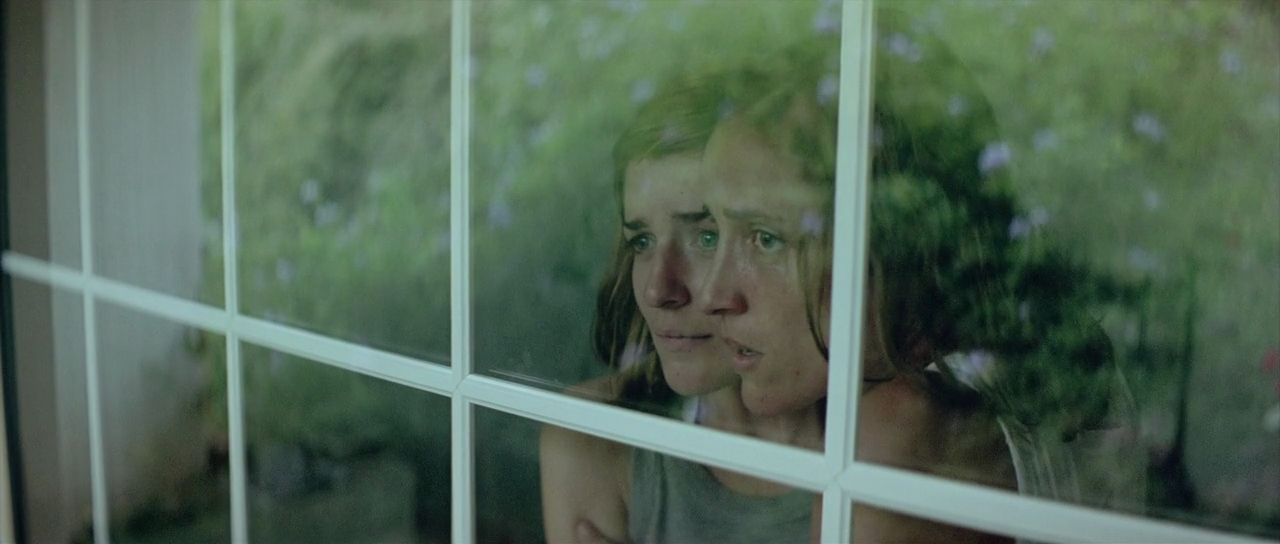
The story concerns a unidentified family. The father is the only working individual in the family of five, the rest are imprisoned in the jail that is the family’s yard. The father tells the children lies of another offspring, whose disobedience led to his death. The outside world has little to no influence on the family until the father resorts to hiring a colleague, Christina, to satisfy the son’s “urges.” Eventually, she becomes a similar tool for the older daughter. Sex creeps into the family’s blood stream, and it starts to tear them apart.

Lanthimos is working with the same cinematic vocabulary as the aforementioned Bruno Dumont and the similarly sterile Michael Haneke and while he gets all the technical stuff right, the extremism displayed in the film’s story threatens to overwhelm all of his other qualities. I don’t mind that the film is frank and disturbing, or even that it manages to be funny within the same scene (a la Todd Solondz, I suppose) but instead that the film’s brute force almost makes it feel a bit didactic. Contrary to one clearly confused Netflix user, this movie is not a cautionary tale about homeschooling. This sounds pretty comical for anyone who has seen the film, and that’s because the message, if it is there, seems like it would be a bit more consequential than parenting, especially since the father is closer to a breeder than he is a parent.

This is probably where the film loses me. Okay, you’re never going to be able to make a subtle or open-minded film about a Josef Fritzl-esque character, but I guess I have to blame it on the subject matter being so displeasing in the first place. I never felt uncomfortable (save the “tooth” scene) but even that wouldn’t be a problem. While I was always fascinated by each character, I found their emotional trajectory to be a little short. So you live in an impossible household, welp, that sure is bad. Maybe emotional relation is at fault here? I don’t feel for the characters anything other than pity. They don’t even seem real, though I guess that is sort of the point.


Ajantrik (1958)

26 01 2011

In an ongoing project to thrust myself back into the life of cinephila, I’ve decided to become completely random with my viewings and dive in head first to uncharted territory. This is some pretty ridiculous rhetoric to start a review, but it explains why I just started with one of Ritwik Ghatak’s most praised works, rather than going in chronological order like I once used to do. Whatever the case, there’s still enough positive things here for me to want to return to his work. Although this isn’t nearly as refined as Satyajit Ray’s earliest work, it is of the same vein, but with its own quirks, some of which become sort of bothersome.

Bimal is fascinated with his car, ney he is absolutely in love with it. While it does provide a mean of income, his relationship with his old Chevy, which he affectionately refers to as Jagaddal, is unhealthy to say the least. Not only does he put hours of work into it, but he also takes the slightest bit of criticism as disrespect. Since the car itself is rather old and not so efficient, nearly all of Bimal’s customers find it humorous. This doesn’t sit well with him, and it contributes to his emotional collapse.

There’s definitely something silly about the story, the fact that it really is about a man and the love for his car. One could argue that movies can’t be compelling without a relationship between two humans. I’d argue it have to be living things (dogs are acceptable, more of these movies are needed for the record) but ultimately, the subject is him and his disconnect with the world. It’s funny, as crazy as Bimal is viewed by the outsiders that come close to him, he would have fit in perfectly with 1950s American car culture. There’s not really that sad, poignant implication of the west’s influence on Indian culture. His infatuation is completely foreign to everyone else in the film’s world.

It’s easy to make a quick comparison to Ray’s earlier (I’m thinking pre-1960s) films, but Ghatak has a slower, less “fly on the wall” style, closer to being an anticipation of that glacier minimalism that is dominating China last time I checked. There’s a lot of nice long, static shots in which we get to observe Bimal and his “shenanigans” in a really objective way. It’s definitely one of the most memorable elements of the movie. Unfortunately, another equally memorable element is the non-diegetic sound that is used to personalize the car. It is  unnecessary and completely intrudes on the film’s earthy, quiet tone. Still, it’s a pretty remarkable movie.


No Such Thing (2001)

25 01 2011

It is getting a little repetitive to proclaim every other Hal Hartley film I see as one of the most profound and moving statements one could put on film, but well, it’s pretty true. This might not be his best effort, but at the very least, one must concede that it is without a doubt, his most polished and most accessible. There’s a lot less dialogue for one and thus, a lot less of that dry delivery that is likely to irk many newcomers to his work. At the same time, the film manages to be just as philosophical (if not more) than his most verbose scripts. It manages to capture the essence of Hartley’s cinematic universe. There’s a lot of “big things” talked about and implied, but it all becomes centralized into something uniquely personal and moving.

The IMDB entry for Sarah Polley is unusually opinionated and states that her face enables many filmmakers to express with her facial muscles and focus less on dialogue. I can’t say this exactly applies for a cinematic disaster like David Cronenberg’s eXistenZ but it does here. The biggest difference between this and every other Hartley film is definitely the amount of talking. It probably helps a great deal that this is the best any Hartley film has looked, but that could be attributed to the DVD’s quality, seeing as how so many of his other films are treated less than satisfactory by American DVD companies. That’s a subject matter for another day and most likely, another blog. This is definitely one of the most visually appealing films in the Hartley catalogue.

As it so often is the case with Hartley’s films, the story while seemingly straightforward enough, has this opaque tone, which fits like a glove in a universe in which philosophy is embedded in the image, rather than implied or read into by overly eager viewers. At first, it seems like a pretty simple satirizing of the news, something better left to works that are grounded more in reality like The Network or Broadcast News. The crux of the film does not lie in criticizing the near cannibalistic nature of sensationalist journalism, but instead in observing its effect on those who it intends to publicize.

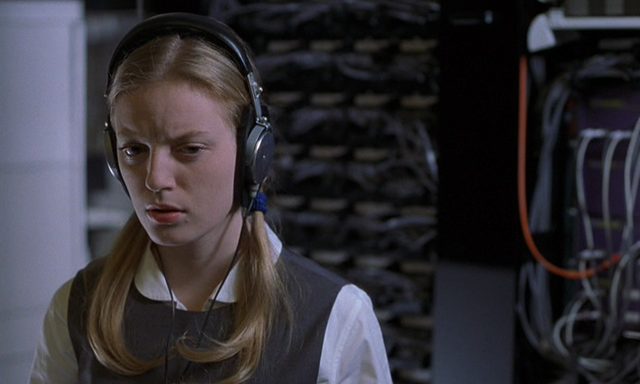
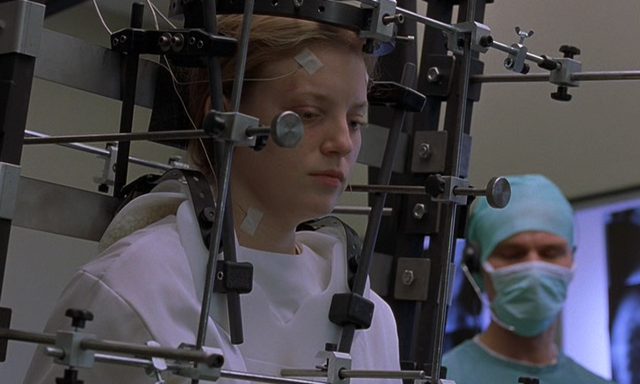
Sarah Polley is so great in this as Beatrice, who acts as the example of said journalism. She has a calm and peaceful demeanor, one that is easy to graft on to her ethereal physical look. Her compassion for not only the film’s monster, but the rest of the world is one that seems to resist any knee-jerk or impulsive response. When she is first introduced to the monster, she is not the slightest bit upset to find out he killed her fiance. She shouldn’t be, obviously, as it was something that had been implied and essentially accepted before she even began her investigation. If there’s anything that makes a film less appealing it is when its characters become motivated by impulses like retribution, it is the sort of reaction that seems so distant from humans with even the slightest bit of understanding in their heart. As this is the case, Hartley’s film will not appeal to everyone, not even all arthouse goers.

This is not to say that I completely mirror or even understand Beatrice’s reactions, but at least they aren’t made to contribute to some conventional narrative arc. If anything, her compassion is overwhelming that it seems to easy blur into the lines of indifference. The way in which her character floats around bares more resemblance to the alienated individuals in the world of Tsai Ming-Liang or Michelangelo Antonioni than Hartley’s usual humanized mouthpieces. I’m not saying this is inherently better, as I have come something of a fan of these mouthpieces, but Beatrice’s conversations seem much more pragmatic than those in any other Hartley films. I suppose this is sort of ironic because the film deals with a monster and surviving a plane crash, but part of me hopes that was intentional. That the film’s fantastical elements gain their legitimacy by the fact that they are downplayed by the filmmaker.

So, as usual with Hartley, there’s a lot to chew on here and I can’t honestly say I’ve come into contact with even a fraction of it, but that sort of what makes people rewatch movies, no? While this is much more reflective (which just means less talking I guess) and has a greater emphasis on visuals (which just means it looks a lot better) it seems to embody everything that makes Hartley’s work so fascinating and that is that it is completely mystifying. Like all the best films, you’ll never get anything resembling an answer, just more questions. That sounds vague and probably pretentious as hell, but the same can be said for Hartley in a way and I don’t seem to mind that in his work.