Anzukko (1958)

27 01 2012

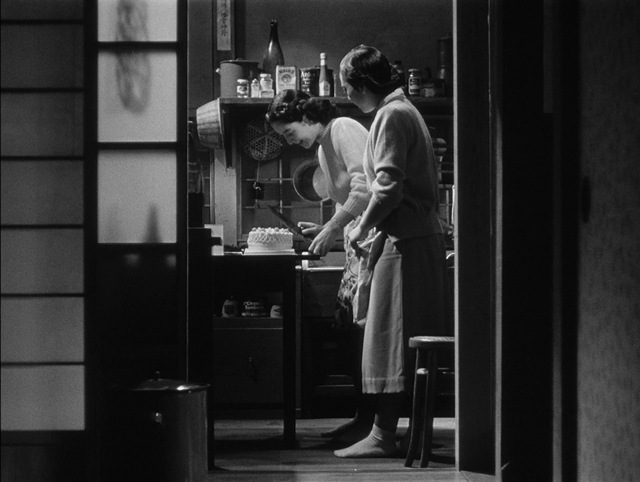
I didn’t realize until afterwards, but I had actually seen this Naruse before. Not only that, but I had written a fair amount about it, which I also don’t remember. My first response to the film seems a little misguided in retrospect since I felt like it was far too upsetting depiction of female obedience, but after watching it again, it seem a bit more complicated than that. If anything, the more dramatic and perhaps sentimental turn from the rest of Naruse’s career is an interesting development for him. The year before he had the extremely feminist and powerful Untamed and he also made Floating Clouds, perhaps his most poetic and romantic film, in 1958 as well.
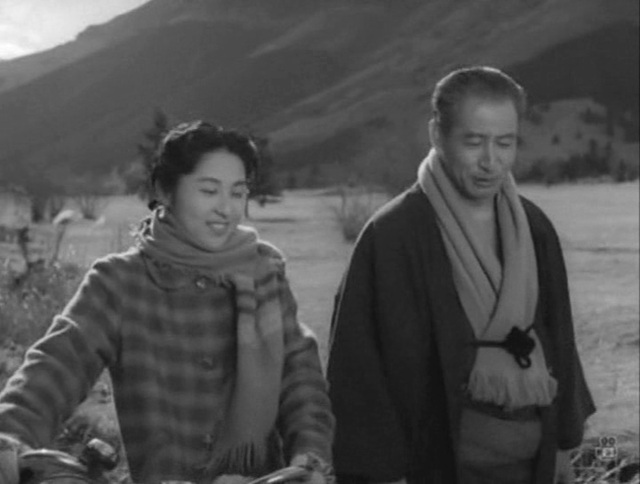
The titular character is played by Kyoko Kagawa, best known for her collaborations with Kurosawa (Mifune’s wife in High and Low) and Mizoguchi (Anju in Sansho the Bailiff) but her relationship with Naruse is just as impressive. Seeing as how this film is a starting point in a “refresher” course for me, I don’t feel comfortable saying this is her biggest role in a Naruse film, but it definitely ranks up there. She plays the daughter of a famous writer, who ends up marrying Ryokichi, an inspiring writer who (at first) secretly loathes her father. Ryokichi is played by Isao Kimura, who is also best known for her collaborations with Kurosawa. As his character becomes more and more unsavory, his performance shifts towards exaggeration. At the film’s end, no one can question that Ryokichi is indeed, a very pathetic character.

In my initial review, I never really got over the fact that such a couple would stay together. As Ryokichi shifts from one temporary job to another, his alcoholism worsens and his hatred for his father-in-law, Heishiro, deepens. Before, I mostly focused on the relationship between the struggling couple but on this particular viewing, it seems less and less important. Although the film is named after her, Anzukko’s actions tends to be just that of a middle man between her husband and her father. There’s something tragic in the fact that a housewife provides all the income for a family and ultimately gets no say in how it is used, but it seemed less of a “deal” this time around.

Perhaps it’s best to not view this movie with Naruse-tinted glasses because if one does, the film is just another relentlessly upsetting story about a woman staying with a man she’s better than. The best drama comes from Ryokichi and Heishiro, though, as the former weighs his own pride over charity, even when he is doing absolutely nothing to help his family from a financial standpoint. Ryokichi might be the least likable character to ever get this type of screen time in a Naruse film. He’s self-destructive, cruel, and unreasonable. His logic of a rivalry between him and his father-in-law stems exclusively during intense sessions of alcoholism. In a way, Naruse has made one of the earliest examples of an “addiction film” and the result is every bit as bleak and unsettling as any modern or “edgy” depiction. Sure, it’s just alcohol but the self-destructive nature of Ryokichi rivals any  character involved with hard drugs.
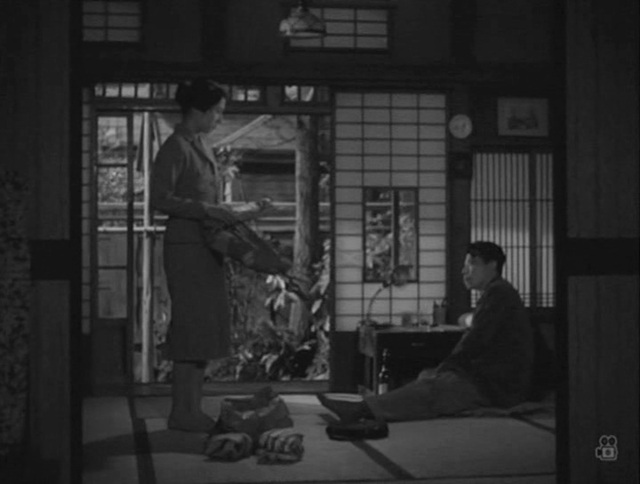
There is still something to be studied about the character of Anzukko. During this viewing, her commitment to her family doesn’t seem as much of a disgusting display of family politics as much as it seems like a complexity. She doesn’t want to lean on the help of her father. He does buy her groceries, but they’re a necessity. One can hardly blame her when she makes all the money and does so without having an actual career. Never is there any love felt between Ryokichi and Anzukko, not even a sense of friendship of respect. It was a marriage of convenience, it seems, but the irony is that it has become a total hassle for Anzukko. The film ends with quiet acceptance, hardly a surprise considering that Naruse seldom went for dramatic shifts in a narrative. It is anything but satisfactory for a character that has put up with so much but receives so little. Where it was frustrating to me on initial viewing, it is now fascinating. Relationships are difficult is nothing new, but the layers of odditity in this particular case make it a subject well worth studying and revisiting.


Le Gamin au vélo (2011)

3 01 2012

In a year where the most acclaimed films seemed like they were constantly trying to be transcendent and spiritual, it’s a joy to be reminded of the beauty that lies in simplicity. Who better to remind us of this than the Dardenne brothers? After all, they haven’t strayed much from their social verite aesthetic that made such a splash in the arthouse market with 1996’s La Promesse. If there’s anything “wrong” about how the Dardennes are making movies, it’s that their mastery is almost repetitive. They make it look too easy on a technical level, almost to the point where their efficiency is boring. It’s not exactly a problem at any point since the stories themselves tend to be engrossing, but their social conscious (so to speak) does sometime overshadow the perfect flow of their visuals.

One could argue that the Dardenne’s way of filming has had a negative impact on film making as a whole. The constantly probing handheld camera has been repeated and translated into the vocabulary of lazier filmmakers in need of capturing a sense of spontaneity in their films. It’s a dumb argument to make, but I mention it because the less talented imitators all share a need to reinforce a sense of reality. Here, though, the reality is probably too frustrating for the audience. There’s no poetic or even “cinematic” interludes that help balance the unflinching wandering eye of the camera’s lens. I’m not naive enough to think that anyone who actually watches this movie is going to be shocked by what unfolds (it’s pretty typical fare for the Dardennes, honestly) but the frustration I am trying to describe is an extension of making a “realist” film. John Cassavetes, who I love, photographed his films similarly but the difference is that his films constantly threw the characters into uncomfortable and dramatic sequences. In other words, there was a reason for the camera’s presence. The difference with the Dardennes is that this is not always true. There’s moments of “dead air” so to speak, perhaps a spark for the countless Bresson comparisons that the brothers still receive.

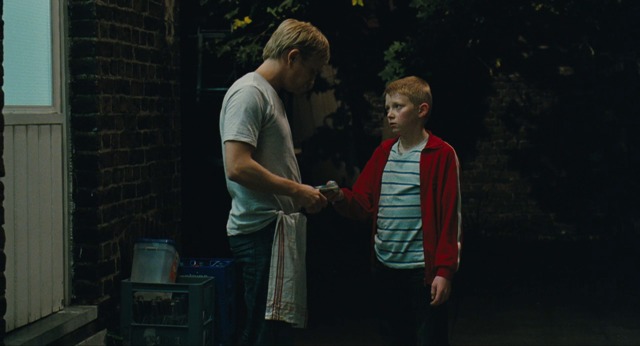
A perfect example of this “dead air” is the completely empty relationship between the child protagonist, Cyril and the local drug dealer. Cyril sees this as an opportunity for male companionship, a category in which he is sorely lacking. His need overwhelms any type of common sense, something that happens frequently in children. He seems to not question the influence of the drug dealer, and quickly finds himself comfortable in his house. The conversations Cyril has with the drug dealer are useless, not even “cute” or clever. It’s awkward and uncomfortable and not in the way that other filmmakers (namely anyone who has ever made a movie about a romantic relationship) capture in a more charming manner. Cyril’s friendships seem to end as quickly as they begin, probably because he is (literally) always on the move.

This is the perfect contrast (perhaps too perfect, if we’re going to nitpick) to Cyril’s maternal figure, Samantha, who adopts him following Cyril’s escape from school and subsequent quest to find his dad. He is resistant to Samantha, and denies her basic human compassion, at least at first. She cares for him way too much and he doesn’t care, perhaps because she’s a woman or perhaps because he’s scared, but probably because of both. The film’s conclusion does not fit into the simplistic mold of someone being the perfect mother figure. It is modeled after the belief that Samantha and Cyril can sustain a more normal life, but it’s at the cost of a child knowing that his father willfully neglected him and unofficially disowned him.

The movie concludes with Cyril sustaining a concussion, getting up, and walking away from the camera. The action is a relief, at first, as we realize he is not dead but it’s a red herring. Cyril is still living with Samantha and he’s still going to be a brat to her, even if there is a hint at the “turning a new leaf” theme. More importantly, the admiration, nay attention of his father is something Cyril will never be able to achieve. In other words, it’s a movie that is hopeless but not draining. There’s a life for Cyril and Samantha still, but it’s not ideal, and their family dynamic is built around the collapse of a real family dynamic.


Nightfall (1957)

7 11 2011

I really, really want to love Jacques Tourneur, but outside of a few especially impressive efforts (the generally unheralded Wichita and the over-studied Cat People) he really just strikes me as a pretty middle of the road genre Hollywood director that has a few moments where he does something interesting. It seems that his whole visual sensibility is limited to big shadows, which is kind of the laziest trick for an action director of the time whose trying to make something deeper. It looks nice here and in Out of the Past, but it kind of perfectly compliments the simplistic storytelling. Tourneur is very fascinating and he did many things with the camera that should be acknowledged, but it seems that more often than not, film snobs are willing to overlook cliches and conventions for a few moments of “pure cinema.”

The setup  itself works, despite the fact that it’s dragged down by the fact that it just chooses specific elements that were popular “noir” motifs at the time. Some nobody guy gets mixed up with legitimate thugs through a completely bizarre one in a lifetime situation. He’s in over his head because these professionals are after him. Additionally, the police are after. Everyone is against him, except for a girl, of course! My cynicism towards this type of story isn’t a condemnation of the film’s narrative itself, but rather a reflection on the limitations that someone unique as Tourneur was trapped inside.

There’s at least two or three instances in which I had to stop the movie to make sure I hadn’t seen it before, which I guess isn’t too much of a surprise. The argument is generally that these type of films are exercises in style and aren’t meant to be complicated narratives. In that regard, I see eye to eye with this film, but it doesn’t have anything interesting to chew on outside of Aldo Ray’s hoarse voice making him seem more interesting.His character is likable enough, but the problem comes in these movies when they really try to force the martyr element down one’s throat. He’s wrongly accused, he’s in a pickle, he just got back from the war. In a world where something shady is supposedly always going on, why does a film like this restrict its protagonist from doing anything bad? He has a “bad past” is the extent of his backstory and while I don’t mind when writers leave their character’s background open-ended, it seems more like lazy writing as opposed to attempt at being opaque.

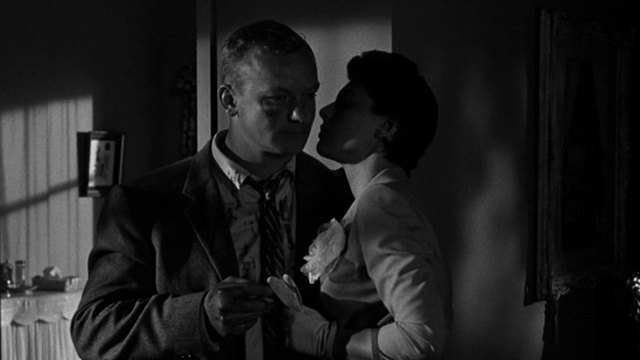
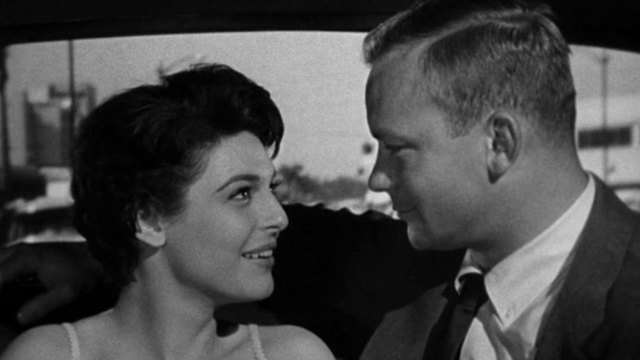
Tourneur does bring out some genuine suspense in his picture and it really does look nice. It seems that his style benefits greatly from the widerscreen, since I always thought something in which the shots were manufactured so deliberately should be seen without the limiting academy ratio. Aldo Ray is actually decent enough, and he’s fun to watch with Anne Bancroft, though their romantic connection seems to have been missing about three or four scenes. I don’t mind the direct and “short” nature of Tourneur’s work (it’s actually one of his best attributes) but to believe these two fall so hopelessly in love so quickly is bizarre, especially since Ray is ultimately kidnapping Bancroft. I guess this is where some would give the film points for being transgressive or even surreal, but when such an element in rolled within the confines of traditional storytelling, it really isn’t that groundbreaking. Instead, it’s another instance of lazy writing. It’s not nearly as lazy as the film’s insistence on using a voiceover that literally describes everything that is happening in the voiceover, but it really isn’t much better.

In the end, it’s actually easy enough to overlook the film’s faults, though there are many and although I seem to be focusing almost exclusively on them. It’s a solid genre film, which clocks in under 90 minutes as it should, not  unlike the way a good pop song should (generally) clock in under 3 minutes. Unfortunately, it never really decides if it wants to be open-ended and fractured (which would have been great) or tightly and completely constructed. Not a masterpiece, but not a full on face-plant, either. I’d argue Tourneur wasn’t capable of the latter.


Moy drug Ivan Lapshin (1984)

4 10 2011

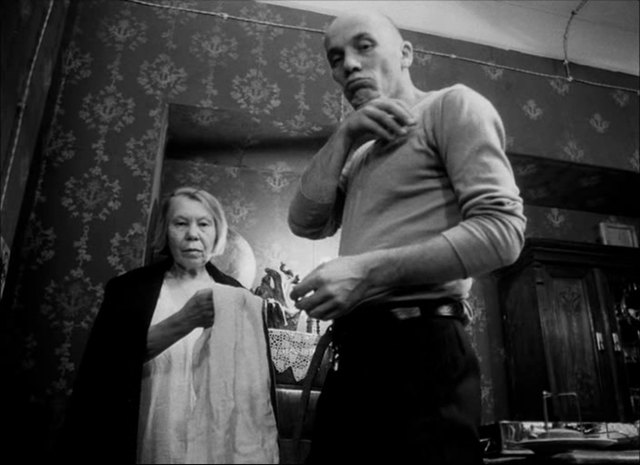
One can’t help but wonder if Bela Tarr, who was currently in the transitional part of his career during this film’s release, was aware of this. It has hints of his fingerprints on it, but to me, it’s something of an improvement. If there was some sort of middle ground between Alexander Kluge’s filmography and Tarkovsky’s Zerkalo, this would be it. The entire experience feels a little inconsequential, perhaps because I can’t fully understand the circumstances facing impoverished Russian villages during the 1930s, I can certainly admire the film from a purely technical standpoint as well as for its attempt to infuse memory into something rather episodic.

I don’t want to get too far into singing this movie’s praises without mentioning that for all intents and purposes, this movie ultimately doesn’t succeed in being a nostalgic recollection of vignettes, but really just a nice slice of life story that is beautifully photographed and has elements of memory kind of tacked on after the fact. The detachment German shows for the film’s narrator (and presumably, the protagonist on some level) makes his words out to be more of a frame story than a poetic meditation. As is the case, the narration tends to interrupt the flow of the images. Although it is not the type of flow that is so crucial in the aforementioned works of Tarr and Tarkovsky, the film’s wandering steadicam does seem to create a rhythm, a form of breathing almost, all on its own.

As evident as Tarkovsky’s influence is, it does not dominate the film in any manner. The shots are long and composed with the type of bizarre beauty that evokes Stalker in addition to Zerkalo, but German is working under different circumstances. The shots seem to be compiled almost at will – like through an innate desire on the part of the filmmaker to capture every moment in the closest possible way. At least this is the case when there’s a lot of walking to be done and truthfully, there really is a lot of walking here. Perhaps that’s the most overt connection to Tarr, the amount of walking, which seems trivial if not comical at first, but there’s something to be said for filmmakers who capture the single activity that is most frequently edited out of movies.

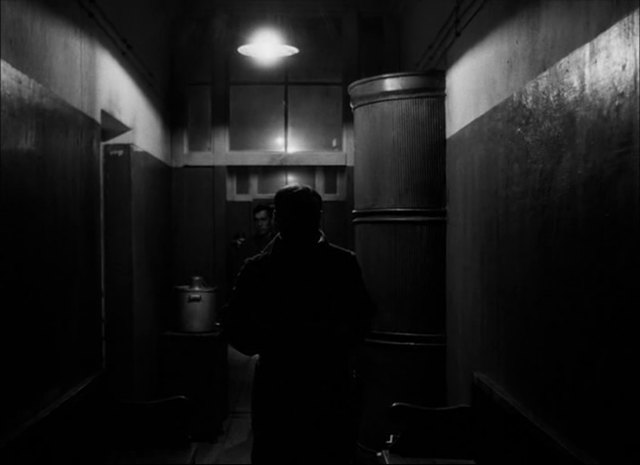
It is not my intent to downplay German’s unique cinematic vision by throwing comparisons on top of comparisons, but the small town “community/family” motif of Ozu’s work is echoed in both content and visuals. There are several (fairly) static shots down long corridors that lead to a collection of men proceeding to get intoxicated. It’s perhaps a bit too easy of a way to build comradery, but there is an inherent connection I get from seeing people photographed intoxicated, especially the way it is done here. The overall message of the film is debatable and probably lost on someone who is a little iffy on the politics, but personally, it seems to embody the importance of family – be it natural or forced.


Bakushû (1951)

3 08 2011

I’m violating my self-imposed rules of not talking about rewatches, but I never had a post written about this film before and I feel like my feelings about it are a bit more assured now that I’ve seen it again in a better situation. My first viewing was in the middle of a storm of Ozu watching. In retrospect, I feel that kind of tainted my appreciation of this one because it was being sandwiched in between his other movies at a rate that isn’t fair to any director, not even my personal favorite. With that, and the fact that the BFI blu-ray/DVD combo package had been collecting dusts for months now, I decided to revisit this one with a clear mind. I’m glad I did as it reinforces everything I believe about Ozu, that he had a knack for not only exposing the human condition, but the intricate subtleties of human interaction.

The story here is not entirely important, because there is very little of one. A family is trying to marry off their daughter. It’s pretty textbook Ozu, but it’s not really a problem. It’s not a criticism of him in any fashion, but I can see how it may become somewhat tiresome when his films overlap so much. This might have contributed to my reasons for rewatching and rewriting a review as well. As great as Ozu is, it’s not entirely difficult to confuse moments from one of his films with a different movie. It’s worth mentioning, though, that this film in particular its own signature moments. For example, the bratty child (sound familiar Ozu fans?) kicking a loaf of bread around in anger, the conversation Noriko and Aya have with their married peers, as well as the conversation they have entirely in a farmer’s dialect.

For someone whose films are suppose to be about what is being built up to, Ozu has always managed to capture truly impressive and distinct, yet fleeting moments of humor. For some, it might be too good-nature and “nice” but his films are ones that always avoid the trapping of trying to do too much emotionally. Yet it might come as a surprise that his films tend to be more moving than Big Important Art Filmswith “deep” messages.

I didn’t intend for this review to be a case study in Ozu’s superiority over other art filmmakers as that would be both unreadable and useless. Instead, it’s just the experience of revisiting him that has struck me, and rather bluntly I might add. It’s the sort of thing that I think has gotten lost in the past few years of my film-viewing as I’ve tried to make my interest more academic, with the hope of a chance at making a career out of writing. I don’t want to get too introspective, but it’s seeing a movie like this one that kind of puts me back in my place and makes me realize that films, ney all art will never truly be academic, at least not in a certain sense. The experience of Ozu is something that, when putting into words, seems like a backwards exercise. It would take longer to explain his brilliance than it would to just experience it. I’ve been trying for at least five years to find a way to describe these experiences and I feel none the wiser.

Okay, that’s a lot of rhetoric to digest and honestly, it even irks me just looking at it but it is the realization I came to when watching Early Summer for a third time. There is a beautiful depth to Ozu’s work that makes it not only ask for repeated viewings, but instead thrives off of them. The more you watch one of his films, the more there is to discover. Proclaiming Ozu as “subtle” and “nuanced” is an old-hat and probably downplays his other virtues, such as the cinematography, which always astonishes me and the music, which should be hokey, but somehow works as a wistful undercurrent to the pillow-shots. On the other hand, there really is so much to chew on here that it can’t be tackled in one viewing. Before I get anymore mushy about Ozu I’ll leave it at this: the film’s final shot is one of the finest of all-time and a perfect conclusion to this funny-sad masterpiece.