Katzelmacher (1969)

7 05 2020

When I was in grad school five years ago, one could easily earn quick brownie points with a professor by saying something like “the personal is political” or “love is a political act.” There’s nothing especially untrue about either of these statements, but the fact that they regurgitate tenants of second wave feminism should have led to more skepticism. I’ve thought about the popularity in such phrases since diving back into the work of Rainer Werner Fassbinder. Someone could callously open an essay about the filmmaker with such a vague and overwrought maxim, but they would be doing a great disservice to the filmmaker. In Fassbinder’s world, politics do not serve as the foundation to a readable moral center. Instead, our political climate shapes and informs our own understanding of the world and our actions. This, to me, is a far more accurate depiction of reality. Such as sensation is hard to achieve, and it requires an extremely attentive viewer. Fassbinder achieves it in Katzelmacher.

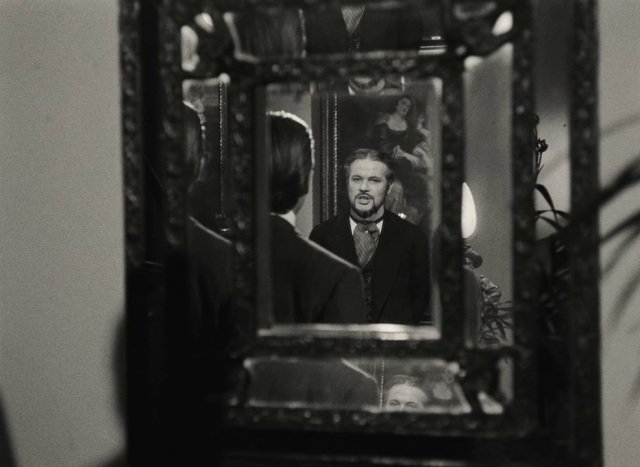
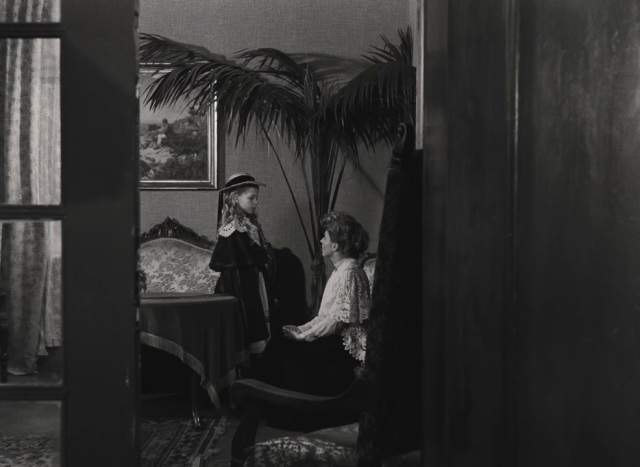
Erich and Marie are lovers, but they seem bounded more by convenience than by enthusiasm. The couple lingers in the promenade of their apartment complex. They are joined by an equally inert cast of neighbors including the gossip prone Dunda, an even more apathetic non-couple in Helga and Paul, and Franz. Franz splits his time between the group and visiting Rosy, a sex worker with aspirations of celebrity. Franz may or may not be in love with Rosy, but he still has to pay for her affections. The group’s silence is punctuated by pints and cigarettes, and only ever interrupted to gossip about their neighbor Elizabeth who rents a room to Peter, her frustrated former lover. Greek immigrant Yorgos arrives with little to no command of the German language. He gives the group a new conversation piece.

I have always thought fondly of this early Fassbinder. My memory of it was basically “mean-spirited Ozu.” It is a domestic drama, character-driven, mostly static, and shot in the academy ratio. I’ll add that they both lived lives of debauchery and solitude towards the end of their careers and then end the comparison there because there is little to no evidence that Ozu’s work ever crossed Fassbinder’s purview. Instead, the likely inspiration is Straub-Huillet whose influence was perhaps a bit more pronounced in Fassbinder’s previous film and debut Love is Colder than Death. The evolution from that film to this one is fascinating. Both are ice cold, but he trims even more fat here.
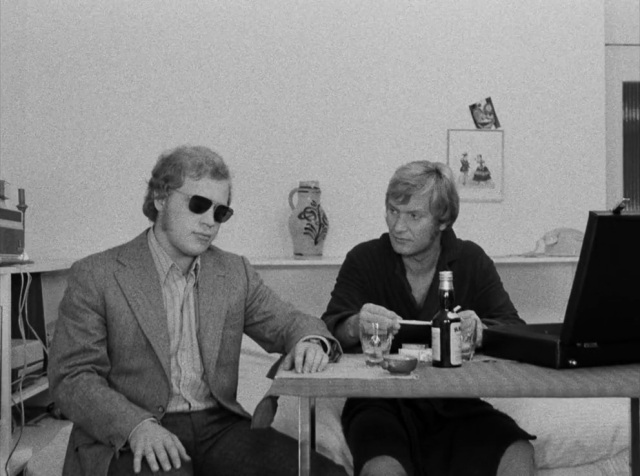
Love is Colder than Death is, to me anyway, a better-looking film than Katzelmacher. It’s a very gut level reaction but I think the earlier film’s wider canvas works better with this grainy, black-and-white DNA. Fassbinder often presents “unbalanced” long shots in the first film. A shot will start with a character on the edge of the frame, as if they’re about to be squeezed out by the imposingly white backdrop. The 1.78:1 aspect ratio offers them some mobility, of which is often taken advantage. As much as people like to chop up Fassbinder’s career into section, I think such lovely compositions serve as the foundation for the much more complex and stunning sequences in works like The Third Generation and In a Year of 13 Moons, which would provide inspiration for Tsai Ming-Liang’s uniquely austere efforts. He had to walk before he could run, and Love is Colder than Death is the more technically compelling film.

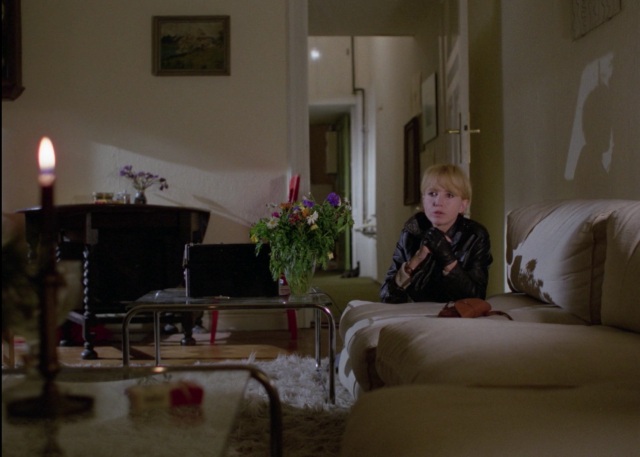
The canvas shrinks in Katzelmacher and the characters have little to no mobility. Most sequences resemble static tableaus. When our group of characters meet up in the parking lot of their apartment complex, they are positioned side-to-side and look head-on at the camera, as if posing for a photograph. The work of Terrence Davies is an instructive comparison, but as his subjects are wont to sing or bicker, Fassbinder’s crew lingers in oppressively apathetic silence. For many, this is a demanding exercise. Disconnect a sequence from this film from the entire experience and it will seem preposterous, but Fassbinder is expertly building something here. The slow rhythm gives way to one of the film’s greatest moments: Yorgos’ arrival. Prior to his arrival, the group acceptance of conversational dead air is rivaled only by their thirst for alcohol. Conversational inquiries sometimes take as long as 30 seconds to receive their return volley and when they do it’s something remarkably vapid. Yet, when they first meet Yorgos, their patience crumbles instantly. Their questions sharpen to interrogation and Yorgos’ inability to respond is met with irritation instead of sympathetic patience. Fassbinder’s formal strategy pays off in offering a moment that is both ugly (as it hints at the underlying xenophobia that bubbles to the surface) and deeply humorous. Such sensations would clash much more awkwardly in the hands of anyone else, but their bizarre harmony here offer Fassbinder’s unique and special ability to depict the ever-contradictory nature of the world.

Unfortunately, such moments offer less attentive viewers the justification to label Fassbinder as mean-spirited. Hell, I had done so myself in the past. I can maybe accept describing him as a cynic, but anything more negative suggests the viewer has lost the plot entirely. While some marvel at Fassbinder’s most popular work Ali: Fears Eat the Soul for its uncharacteristic warmth, it suggests to me that they were never that attentive as viewers. I understand such a claim, but that film is not particularly different than the rest of the filmmaker’s world. To Fassbinder, we are grounded and informed by the conditions of our reality. As it is, he seldom presents us with someone without faults. But even those “moral faults” are part of our conditions. The apathetic tenants of Katzelmacher are not the architects of xenophobia, but they do exist in the world where it exists and this, they participate in it. They do so in varying degrees, but no one is ever innocent. Dunda spreads gossip about Yorgos, Marie falls in love with him, and the men in the group ambush him in violence. This “climatic” scene is followed by a private conversation between Elizabeth and Peter. She scolds him but she does not mouth a moralistic correction, but instead vocalizes the more realistic response: quiet tolerance of society’s most deeply ingrained prejudices. “You didn’t have to help him, but you could have just walked away.”



Die dritte Generation / The Third Generation (1979)

4 05 2020

There is a critical premium often placed on works of art that manage to “capture what life is like in the present.” The truth is, our present reality is often elusive. Literature and cinema that gets praised for this accomplishment often boils down our present conditions to a dramatically relevant narrative. Fiction that is intentionally and specifically bound to the time of its creation lacks the chaos and illusiveness. To me, The Third Generation is not only one of Fassbinder’s greatest achievements but is also a film that speaks to both its present (1979) and ours. It is this way because it is stubbornly non-specific. It is a film in flux. Its characters grasp at multiple identities but fail to grasp any. The narrative shifts incomprehensibly and wildly. This over-stimulation of information in The Third Generation is its greatest strength, though. It pounds us into submission, stumbling upon a sensation that is far too familiar.

“Terrorism was invented by capitalism to justify better defense measures for capitalism.” So begins The Third Generation as industrialist Peter Lutz looks out at a snowy West Germany from his high-rise office. Bresson’s The Devil, Probably, a film about politically apathetic youth, plays on a television and offers a temporary distraction for him. His secretary, Susanne Gast, remarks that the film is so sad. He retorts, “As long as the movie is sad, our lives can be happy.” Over the phone, Susanne sets a political plot into action by quoting Schopenhauer, “The world as will and representation.” This message gets relayed to the other members of the cell that includes her husband Edgar, schoolteacher Hilde, the organization’s leader, August, as well as a married couple in Petra and Hans. The group hunkers down in their hideout, an apartment inhabited by heroin addict Ilsa, who is later joined by a former lover, Franz.

The group, we discover, lacks a cohesive plan, not to mention a guiding political purpose. It would not be inaccurate to describe all of them as 30 something bourgeoise leftists. Unlike the characters in Bresson’s The Devil, Probably they are not lacking in urgency, but in ideology. This sounds absurd on paper, but Fassbinder made a career out of obfuscating details in his characters. Their lack of politics is not a cynical strike at a generation, but instead a clever depiction of its inconsistencies. There are no political good guys in The Third Generation because such a didactic approach would completely go against the grain of the overstimulated world that has been built. Some critics have correctly identified the film’s resemblance to Godard, but Fassbinder’s distance is directly opposed to Godard’s impassioned didacticism. Fassbinder has much to say here, but he never speaks in absolutes. An audience intent on finding the “point” here is already doomed to miss it, perhaps there isn’t one at all.

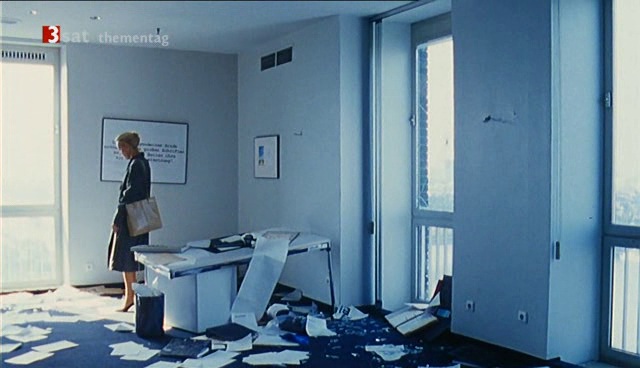
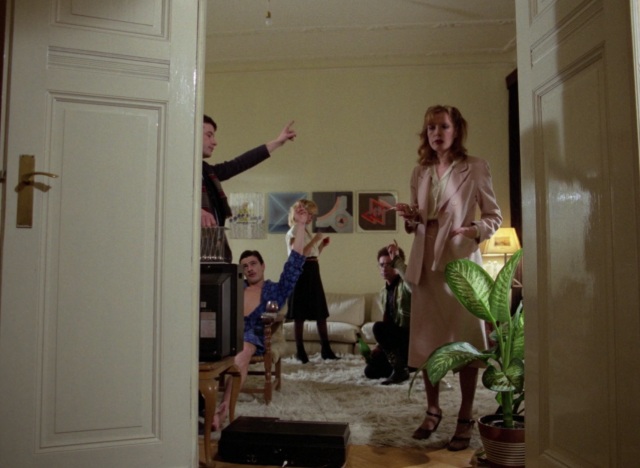
The many moral contradictions posed in the film is reflected in the film’s style. The terrorist cell’s apartment hideout acts as the perfect set for the camera’s choreography. It is often static and depicts drawn out hallways whose corridors layer the composition. Throughout the film, there is always more than one thing going on. Multiple conversations become intertangled in each other as the anodyne hum of a television or radio continues on unabated. The individuals in the terrorist cell are constantly stimulated. They interact with the media, with art, with each other, but their inability to detach from this steam has not made them energetic, but inert. They are disoriented by this landscape, and this disorientation is reflected in their inability to understand themselves.

A lot of what I’ve described about the film feels vague and imprecise, perhaps an inevitable side effect of analyzing a film that functions through characters with opaque motivations. This tends to be the case with Fassbinder, but he ramps this sensation up a notch in this film because it is specifically concerned with capturing the dizzyingly imprecise experience that is modern life. The overstimulation works for me, brilliantly, but it is easy to see someone overwhelmed and frustrated by a film that lacks not only a “plot” but any political conviction. The apathy does not obscure its ideology, but instead interrogates the idea that one ever be necessary to begin with. Fassbinder might be as numb as his subjects, which is why he observes, but provides no insight on where he’d place them morally. As disoriented and confused as the terrorists are, he is no better than them. And, of course, neither are we.


Effi Briest (1974)

2 05 2020

Theory is, at its core, a practice this requires citation. It would be exceedingly difficult in 2020 to write an essay without referencing a past work. It’s like thinking of a new number or color. It is necessary to quote. Among the many celebrated figures in the Frankfurt School, Walter Benjamin was especially remembered for his quoting. He equated his database of quotes to a collection, and he speaks of such a collection with a tacit understanding of its absurdity. Many would consider cinema’s equal to be Jean-Luc Godard. After all, his aesthetic is often shaped by the interjection of quotes. Although often lacking attribution, such quotations (be they intertitles or voiceover) work as cinematic footnotes to the image, rather than simply reinforcing or re-describing it. Fassbinder’s earliest films bear traces of Godard’s influence, but as his career progressed into the middle part of the seventies, Douglas Sirk took over as the guiding influence. The melodramatic conceit in Effi Briest reflects this shift but quoting informs the aesthetics. It is a film made entirely “in quotes” distanced from the source material. It is beautiful and compelling, but also maddening.

A teenage Effi Briest accepts a marriage proposal from the older and wealthier Baron Geert Von Instetten. Upon moving into his mansion in a secluded town she is immediately confronted with a sense of loneliness. The moments of social interaction she is treated to is anything but stimulating as the Baron’s social circle consists of individuals who find her primitive and uninteresting. She instead finds comfort in the companionship of Major Crampas, who is much closer to her in age than her husband. This infuriates the Baron who expects complete devotion from Effi and sees Crampas as little more than an opportunistic Lothario.

Much of what happens in Effi Briest can be described as “melodramatic.” The tension in the film itself is the fact that we don’t see much of the stuff that does happen. Fassbinder is (intentionally) at odds with “the text” of the film. The excitement that could come from such a narrative is stifled, artfully underlying the literal restriction placed on Effi herself. In a sense, she is given everything materially. She has the Baron’s wealth, access to his servants, and his unwieldy estate. Yet, she also lacks any personal mobility. Her predicament informs Fassbinder’s construction of the film. His compositions are exquisite, but he refuses to give us any of the juice in the narrative’s drama.

I should emphasize that I greatly admire what Fassbinder does here. Two of my favorite filmmakers ever, Mikio Naruse and Yasujiro Ozu, did something extremely similar. At the risk of reducing the complexity of their work, I would also say that their films were also driven by characters. There is, of course, theoretical undercurrents in all of their work (if you want an elucidation on this, I’ve written considerably about both filmmakers on this website) but it situates itself differently than it does here. It pains me to say this and I know I undoubtedly sound like a rube in doing so, but Effi Briest is simply too stiff. When Fassbinder withholds the drama in say, Love is Colder than Death, it works. In that film, I am profoundly moved when he deprives us of the sensations one expects in a crime drama. When he attempts something similar with a period melodrama, though, it feels too much like the stuffy chamber piece that is the foundation for the abstraction.

As it stands, I find myself more fascinated by this particular experiment than anything else. I can even go back to the certain sequences and pinpoint their brilliance. Effi’s frustration with the Baron’s social circle gets expressed not in Fassbinder’s perfect compositions but in a brilliant and descriptive inter-title that follows: “An artifice inspired to calculate fear.” The stuffiness of upper crust society paradoxically describes the film’s own aesthetic aspirations. There are endless films that quote from a literary source, but there are very few that use a quote to actually inform the film’s actual syntax. Fassbinder’s absurd productivity suggests that he treated each film as a new experiment. Many of these experiments work for me, and I can’t even fault the ones that don’t. They offer something new and fascinating even as they fail to stimulate. Watching Effi Briest is a frustrating experience, yet it is entirely unique one as well. It reflects the genius of its filmmaker.


Die Ehe der Maria Braun / The Marriage of Maria Braun (1979)

30 04 2020

Roughly ten years ago I sat down to watch The Marriage of Maria Braun. It was my first experience with Rainer Werner Fassbinder. I trust very little of myself from ten years ago, but I knew I appreciated the film on some level. If I had to guess, my 18-year-old cinephile self probably liked that Fassbinder used a Steadicam and I probably also thought that Hanna Schygulla was pretty. In a way, I wasn’t wrong, but I was hilariously underprepared to fully comprehend Fassbinder. As one of his biggest International hits, Maria Braun is a popular entry point but as such it often gets decontextualized from its own author. This was Fassbinder’s 19th film in ten years (one can juke these stats by including Fassbinder’s many television productions made during the timespan) and he had evolved substantial. While I resist the rigid way his “eras” are sometimes catalogued, there’s something to be said in the fact that this film managers to synthesize his admiration for his two heroes, Bertolt Brecht and Douglas Sirk.

Towards the end of the Second World War, Maria marries a soldier, Hermann Braun. Unfortunately, the war isn’t over, and the ceremony takes place amidst an allied bombing raid. Days later, Hermann is declared dead. With little to no economic prospects, Maria becomes a hostess at a bar popular with American soldiers. Hermann is actually alive, and he walks in on Maria entertaining one of her patrons, Bill. In the ensuing struggle, Bill is murdered by Maria but Hermann takes the blame with the expectation that Maria will wait for his release. She finds work as an assistant for the wealthy Karl Oswald, and then graduates to his mistress with the hope that she’ll be able to provide for both herself and Hermann upon his release.

In Fassbinder’s robust filmography, The Marriage of Maria Braun is second only to Ali: Fears Eat the Soul in terms of popularity. Personally, I have never fully clicked with Ali. It’s one of those films that I should like more than I actually do. I think it has something to do with the fact that it is by far Fassbinder’s most tender and gentle work. He is often described as cynical, if not mean-spirited, and that film feels like a conscious reaction towards such criticism. In a way, it’s just too precious. To me, Maria Braun strikes a better balance. Fassbinder’s humor is still intact, and the characters needn’t spiral down the rabbit hole of melodramatic misery. The most striking thing about Maria’s suffering is that it isn’t dramatically apparent. Her pain is much duller than the kind depicted in Ali. Punctuated by Schygulla’s charisma, it cuts deeper and burns slower.

The film’s opening immediately displays this sort of balance. One can find countless plot descriptions across the internet that say something along the lines of “Maria gets married amidst the war” but this is an extremely literal description. There’s a staccato brilliance to this opening, one that calls back to Fassbinder’s start as a filmmaker. The Berlin Film School deferred him in 1966, which forced him to reroute through Munich’s Action Theater. He became fascinated with Bertolt Brecht and incorporated his ideas into his stage plays. The earliest Fassbinder films reflect this fascination as well as the theatrical background. The compositions in his first feature film, Love is Colder than Death, are static long shots. We tend to see the entire bodies of his characters and they speak out of the rhythm. A dismissive audience would describe them “as not acting like real people.” For many, this is difficult, but to me it is an accessible source of humor. On the surface, Maria Braun is completely unlike this, “the characters act like real people.”

This is an incorrect assessment. In both instances, Fassbinder is challenging the conventional dramatic demand for empathy. In a way, his withholding of any “identification” is a tease. It retrains us. This works wonderfully for Maria because she never keeps up a moral standard. We don’t look up to her, or admire her, and we shouldn’t do those things in film. Sure, she preservers, but she also manipulates and is ill-tempered. She’s not “good” and she’s not “bad.” Fassbinder played with empathy throughout his career. It’s obvious in his earliest Brechtian features, but he’s also doing it in his melodramas, where both the performances and misfortunes are extended to absurdity. Again, the balance is perfected in Maria Braun, Brecht and Sirk are both present. As it is, the surface often resembles a handsome and accessible entry point into Fassbinder’s world. Revisiting Maria Braun after seeing his stranger and thornier efforts is nourishing because of its similarities to those films, not the differences.


Die Beischlafdiebin / The Sex Thief (1998)

27 04 2020

After the rare misfire in Cuba Libre, Petzold is back on track with his usual concerns in The Sex Thief. In all honesty, this feels like his own personal attempt at refining what he accomplished in his debut, Pilots. The story is remarkably similar: two women fighting back against an exploitative labor relationship, framed through the ever-watchful eye of state surveillance. In that earlier film, Petzold’s brevity made his story hit harder. Here, I guess his characters are fleshed out, but I’m not sure that’s exactly a good thing for a Petzold film. As it stands, I think he runs out of steam early. In a way, it makes sense that he had to make Cuba Libre and this after Pilots before he could achieve The State I Am In. Somewhere during this made for television period he found a way to let his camera linger in a way that artfully plays up the tensions in personal relationships without making them resolutely clear. As it is, he is still working through some aesthetic growing pains in this film.

The film opens with our protagonist, Petra, in the embrace of who we presume to be her lover. A bucket of water is quickly thrown on this fire when Petzold cuts directly to Petra robbing this man in his sleep. This, we soon learn, is her profession. Petra makes her money by seducing, drugging, and robbing men. To her, the cause is noble, as she is doing this to finance the education of her younger sister, Franziska. After a close call with a undercover cop, Petra gives herself a break and visits Franziska. She keeps her profession a secret from her sister, telling her that she’s a successful manager. The sisters are telling lies to each other, as Franziska is not furthering her education but working in retail. Upon this discovery, Petra makes it her mission to assist Franziska in finding a job that fits her credentials.

There’s a somewhat recent interview with Petzold in which he is asked about the “transient spaces” depicted throughout his work. He responds by relaying a description of an extended stay in London’s Heathrow Airport. To quote him, “this is a shit place in the world, but it’s filled with images of waterfalls and beautiful women and advertising for wellness. Yet nothing is happening—you’re dying there. Capitalism makes all of the world the same. It tells you that just around the corner there’s an adventure, but there’s nothing.” It’s a telling description because Petzold often perfects this “airport feeling.” In The Sex Thief, Petra spends all of her time in hotels, which she uses as her justification for visiting her sister’s loft. “I work for hotels, I live in hotels, I eat in hotels. I wanted to be somewhere far away from that.” What she seeks is a lifestyle rooted, a routine, and a foundation. She tries to accomplish this with her sister, helping her acquire stable employment, but she helps her by using what she knows, which yields little success.

Petra’s coaching of her sister is sensual and precise, and Petzold’s depiction of it is something that manages to channel both De Palma’s lasciviousness and the otherworldly detachment of late Bresson. I’ve never considered either of these filmmakers in analyzing Petzold but I find it informative, if one applies the comparison with some caution. Bresson is perhaps the urtext to a certain kind of Western European Minimalism of which Petzold, at least in his early days, is undoubtedly a disciple. Meanwhile his fondness for Hitchcock is well-documented, and he does participate in the sort of narrative slight-of-hand that informs all of De Palma’s work. This is the Petzold film that is most specifically about eros, yet it also feels the least sensual of all his work. Perhaps it is that incomparable tension that he slowly builds that can make a film like Gespenster feel uncomfortable and sexy at the same time. Here, romance is a labor-performance, stripped (pardon the pun) of its nervous (and exciting) energies. It’s a cynical view, but it isn’t unearned.

Unfortunately, the cynicism of The Sex Thief isn’t balanced by the humor like it is in Pilots. Fittingly, there’s a laborious sensation felt in watching a film that, despite its many insights offered by a brilliant filmmaker who is just beginning to come into his own, is something of a retread of an earlier film. It’s a form of homework I don’t mind completing mind you, and there are moments of unique brilliance. When Franziska goes in for a job interview, the back and forth between her and her potential employer is filmed. Her seduction doesn’t work, which makes Petra seek the interviewer out. She seduces him and takes him back to his apartment, where he is all too eager to show her footage of the day’s interviews. There, he pinpoints the errors in Franziska’s seduction. The sequence quickly synthesizes Petzold’s chief interests, which are made literal. It’s an austerely observed sequence of labor, sex, and surveillance all interacting at once. One can’t fault him for being too on the nose in this film, because it feels like a necessary exercise on the way to making The State I Am In, his masterpiece.