Nobody Walks (2012)

11 02 2013

I’ve tried to stay on the optimistic side of things with Lena Dunham, while obviously acknowledging her inherent flaws as a writer, there’s something that makes both her debut feature, Tiny Furniture and her television show, Girls, very easy to watch even as the actual works might not be all that profound. At the risk of using a film critic cliche, her work is very watchable, but this is not the case for this film, for which she penned the script. I’ll give her credit for trying something serious but her script’s biggest problem might be that characters, none of which are terribly interesting, are all fueled by desires to have sex with people they shouldn’t. It sounds sexy, I guess, but it’s ultimately just a boring film.

1

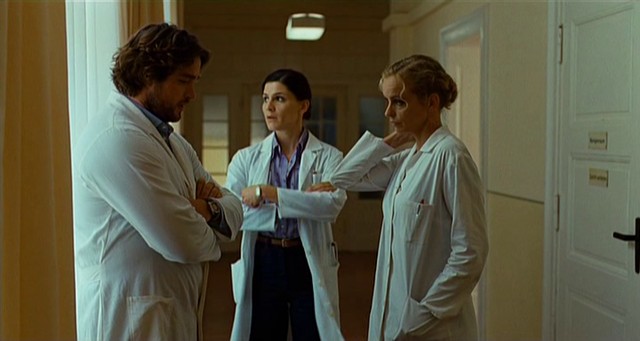
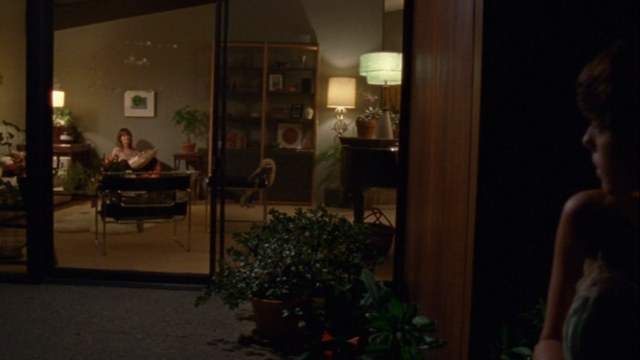
Martine comes from New York to Los Angeles to collaborate with Peter on her film. He’s a sound designer and with a huge house at his disposal, finishing the product doesn’t seem to be a problem. The two share an attraction, which is a problem because Peter is happily married to Julie and is busy raising two children, one of which, Kolt, is from Julie’s previous marriage. Kolt is also full of desire, her romantic longings are directed towards David, Peter’s assistant who has an interest in Martine as well.

2

Here’s a confession: I felt like a complete idiot typing up that plot synopsis. Such a ridiculous outline should make for embarrassingly bad movie, but give Ry Russo-Young some credit, it all unfolds somewhat naturally. It helps that Olivia Thirlby seems to ground such sensational content, giving a performance that is probably too good for something so sleazy. The film never feels like it’s fueled entirely by sex, at least not representing sex, but the problem comes from the fact that every character seems to throw good judgement out the window in order to fulfill a carnal desire. Strike that, only Martine and Peter do that, and while Thirlby’s performance eases the melodramatic burden of the story, John Krasinski’s performance seems to do the exact opposite.

3

Here’s another example of me wanting to give some part of this film some credit: Krasinski at least tries, but that’s sort of his fault. It’s a little bit harder to show the surface of a crumbling marriage when you’ve been conditioned to make witty comebacks and smirk at a camera for half of your career. There’s a scene towards the end where he has a break down, and the manifestation of his anger is him throwing a bike into his oversized pool. This is nothing but comical, and this is clearly not the intention. He’s left out to dry with such a useless and unlikable character, and he’s not nearly talented enough to salvage some sympathy from him.

4

The film does benefit from a few stylistic flourishes, mostly the ones used to represent the sound design work Martine does for her film. The film looks nice enough, especially considering almost all of the action is limited to an expensive Hollywood house. This comes back to the film’s biggest problem: who the hell cares about such people? Maybe I’m to blame for watching one too many “social realism” films from Japan, but the film gives us only a short glimpse into these characters’ lives and when we leave them, it feels like a relief. It takes less than an hour for the “overwhelming” sexual tension between Martine and Peter to break and for the two to fuck. Clearly, Peter  got over the mental anguish of cheating on his wife with some ease. If that’s the case, why should one bother to care when everything is a mess for him at the film’s end? They shouldn’t.
5


Genroku Chûshingura / The 47 Ronin (1941)

4 02 2013

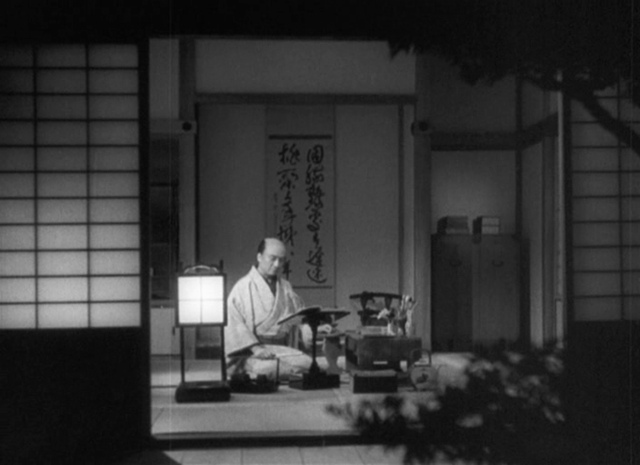
Mizoguchi is best remembered for his historical and poetic epics. Films like Sansho the Bailiff and Ugetsu have helped shaped his image as a filmmaker whose talents lie in that of his virtuoso camera movements. This wasn’t always the case, though, as for my money, his best work is the less expressive social dramas like Gion bayashi and Sisters of the Gion. By 1940, he was better known for the latter, though the release of Story of Last Chrysanthemums in 1939 was an excellent showcase for his talent with the camera. His next film, this two part epic, seems to have been the most visible shift in his style, taking a well known tale in Japan and making it unrecognizable through his distinct personal vision. It’s an impressive film from a technical standpoint, but it’s lacking in other fields.

1

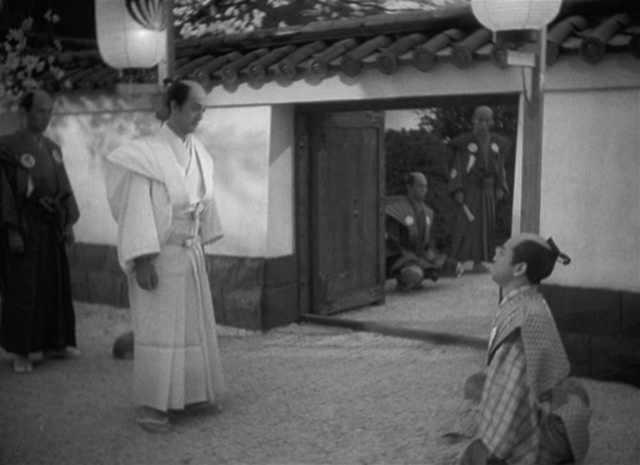
Lord Asano seeks Lord Kira of the Shogun court for advice, but because Asano isn’t aware that he’s suppose to bribe Kira beforehand, he isn’t given substantial advice. Upset by Kira’s dismissive attitude, he attacks him, which ends up with Kira being wounded. The attempt at murder, especially against such a high-ranking official as Kira, within the court is punishable by an order to commit suicide. Asano’s retainers, following the protocol of bushido and general loyalty, attempt to seek vengeance against Kira. They are surprised to find that their cause is actually supported and condoned within the system, even as those supporting individuals cannot publicly express this.

2

There is an awhile lot of subtext in this story, and it would be wise for one to familiarize themselves with the story of the 47 Ronin. Additionally, the film’s production could also use some context. The intentions of adapting the story was definitely nationalistic, even as the end product might not have shown such a stance (more on this later) and while part one lost an enormous amount of money, the Shochiku company was pressured by the military to distribute part two. This was brought on by Shochiku’s notable lack of national policy films at the time. This seems like a lot of red tape I’m going through without even getting to the meat of the film, but it’s important. While Seika Mayama’s adaptation of the story (which Mizouchi’s films is based on) is fairly revisionist, it was still seen as a suitable source of national pride.

3

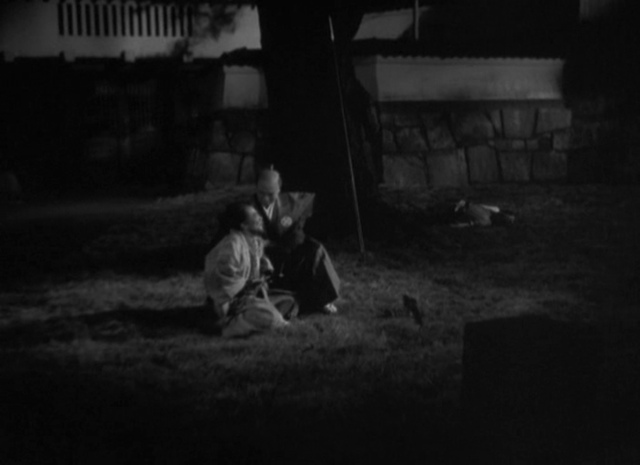
The film doesn’t flow in the convincing manner that the military probably wanted, and one can’t help but think that Mizoguchi might have intentionally signed on to the project to subvert the tale. While this film, because of its length, might be too difficult for a beginner, it is a very accurate representation of Mizoguchi’s stylistic flourishes. The entire film, with the exception of some dull dialogue-driven scenes, seems to be based around elaborate tracking and crane shots. It’s fairly impressive, especially when the film’s set (designed by future filmmaker Kaneto Shindo) were constructed specifically to fit the movements of the camera.

4

It’s easy to underestimate Mizoguchi’s wizardry here. There’s two or three sequences here in particularly of such great beauty, that it isn’t difficult to divorce them from the film’s context. This feels necessary since the film’s context, the actual narrative that is, is not particularly exciting. Apparently, Mizoguchi cut several dialogue-driven scenes from Mayama’s source because he didn’t feel comfortable working with such expository sequences. I’m not one to criticize a filmmaker for what they left in, but there are several fairly long stretches in this film that revolve around conversations that serve just to forward the plot, which is bizarre enough considering how slowly the story unfolds. It seems that the dialogue necessary to tell such a story mostly just tripped up Mizoguchi and prevented him from making a film conceived entirely out of long tracking shots.

5

The film was intended to evoke bushido, “the way of the warrior” in the public and thus, remind them of their country’s military that they needed to support. One can’t blame Mizoguchi for wanting to ignore the military’s intentions for the film, but his disinterest doesn’t exactly subvert the theme of loyalty. As is the case, this film is technically dazzling but ideologically, at its best, it’s convoluted. One could argue it’s downright detestable, but that might be going too far. Shochiku had to make this movie or the military would have shut them down. It’s odd, though, because the film itself almost made the company go out of business with all the money it lost. A fascinating film, none the less, that’s a must for any Mizoguchi fan, but not one that should be a priority for anyone trying to familiarize themselves with the director.

6


Yabure-daiko / Broken Drum (1949)

29 01 2013

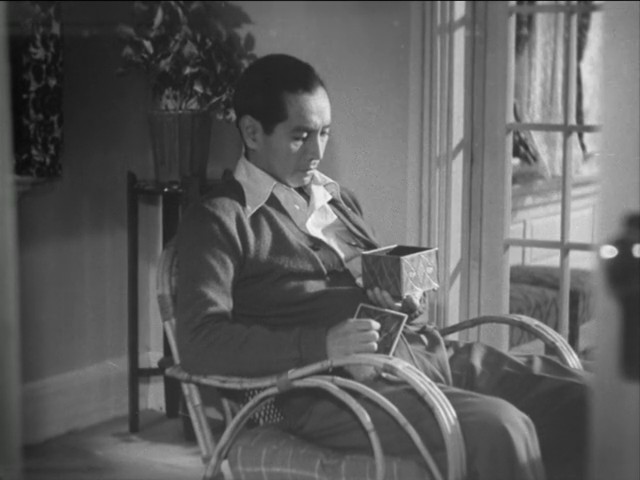
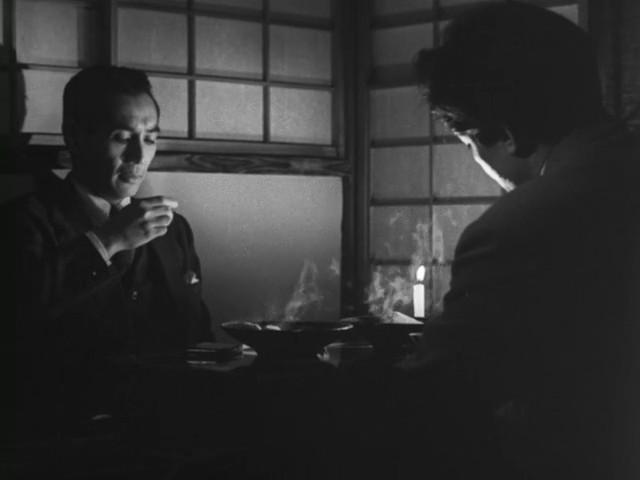
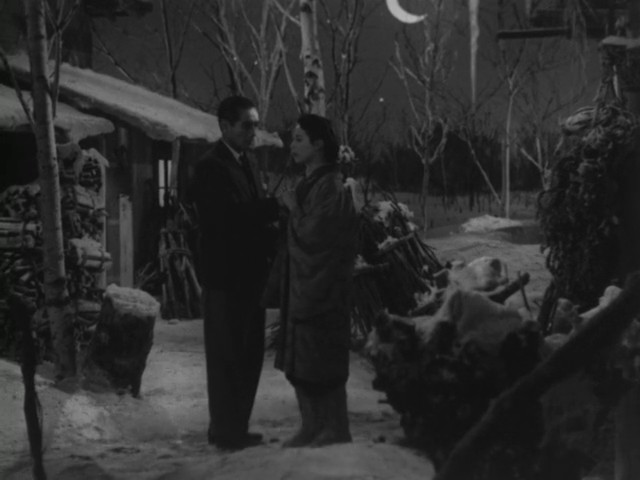
One might think that a comedy would be the perfect thing to correct Kinoshita’s usual problems. Unfortunately, this is not really the case. This particular film is considered a satire, but it’s so painfully didactic that its attempts at humor are undermined by, among other things, Tsumaburo Bando’s hammy performance as the stubborn father. His behavior quickly resembles that of a tyrant, which is where the “satire” is meant to come from. I mean, this is what I’m guessing. The overwhelming sentimental touches that would come to characterize Kinoshita’s most popular work. It’s an easier viewing since he seems to be going for something light-hearted, but that doesn’t make the film any closer to being something special.

1

Gunpei Tsunda is the patriarch of the family, and he doesn’t want any of his six children or his wife to forget this fact any time soon. He frequently requests his children to do work that isn’t necessary, especially considering the fact that the family’s wealth enables them to replace the maids that leave because of Gunpei’s strict attitude. Meanwhile, his eldest son, Taro, can’t stand the pressure anymore and leaves the family business to start up his own music box company. To make matters worst, Akiko is rebelling against the marriage Gunpei has arranged for her, instead shifting her energy to Nonaka, an artist who she meets on a bus.

2

I’ll give Kinoshita something of a break: I’m more than willing to admit that he and I don’t exactly see eye to eye in terms of comedy. Most of the material here is childish silliness, which doesn’t automatically make it worthless but the film seems to working towards some important statement about family relations. Most of the humor comes from Gunpei just acting like a complete jackass, which might not have been entirely unrealistic considering the time but Tsumaburo Bando’s performance is simply too much. If you aren’t able to comprehend that he’s far too controlling, Kinoshita throws in the bizarre detail that when Gunpei shouts, he makes a gesture that greatly resembles the Nazi salute.

3

It’s worth mentioning that Kinoshita had some help with his script, and it comes from Masaki Kobayashi, who I actually think even less of. Oddly enough, the directors seem to suffer the same problems, though their issues aren’t as noticeable here. Again, this is a comedy, so the films flows with an energy that isn’t present in the later work of either Kinoshita or Kobayashi. The idealism and sentimentality of Kinoshita, on the other hand, is at the same volume as it is in his latter films, which makes the film’s conclusion seem both unearned and illogical.

4

Gunpei is the least likable character in the film and fittingly enough, the least interesting. The film greatly benefits from the sequences where he’s absent from the screen. Akiko’s interactions with Nonaka are charming, even as they have that particularly problematic brand of Kinoshita romanticism. Towards the film’s conclusion, Gunpei’s family has left him and they are completely justified. They’ve escaped from what is, in reality, a very scary case of domestic abuse. However, we get Gunpei suddenly realizing what he’s done wrong and he’s filled with remorse. The rest of the family accepts him back into the fold. He will now serve as a consultant at Taro’s new company. Heartwarming music swells and we’re supposed to feel the warmth of family unity.

5

It is a sequence like the one described above that details the problem with Kinoshita’s sentimentality. It’s not simply that he is sentimental, that’s at least a part of it, but it’s also that these feelings are completely unearned. We learn just before Gunpei’s big revelation that he frequently beats his wife, but after two weeks she is more than willing to forgive him. There are cases of abused spouses welcoming their abuser back into their life, I’m not contesting that. However, it shouldn’t be such an overwhelmingly happy moment. In reality, Gunpei would likely hurt his wife again, but the warm, manipulative music is there to help you hopefully forget the real life danger of such a relationship. Everyone forgives and is happy in the end, but they should be a lot more cautious.

6

With all this said, there is still some positive things to take away from this film. Masayuki Mori is great again as a leading man in a Kinoshita film as Taro and Toshiko Kobayashi is very charming as Akiko. Not to go back to basing, but it is a shame she didn’t work with too many directors other than Kinoshita. As this is the case, I still have some reason to continue with his filmography. Here’s a (non) surprise: the film’s cinematography from Hiroyuki Kusuda. There’s a few impressive pans, but the most notable sequence seems to be a long(er) static shot where Akiko and Nonaka finally embrace. Toichiro Narushima, who would later serve as a cinematographer for Oshima and other New Wave filmmakers, served (uncredited) as an assistant director.  While the film is still very much Kinoshita and grounded in something more traditional, it does have some visual flourishes that anticipates the next generation.

7


Barbara (2012)

28 01 2013

It sounds like I’m just a bitter cinephile, but for whatever reason, Christian Petzold’s increase in popularity among the arthouse crowd has come with his biggest disappointments, in my eyes, as a filmmaker. Jerichow and Yella were both big international hits for the filmmaker, but they did little for me. It seems that the distinct minimalism developed by Petzold in his earlier films was now being designated for middlebrow dramas, that worked against the discourse established in films like Gespenster and The State I Am In. 2011’s Beats Being Dead felt like a return to form, but I knew considering the specific circumstances it was made under (it’s part of a three film series, in which each director takes a different perspective on the same story) it might not have been a sign for the long-term. It turns out I was wrong.

1

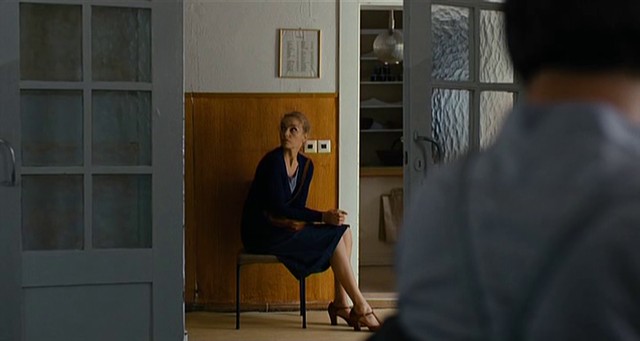
The film’s titular character, Barbara is a doctor in Berlin who is exiled to the countryside after she reveals her intentions to move towards the west. There’s several small dramas happening within the hospital. Barbara becomes attached to a young girl, Stella, whose problems had been previously dismissed by the other doctors in the country. In the mean time, Barbara has secret meetings with her lover, who gives her money and informs her of the details pertaining to her slowly evolving plan to leave for the West.

2

On paper, the story seems quite silly. In fact, the premise doesn’t seem particularly disconnected from Petzold’s last two collaborations with Nina Hoss. Once again, she’s a woman hiding something and once again she doesn’t with a cold type of composure. Part of the appeal of her performances is that she does reveal very little about herself, outside of the details of plot. It sounds a little bit critical to consider Petzold’s film as a genre one, but much like Jerichow, he seems to be drawing upon common narrative elements, even as he shies away from the iconography and form of a conventional “mystery” film.

3

The context of this film might give it an immediate advantage on Jerichow, which fit far too firmly into the narrative makeup of a noir. In that film, Hoss is expected to act as a modern femme fatale, but her acting style draws most of the life out of such a character type. In this situation, her acting style makes her character inherently more interesting. She seems not only reserved, but calculating in her actions, but she manages to show compassion and even acts on a bizarre impulse in one situation. Her friendship with Stella might seem a little manufactured and hokey, but it gives her character a chance to display not something that’s good (which it is, but that sounds too corny) but more importantly, something about her that is interesting. Her ability to connect to children gives Petzold to return to some old material that he had somewhat neglected.

4

What made Beats Being Dead feel like such a change in direction for Petzold was that he had returned to working with adolescence or at least young adults. In his very best films, Gespenster and The State I Am In, teenagers and/or young adults play a crucial role. The conversations, which are awkward and fractured, seem bigger because everything means more when you’re younger and, as some people see it, dumber. The dialogue in Yella or Jerichow seemed to bring the pace to a halt. They felt like a director uncomfortable and maybe uninterested in what his characters had to say. This isn’t exactly a problem since Petzold is arguably a more visual director anyway, but the conversation sequences in those two films seemed forced within his aesthetic.

5

This is not the case in Barbara and part of me wants to credit it to teenagers returning to Petzold’s world. They haven’t returned as the focus, but they still serve as vital parts in revealing to the audience the character of Barbara. Hoss seems more like a human being and less of a figure self-consciously written to be quiet to help make the “slow-moving art film” feels more like that exactly. Her interactions with Andre seem not only like they could be studied multiple times but that they should be studied multiple times. This is an important difference between this film and the other Hoss-Petzold collaboration I’ve mentioned already. The conversations feel important, not in a narrative sense, but in a way of understanding the character. Maybe Petzold’s compositions are tighter and maybe Hoss has delivered a better performance but the truth seems to be that these two talented people are finally working with a script conducive to their talents.

6


Zemma / The Good Fairy (1951)

21 01 2013

There’s nothing necessarily wrong with making wistful films, but the type of romanticism apparent in the films of Kinoshita has always been somewhat grating to me. The problem is not that it’s naive exactly, but his almost mystical realism seems like child’s play compared to the titans of Japanese cinema during the 1950s. This isn’t exactly a fair comparison, but there’s definitely something here that prevents a film like this one, which has plenty of things working in its favor, from really feeling like a bona fide masterpiece.

1

Nakanuma works at a newspaper and he’s investigating the disappearance of his onetime friend and potential lover, Itsuko. Itsuko left him many years ago for a comfortable existence with the much older Kitaura. Nakanuma sends a reporter, Rentaro to find interview Itsuko. She’s now living with Mikako and her father, played by the great Chishu Ryu. Rentaro falls hopelessly in love with Mikako, which puts both him and Nakanuma in a tough position. Their paper needs to put something out about Itsuko running away from her husband, but neither wants to betray the trust they’ve earned from their respective love interests.

2

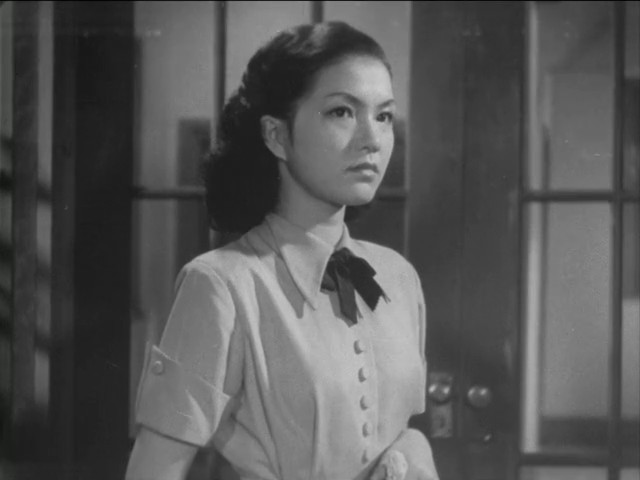
Rentaro is played by Rentaro Mikuni, best remembered for his performances in Vengeance is Mine and The Burmese Harp, doesn’t fair too well here. He’s a bit too emotional and a bit too dramatic, perhaps an accurate manifestation of Kinoshita’s own philosophy considering his manipulative streak. Rentaro falls in love with the 19 year old Mikako and although she is played by a very charming Yoko Katsuragi (later in Scandal and Japanese Tragedy), her interactions with Rentaro don’t seem to be particularly romantic. They’re cute to watch together, but it doesn’t fit with the film’s extreme finale.

3

Mikako’s health gets worse, the illness that is hinted at towards the film’s beginning comes back in the end to give us our ridiculous conclusion. Rentaro’s questionable behavior is meant to be held up as the moral standard, as the characters around him show some flaws. The film tries to villainize Itsuko (played by the lovely Chikage Awashima) because she is somewhat motivated by money. However, a single woman in 1950s Japan, who is trying to escape the control of her unfit husband shouldn’t be blamed for some greed. Her means to money would be difficult if the proposed divorce were to ever go through. This is where Kinoshita tends to lose me,  directing his characters to single dimensions. It’s a shame too, because the fragmented way in which he tells Itsuko and Nakanuma’s love story is actually interesting. I wish he had explored that more.

4

Instead, he shifts his focus mostly to Rentaro and a b-plot involving Nakanuma’s current girlfriend, who he somewhat uses. Again, Kinoshita feels like he needs to build certain characters with a number of flaws so we can recognize that they’re bad, or an example of what the protagonist is fighting against, at least ideologically. It’s a little insulting really, because the characters seem like they could be interesting had they not been drawn with such broad strokes. Mikako, of course, because of her poor health is of course a martyr. Don’t get me wrong, her story is heartbreaking enough, but she’s reduced to being an embodiment of primitive small town-ness. Rentaro falls in love with her as much as he falls in love of the idea of escaping the city, which is a nice sentiment but compartmentalizes a character.

5

These things wouldn’t be nearly as frustrating if the film didn’t have so much in its favor. While Rentaro Mikuni is over the top, the performances from Chishu Ryu, Masayuki Mori, and Chikage Awashima seem to ground both him and the film to a much more tolerable level. The photography is absolutely excellent, even when a very fake studio set is used to depict the countryside. Hiroyuki Kusuda frequently collaborated with Kinoshita, and the photography in these films tends to be fantastic. In a way, this perfectly summarizes how I feel about this film as a whole. It magnifies much of what’s wrong with Kinoshita’s work, but it also magnifies the good things as well. It feels like a missed opportunity through my lens, but there are enough inspired moments to make this much more enjoyable than most of the filmmaker’s oeuvre.

6