To Rome With Love (2012)

21 04 2013

I’ve never been a particularly big fan of Woody Allen, but I’ve never really had a big problem watching his films. After all, who wouldn’t want to be able to a young adult living in New York, Paris, or in this particular case, Rome? Personally, there’s a bit of wish fufillment in my enjoyment of his movies and perhaps it’s that slant that also prevents me from seeing most of his films as really artistic or resonating in my head after the film itself ends. To Rome With Love might be the worst offender, but it’s Allen at his most transparent: he’s never been more self-conscious. In a weird twist, his biggest problems being magnified have produced his most interesting movie in years. I hesitate to call it great, hell to even call it “good” but it’s not a film I regret watching in the least.
1

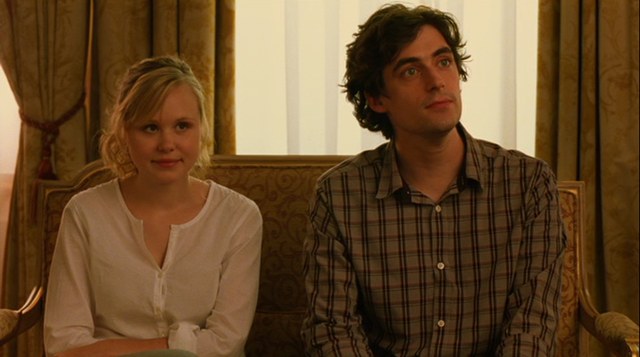
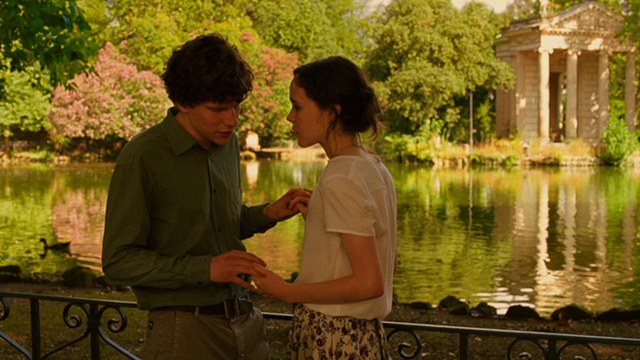
Middle-aged and married, John returns to Rome with intentions of revisiting where he once lived. There, he meets Jack, an American student living with his girlfriend, Sally. Her best friend, Monica, moves in with the couple, which throws their relationship into question. John continually confronts Jack about his potential feelings for Monica, but Jack manages to brush them aside. Meanwhile, Hayley’s parents come in from New York to meet her fiance. Meanwhile, a middle aged businessman becomes celebrity apropos of nothing and a rural couple loses each other in the big city, each getting involved in another romantic situation.

2

I try to be vague in a lot of these plot descriptions, but here, I saw myself particularly trying to recount the vignette involving John and Jack. In a way, it seems to be a slight retread of Allen’s Midnight in Paris as John (played by Alec Baldwin) seems to be reliving his youth through Jack. It could be deduced that John is something of a ghost, as he converses with Jack about a scene’s subtext as the scene itself is unfolding. These scenes can be uncomfortable in their smug nature, but I can’t help but believe that is intention entirely. After all, is there a better word than smug to describe Baldwin as a performer? As Jack and Monica slowly develop their affections, he is always there to scrutinize her behavior. One wonders why only Monica is given this treatment, but this might be more indicative of Allen’s problematic women characters, more so than the usual superficial criticism that he just lives out a fantasy with his films.

3

The film is still very much a fantasy, perhaps Allen himself coming to terms with his age in a way that is the antithesis to that of his hero, Ingmar Bergman. The film even acknowledges this idea, as Allen’s wife in the film does little more than provide a psychoanalytic reading of her husband’s actions. This all might seem too meta, since Allen is either removing the interpretative power of the viewer or he’s just adding another layer of self-consciousness.  I have often felt that his films seem to be made with a fear of criticism, as if he anticipates common criticisms and then teases those ideas with the hope that the audience might feel guilty about arriving at such a thought. This is certainly how I’ve digested a great deal of Allen’s work, but it seems to be less of the case here. Perhaps the breezy tone to this film’s proceedings make it seem less obnoxious in its occasional intellectual posturing.

4

I find it funny that the most frequent problem I have with Allen (especially his comedies) is a sentiment echoed by himself. Be it the Fellini conversation in Annie Hall or this bit in Manhattan, there is also a character in Allen’s films that attempts to sound more intelligent that they actually are. Ellen Page’s Monica character is given this negative characteristic here, and it’s this trait that Baldwin’s John constantly tries to point out to Jack. Almost halfway through the film, Monica and Jack have an exchange about architecture, she brings up Gaudi and speaks about him in a fairly stilted way. John tells Jack this, “she knows certain cultural phrases that imply she knows more than she does.” To me, this hits fairly close to my own problems with Allen. It’s more that he feels compelled to demonstrate his knowledge (and do so through with conversation) than that I think he’s actually a fake smart person. Still, this moment implies an awareness. Sure, it’s been in his earlier films, but it feels oddly poignant here.

5

This isn’t to say the film is perfect, or even particularly good. The two non-English segments seem particularly hollow, perhaps just Allen indulging in the perceived “exotic” nature of Italy. The Roberto Benigni story has a nice surrealist touch to it, but it ultimately becomes a boring criticism of celebrity culture. In such a situation, it’s hard to see Allen as anything more than a Dad complaining about an issue of Us! Weekly. The other one is a serviceable comedic bit that is charming. The real appeal for me is when Allen confronts his demons, not because he’s particularly articulate or pointed about them but more than he presents them in an entertaining fashion. This isn’t a great film, but Allen has something a little bit personal here and he manages to proceed with it in a “charming” way. This is a film that goes down easy, and it actually does have something to say. It’s not the most substantial film, but it’s nice. Sometimes you just want something nice.
6


Anata kaimasu / I Will Buy You (1956)

15 04 2013

I haven’t been shy in expressing my distaste for Masaki Kobayashi’s films in the past. I find his heralded masterpiece, The Human Condition to be, in spite of some impressive visuals, a far too  schmaltzy experience. Kobayashi’s mentor was Keisuke Kinoshita, who I believe suffers from the same problem. For whatever reason, I find myself going back to their work, perhaps because there’s something apparent that warrants such re-visitation or maybe it’s just a personal interest in Japanese film from this time period. Whatever the case, I give these two more chances than they probably deserve considering my personal experience with their best-known work. I do so for the off-chance I come along a film such as this one.

1

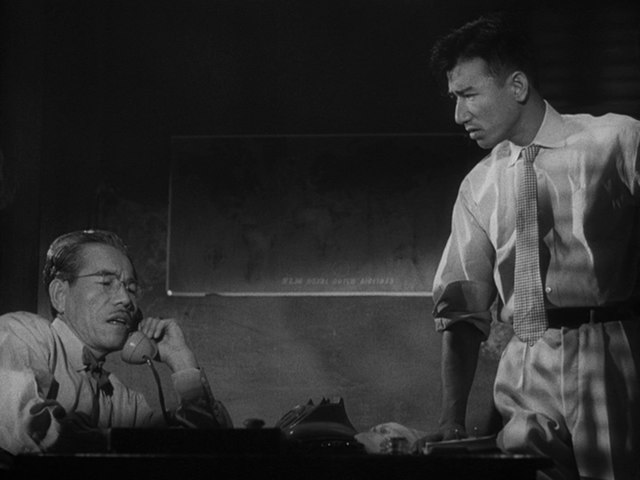
Daisuke Kishimoto is a young baseball scout for the Toyo Flowers. He and several other club scouts are in the middle of a bidding war with the country’s hottest prospect, Goro Kurita. The recruiting process is highlighted by crafty maneuvers against rival scouts, some suspicious gifts, and a constant interaction with Kurita himself. In the process, Kishimoto, convinces himself that he has something of a relationship with Kurita, but their interaction never escalates beyond a sales pitch.

2

I will take a step back and acknowledge that this film isn’t exactly a masterpiece and it certainly suffers from some of the things I’ve personally come to expect from Kobayashi as a director. That said, though, his style seems to translate better in a film like this, which can build upon his aesthetic without forcing a rather contrived type of humanism. That impulse actually creeps in towards the end of this film, but most of it is a fairly compelling study of the state of popular sports in 1950s Japan. It’s obviously not a flattering portrait, but it is an engaging one.

3

Considering the film’s content and the fact that Kobayashi would follow up with Black River in 1957, their might be a pull for some to classify this as a noir. I’m not against this theory, but I think Kobayashi is emulating another classic American genre here, the science fiction film. Obviously, there is nothing remotely science fiction about this, but the film’s tone seems to be not unlike that of such American films from the same period. Kishimoto is frequently flying to and from certain location, and this information is given to us in a fairly simplistic, slightly plastic looking shot of a plane that is repeated frequently throughout the film. The “establishing shot” of the airplane is always followed up with a shot of Kishimoto in the airplane and he’s usually mulling over the possibility of convincing Kurita to sign with the Toyo Flowers. These sequences are accompanied by theremin music.

4

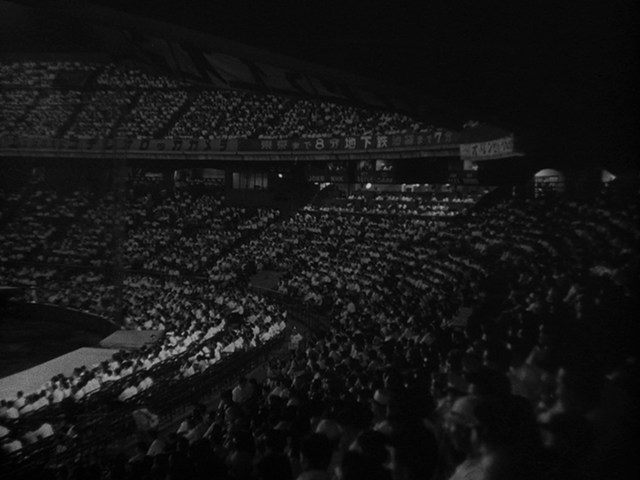
The planes eventually land, and we’re transported to a world with images that seem other-worldly. Baseball stadiums filled to capacity seem to suggest an almost industrial spaceship, ones that have managed to benefit from the nature of the baseball world. The front office people involved with baseball are almost all crooks. We see them frequently gamble, rather innocently at first with a sumo wrestling match, but then they bet of horseracing, and lter, dogfighting. As it tends to be the case with Kobayashi, the intentions are clear, arguably to a fault, but his critique here is buoyed by some humor to the proceedings. The film doesn’t quite reach the satire of Yasuzo Masumura’s very similar Giants and Toys from 1958, but it does shy away from Kobayashi’s ham-fisted tendencies.

5

As I already mentioned, this still suffers from some traditional Kobayashi problems. The film ends with [spoiler but not really] Kishimoto failing to sign Kurita. In the process, he’s become close with another scout, Kyuki, who is much older and his fallen ill. He is disgusted when Kurita decides to sign with neither of their teams. He goes into a tirade, calling Kurita a monster. It’s not because he didn’t get to sign Kurita himself, but that Kurita betrayed Kyuki as well. This seems to be the most problematic stretch of the film. For 100 minutes, we’re conditioned to believe that the world of baseball is a nasty one, but the film’s discourse seems to shift with the embodiment of the problem: Kishimoto. The audience is to take up his cause: that Kurita might be the root of the problem and he’s too young to realize how much trouble he caused everyone.

6

As the film concludes, we’re given a scene of Kurita’s approaching his first at-bat, but we never get to see the first at-bat. This might be one of Kobayashi’s strongest moments ever. My problems with him tend to suggest that he shows and tells us too much, but the fact that he withholds Kurita’s actual participation in the big leagues is crucial. Throughout the film, there is a side plot involving the actual baseball world and we get some impressive archival footage of some Nippon Professional Baseball games. The rest of the film is about everyone stumbling over each other just to get closer to Kurita. All it does is give one professional baseball player. It’s a clever bit on Kobayashi’s part and it provides a powerful statement. Within something as specific as professional baseball, he has made something more constructive and interesting than what he did working within a more important context.

7


Kiri no hata / Flag in the Mist (1965)

11 04 2013

For whatever reason, Yoji Yamada has yet to really catch on with the arthouse crowd. I suppose the narrative of Japanese cinema tells us that this was the time period of “radical filmmakers” like Nagisa Oshima and Yoshishige Yoshida. I use the quotes somewhat sarcastically, because when it comes to aesthetic, Yamada is just as evolved as any of them. He hasn’t gotten a larger critical evaluation because it’s his content, which lacks the edge of filmmakers like Oshima and Yoshida. He makes, at the risk of using an already overused phrase, more of a “humanist” and a lot of dramatic works are grounded within the home life. This is not the case with Kiri no hata, a stylish thriller, that is a bit less sensitive (at least superficially) than Yamada’s more gentle work. It’s a perfect fit as his usual merits manage to stand point even within a genre piece.

1

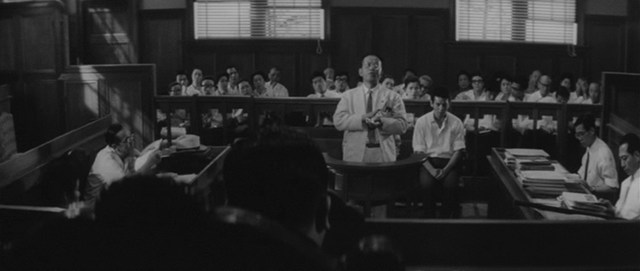
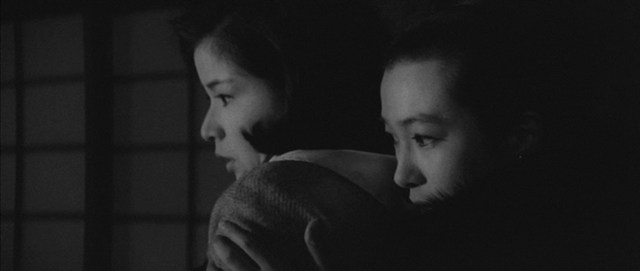
Masao Yanagida is on trial for the murder of a loan shark, and the evidence is not in his favor. His sister, Kiriko Yanagida testifies on his behalf, but the fact that he owed the loan shark an enormous amount of money that he didn’t have is enough to send him away to prison. While there, he dies only a year into his sentence. Kiriko, obviously frustrated, finds a golden opportunity when the mistress of the lawyer who essentially put her brother to jail is seen at the scene of a different murder. Kiriko can now use the justice system to her advantage and perhaps avenge her brother’s death.

2

One of the problems with writing a plot synopsis comes when one can’t capture the same spirit with which the story itself unfolds. I would note that my description of the story is not at all like the way Yamada tells it. Instead, he takes a more elliptical approach, cutting in between the trail, the events leading up the murder, and the year following the trail. He does this all rather flawlessly, perhaps not with the dizzying Roeg-like precision of his contemporary, Yoshishige Yoshida, but in a more restrained way, which still manages to serves the film’s function as a genre piece. It’s hard to think that Yamada didn’t see Kurosawa’s High & Low before making this picture, while that one is ultimately more complicated and intricate, Yamada seems to move the pieces of his film around in the same way. The compositions are cut tightly in a way that evokes a similar tension.

3

This is still a film that represents Yamada’s work, even if it not representative of the genre he spent most of his time. His “humanist” streak still shines through, although one might argue that the film’s conclusion is a fairly cynical one. I don’t think the two aren’t mutually exclusive. Yamada’s portrait of Kiriko, played by Chieko Baisho, is so rich and complex that her final decision plays out not like Yamada and the film’s writers winking at the audience (like twists tend to do) but instead, like a radical and empowering decision by Kiriko.

4

Yamada’s position as a more conservative filmmaker (not ideologically, but in form) compared to the New Wave isn’t an inaccurate one. While all of his films are beautiful, they lack the formal playful of the ATG crowd. Instead, his aesthetic is more in service of the film’s other parts, which sounds like a way of saying he isn’t cinematic, but I hope to not be implying that. He’s extremely cinematic, and this film might boast his most “cinematic” scene. A wonderfully constructed, completely wordless sequence of Kiriko following a man around from a Ginza bar  to his house. It has an Antonioni quality and actually anticipates Antonioni’s Blow-Up by being in the context of a suspense film. It’s one of Yamada’s best moments as a director in a career that is full of them.

5


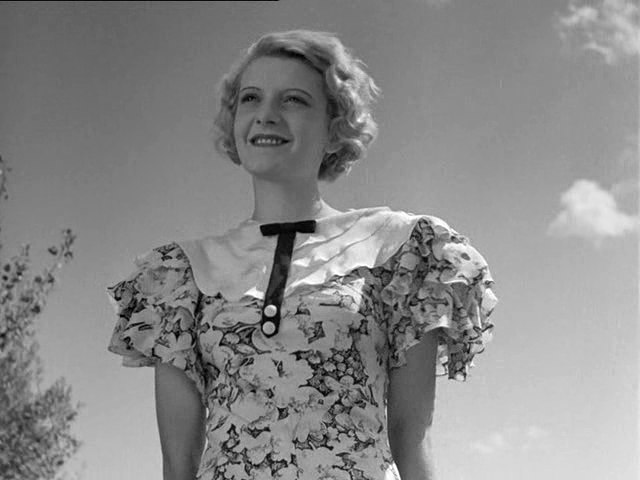
Treno popolare (1933)

18 03 2013

One of the benefits of being a cinephile in the digital age is the ability to address gigantic blind spots quickly and Italy before Rossellini is such a blind spot for me. I decided pretty much just this afternoon that I wanted to study (read: see) more from Italy, basically anything outside of the country’s contributions to the typical arthouse canon. Treno popolare has not received much ink, nor has the film’s director Raffaello Matarazzo. This is something of a shame, as this is one of the most gorgeous films of the time period, perhaps not much is “there” in the pathos department, but there is a bittersweet tone to the superficially light story.

1

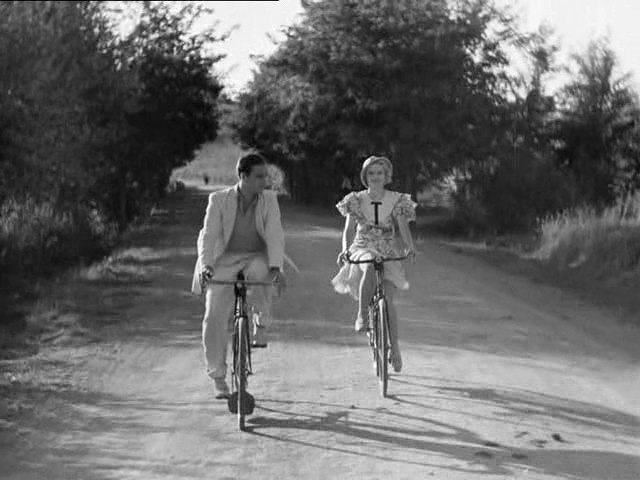
Giovanni plans a Sunday picnic date with his coworker and crush, Lina. They take the “common folks” train from Rome to the city of Orviento. Along the way, they meet up with Carlo, who is the charming opposite to the bookish Giovanni. Eventually, Carlo and Lina find themselves planning their picnic around Giovanni’s presence, capitalizing at every opportunity to get rid of him. There’s also a side story involving a lecherous businessman, who is caught by his wife. The young girl he was planning on spending the day with is left alone and totally humiliated, giving us the more tragic perspective of a scenario that is sometimes played up for laughs.

2

I try to avoid comparisons when I’m not entirely sure of a film’s background (as is the case  here) but I couldn’t help but be reminded of Hiroshi Shimizu’s Arigato-san from 1939. There, we follow a group on a bus ride and despite the jaunty attitude of Shimizu, there is a deep, troubling sadness brewing in the lives of all of the characters. Here, too, we have a jaunty, upbeat tone, but we don’t get anything quite as upsetting as a young girl being sold into prostitution. Instead, the affairs here seem somewhat frivolous, a point which is magnified by the middle class status of all of the characters. In fact, there is a reoccurring song about the glory in belonging to the populist working class, though I get the impression that the songs presence is somewhat tongue-in-cheek here.

3

Another point of comparison might be Jean Renoir’s Toni, which came out a year later. The film is considered something of a starting point for Italy’s neo-realist movement and Luchino Visconti served as an assistant. To my knowledge, there weren’t too many other Italian films from the 1930s that were shot on location. Indeed, I went ahead and looked at some of Matarazzo’s other films and it most of them were shot primarily in a studio, and look like they maintain the aesthetic of the “telefono bianco” (white telephone – dramas about the upper class) movement. Here, though, the images here are vital, and they seem to channel the youthful exuberance of Carlo and Giovanni. The film was shot by Anchise Brizzi who is responsible for Shoeshine and would work with everyone from Julien Duvivier to Orson Welles.

4

There’s a lot here to love (I haven’t even mentioned Nino Rota’s first score!) but I would hesitate to call this exactly “neo-realist” at least from my own personal understanding of the movement. Certainly, elements are there, but I think approaching the film as proto neo-realist might set up unreasonable expectations. The problems here are the anti-thesis of neo-realism, they’re entirely trivial and immediately solvable. Maybe this makes Matarazzo’s film silly or less important than something like Umberto D. but still, perhaps as just a piece of technical filmmaking, it is excellent and an absolutely worthwhile experience. If you’re in the mood for something delightful, you couldn’t do much better than this.

5


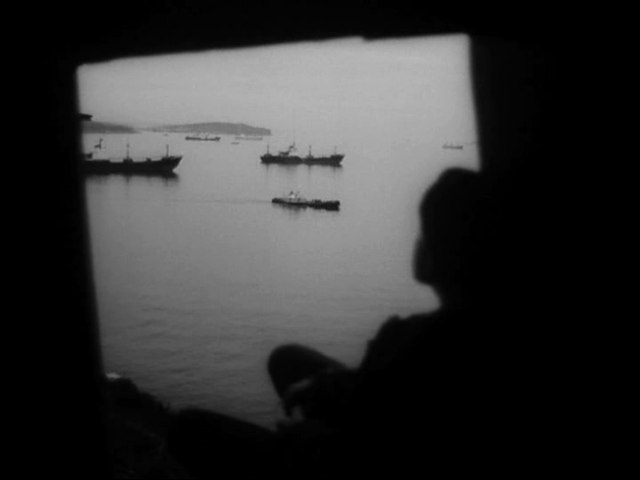
Zamri, umri, voskresni! / Freeze Die Come to Life (1989)

12 03 2013

I had wanted to see this for a number years just from the strength of the title alone. It has a weird poetic tone to it, which I guess could be a good point to start talking about the film itself. It fits into that mold of beautiful but ugly movies about impoverished children. Yes, this fits very comfortably with Pixote, I Was Born But…, and yes, even Gummo. If there’s really any faults in the film, it’s that I’ve already seen this sort of thing done before, but the movie still fulfills the promise by building on a similar pathos as those films.

1

Valerka lives in a remote Siberian village with his mother. He makes money by selling teas to both the locals and Japanese prisoners of wars. Galia also sells tea, and is occasionally both the victim and the perpetrator of Valerka’s teasing. Because the rest of the children in town seem just too young or just too old for them, they begin to bond just by the fact that they have no other friends. Through their eyes we see the absurdity and sadness in the forced marches for Stalin, yeast poured into the sewers, and retrieval of a stolen pair of skates.

2

It’s important to note that Kanevsky’s film never goes the political route. Sure, we see Stalin’s perceived negative influence on an isolated community, but his film is not one of commentary, at least not an explicit commentary, but instead one of observation. These forced marches and sing-alongs are completely ridiculous, and if anything, they’re played up for laughs. The one time we see them in an extended sequence, the man enforcing the marches orders everyone to march through the feces that have brewed to the surface from Valerka pouring yest into the school’s sewer system. Such an image has that weird ugly-beauty reminiscent of the films I’ve already mentioned, but it has comedic quality as well. One can sense a growing dissatisfaction with Stalin as most of the town ignores and scoffs at these rituals, even as no one goes out of their way to make a declaration of his politics.

3

The strength in Kanevsky’s images is, in fact that no subtext is necessary. There certainly is one. This is one of the last Soviet films of note (Sharunas Bartas’ Three Days from 1991 is the latest I’ve seen) and while there isn’t a perceptive foreshadowing of the Soviet’s collapse, but instead a sense of giving up. That’s the subtext in these images, but again, I don’t think they’re necessary. The images themselves make the film vital not only because of their immediacy, but because they are beautifully composed. Sure, the camera wanders a lot, but at times, there are expressionistic flourishes throughout. The sequence where Valerka gets his skates stolen seems something from Guy Maddin’s canon, somewhat a contrast to the more free-wheeling tone that dominates the majority of the film.

4

As I hinted at the beginning of the review, there is really nothing wrong with this movie. It is sort of perfect and its finale really manages to pack a punch. So why isn’t this the best movie ever? Well, in a weird way, the film met my expectations perhaps too perfectly. It really is sort of a middle point between Gummo and a Bela Tarr film. If that sounds exciting, then you should definitely see this film. It seems to turn on a more surrealistic switch towards the final half hour. The vignettes that happen earlier seem a little bit “organic” and “real” where as the ones towards the end more closely resemble an imitation of something from a Herzog documentary. Again, there’s really not a single thing wrong about this movie, but I’m somewhat jaded from seeing  a similar thing already. It’s still a masterpiece, though. Sometimes you don’t need a film to reshape the cinematic vocabulary, you just want it to re-examine what you’ve already believed. That’s what this is for me. To make my rambling a bit more concrete, just see this movie. It’s really great.

5