La classe operaia va in paradiso / The Working Class Goes to Heaven (1971)

12 06 2013

I’ll begin by confessing I know next to nothing about Elio Petri, and until about a week ago, he was nowhere near my radar. It was a viewing of Mario Monicelli’s I compagni / The Organizer that sparked my interest in this particular film. That film and this one are united in a depiction of a post-industrial labor in Italy. Monicelli’s film, even when it does get serious, plays up most of its content for broad, sexually-driven comedy. Petri’s film is much different, and at times, the aggressive nature of its protagonist threatens to derail the film’s ideology. The film ultimately works not be being a particularly gripping human drama or looking nice, but by meditating on the effectiveness and differences between radical leftism and more central liberalism.

1

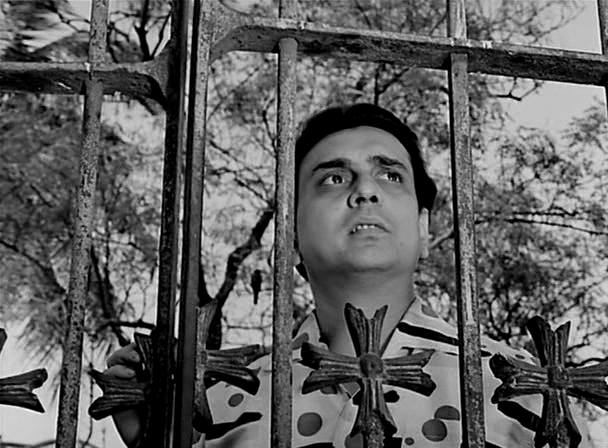
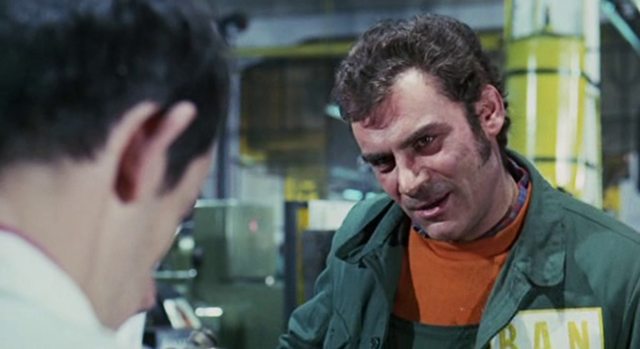
Lulu is the best worker at the factory and he’s fairly confident in his abilities. This endears him to his superiors and makes his coworkers, most of whom are unionized, loathe him. He’s indifferent to the political landscape. He comes home every night and he’s too tired to do anything with his girlfriend but he finds his fatigue peaceful. This changes when he cuts his finger at work, and slowly becomes more and more interested in the politics surrounding the factory. From here, two groups emerge. A political activist group concerned with starting a revolution and the more centrist union, which focuses on improving working conditions.

2

The way I describe the politics of this film presents two scenarios are oppositional binaries: the first being the workers v the bosses and the second is the one between the union and the activist. One could deduce just by the way that these pair of binaries are presented that Petri is equated the safe “moderate” union as being just as bad as the bosses. This is a pretty simplified reading, though and I think the film deserves a deeper one, though I will agree that Petri is ultimately in favor a revolutionary approach, even as the film is constantly presenting us with characters who engage with radicalism as insanity.
4

Even as the film seems to be empathizing with the worker’s skepticism towards the activists (all of whom appear to be students, and who are dismissed because they must be financially stable), it illustrates an important divide within the proletariat. It was probably relevant when class consciousness became a thing, and it sure as hell is important now. There’s still a stigma between the intellectuals and the actual workers, but the film sees this tension benefiting the factory’s owners. To be blunt, the fighting between the oppressed is capitalism’s preference. If those who are hurt by it can’t even agree with each other, they’ll never organize and the system has nothing to sweat over. This might all sound like too heavy for some, but the unfolding of the chaos outside the factory is actually enjoyable, if only because Petri himself is struggling within himself. The effect is that the film is not propaganda, it’s polemic yet smart and realistic.

3

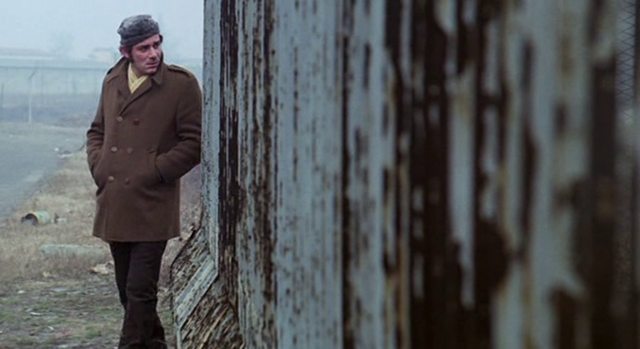
While I don’t find any of Petri’s aesthetic choices particularly interesting (just a lot of steadicam and closeups really), there is something to be said about the way he introduces the factory to us. As the workers start their day, a voice tells them over the PA that they need to love and care for their machines as if they were a person. The initial images of the machines seem to follow the lead of the voice, Petri captures them in a way that almost seems sympathetic, despite the fact that they are indeed machines. Later, Lulu has casual sex with his coworker, Adalgisa. Their photographed just like the machines as they embrace. Their encounter is comically short and unpleasant. After all, Lulu only sees Adalgisa as sexual potential. She “serves” him, the same way he “serves” the factory. They’ve both been objectified.
5

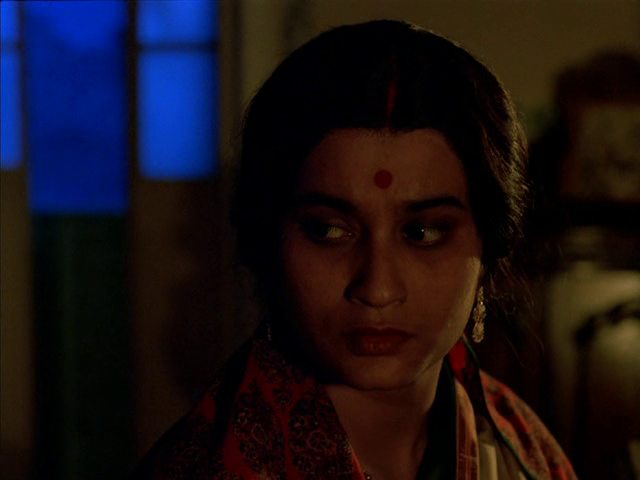
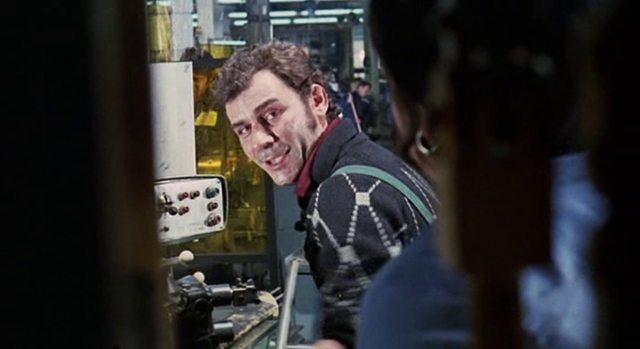
It’s unfortunate that The Working Class Goes to Heaven hasn’t endured the test of time critically. It’s the type of work that begs for canonical consideration, if only because of its political discourse. There’s a lot to chew on here, but the few writings I’ve found on the film seem to gloss over or ignore the film’s biopolitical implications. Worse, some see Petri as identifying with the centrism of the union. I cannot understand how, though. The film ends with the union reuniting Lulu with the job he had lost for political reasons. As the good news is delivered, the camera observes his face. He’s feigning happy enough to convince the others he’s excited about work, but he realizes he’s back in life lived in service to capital. He later describes a dream while working, the symbolism is heavy and the sentiment is clear: this is not a way to live.
6


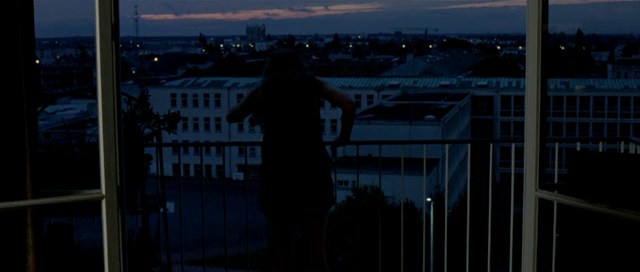
Des filles en noir / Young Girls in Black (2010)

2 06 2013

My impulse in starting this review is to negotiate Jean-Paul Civeyrac’s importance in contemporary French cinema. Perhaps that’s the sort of argument that deserves its very own space, but a film like this absolutely repositions the filmmakers as one of the country’s best and alas, it seems like no one really is interested in talking about him. This might be one of his more accessible films, but it is one where he builds on his own work. Where he might have been treading in the territory of Rivette or Lynch before (which is perfectly fine!) he is absolutely coming into his own with this feature.

1

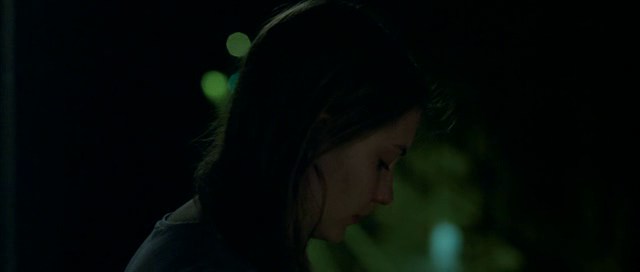
Teenagers Noemie and Priscilla are ostracized at school. Priscilla seems to have something of a boyfriend in Sam, but all of her trust belongs to her best friend, Noemie. The two are falling behind academically, though they manage to give an exceptional presentation on Heinrich von Kleist. Their classmates are confused and alienated by the presentation, one of them calls their fascination with the poet “sick.” In retaliation, Noemie announces that her and Priscilla will follow Kleist’s route and kill themselves. They explain this off as nothing serious, but then they begin planning a way for them to end their lives together.

2

A film about teenage girls committing suicide might sounds laughably cumbersome to many, but it might be to Civeyrac’s credit that what is commonly understood as a “phase” is treated with such serious attention. At the same time, it is important to mention that this isn’t a social problems film, even as the working class background of both girls is intentionally illuminated. It’s not a “social problems” film by my understanding of the term because it isn’t about confronting the issue of  teenage angst, that’s what a terrible movie would do. The film is immediately built around the minds and hearts of the two protagonists. Noemie and Priscilla don’t sound the slightest bit ridiculous when they announce that they’re going to kill themselves.

3

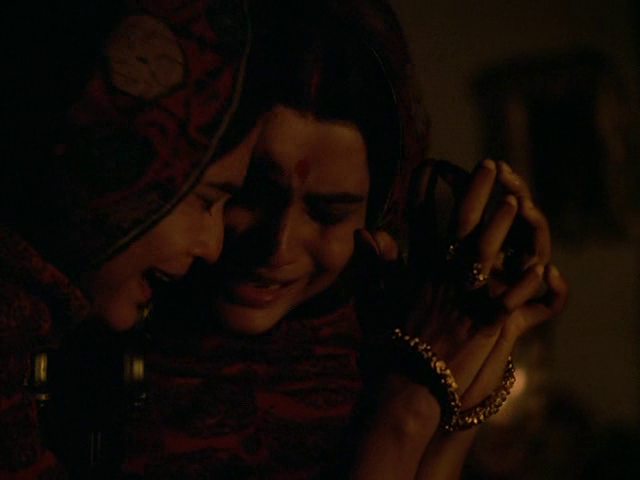
I mention the hearts of the two girls on purpose as I would argue that this is indeed a love story. It’s not a sexual or romantic one, even as the photography itself captures both sensually. The aforementioned shades of Lynch might make Mulholland Dr. a reference point, but I don’t think that film’s sexual nature translates to this. Civeyrac himself has shown he’s able to blur the lines of physical interaction and their conscious intention. Civeyrac’s 2000 film, The Lonely features an extended sequence of two friends wrestling naked. The act is understood as playful but it goes on for an uncomfortable amount of time. It’s inevitable that one might eventually read that sequence as sexual. The opposite seems to be going on here. When Noemie and Priscilla embrace, it could initially be read as sexual, but as the camera linger, we realize it comes from a different kind of love. The two are bound together by the fact that the rest of world terrifies or hurts them.

4

It might be a sign of the fact that cinema doesn’t have enough narratives that is dominated by just two women that this film will indeed be connected to something like Mulholland Dr. The other comparison I mentioned before was Rivette and indeed, the female relationships in Celine and Julie and Le Pont du Nord might be closer to the spirit of the friendship in this film than that of the relationship in Lynch’s film. The biggest point of difference would be that Civeyrac doesn’t share Rivette’s playfulness. The situation here is much more dire, which isn’t a criticism of him being too serious. He certainly can’t be accused of playing up emotional torture, he’s observant with his camera and his characters do the reflection, not him.

5

One might confuse a strong emotional reaction to this film with the fact that it involves an event that is, for lack of a better word, a tragedy. This isn’t the only reason the film registers for me or why I think it packs a punch. The impact is a jarring one, but it is not that haunts us because of our primal reaction. It’s impossible to talk about suicide without getting personal, because it is perhaps the most personal act. There have been films about it before and there will continue to be films about it, but few films have captured the mental processing of it. To clarify, Civeyrac hasn’t made a heavy-handed film where pretentiously contemplates death, but one where the mere existence of living must be evaluated frequently enough that it becomes overwhelming.

6

Civeyrac’s film runs only 84 minutes and it’s not like he’s packing a lot of information into this time period. It embodies to me what it means to be cinematic. The film’s narrative never seems like that exactly, but instead it’s the unfolding of events, most of which are relatively minor. While it creates a fascination internal conversation between Noemie and Priscilla on death, it creates another dialogue with Noemie on personal trauma. Her rehab does not end with a triumphant return into the public, nor does it comfort us with the idea that she’s safe. Instead, it’s a ongoing emotional battle, which I realize could not sound more pretentious. Thankfully, Civeyrac has managed to convey all of this beautifully in his film.

7


Ghare-Baire / The Home and the World (1984)

27 05 2013

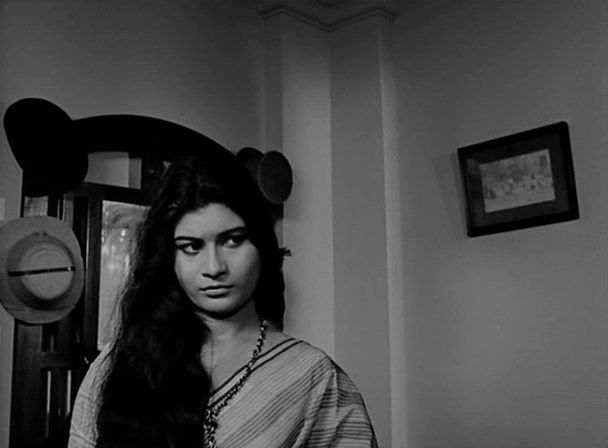
It’s sort of funny to see this so quickly after Mahapurush because it represents Ray operating on the other end of the spectrum. Where as I found that film a bit too simplistic and silly, this one might be Ray’s most dense work and certainly one of his most beautiful. While it presents itself as a political film, it is also one that registers with Ray’s interest in social standing. Most interesting, he examines the conflict between activism and class. Unfortunately, his portrait is somewhat simplified, but the film itself is still ambitious. Ray himself might fall short of being fair and showing compassion towards everyone, but ultimately two sides develop from the polemic material.

1

Bimala marries Nikhil and is given what few women in India have: personal freedom. Nikhil is a modernist in every sense, educated in England with a group of revolutionary friends. He identifies as liberal and wants Bimala to have every opportunity to experience the world. He buys western clothes and piano lessons for her. He shares that his interest in having her see the outside world comes from the theory that she’ll never know if she loves him if she doesn’t see other men. At this time, we are introduced to Sandip, the leader of the Swadeshi movement, which centers its focus on exclusively buying and using national products. While this obviously clashes with Nikhil and Bimala’s Western-inspired lifestyle and later, it begins to threaten the couple’s love.

2

There’s many layers to appreciate here and the complex hidden away in Nikhil is a good place to start. While he openly presents himself as a leftist, his own words seem to betray his perceived ideology. One must admire his attempt to emancipate Bimala, but he explains that this is done for completely selfish reasons. He wants her to experience other men so they’ll know they are truly in love. Of course, this ends up foreshadowing Bimala’s relationship with Sandip. More importantly, it’s inherently problematic. He speaks as a progressive, but he explains this as being for a selfish reason. More importantly, he frees Bimala but only sees her only worth in her love or more cynically, her body.

3

It’s to Ray’s credit that Nikhil still feels like a real person and the not saint one might make him out to be for ideological identification nor the bad guy that could be read into his selfishness. The film does present a problem by their social status, they are obnoxiously upper class, perhaps the wealthiest family in any of Ray’s films (though I realize I made a similar proclamation in my review of Mahapurush) and although we ultimately sympathize with them, their financial position is important to the film’s politics. The Swadeshi movement is founded upon ending the use of foreign products in India, but the rub is that a majority of the poor’s income comes from selling these foreign products. This is something Sandip is confronted with when he asks merchants to burn their foreign goods, they reasonably protest that their life is difficult enough.

4

Nikhil, being a centrist, sides with the poor. He opposes Sandip (which creates an interesting personal dynamic between the two friends) and embraces the rallying cries of the poor, but it ends there. His extreme wealth puts him in a position to do more, but he doesn’t. The poor speak out against the Swadeshi because it would only make their suffering worse and Nikhil seems to lazily rest on this part of the argument to restrain himself from getting involved. If anything, his education, money, and apparent leftist ideology would suggest an interest in helping the poor, but he uses them as a point in opposing Sandip.

5

I must explain that the film itself is not entirely concerned with the Swadeshi movement, but it is one of the many currents flowing through the story’s arc. The main appeal here is the development of Bimala into the Western influenced woman Nikhil sees her to be. Interestingly, she tries to resist this. The film doesn’t make much of a point in addressing this dynamic but I find it interesting nonetheless: Nikhil wants to improve the position of women in India, but he seems to be imposing a very Western lifestyle on his wife in the process. His attitude is kind of a problem because he’s pressuring his wife into another life, albeit one that is probably more open.

6

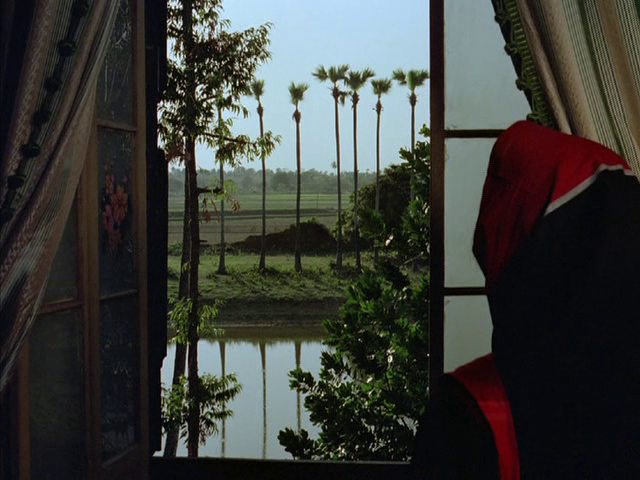
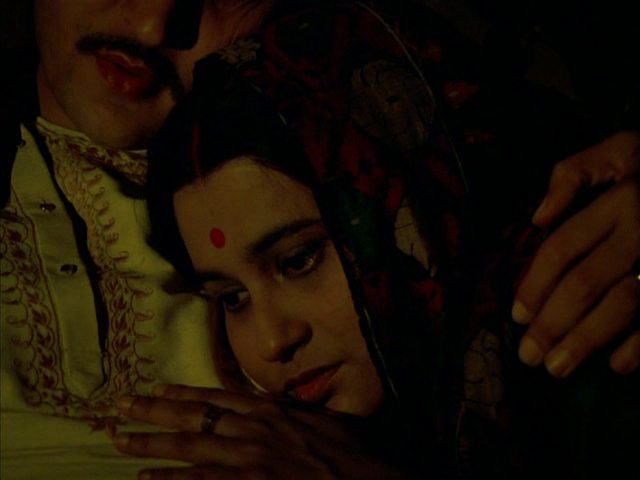
Ray’s visual style here is worth a viewing alone. One could argue that it’s just the benefit of advancements in film stock as the deep focus cinematography here isn’t that different from that in a film like say, Mahapurush. I’d say this is sort of a simplification of what Ray has accomplished here. Certainly, his camera movements are nothing new, but his use of colors here is not something inherent. I usually associate a yellow-brown color palette as a side-effect or trend of digital filmmaking. It looks utterly gorgeous here, perhaps recalling at times the violent colors of Bergman’s Cries and Whispers (which this film shares a chamber drama impulse with) while also anticipating the high saturated blues of an entire generation of East Asian cinema. Needless to say, it’s a little bit breathtaking.

7

One of the best attributes of Ray’s film is that the dynamics I’ve glossed over above are never given a definitive moment. The love triangle is never exactly handled like one, instead the focus is on Bimala, the developments happening within her as she’s being used as some sort of emotional tug-of-war. Perhaps I’m at fault for not discussing her enough, but her journey (to risk sounding corny) is the film’s biggest pull and it’s also the hardest to explain with words. It’s not that she or the rest of the film’s characters are hard to read, but the fact that their actions can suggest something else about them and of course, about India at the start of the 20th century. It is not a fault that Ray gives us no answers, but it is instead a strength that he can evoke concepts but still make the film feel “complete” even as it is open-ended.

8


Mahapurush (1965)

22 05 2013

I recently saw Satyajit Ray’s Devi (1960) and was reminded of why I fell in love with the filmmaker in the first place. Although I find critiques of organized religion uninteresting more than anything, that film works because of its beautiful photography and the fact that the religious subtext of the film plays with one of Ray’s other frequently revisited themes, women in India, a subject far more interesting to me. Mahapurush is also a religious critique, but the tone is far more silly and it doesn’t have the thematic or photographic high points of a film like Devi. It still manages to work, but it might be the least essential film I’ve seen from Ray so far.

1

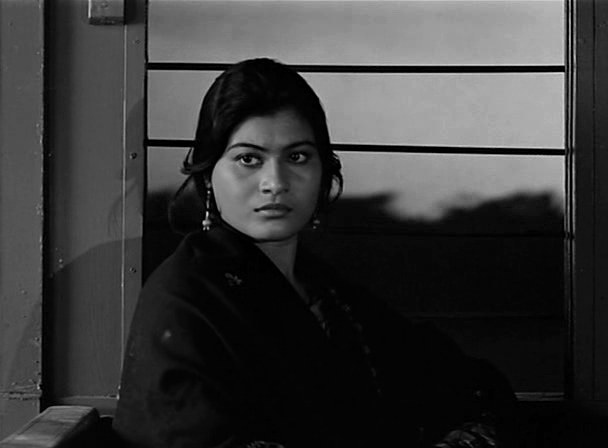
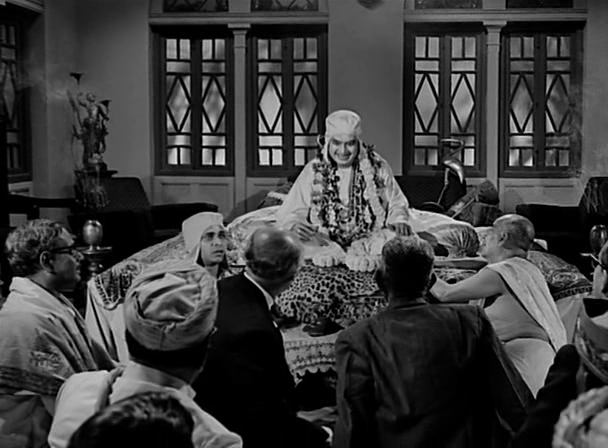
Gurupada Mitter, still reeling from the death of his wife, meets Birinchi Baba on a train. Perhaps because of his vulnerability, Gurupada believes in the tall tales he is told by Birinchi. He later decides to follow Birinchi, seeing him as something of a holy man. The obvious problem is that Gurupada’s decision-making is affected by the recent tragedy, and he can’t see that Birinchi is an obvious phoney. Meanwhile, Gurupada’s daughter, Buchki is upset with boyfriend, Satya. Satya seems to be the only one who sees Birinchi as a false prophet, but nobody seems to listen.

2

It’s important to note that there isn’t really a hint of pathos in this particular film, which is certainly a rarity for Ray. Almost all of the characters are upper class and in an outstanding financial position. This isn’t really a huge problem with the film, because it’s aspirations are nothing beyond a religious farce. At its best, the film resembles one of Luis Bunuel’s catholic comedies. Unfortunately, the film never gets to that level of absurdity, instead it mostly just revels in the silliness of the Baba character and his assistant, the latter of which is played by Robi Ghosh, a frequent provider of comic relief in Ray’s work.

3

I will give Ray’s screenplay some credit for being humorous, but saying it’s funny is something of a stretch. Admittedly, much of the humor is based in the language, puns that can’t be translated to English and references beyond the grasp of most western viewers. Still, there are a few bits that are memorable. Birinchi references the Biblical allusion of the near-impossibility of a wealthy man to get into Heaven. He asks “why?” and cries out for the sad rich men of the world. It’s a silly sequence, one that encapsulates the film’s overall tone: this is sort of trivial, but isn’t kind of amusing? By having Gurupada be a lawyer, one could argue that Ray is suggesting that even modern “intellectual” men can fall victim to the allure of spirituality. However, we’re never asked to feel for Gurupada being tricked, we’re immediately invited to laugh at him for falling for such a ruse.

4

Ray seems to understand that the film’s content isn’t exactly important or meaningful. There are some visual allusions to bigger things (including one really obvious one to cultural imperialism) but the filmmaker seems fine giving us a message in a light, unassuming way. It’s not a great film at all, but it’s certainly not a bad one. It seems to me that Ray’s prolific nature allowed him to frequently touch upon topics more than once, sometimes in a different tone. Ray himself made better movies about the same sort of thing as Mahapurush but it’s interesting to revisit familiar thematic territory. It’s an interesting film in how it fits in with the rest of Ray’s career, but otherwise, nothing really special.

5


Upstream Color (2013)

16 05 2013

I feel it’s not a bad place to start by mentioning that I was no great fan of Shane Carruth’s debut Primer. While an impressive accomplishment considering the circumstances under which it was made and the density of the narrative, it’s ultimately too scientific of an experience. This is because it’s a science-fiction film, as is this one, but instead because it is far too concerned with the details of its own narrative. Upstream Color is a better film, almost inherently so, because it is actually interested in what is going on with human being. Still, Carruth’s fascination with exploring the details of his science is a presence, which is a shame considering that there’s a much better film underneath that. Thankfully, his talent manages to shine through, perhaps in spite of his true motivations.

1

Kris is kidnapped, drugged, and conned out of her own money by a mysterious man who seems to control her mind. When she regains her independence, she finds her life in complete shambles, the lone bright spot being that she’s drawn to Jeff, who may or may not have gone through the same experience. Within this love story, the narrative weaves between that of the individual who controlled both of them, as well as a farmer interested in folly effects. Of course, he’s also connected to the story.

2

It sounds sort of simplistic the way I described, but I could easily see most of this film’s audience getting lost in the narrative’s complexity. The film’s discourse seems to be structured around most of these detailed proceedings. At the risk of “spoiling” the movie, the overarching theme seems to be one of questioning why things are the way they are, i.e. a call to become aware of hegemony. Kris and Jeff begin to question why they were drawn to each other, and in the process, they uncover the secret that explains how they were exploited. It’s important to mention that they are not alone, as the film concludes with the couple sending Thoreau’s Walden to the other victims, something that will bring their trauma back into consciousness.

3

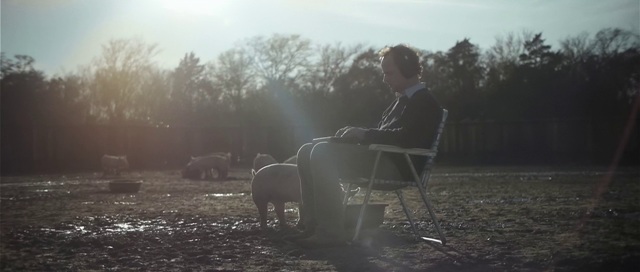
This all sounds very heavy, but it might not understood as such in the film’s storytelling. On one hand, the content does feel heavy just by the nature of Carruth’s style (Malick’s Tree of Life was the most frequent comparison made when this first premiered) but the filmmaker manages to produce a rhythm to his images. Indeed, this takes cues from Malick’s elliptical, poetic flourishes so the film’s execution of the cumbersome narrative flows rather naturally. It helps that the film is so visually striking, even for someone like myself who feels inundated with arty posturing that includes shallow focus and lens flares, both of which are reoccurring tools in Carruth’s cinematic vocabulary. His visuals are striking even as they’re founded in these overused techniques.

4

There’s going to be the notion that the film survives exclusively on its atmosphere, which sounds like a criticism to some, but I would emphasize that the film is at its best when it indulges in being more visually based. It becomes something of a chore when we’re forced the details of his science-fiction. It’s hard to call it exposition since none is ever really given, the film is fairly elliptical, at times feeling like a constant montage. Still, the less interesting “mystery” narrative strand becomes the biggest point in the film’s final third, which is particularly disappointing considering there’s a wonderful love story going on right in the middle of this. The relationship doesn’t feel deep, but it is one that draws on the physical, which I don’t mean as sex exclusively. Instead, the film’s greatest quality, is the hyper-sensory experience that we get flashes of from time to time.

5

It doesn’t feel right to criticize a film for what it’s aspiring to be and to just enjoy it for something else, but I think the love story here lends the film its most tender and vital moments. The film’s opening, which is essentially Amy Seimetz walking around and hurting herself is captivating, if only because the actress herself is so captivating. At times, one wonders what the film would be like if the filmmakers had just stayed with her perspective as the other narratives seem a little too on the nose. The symbolism with the pigs, for instance, is sort of embarrassing. I guess in conclusion though, there is a wonderful film here, but it’s from pieces picked off what is kind of a mess. Not a intentional, beautiful mess, either. Instead a film made by a very talented person who doesn’t quite know where he should direct his focus. Here’s a hint for the future, keep the camera on your actors when they have an energy as Seimetz does here.

6