Ginza keshô / Ginza Cosmetics (1951)

11 06 2014

1951 was an exciting year for Mikio Naruse. Months after Ginza Cosmetics, he would also complete Repast, ushering in a new chapter in his career. With these two films, he started making a different kind of film, not one ideologically divorced from his work in the 1930s, but one that took a different direction stylistically. I hesitate to use the terms observant or intimate because, although they have a positive connotation, their overuse and misuse have implications of a film that is visually flat, or crudely stitched together. Naruse’s style at the final part of his career showed the director at his confident and concise. While many called him stylistically “invisible” (including Akira Kurosawa in one sort of overused quote) I find this to be a mistake. Sure, it’s not as noticeable as his peers, but Naruse’s aesthetic was so deeply in tune with his ideas that it seems impossible for him to express them in this context without this so called “invisible” style.

1

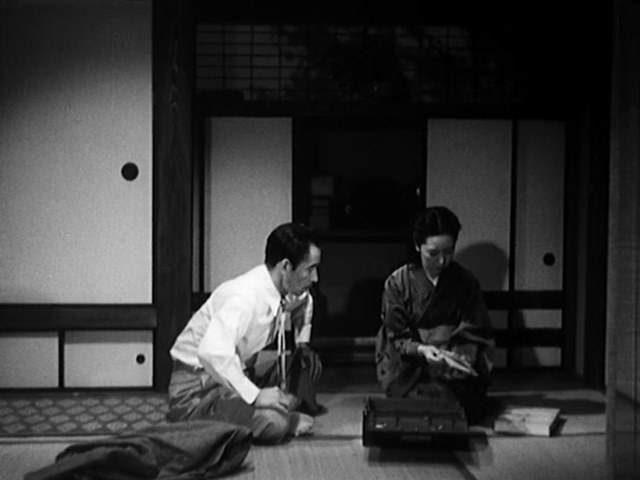
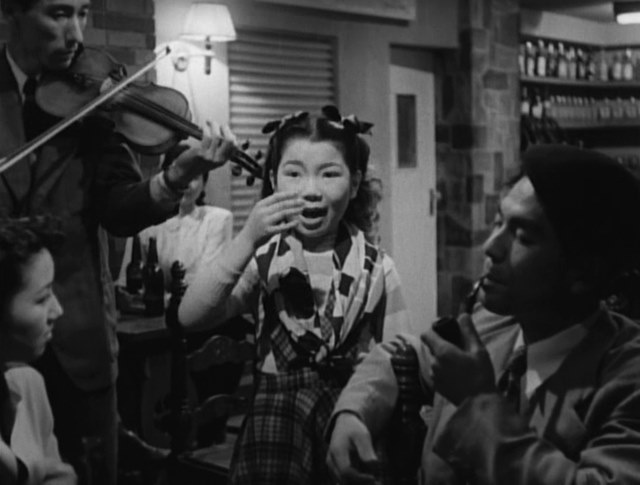
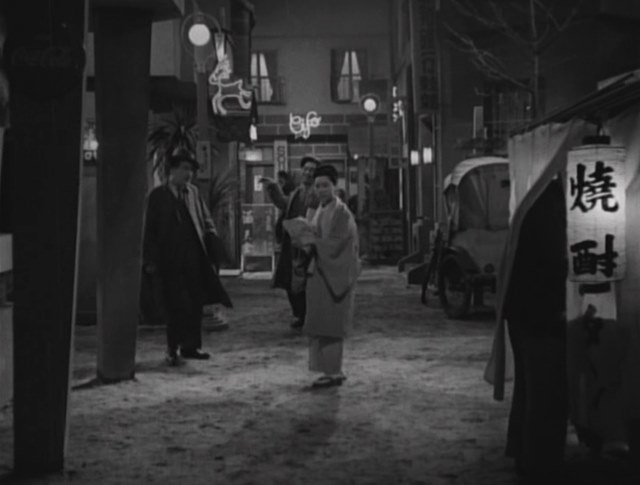
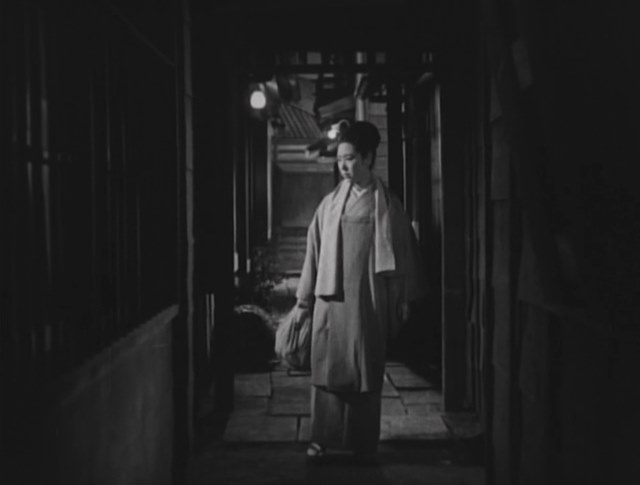
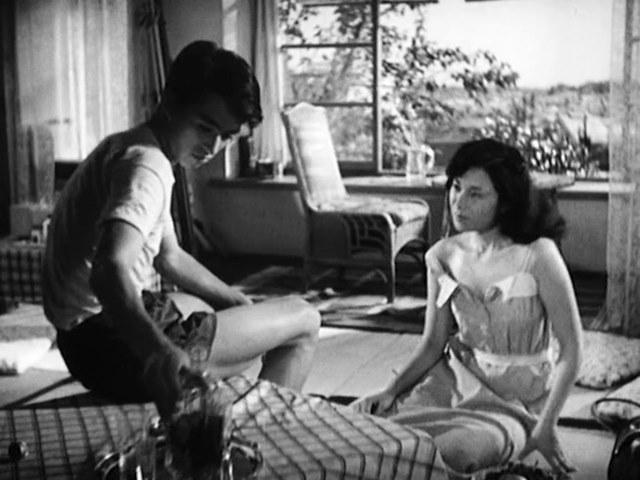
Yukiko Tsuji is an aging barmaid, but despite her age she’s still called upon to take care of her younger sister as well as her son. She tells her younger sister, with some sad acceptance in her face, of the way her heart was broken. “Most men are beasts” she adds. Later on, we see evidence to back up this claim. Around the bar, men endlessly make advances towards Yukiko who, yes, as a sex worker does have sex for money at times, but the environment in which she works is one that is constantly challenging her comfort. Her age and lack of money leaves Yukiko in a tough spot, her work is tied to her youth and physical appearance while that work itself is still not enough to pay for the expenses that are necessary for something as simple as staying alive.

2


It’s not the most unique idea to suggest that Naruse’s films about ultimately about money. His protagonists, almost all of whom are women, are sandwiched by being women and being poor. That sounds like these are two separate forces, but in Naruse’s world and the one we actually live in, these two oppressed status actually work together, influence each other, and ultimately have a relationship that makes one inseparable from the other. Some might call Naruse’s work superficial because it is about money, but most of life is superficial then. It’s not “materialistic” to be concerned about money when surviving is at stake. Perhaps then, it would be more accurate to describe his films as not being about money, but self-preservation.
3


Yukiko is played by Kinuyo Tanaka, who is most famous for her collaborations with Kenji Mizoguchi. She’s always wonderful in a Mizoguchi film (or anybody’s film for that matter) but I honestly prefer her here. There’s a quiet resignation in her performance, though I think Yukiko is not one who has given up. Instead, she’s accepted reality, an admittedly harsh one that seems set to both scrutinize her behavior and want to benefit from it. The men in the film joke about the “standards” of the women they interact with, yet have no problem in continuing in hanging around them. They seem oblivious to their moral dishonesty, but it has the dynamic in sexwork changed much? Naruse (like Ozu) hasn’t made a film critiquing Japan’s old-fashioned morals (which is how so many western critics frame it) but instead the racist, patriarchal society that we inhabit today.

4

After seeing Jonathan Glazer’s Under the Skin a few months ago, I remarked on twitter that it beyond all of its modern stylization, it actually came from the same place as most of Naruse’s work. To be short, I think Glazer’s “science-fiction” film is actually obviously about the horror of being a woman in a public space. It’s scifi context gives some justification for a male audience that weirdly enough, might have a better time understanding the discomfort of an alien over an actual living woman. Naruse’s work doesn’t have this context, of course, but it does give us the same experience. One that supports Yukiko’s claim that all men are beast. While trying to pay back a fine, she asks for help from a wealthy businessmen. The overwhelmingly polite man slowly becomes more and more forward and aggressive until he finally gets Yukiko alone in an abandoned garage. He’s only considered her status as a sex worker and not her status as a human being, which is why he seems genuinely upset and confused when she runs away.
5

There’s an IMDB review of Ginza Cosmetics that mentions, in passing, that the men in Naruse’s films are generally weak. I wouldn’t disagree, though I would add that they are indicative of the reality. “Weak” not in the sense that they’re under-written but instead that in Naruse’s world they are indeed the peripheral, which is seldom the case in most films, arthouse or not. In Naruse’s Flowing (1956) the men seem to only arrive when they’re imposing on the geisha house that the film revolves around. There’s a similar sensation here that the men, when they are present, are imposing on the lives of women. Humanism is overused in describing film and usually applied to filmmakers who try to make all of their characters equal but by making the marginalized individuals the center, I’d argue that he’s more humanist. Not that it’s a contest.
6


Musashino fujin / The Lady of Musashino (1951)

3 06 2014

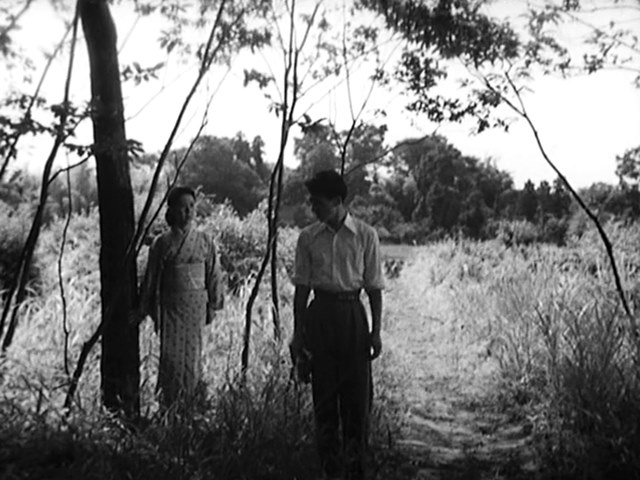
What makes a protagonist for a Kenji Mizoguchi film? For starters, one needs to be a woman, preferably a struggling one. This doesn’t sound too complicated, we need someone who can express years of pain and disappointment in simple facial tics? Yes, Kinuyo Tanaka is perfect for the part. This might sound like me being glib or reductive, but it is part of the filmmaker’s DNA. None of this is a problem to me, as his fellow countrymen, Ozu and Naruse, made films of a similar ilk during the 1950s, but the one reservation I still have about Mizoguchi and will continue to have about him is why he must turn his women into martyrs. Sure, yes, a patriarchal society is to blame, but the insistence on sacrifices leads me to believe that there’s actually something quite troubling working underneath his art.

1

Michiko Akiyama is stuck in a loveless marriage to her husband and professor, Tadao. The two exist at two opposing ends, Michiko loyal and committed to the moral code of the past. Tadao, on the other hand, is unapologetic about his the west’s influence on him. In his classes, he teaches a “theory” that suggests that adultery is inevitable and logical, all to the delight of a giggling group of women who are obviously impressed by his charm and good looks. Tsutomu enters the picture, a young man eager to escape the city and the “amoral women” he associates himself with there. Upon arriving in Musashino, he finds the pure woman he’s looking for in Michiko. Yet, the thing that makes her attractive is part of what keeps the two from being together.

2

The setup here, which comes from a Shohei Ooka is actually quite concise and economical. The story gives us a woman and a man in a unsatisfactory marriage, yet we only see pressures and responsibilities held up against one of them. That would be Michiko, of course. Her father tells her early on that she’s responsible for keeping the community of Musashino and the family name alive. Tadao receives no similar scrutiny, and in fact, we’re not entirely sure he cares the slightest bit about the actual relationship. While he doesn’t care for Michiko, the burden will be placed on her if they’re not able to reproduce. Of course, because they can’t stand each other, this is not even close to a possibility.

3

The always wonderful Masayuki Mori plays Tadao here, and he manages to breathe some life into a character who is intentionally underwritten. The problem here is that his “badness” is so one dimensional that the dynamic never also for something more realistic. Also in 1951, he was Mikio Naruse’s Repast, where he was also a negligent husband. Naruse’s film, coming from the pen of the great Fumiko Hayashi, gives a balance to the relationship that still manages to illustrate the power dynamic. I’m not arguing for something more “subtle” just because it’s better storytelling, but also because this aforementioned power dynamic often manifests in situations where it not be as so clear and obvious as it is in The Lady of Musashino.

4

All of this is a bit more forgivable when one considers that Mizoguchi often wore his politics on his sleeves, yet I think my other problem with the film is that he’s really not as clear as he should be. One sequence gives us Michiko and Tsutomu walking along a beautiful river, which Tsutomu tells us was the location of a sex worker’s suicide. This folk tale is told in passing and seemingly isn’t meant to add much beyond the suggestion of something mythical. Ultimately, I’m finding myself placing a lot of Mizoguchi’s own work on that same plane. There’s a few exceptions (Flame of My Love and Street of Shame come to mind, but there are others) but mostly his sacrificial women are obscured by the mythos of their storyteller. Mizoguchi achieved visual poetry often, but instead of expanding on the pathos of his characters, in films like Mushashino, he seems to minimize their plight and reduce his women to tragic individuals whose stories we’re to tell over a camp fire.

5


Anne Trister (1986)

21 05 2014

Self-discovery is a real thing, a real process, yet it has undeniably become sullied, if only because it’s something so frequently depicted. Referring to our lives as “journeys” is hackneyed, as is the visualizations of said journey to have roads and paths. Yet, I can’t help but find these rickety and recycled images flowing through my head while watching Lea Pool’s Anne Trister, which is indeed a film about self-discovery. At times, the titular Anne seems to fit into all of these tired images, but it would be too cynical (and stupid)  to write off every film about “finding yourself” just because it sounds so trite. Pool manages to tiptoe around these problems, and while her film’s simplistic symbolism occasionally threatens to push into that banal territory, her images and Anne herself remind us to be compassionate and loving. It’s not that the film begs for sympathy, it’s that it understands how, when struggling, most of us deserve some.

1

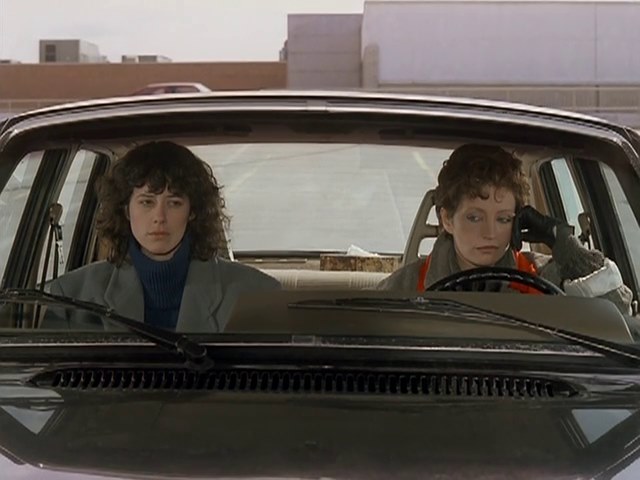
Following the death of her father, Anne Trister decides to reconnect with some distant family in Montreal. Departing from Switzerland, she must say goodbye to her boyfriend. The two keep in touch through letters. Anne begins living with a child psychologist, Alix, who spends most of her time analyzing a problem child named Sarah. In the mean time, Anne takes over a sprawling, yet vacant and deserted studio space and commences resurrecting a complicated mural. Alix’s relationship with Thomas begins to grow sour as Anne finds herself increasingly attracted to Alix. Neither of them are quite sure what to do next, so they both retreat into their work. Anne, working harder than ever on her mural and Alix, whose observations of Sarah develop into an experiment.

2

I find myself struggling to describe the relationship between Alix and Anne, but that’s mostly because there isn’t that much there. This is not a talkative film at all, and the beauty of the two’s love comes from what is left unsaid (which is a lot) and the fact that neither is entirely sure what they’re suppose to be working towards. Both are involved in seemingly steady romantic relationships with men, yet their potential romance doesn’t even seem to clash with that. There’s no suggestion that monogamy is necessary or even something to be concerned with, because Alix and Anne are probably more concerned with what they mean to each other, then what their love (and however that may manifest) means to the people around them. They’re not and shouldn’t be concerned with how their boyfriends may negatively react.

3

I feel like even bringing up the peripheral heterosexual relationships at play here undercuts what Pool is trying to accomplish. They’re not of consequence here, and Thomas being jealous about Anne seems like something only the most oblivious and selfish men in the audience would be concerned about. The film is about Anne, and her identity. That could mean her sexual identity, but the film does not try to neatly file away her new attraction into some huge “aha!” moment. Queerness doesn’t always perfectly make sense one day. Pool makes no attempt to define her protagonist, or even lead us to conclusions about her. Anne herself opens the film with a quote about her paintings that seems to reflect this, “We don’t always feel like working in standards, the frame limits me.” Although Pool has tightly composed her subjects literally, she has created an environment where, although they are overwhelmed and even scarred, they are still given the freedom to express their solitude.

4

If Pool takes a misstep, it’s that her film gets bogged down by the weight of its intentions. To elucidate, the film is centered on some heavy symbolism. The mural that Anne spends most of the film’s running time constructing is torn down while she’s in the hospital. She’s only in the hospital because of course, there’s a tragic accident while she’s working on the mural. With a  film like Anne Trister it feels almost unfair to ridicule melodramatic turns since the narrative itself is not the point here. The film situates us so firmly with Anne that we might be willing to forgive some of its more forced moments. However, the film’s simplistic setup of the mural = dreams is corny. So all that hard work gets destroyed, which is sort of how Anne feels so far in life. All the effort put into her relationships, her love for her father, her work as a painter, her life feels destroyed. She feels lost and alone. Pool does a good job of communicating this without the tacky symbolism. Still a great film, but its strengths almost get lost alongside the rubble of the destroyed mural.

5


À tout prendre / Take It All (1963)

20 05 2014

If there’s been a theme on the blog the last couple months, it’s been the way  films center certain individuals in heterosexual relationships. Back in January, I applauded Hong Sang-Soo for decentering the men Our Sunhi, making a film instead about the titular protagonist. The result is that the one we are to sympathize with is a woman, and this is a rarity. I’ve been coming back to it sense then, finding echoes of Hong’s achievement in the works of someone like Eric Rohmer, but looking for it everywhere. My interest is in destroying or at least deconstructing the way heterosexual relationships are established in fiction. So often the plight of the men is the one we are to be concerned with. Claude Jutra’s debate doesn’t decenter the male protagonist, who is Jutra himself, but it does provide an introspective look into the male mind, and provides some criticism to the dynamic. Jutra hasn’t stripped it away completely, but he has freshly given us something to eat away at the series of images we’re given that tell us that only men feel heartbreak.

1

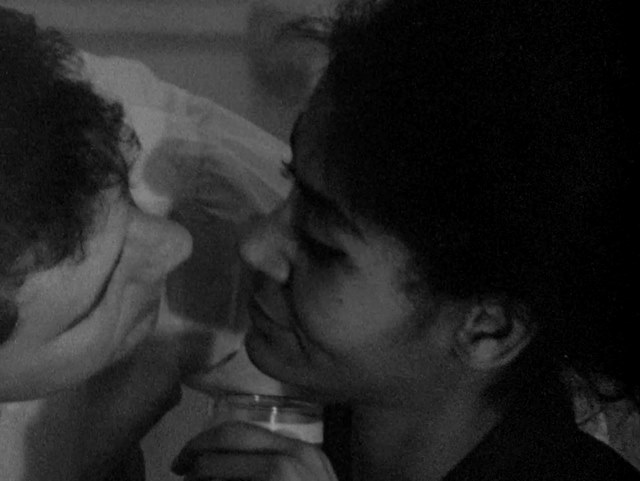
Claude likes his solitude. He tells us as much in voiceover. Yet, when a friend suggests he go to a party, his initial resistance quickly fades. He doesn’t seem to be have a particularly good time, but then he spots Joanne. His inner monologue begs for her to notice him, and eventually, she does. The two, perhaps because of the intoxication, flirtation, and the excitement of the moment get caught up in each other’s bodies. The prospects of a one night stand are soon written off, Claude affirms his love for Joanne. The two start spending time together, she leaves for a fashion shoot in Manhattan. He doesn’t exactly remain faithful, but he feels no obligation to do so. The relationship seems to casually float along,  never reaching the excitement of the first night, while still not feeling overwhelmingly negative. One day, Joanne asks Claude about his sexuality. He doesn’t know how to answer.

2

There’s definitely an impulse to compare Jutra’s debut to John Cassavetes’ debut, Shadows. It is similarly rough around the edges, composed of jarring edits punctuated with more observant and tender moments. An important scene in Cassavetes’ debut involves Tony meeting his girlfriend, Leila, and her brothers. With her lighter skin, she passes as white and she certainly “fools” Tony, who freezes up and runs away when he sees her much darker brothers. Weirdly, this is the only moment in Cassavetes’ ouevere that ever comments on race, and the quotes from the man himself suggest he had a “color-blind liberal” approach to the matter more often than not. Jutra has made a film about race, even more so than Cassavetes, and he has wisely not taken the position of the one to be the preacher, but the one to, perhaps, be preached towards.

3

It would be unwise to say the film immediately takes notice of Joanne’s blackness, but only because we see things through Jutra’s eyes. Sure, he notices the color of her skin, but in his liberal mind, one that is suppose to be progressive enough to ignore race, he probably convinces himself he’s seeing nothing more than a pretty girl. This is actually, well, it’s smart. It’s this kind of casual avoidance of reality that leads to the relationship disintegrating. At one point, Joanne herself points out that she might be nothing more than experience for Claude, “You love me because you think I’m different” she says. “You think I’m exotic.” Indeed, Claude himself believes that Joanne came from Haiti and he asks her for stories about her upbringing. Twisting reality, she indulges in the Othering fantasy he wants. She does it because she loves him. He loves her because of bullshit like this.

5

The truth becomes clear as the film progresses, Claude really doesn’t love Joanne. He loves an idea of her, one that he created, and one that she played along with. She becomes pregnant, but he selfishly removes himself from the relationship entirely. I think this becomes a reality for a lot of dudes, especially ones in my age group: the idea of a “girlfriend” is something both so elusive and so attractive that when the time comes to be in an actual relationship, there’s no room to, you know, actually take care and feel for another person. Claude ends up getting bored and frustrated with Joanne so his clean break is meant to help him. He still wants to see her, of course, but by forever removing himself from her life, he’s romanticized his past. He can wistfully think back to their time together, which is probably more satisfying to him than doing the actual work that is necessary for a relationship to continue. Jutra exposes himself, he exposes how other countless “tortured, sad boys” are not really that, but just slanted male expectations. One that can’t and shouldn’t be filled.

6


Underworld U.S.A. (1961)

18 05 2014

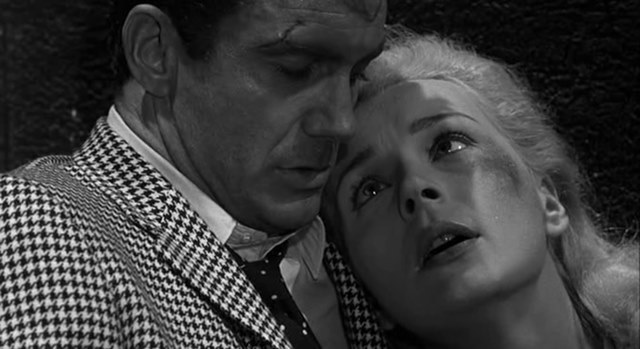
Samuel Fuller’s reputation is cemented, it’s far too late to challenge it. The conventional wisdom suggests that he might not have made the most perfect films, but he instead fueled the ones he did make with a passion and fervor that it indemnified anything that would conventionally be read as “bad” filmmaking. Fuller’s reputation is immensely entertaining because, while outside of Hollywood, he wasn’t working in complete opposition to Hollywood filmmaking. His films then become a study of the small things that are conventionally diagnosed as “good” and “bad” in American cinema. Underworld U.S.A. is unique in the Fuller filmography, its one of the few films (of which I’ve seen) that seems to fit most closely in the mainstream mold. Even as it feels more perfected, it has one of Fuller’s most riveting political observations. It feels closer to Hollywood, but what it says couldn’t be further away from it.

1

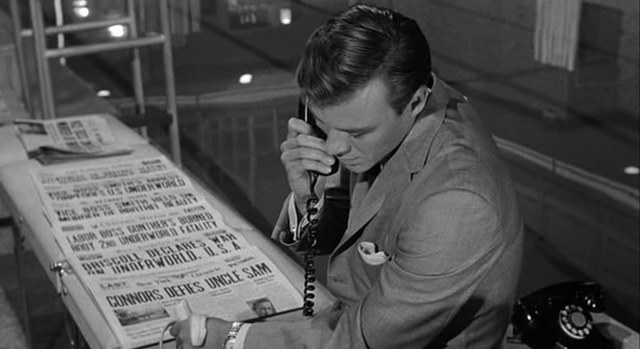
On New Year’s Eve, Tolly Devlin witnesses the death of his father at the hands of four men. The trauma of the situation leads him down a lifestyle of crime, where he ends up in prison. There, he becomes a model prisoner. Volunteering at the hospital, and closely listening to the doctors. His motivation is for revenge. He’s trying to find Vic Farrar, a dying man who may have been responsible for his father’s death. He gets Farrar alone and asks him for the names of the other three men. Since the murder of Tolly’s father, the remaining three murderers have climbed to the stop of the crime syndicate. Out to get his revenge, Tolly decides to work for both sides, all while living with his mother-figure, Sandy.

2

After a disappointing revisit with The Naked Kiss (I find the film’s attitude towards sex work rather paternalistic), I was afraid of exhausting myself on Fuller. Underworld U.S.A. is kind of the perfect film for someone who admires him, but who might also grow impatient with the filmmaker’s didactic and simplistic approach. Here, he’s a bit more reserved, and the energy that he usually uses to plow his hamfisted and simplistic politics through a film’s core, is instead used for something refreshing here. There’s part of this film that feel remarkably typical for the noir genre, but then one takes a step back and realizes that the protagonist is a grown man trying to solve a crime while living with his mother. He actually touches upon something far more interesting, politically speaking, then he does in his work that I’ve seen. It’s the idea that the American criminal justice system is not just corrupt, but that it is intentionally structured to benefit the people at top, and keep those at the bottom down.

3

At the surface, Underworld U.S.A. is, in addition to a revenge film, one of just countless films that depicts corruption within the police force. While many of these films get praised for being “daring” they are actually the opposite. The “crooked cops” motif actually reaffirms the idea that cops, generally speaking, are working with our best interests in mind. This sounds like conflicting ideas, but the crime drama that depicts corrupt police usually involves either downfall or a suggestion that they’re in the wrong. They are positioned as abnormal versions of the moral upstanding officer, and they usually see their justice. I mention all this because Underworld U.S.A. gets right what so many of these films get wrong: it does not suggest that there’s anything unusual about this kind of behavior. It recognizes the crooked cop as almost a cliche, something inevitable, which is the truth.

4

Perhaps more important than this attitude, is Fuller’s idea that the system itself is entirely corrupt. This sounds like the waxings of a teenage rebel, but there’s no denying that the criminalization of certain bodies over others does not come from a “mistake” by the authorities, instead it is a conscious hegemonic move. Underworld U.S.A. is almost completely white, which doesn’t provide Fuller to come all the way around on these musings and make a more typically Fullerian insight that is more pointed. However, it might not need to be there. The bureaucracy of the justice system is presented as both impenetrable, yet easy to influence. In Dolly’s case, it helps to be a schmoozer and to be a white male, and also to be in a dramatic movie. That sounds like I’m writing him off and the movie off, but these opposing ideas do exist in America’s crime system. It can be influenced easily by the powers that be, all if it serves the purpose to make them richer (see the War on Drugs) and maintain control of those at the bottom. Fuller maybe didn’t realize he was illustrating this complex within America, but maybe the fact that here, he finally seems comfortable and less eager. He seems to have something more interesting to say when he’s not entirely sure of what there is to say.

5