Kurosen chitai / Black Line (1960)

6 08 2014

Teruo Ishii started his career as an assistant to the great Mikio Naruse. While Ishii would go on to become Japan’s most beloved cult filmmaker, there is still traces of his mentor in this early effort. The jazzy, noir qualities of When a Woman Ascends the Stairs show up in Black Line, while Ishii also seems to devote some attention to the plight of women and yet, the sensitive qualities of Naruse’s work are absent. Not because Ishii’s film seems to “miss something” but instead, because he operates on a completely different level. The aforementioned noir quality is taken to its logical conclusion and the result is a film that feels like a serviceable genre flick, with only a few isolated moments that hint at something more.

1

Koji Machida wakes up and finds himself in bed with a woman, but the woman is dead and he’s the obvious lead suspect. Machida suspects he’s been carefully framed for the murder so he begins an unofficial investigation. It leads him to another women, this one gets deliberately run over by a car while the two are arguing. Machida looks even more suspicious, but as he climbs deeper into the underworld, the women become more welcoming (if only for the fact that they read his questioning as flirting) but the men become more hostile.

2

That last sentence suggests something that is one of the few major points of interest in Ishii’s film, and that’s how he handles gender. Machida himself seems to have a gendered protocol for social interaction, one that is confrontational and demanding around men, while cool and distant around women. For the latter, he seems to have been raised on American noir, perhaps using Humphrey Bogart as a character to emulate, not unlike Belmondo does in Breathless. This isn’t the most revolutionary idea, and I’m not even sure Ishii himself is making a conscious decision to meditate on Machida’s social malleability, but instead it is something that rings true that probably just flows subconsciously from the film’s script. It’s not always a gendered thing, but it can be: being around different people can shape our interactions and even how we talk depending on context. Much is said about the performance of gender, but that’s not the sensation here. Instead, it’s one where social interactions are read and experienced through a certain filter. I find the experience a difficult one to describe, especially because the language here is so tricky. Machida isn’t vapid or empty because his personality adapts to situations, this is something that happens, in some degree, to most of us.

3

Machida’s aforementioned social protocol encounters a problem, at least through Machida’s eyes of interpretation, when he meets Kayako, a trans woman. Their small conversation, which eventually ends in Machida shouting is a small portion of the film. I have no doubt that Ishii himself thought nothing special of the sequence, it is one that might superficially convince the audience of how “deep” Machida is in the underworld, but that’s already problematic. The scene is fascinating because of Machida’s inability to recognize Kayako as a woman (the film, alas, doesn’t do this either, crediting Kayako as “gay man”) and thus, his coolness around women isn’t present nor is his hostile attitude that is reserved for men. Kayako is a woman, but Machida struggles to accept this, eventually shouting at her before storming out.

4

Before the sequence concludes, Kayako leaves us with a rather succinct observation: “I am only here to please men.” Perhaps the most recent transphobic travesty found in the New Yorker is weighing on my mind, but how often is this idea about someone’s existence taken seriously? Although, Kayako is presumably a sex worker, this doesn’t imply that her or any other sex worker exists only as a tool for a man’s sexuality. This is 100-level feminism, yet it somehow seems to be forgotten about and not applied to trans women. Instead, an argument exists that their existence is itself a sexual perversion. I don’t want to dwell in the argument because it is so offensive, but Kayako’s line seems to acknowledge this line of thinking and expose it for the error that it is. Call it, if nothing else, an unintentional moment of clarity in a film that is far more comfortable exploring more familiar noir territory.


5


What Price Hollywood? (1932)

4 08 2014

George Cukor’s 1932 portrait of the rise, but not the fall of a young aspiring actress is best remembered as providing the working template for A Star is Born. Opening with its protagonist, Mary Evans, wistfully flipping through a celebrity gossip magazine, Cukor throws us into his world – Hollywood. But instead of another tired Hollywood exposé of the system that casually pokes fun at its own infrastructure, What Price Hollywood? presents something rare even in modern film. It’s a movie whose central relationship is that between a man and a woman, but one without any romantic connotation. Mary Evans’ relationship with Max Carey is friendship, but the film wisely doesn’t see that as a limitation, but instead an entirely new type of connection, one seldom represented in film.

1

Mary Evans is a waitress at a Hollywood restaurant. Seeing stars is not unusual for her or any of her coworkers, but she spots a golden opportunity when filmmaker Max Carey waltzes in one night. Max wakes up the next night with a tremendous hangover, which we soon discover is something of a trademark. He has no idea what happened the night before but Mary is laying on his couch. She tells him it was all rather wholesome, but that he promised her a spot in his next production. Not a problem, at first, but then it soon becomes apparent that Mary can’t exactly act. With her one seemingly washed away, she returns to her apartment exhausted but gets inspired. The next day she nails her scene, and her ascent begins just as Max’s alcoholism triggers his descent.

2

Cukor’s friendship-driven narrative naturally leads itself a queer reading. In one sequence, Max tries to show a distracted Mary how to properly seduce a man. I don’t think such a reading is forced, but I do think it is a little unhelpful here. While I find it’s a necessary viewpoint to consider throughout Cukor’s work, I think the personal thing here is the idea of platonic men-women relationships, which sounds so simplistic and unremarkable on paper but it plays out so beautifully, albeit tragically in Cukor’s hands. Mary does have a love interest, Lonny (who I’ll get to later) and while Lonny is a deplorable individual, his presence seems necessary to make us realize the value of Mary and Max’s friendship. With Lonny introduced, the film sets up an easy love triangle, one that would have been expected in 1932. Cukor wisely steers the movie away from this territory.

3

If there’s one particularly loud hiccup in Cukor’s visions, it is Lonny himself. He quite literally forces Mary on a date, by dragging her out of her bedroom. He later has to feed her. Such a setpiece is meant to be “charming” in the man’s persistence in his love interest. Again, it wouldn’t have been that unusual to see in a screwball comedy at the time. So how can I excuse Cukor for such a character? Well, I think the fact that he does come off so negatively is a conscious move. Mary and Lonny eventually end up together “happily” or at least we would read this from the final scene’s cinematic grammar. Lonny is such a reprehensible character, though, that it feels like an error to read this so easily.

4

Instead, I find Lonny’s presence and representation of romantic love for Mary to be emphasized as negative to contrast to the more positive friendship she has with Max. How often does cinema, like other forms of storytelling, emphasize the importance of finding “the one” or experiencing true love. Weirdly, this kind of grandiose sensation is one we’re suppose to both feel and try act out, which oddly enough leads to troubling and even abusive behaviors. Fittingly enough, it would not be a stretch at all to classify most of Lonny’s behavior in this film as abusive. A similar diagnosis could be made of most romantic relationships in Hollywood films at the time. The question becomes then if What Price Hollywood? romanticizes such a problematic dynamic or it attempts to deconstruct it? I think Cukor’s usual critical eye for Hollywood’s compulsory heterosexuality is present. Within this though, is a tribute to friendship. Again, it sounds corny, but how often have you seen a film about friendship that wasn’t just heterosexual men bonding? It is a vital image when other such relationships are represented, even more so when they’re cloaked in what appears to be a typical romantic situation.

5


La prima Angélica / Cousin Angelica (1974)

2 08 2014

Spanish playwright Ramón del Valle-Inclán once said, “Things are not as we see them, but as we remember them.” The phrase seemed to stick with filmmaker Carlos Saura and writer Rafael Azcona, as it became the inspiration for the two’s 1974 collaboration, Cousin Angelica. Memory, perhaps because so many of us experience it through certain visual cues, is an immediately cinematic sensation. Saura doesn’t construct his images with the flash and poetry of someone like Tomás Gutiérrez Alea, whose Memories of Underdevelopment seems to be touching on a similar impulse. Instead, Saura smashes the past and the present into the same image, constantly manipulating the continuity of a single shot. The result is unique, to say the least, and if nothing else, it proves that describing a film as “dream-like” can mean just about anything.

1

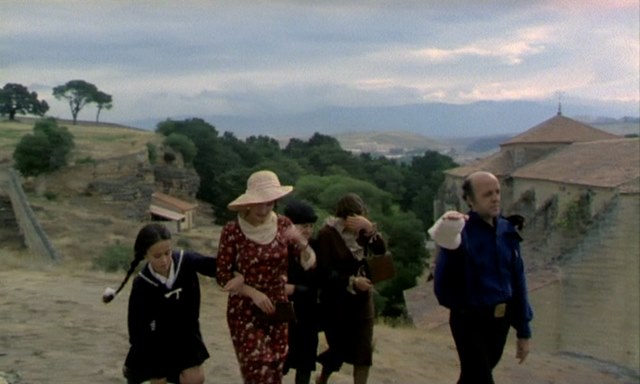
Traveling from Barcelona to Segovia to bury his mother remains, Luis recounts his visit in 1936. It was there, right in the middle of the Spanish Civil War, that he met and fell in his love with his cousin Angelica. Meanwhile, in the present, Angelica is now married with a daughter of her own, also named Angelica. Her daughter is the same age she was during Luis’ last visit, they appear to be the same person. Similarly, Luis can’t shake the memory of Angelica’s fascist father being the same physically as her husband, although actual photographs suggest that there is no resemblance at all.

2

While Saura does present an entirely new way of linking the present with the past, it might be of use to mark some familiar territory. If there’s one film that seems to operate on a similar ground as Saura’s, it’s the final film of fellow countrymen Luis Bunuel, That Obscure Object of Desire. There, one woman is represented by two different actresses. While Bunuel is meditating on something else entirely, he and Saura share for the mise-en-scene to be jarring as opposed to Alea’s more familiar (think Malick) route where the editing juxtaposes two different realities or periods of time. Saura manages to capture two different period of times within one frame, and does so with a calculated and precise eye.

3

This plays out in a fascinating, almost mysterious nature while watching the film. In one sequence, Luis and Angelica seem to recapture their love from the summer of 1936. They climb on top of a roof and embrace. Cut to a static shot inside the window they climbed out of, and we hear, off-screen, Angelica’s father of the past or her modern day husband. Because the two are played by the same actor, a connection made from our point of view, Luis’  brain, there is a tension not in where the film is, but when the film is. Because Luis’ memories are interacting with the present, the answer might be both the past and the present. That sounds needlessly complicated, but it is reflective of the film’s greatest strength: the dedication to filming the experience as Luis himself would both comprehend, reflect, and respond to it.

4


Meghe Dhaka Tara / The Cloud-Capped Star (1960)

27 07 2014

It takes all but two minutes of Ritwik Ghatak’s The Cloud-Capped Star for money to be discussed. Saying that money is a primary theme of the film might evoke some groans, how often do we expect works of arts to communicate something deeper, whatever that means. We often expect the grandest of artistic statements to not dabble in something so common and superficial? The binary between the grand and the everyday is, of course, a completely false one. Ghatak’s characters are motivated by money, their unhappiness and despair is fueled by their inability to pay the rent. The Cloud-Capped Star‘s biggest accomplishment is that it is as poetic as it is pragmatic. A drama that creates a rhythm of daily existence, but captures and frames the routine is such a mesmerizing way.

1

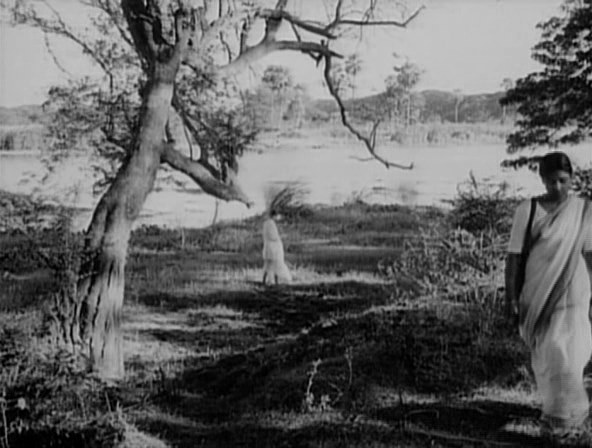
Neeta breaks her sandal on her way home, but instead of purchasing another pair, she finishes her commute barefooted. Awaiting her at home is her brother, Shankar, a talented singer with no means of income. He knows Neeta is bringing home her monthly salary, and hopes she might be willing to share her earnings. Younger siblings Gita and Mantu also ask for some of Neeta’s earnings, as they seek to acquire new clothes. Putting the rest of the family before herself is just a part of Neeta’s life, even though her mother scolds her for doing so. With both of her parents unemployed, Neeta is the family’s main source of income. To continue her role, she puts her romance with Sanat on hold. She delays her own happiness, with the expectation that one day, she will be repaid for her sacrifice.

2

We’ve known Neeta for a very short time when she reads a love letter sent from Sanat. She holds the letter with so much devotion that it might as well be an actual person. She gazes into the sky, presumably to dream of a lovely future. Then, she is immediately interrupted by her brother, Shankar, who begins to tease her for the letter. This early moment builds a structure that is followed throughout. Neeta’s moments of happiness and rest are fleeting, and they are likely to be interrupted. Her family expects everything of her, and when she takes time to pause from her unreasonable duties, someone comes along to correct her or criticize her for forgetting about the moon when she only gives her family all of the stars.

3

It sounds a little too dreary to say that Neeta is doomed, but her situation is one that can never quite be appreciated. Her family can acknowledge her personal sacrifice, but they never seem to be fully aware of its weight. The only time her devotion is mentioned is in arguments. For example, her mother praises her in passing, but she mentions her as an example when criticizing Shankar and his lack of work. Acknowledgement comes but only with the expectation that everyone else should be working as hard as she is, never is the idea that she is working far too hard floated through someone’s consciousness. Neeta’s love interest, Sanat, suggests that she’s “not cut out to endure this” but even here, something seems to be missing. Neeta’s reply, “It doesn’t matter” is quite telling. Sure, she’s not cut out to endure this, but nobody is cut out to endure suffering.

4

Sanat himself suffers, though he tells us that he suffers for an ideal. To be more direct, he is basically turning down job offers to pursue his academic interest, with the hope of a more worthy career. Throughout the film, the people around Neeta look down on “physical labor” in spite of the fact that they can’t even pay the rent. Neeta gets such a job to earn some extra money for the family, but another personal sacrifice is seen as shame. Her father asks, “Is this what the middle class has sunk to?” The family can’t pay rent, sure, but physical labor is something beneath them. Once again, everything is expected of Neeta, yet everything she does is unfairly scrutinized. As a woman trying to take care of her family, her suffering is seen as trivial next to the “artistic” or “political” suffering of her father and Sanat, the latter who willfully chooses such a life. Little do they know, her suffering is far more political.

5

There are some who would hesitate to call Ghatak’s film political, if only because the idea of the “political film” evokes an idea of a film far removed from his world. I don’t like the phrase, simply because it implies a genre, one that is often used to describe experimental and consciously political works of Europeans like Godard or even Pasolini. Ghatak, like Naruse before him, is extremely political even if the vocabulary of Marxist theory is absent. I love Godard and Pasolini, for the record, but this image of the “political film” ignores The Cloud-Capped Star or When a Woman Ascends the Stairs, to give one Naruse example. Like Sanat’s consciously political suffering in this film, the musings of men is given more weight. Sure, Ghatak was a man, but it is easy to see his film gendered feminine. Those critical of the film accuse it of being melodramatic, a term that evokes femininity and something less authentic. It is something meant to undercut the political implications of such a film, after all shouldn’t Marxist theory be left to solemn white males? The answer is, of course, no it absolutely shouldn’t.

6

The irony in all of this is that Ghatak himself was vocally political and a member of Indian Communist Party, but such a detail contradicts the way western film scholars construct narratives around Asian filmmakers. This is the narrative that focuses on Yasujiro Ozu’s spirituality, the one that ignores his queerness and his radical politics. It’s the same narrative that focuses the attention on Satyajit Ray and applauds his humanity, but in the same breath dehumanizes the dense and vital history of the rest of Indian cinema and its contributors. This all seems like an off-topic tangent, one that suggests a simplistic reading of western film criticism. It’s related to my larger point, though. The Cloud-Capped Star is a deeply political movie, even as it is not a “political film” in the European tradition. It’s a movie about existing in a world that does everything to get rid of you, to achieve happiness despite the obstacles being endless. At one point, Neeta remarks, “All my suffering will vanish.” She’s wrong, of course, but that’s the tragedy.

7


The Clock (1945)

23 07 2014

Hollywood is the place where the most hopeless of cynics finally lay down their insecurities and admit that love is a beautiful and wonderful thing. Romance filmmakers in Hollywood often swing for the fences and sometimes the results are transcendent (Frank Borzage) and other times, we get a film like The Clock, which is admirable enough non-musical effort from Vincente Minnelli. The reason Minnelli’s boy-meets-girl fable falls apart is not because it is difficult to believe, but instead because it so flippantly portrays its romance that it is difficult to read it as anything else than just an advertisement for the idea of love. Perhaps this is what a lot of Hollywood romances were and what many modern ones inspire to be, but the parts of this film suggest something far more courageous that the disappointment is deeper.

1

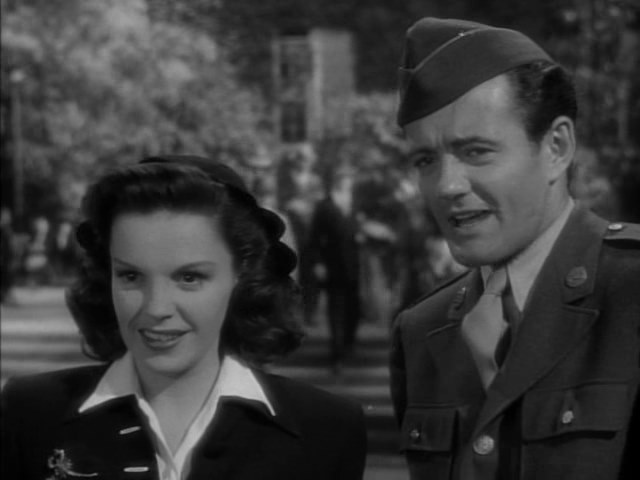
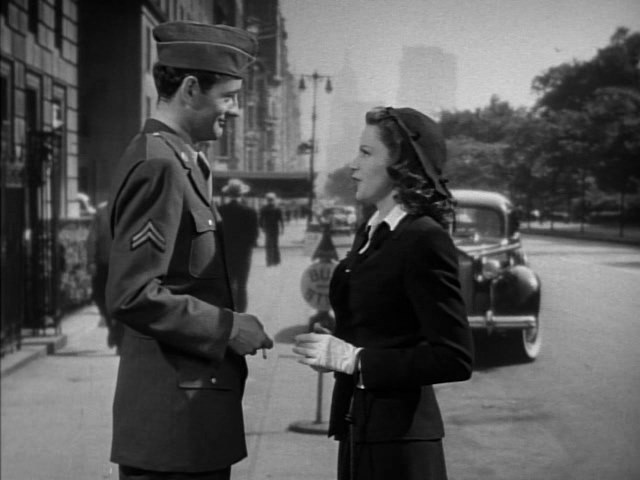
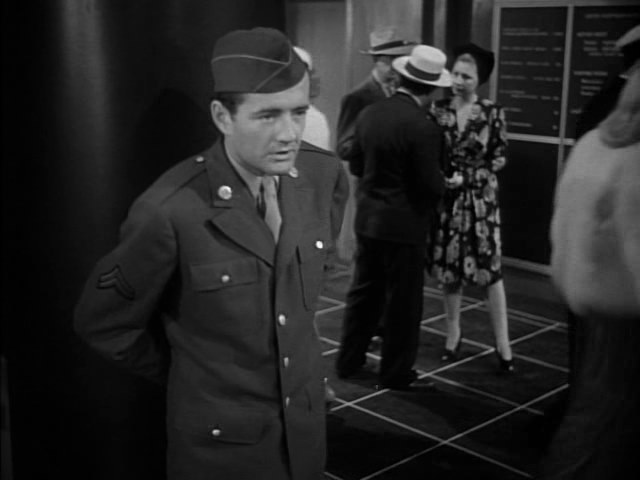
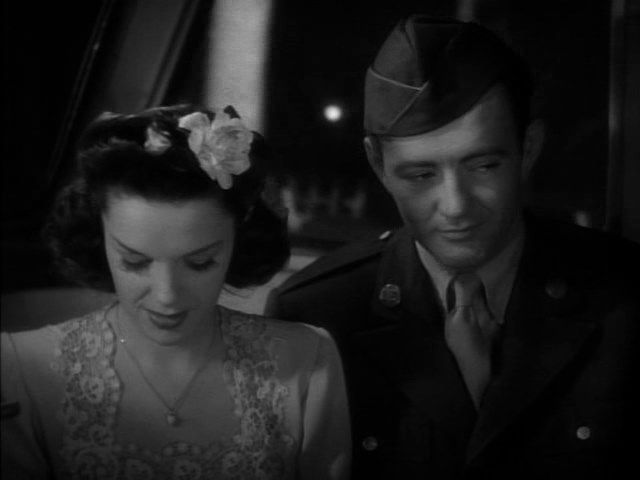
Joe Allen, on a two day military leave, finds himself in the inspiring and overwhelming monster that is New York City. Upon arriving at Penn Station, he bumps into Alice Mayberry. Alice, like the rest of the city’s inhabitants, seems to be in a rush, but she is eventually taken by Joe’s small town charm and she agrees to spend the afternoon with him. The budding friendship blossoms into something more as the two get into plenty of mischief running around the city. The question is, will their short time together be enough for them to stay together when Joe has to return back to the military.

2

I would like to state that first off, Vincente Minnelli does not deserve all the blame here. He tries pretty much everything in his cinematic power to capture the sort of magic that is a new romance is meant to evoke, in fact he succeeds. The film opens with Joe arriving at Penn Station with a tracking shot that immediately communicates everything about New York City and Joe’s relation to it. Without ever telling us, we already know that he’s never been anywhere nearly as big. His naivety is later confirmed in the dialogue, but Minnelli gracefully speaks for the character with his camera’s movements. There’s inspired moments such as this sprinkled throughout the movie (I’d be remiss if I didn’t mention Keenan Wynn as a drunk) but they’re not enough to buoy an experience that ultimately suffers from certain cultural expectations.

3

So where does the film fall apart? Well, at the risk of rehashing old reviews, I’d like to yet again bring up the idea of “decentering relationships” that I first discuss in my review of Hong Sang-Soo’s Our SunhiHong’s film expertly shifts the perspective from the men in relationships to one woman, and in the process, deconstructs many of the grand romantic gestures made by men in older films such as this one. In reality, one would be turned off by such actions. In The Clock, Joe is relentlessly passive-aggressive, which fine enough. I can say that I’ve exhibited similar behavior in certain situations, but here, it is somehow suggested to be a cute and endearing part of Joe’s smalltown makeup. Alice finds him charming, despite the fact she seems to have a life to return to.

4

There’s something that should be said for what little we know about Alice and what little we’re given about her before she bumps into Joe. To be fair, Joe is an equally opaque character, with not much known about him beyond his involvement in the military in his midwestern upbringing. Yet, we continue to get no details about Alice. Throughout the film’s first half, we get her repeatedly telling both the audience and Joe that she really needs busy and needs to, you know, get back to her life. However, all the other things in her life, indeed the things that would help contribute to making her believable as a person with a life outside of being Joe’s fantasy are erased. We see her roommate and see the fallout of a cancelled dinner plan, but not much else. It is perhaps too much to ask a film to completely eat away at the structures that make the world relatively devoid of pressures for men, but there’s also so much at stake for a film like The Clock.

5

In the past week, I’ve seen enough public displays of affection to last me a lifetime. I don’t really mind them, but it’s made me think about the problems in a film like this one. I hear many of my peers talk about they “want a girlfriend” with no idea that a relationship is a bit more than something you can just acquire. Films like The Clock, as well made as they are, feed into these ideas. Think of it in this way: beer commercials can’t actually show the product being consumed and often these romantic movies, can’t show the work that goes on within a relationship. Instead, both just show individuals being happy, suggesting that you need to experience this joy for yourself as soon as you can. It’s more than just “getting” a girlfriend, not to mention the possessive and problematic notion of such language.

6