Deus e o Diabo na Terra do Sol / Black God, White Devil (1964)

13 05 2015

Karl Marx’s most frequently recycled axiom is “Religion is the opium of the masses.” It’s unfortunate, of course, because it might be least insightful and most banal. More importantly, it doesn’t seem to hold much weight today. Sure, a majority of the world identifies as religious in some manner, and power structures are defended and held up in the name of religion. Yet, the drug of the choice might be pop culture. I won’t descend to the level of some trite condemnation of the multiplex showing endless superhero films. The superhero film, Marxism, and Christianity all splinter into a unifying vision for Glauber Rocha. Emancipation is his chief concern, but there is many ways in which it can be envisioned.

1

Receiving the ire of his wealthy boss one time too many, Manuel bursts out in a violent fit of rage. The ecstasy of breaking free from his oppressor is short-lived and he realizes that he and his wife, Rosa, must immediately go on the run. They seek the guidance of Saint Sebastian (the title’s Black God), who has provided the hope of salvation for the country’s poorest individuals. Meanwhile, Antonio das Mortes is sent, by a more respected and “conventional” priest to take care of Sebastian and his followers. Tragically, this pushes Rosa and Manuel into the arms of Corsico, the title’s White Devil.

2

While Glauber Rocha’s hallucinatory aesthetic is unique, there is a impulse to ground the experience of the film itself. We must, in order to feel, comfortable, find some sort of link between his images and that of other filmmakers. A common one seems to be Alejandro Jodorowsky. I’m no big fan of Jodorowsky, but I’ll ease up on him here. The Jodorowsky film is one that realizes that images, despite the power they hold, have no center. There is no connection between an icon’s power and the experience of real life, thus Jodorowsky himself sends forth countless images. One that provoke and even enrage, because they have to be unique. Realizing the lack of a center, Jodorowsky must demolish the old images and erect entirely new ones. Thus, shit and fire become key ingredients in his palette, the former so vile that it presences threatens to unseat the power structure of icons. Meanwhile, the fire becomes the thing that does destroy.
3

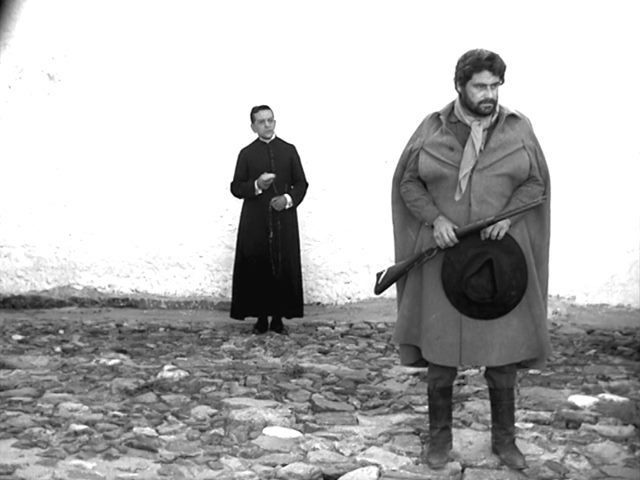
I think Rocha does have something in common with Jodorowsky. Both filmmakers come to the understanding that icons don’t have a center, but Rocha is not demolishing their power. Instead, he shows reverence for this. If images have no center then they, like language, are arbitrarily embedded with a meaning. This arbitrary assignment means they are powerless for Jodorowsky, but they are proof of their power to Rocha. He shows reverence for them not because they mean something to people, which is their greatest power. In one of the film’s most impressive sequences, Sebastian stands before the cross of his temple. Surrounded by the chaos of the world he finds solace in his worship, not by hiding from the suffering but confronting it head on in prayer. The scene ends with violence, which is all the more shocking because we’ve been guided by a filmmaker who has given these images the chance to breath and have power over the individuals who confront them. He is not positioning them around, emotionlessly, in order to provide the most striking visual moment.

4

Black God, White Devil is critical of images, symbols, and icons but it does not throw stones in their direction. Instead, it takes the time to critically acknowledge how and why they are important to us. Corisco, the White Devil, is comically inept, a crass parody of a revolutionary figure. He can’t see the need for images. Fittingly, he ignores the warning of a wandering blind man. He sees the people’s need to believe in him as a means to wield his power, a sign of their weakness. This give us the film’s most sensual moment: a protracted kiss that is heavy on beard, but it also ends his reign. There is no need to be cynical if one’s emancipation is at stake.

5


Keiko desu kedo / It’s Keiko (1997)

11 05 2015

Many artists have tried to capture the essence of time. Time, which is measured, but feels immeasurable in the way we experience. Time lingers and blasts through with such swiftness that we sometimes struggle to remember how it ever passed. In her latest book, Ongoingness: The End of a Diary, Sarah Manguso confesses that she kept a daily journal as a means to combat time’s progress. She writes, “The diary was my defense against waking up at the end of my life and realizing I’d miss it.” While Manguso’s strategy was to fight this daily, Keiko tries to do this by the minute.

1

Keiko spends most of her evenings in her apartment, counting off the sixty seconds in order to measure (and be conscious of) each minute. The death of her father is behind her, but she seems uncomfortable addressing her feelings. She instead focuses on her looming twenty-second birthday, which she sees as a crucial marker in her life’s timeline. In addition to counting each minute, she hosts a news program, composed mostly of her reciting the telephone numbers she called. Keiko, it seems, is struggling to make sense of time. A minute, an hour, a day – all seem like forces imposing on her, especially as she continues to reel from the loss of her father.

2

Keiko desu kedo is one of the earliest efforts from Shion Sono, who, in recent years, has transformed into one of Japan’s most beloved directors. The flash found in something like say, Love Exposure or Suicide Club is absent here. “Minimalism” has become overused in film circles, and I personally lament grouping all films composed of static shots and limited “action” together. Sono’s minimalism, if we prefer to call it that, does not function in the same way it would come to function throughout most of East Asia in the late 90s and early 00s. The films of Hou and Tsai are observant, while Sono’s (through Keiko Suzuki) is confessional.

3

While the film is presented as confessional, Keiko herself confesses very little. She gives us the facts that one might find useful, but she does not reveal the pain that she is likely hiding through her dedicated attempts to capture and cage time. The film’s grammar suggests, at every turn even, that she is revealing something personal even if she never offers up what this is through language. Sono fixates on Keiko’s face to the point of abstraction. It does not feel claustrophobic, mostly because the camera seldom grants us access to the space around her. Indeed, her apartment, with it blood red walls sharply contrasted with bright yellow lamps seems to become an abstraction on its own, ready to transform into a cartoon.

4

Many will find themselves frustrated by a film that is built around one character who is frequently shown counting to sixty. The final ten minutes could be maddening, but they are something of a revelation. Keiko finally steps outside of her apartment, the space opens, and the camera becomes more mobile. It tracks her as she skips in unison with her counting down the city streets. Her body’s performance seems to clash with the walking of passerby’s. Pardon the banality, but Keiko has to march to her own beat. That sounds corny, but consider this: Keiko has grieved, which is out of step with how our bodies are meant to perform and act out. Trauma, and our ongoing struggle to deal with it, goes against the state’s preference for our bodies. We need to do it, though. We need to be like Keiko, who continues skipping and counting far beyond the city’s streets, braving her way into a literal snow storm. Sometimes it isn’t even productive for dealing with loss, but we all deserve the opportunity to find that out for ourselves.

5


Subete ga kurutteru / Everything Goes Wrong (1960)

4 05 2015

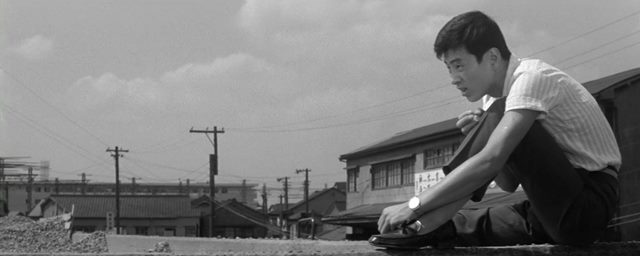
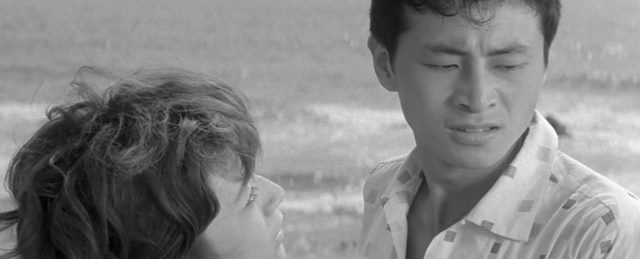
Frustrated by the cathartic images of war that the local cinema is treating him to, a despondent Jiro mopes around the city. His friends are enthralled by the images that they see, however they all leave the dark room of the cinema and enter the bright, bustling street corners of Tokyo’s Shinjuku neighborhood. It is easy to read Suzuki’s jazzy, fast-paced tale of teenage angst with Godard’s Breathless and Oshima’s Cruel Story of Youth, yet Suzuki has an investment in his city. An interest in the infrastructure that is more literal than Godard’s meditation on style and language or Oshima’s poetic interpretation of public space. This might be less visually stimulating than those two and we might be stuck with a flatter protagonist, but Suzuki surveys a city in transition. He reveals a truth: all cities are always in transition.

1

Jiro drifts around with his wanna-be gangster friends, they drink, they smoke, they fraternize – anything to distract themselves from school and their lives at home. Jiro, on the other hand, is still very much emotionally invested in his mother, Misayo. The family’s father was lost in the war, leaving Misayo as the only one responsible to provide for her son. She’s done so with  help from Keigo, a married businessman. While it would be accurate to describe their relationship as an affair, it is still one build on respect and trust. Jiro sees the relationship as only physical and financial and he scrutinizes his mother for sinking so low. “You’re basically a whore” he charmlessly declares just as he dramatically darts out of their home. Jiro’s unreasonable expectations of his mother translate to his would be lover, Toshimi.

2

Along with Breathless and Cruel Story of Youth, one feels an impulse to bring Rebel Without a Cause into the conversation. The characters in Ray’s film are, like Suzuki’s,  frustrated teenagers who only register events as either being or leading towards an emotional climax. There is one crucial distinction to be made here. The world of Rebel Without a Cause was suburban, the parental anxiety of teenagers’ “freedom” was evident in their access to cars. Space in Ray’s film is readily available, but it is in high demand for Suzuki. There’s a nervous energy the first time the camera whips across a crowded city street, and it is to the film’s credit that this same excitement is present even in private space.

3


The private vs the public is the most fascinating relationship in Everything Goes Wrong because they aren’t presented as in conflict. Oshima’s early “sun tribe” films (the aformentioned Cruel Story of Youth but also The Sun’s Burial) were only interested in the public space. It was here that Oshima could find violence, sure, but also visual poetry. Pop culture was on the periphery, it was simply a thing in which the film’s subjects were involved. Pop culture is part of the architecture for Suzuki, though. A poster of Coleman Hawkins is prized, if not fetished, as it seems to preside over the gang’s local bar. Suzuki, who would became a far more “pop” filmmaker than Oshima (at least only in retrospect, Nikkatsu still had no idea what to do with him) and maybe he recognized that pop culture was not just a thing, but part of the history. Denise Scott Brown’s essay Learning from Pop advocates for a serious consideration of popular culture within architecture, Everything Goes Wrong feels like it would be a perfect case study for her.

4

But, of course, pop culture is just frivolous nonsense, isn’t it? Suzuki wasn’t even the first Japanese director to acknowledge the presence of western culture. Tokyo itself translates into “Capital to East” (as opposed to the West) which suggests that those who named the city realized its relationship to the rest of the world. The structures we see in the film are all Western-influenced, even if they aren’t. Fukuzawa Yukichi’s Goodbye Asia (written in 1885) saw a country transforming itself into the modern as a means of protection from Western imperialism. This process involved demolishing old structures and displacing many place, an act that is erased by said demolition. The “pop” images bring this history back to the surface, and suggest that America’s occupation (and influence) of Japan was anticipated long before the war ever started.

5


Kaze no uta o kike / Hear the Wind Sing (1980)

30 04 2015

I’ll have something on this in a couple days.


Okayo no kakugo / Oyako’s Preparedness (1939)

29 03 2015

There’s a simultaneous sense of difficulty and joy in writing about a filmmaker like Yasujiro Shimazu. It comes from the lack of literature about the filmmaker in general. It’s difficult because there’s no consensus discourse formed around his work, but there in lies the joy. The responsibility is great, but engaging with his films provides us the opportunity for us to establish a narrative. Frustration comes from the many holes we have in his career. As is the case, I hesitantly call this film an important departure from his 1938 effort So Goes Love. Like that film, a “light” comedy turns dark, but the political factors are more muted here. It’s an important change for Shimazu, and the role of his leading lady, the great Kinuyo Tanaka, positions an even greater career shift.

1

Oyako is a live-in assistant at a dance academy.  She occupies the space of both a pupil and a professor, providing lessons, but also acting as something of a maid to the academy’s “master” (as she refers to her) Osumi. Shunsaku, a photographer, enters the studio one day to photograph the two. Oyako is visibly flustered by the appearance of such a handsome man. She can’t hide her blushing face, which is explained away by Shunsaku’s assertion that “cameras make young people blush.” While waiting for the development of the pictures, Shunsaku takes Oyako out to dinner. She’s completely smitten, but later overhears a conversation between Shunsaku’s mother and Osumi. He’s interested in marrying a complete different student at the academy.

2

The economic hardships depicted in a film like So Goes Love are not completely eliminated here. For example, Oyako’s grocery shopping trip ends prematurely because of money. Income doesn’t drive the narrative here, love does. Oyako’s unrequited crush for Shunsaku is to be understood by us as a tough case of puppy love. Osumi herself explains the pain as being part of her youth. Age and experience makes us wiser about relationships, time allows us to reflect on past heartbreaks as something not so serious. Even if we cried uncontrollably, as Oyako does here, the privilege of hindsight allows us to even laugh about these earlier disappointments.

3

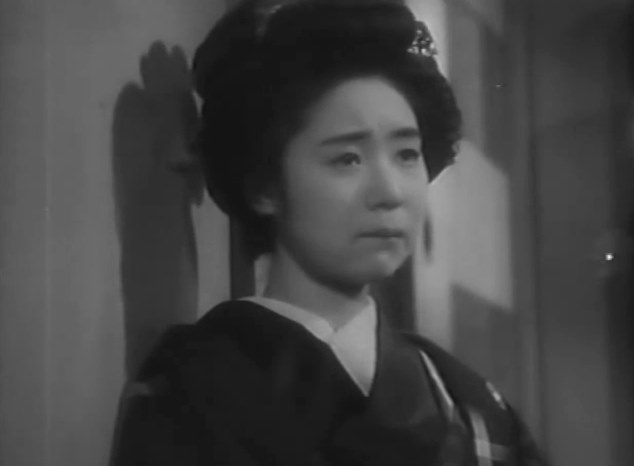
Still, Oyako’s pain is registered as valid by Shimazu’s camera. For most of the film, his eye remains neutral. The tight spaces of dance academy almost seem to expand with his camera’s distance. However, he focuses in after Oyako gets her heart broken. He himself might take the position of Osumi, he suggests we all experience these unrequited crushes in our youth, but even then he understands that Oyako’s pain, in that moment, feels like the biggest tragedy ever. With this pain, she imagines herself delivering a powerful dance performance on a stage. It’s all captured in one take, then the film dissolves back to her in the dance academy. She collapses, the camera slowly pans in unison with a swelling soundtrack. The pans anticipates the presence of another body. Perhaps Shunsaku has returned to pronounce his love! The pan stops, but no body enters the space. The film ends.

4

It is interesting that Oyako’s youth is stressed so frequently as the woman who plays her, Kinuyo Tanaka, was transitioning out of the “youthful” part of her career. Prior to the 1940s, Kinuyo Tanaka was a sex symbol. At the very least, her sexuality played a factor in her public persona. As the 40s rolled along, Tanaka’s image shifted. In A Hen in the Wind, she was the victim of spousal abuse in Ozu’s most violent film. Her collaborations with Mizoguchi, furthered this image of the enduring victim. Even in Life of Oharu, where she plays a sex worker, her own sexuality of no interest. The tragedy of the film is the sexuality of men violently imposed on her own body. Because of so many traumas, love itself triggers pain and anxiety. At a certain point, her face became indicative of endurance but unlovable. It’s an unfair arch that dominates the career of many women actors, but Oyako’s Preparedness should be commended for mapping this trajectory.

5