Chronicle of Summer (1961)

9 07 2008

Like Mister Chicken, this starts out extremely promising before ultimately losing its novelty and then, becomes a somewhat excruciating experience. It’s difficult to not admire Morin and Rouch’s intentions, but on the other hand, they execute it rather poorly. As I’ve come to expect from Rouch’s films, there’s plenty of wonderful moments but in this case, nothing ever really gels. Almost all of the people participating in the “experiment” are interesting, but not at the level that I want to hear their dull philosophical discussion. Even worse, said discussion never seem to never go beyond the rather predictable topics. Still, it is nicely filmed with plenty of great cinematic moments.

In 1960, Edgar Morin and Jean Rouch sent two young women into the streets of Paris to ask “Are you happy?” to as many people as possible. It was their intention, that through such an exercise, they would be able to capture something truthful about life, which eventually gave birth to the term “cinema verite.” In addition, Rouch and Morin also begin to document, on a more intimate scale, the lives (and thoughts) of an anxious generation. This includes a holocaust survivor, an African student, a factory worker, and a Italian immigrant. All confused and upset about the complications and abstractions that come from human interaction.
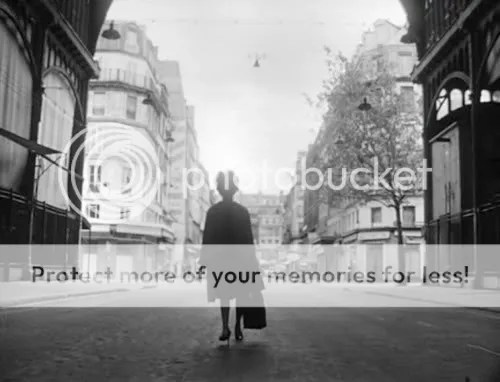
As appetizing as this all sounds, it is mostly just people discussing their philosophical concepts and telling anecdotes that are occassionaly interesting. Every once in awhile, the camera stumbles something that is truly heartbreaking but in all honesty, most of it is just people talking about issues that are far too abstract to be articulated in the form of speech. This is why so much of the film is rather dull: it does too much telling, not enough showing. Perhaps that is the point, but really, who cares about someone’s concerns about life’s repetitions. I mean, I personally relate to such a concern but when I have every person in the movie telling me the exact same idea, it begins to feel a bit like the filmmakers are just trying to expand the film’s running length.

One of Chronicle‘s great strengths, however, lies in its conclusion. The lights are turned on in a crowded theater. The audience: the characters in the film, who have attended a screening (most likely provided by Rouch and Morin) of the exact same film the audience has just finished. Some of the characters find the film too personal, while others find it far too constructed and fake. The very mixed response sparks the single most interesting discussion in the whole film; Rouch and Morin ponder on the ability of a camera to truly capture the truth. Overall, a worthwhile experiment, just not an entirely successful one.


Cockadoodledo Mister Chicken (1974)

8 07 2008

One of, if not the only, fictional feature from Jean Rouch is also one of the craziest films ever imaginable. Even though he’s influenced everyone from Werner Herzog to Jacques Rivette, his cinematic vision is still one of the most unique and relentless. Perhaps this is the only fault of Mister Chicken. For as crazy and spontaneous as it is, it might not have enough “there” to actually sustain itself for 90 minutes. There’s a great moment with every minute, but its possible that Rouch can’t get enough out of something so freewheeling. Still, he impressed me a great deal with this film and I’m certainly looking forward to future Rouch experiences.

Lam, a farmer, and his apprentice, Mallou take off in their makeshift automobile to start their chicken business. Along the way they pick up Damore, a priest, who is oblivious to likely long-term commitment of the trip. In their tiny automobile, which has been nicknamed “patience” in relation to its inconsistent functionality, tensions quickly begin to boil. The gang is stopped by a female hunter who is in search of her elephant. They, for whatever reason, suspect she is the devil. Mallou goes to retrieve a tire and when he returns, he finds Damore in a hysterical state.

The film continues to build upon occurrences such as the one described above. Damore becomes hysterical again, but this time is healed by an instrument, which is actually just a long pink plastic tube that Mallou vigorously rotates. Like Herzog’s Even Dwarfs Started Small, which actually predates this by a good four years, there is nothing to comprehend, to “get” in a sense. Like Herzog, Rouch interests (seemingly) lie in capturing undeniable images with a hyper-kinetic type of spontaneity. This pretty much accounts for my appreciation of Mister Chicken, which, after awhile, simply wears out its welcome. Essentially, the film runs out of gas and then drags itself to the finish line, but does so successfully.


Good-for-Nothing (1960)

7 07 2008

Yoshida’s first feature is very much in the same thematic vein as Nagisa Oshima’s two features from 1960, Cruel Story of Youth and The Sun’s Burial. While Oshima went for something more kinetic and spontaneous, Yoshida showed a bit more restraint which results in one of the earliest cases of a formalistic Japanese New Wave film. It still packs the energy that people like Oshima and Immamura intended to capture, but just does so in a much more technically mature manner. If there’s anything specifically “wrong” about the film, it’s that the whole thing is a bit too obvious in its freewheeling style. Like Cruel Story of Youth, one can’t help but think of it as a Japan-izied version of Breathless. All three directors (Oshima, Yoshida, and Godard that is) would go to do better things, but all their debuts are good films in and of themselves.

Jun, a disenchanted youngster with very little passion, has become absorbed by a local gang. The gang hatches a sort of prank crime by kidnapping the secretary of a large corporation, which is owned by the father of the gang’s leader. Makino, the secretary, begins to notice promise in Jun, despite his “tough guy” exterior and they begin a relationship, which turns out to be the root of many problems. Jun is conflicted between his friends and Makino, and to make things worse, completely unsure of what he wants to do after graduation.

Yoshida builds a surprisingly strong foundation for the rest of his career here, but it would be a lie to say that this anywhere near the quality of The Affair. I can see him setting up some technical elements that would eventually become a more steadicam-driven version of Antonioni’s aesthetic. Still, the film is strictly embryonic in its compositions. Yoshida clearly has the right idea, but the shots never seem to transition as seamlessly as they do in The Affair. Perhaps this is a slightly unfair compliant, but in the world of cinema, every thing should come off naturally. Not just the obvious stuff such as dialogue or character movements, but the flow of the shots as well. It’s an abstract balance and perhaps an impossible one to self-consciously obtain.

Then again, maybe this “flow” is merely interrupted by the very standard “New Wave” sort of narrative. Jazzy music? Check. A gang? Check. Loose women? Also check. Maybe I’m condensing Yoshida’s story into a far too narrow category, but I still can’t see enough unique ideas present here. Really, it is just a more formal and slightly more fleshed out version of Cruel Story of Youth. Of course, this is far from being a bad thing, but it’s just that nothing elevates the film beyond the time period. Ironic considering how The Affair, if anything, is a completely timeless effort. Again, this isn’t to say that Good-for-Nothing is not good (hah!) but it is just not really great. A solid, very enjoyable effort from Yoshida but not an outright masterpiece.


Young Mr. Lincoln (1939)

7 07 2008

Call me neglectful, or hell, even call me naive, but I had never seen a John Ford film until last night with a viewing of Young Mr. Lincoln. Among other things, it marks Fords first collaboration with Henry Fonda, who, for the most part, carries the whole picture. This is pretty much fine by my standards as I’ve expressed my admiration for him before, but this pretty much confirms that he was the best “classic Hollywood” actor, at least so in my eyes. Ford doesn’t do anything really radical, though it is not like I expected that of him. For the most part, he just places his characters in very beautiful (albeit sometimes artificial) locations.

A young Abraham Lincoln is confused and worried for his future, like any other young adult. During a poetic conversation with a girl, he is criticized for his like of ambition. Time passes and the very same girl dies. He visits her grave site for another conversation, which provides motivation for him to “begin doing something.” Meanwhile, a family is in need of groceries from Lincoln’s store. Their only means of payment is a law book, which sparks Abe’s interest in law. Soon, he moves to Springfield to being practicing law with a friend. During a July 4th celebration, a man is killed in what seems to be a clear and simple murder case. An angry mob forms and plans to kill the two young men in question, but Lincoln breaks up the mob and thus begins his first case as a lawyer.

While most of the plot does seem downright mythological, it proceeds in a very natural way under Ford’s elegant direction. Perhaps one of his single greatest strengths (at least in this film) is his ability to avoid the cinematic principles that trapped so many Hollywood productions from this time period. There is some slightly too expressive musical pieces, but for the most part they seem present to underscore the very poetic intentions as opposed to manipulating one’s feelings. On the other hand, the otherwise great ending, is handled in the most manipulative and heavy-handed patriotic way.

The initial poetic poignancy displayed in the opening sequence between Abe and Ann is quickly ditched when the film ellipses to Abe speaking to Ann’s grave. While this shift in tone is somewhat disappointing, it doesn’t really ruin the film at all. Perhaps the whole courtroom drama is a bit boring to others, but I can’t help but seeing it as one of the comedic heights of 1930s cinema. If anything, it is a relief to finally discover that Ford is not the humorless monster that he is sometimes characterized as. In fact, not only is this film really funny (not to mention really fun) but the interviews that appear on the BBC documentary prove that he was just as clever in person. There’s obvious limitations that come from working in Hollywood in the 30s, but I’d saw this about as a perfect of a movie as anyone could have made considering the circumstances. A great introduction into Ford’s ridiculously long career.


Throne of Blood (1957)

7 07 2008

This is a bit more in the vein of “usual Kurosawa” compared to my last two outings, Drunken Angel and Stray Dog but in my eyes, it is definitely in the same ballpark. Mifuni is at his usual over the top-ness here, and the plot is, understandably, equally over the top. On the other hand, there is a very formalistic aesthetic here, almost like Kurosawa’s take on Ozu, which predates Kobayashi’s Harakiri by a good couple of years. Perhaps it is slightly academic to praise a film merely on its compositions, but they really are wonderful. Considering what Kurosawa was working with (MacBeth and an actor who always yelled) he pulls it off in a very convincing fashion. This is definitely one of his better efforts.

Washizu Taketori and Miki Yoshiteru stumble upon a spirit in the woods after returning from an exhausting battle. The spirit informs of their futures, both of which look extremely bright. As they make their out of the forest, they are startled by how quickly the spirit’s visions become true. They are immediately promoted by the emperor. Both are flattered, but Washizu’s wife sees this as a perfect opportunity to climb the ranks of the feudal system, which would lead to murdering the same emperor that promoted Washizu.

Depending on one’s feelings towards Shakespeare, this is either extremely riveting or mildly entertaining. Personally, I find myself falling in between the two reactions. I really can’t see how anyone could find this film particularly boring or dull in anyway. It’s slow, certainly, but there’s enough of visual gracefulness for the experience to almost be inherently entertaining. Of course, it helps that there’s plenty of plot-oriented material for the less artsy audience to chew on. Still, most of the film’s strengths play off of the very formalistic aesthetic, which compliments the ritualistic sensibility of the time period.

What doesn’t compliment the time period, or even most of the story for that matter is Toshiro Mifune’s hammy performance. He seemed a bit more subdued than his usual self in Drunken Angel and Stray Dog but he’s fully absorbed by his usual shtick here. In all seriousness, did this guy never yell? I personally can’t think of any performance he’s ever given in which he doesn’t violently shout during the whole running time. Yes, there’s scenes that call for this, such as the finale, but other times, not so much. It’s sort of silly to think that anyone would yell when discussing plans to kill the emperor with their wife, but Mifune has no problem doing so here. Supposedly, this is the point, but it just intrudes on one of Kurosawa’s more enjoyable efforts. A good film, in spite of one exaggerated performance.