Days and Nights in the Forest (1970)

1 11 2008

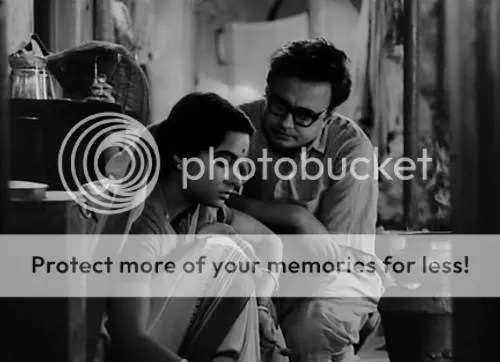
Of all the Satyajit Ray films I’ve watched lately, this is by far the most emotionally and formally mature effort. I suppose this shouldn’t be a huge surprise since it is also the youngest film I’ve seen of his. Whatever the case, this definitely takes what I liked about Charulata and Nayak and put into a stylistic context that is a bit more calm but confident. Calling this an Antonioni film with a lot of dialogue would be a pretty good idea of the overall tone. Even though I would have preferred for the film to be a bit less talkative, it is still pretty impressive that Ray was able to juggle all the talking and still make a very “contemplative” experience.

The characters here are a lot more accessible than the ones in the other Ray films I’ve seen, including Pather Panchali. Here, the story centers around a group of four males, seemingly longtime friends, who take a break from their draining work lives to vacation in an isolated forest. It’s by far the most free form narrative structure I’ve seen in a Ray film and it compliments the slightly conscious “character study” element of the film. It’s the same sort of character-driven tone that is found in the last three Ray films I’ve watched, but it feels a bit more calm and unhurried here.

It’s a bit ironic then that this film is substantially shorter than Mahanager as that film tries to cram a lot into its 135 minute running time. Here, the characters are quickly laid out. One can quickly immerse themselves into their interactions. It helps a great deal that the visual style here is much more consistent than it is in most of Ray’s other films. It wouldn’t be all that surprising to see an extremely shaky handheld sequence followed by a long static take in some of his films from the 1960s, but here, everything feels much more unified and cohesive.

So while this feels like one of Ray’s longest (or perhaps just slowest) films, it also feels like one of his most satisfying. It’s one of his most “complete” and “fufilling” films simply because it takes the time to push the audience into the world of its characters and there is very little dramatic pacing to follow. There is some hints at conventional dramatic turns towards the film’s conclusion, but it is certainly not enough to taint the previous hour and forty minutes.


Riding Shotgun (1954)

28 10 2008

Now this, on the other hand, was just flatout amazing. Even the color + academy ratio combo couldn’t keep it from being one of most visually lovely westerns I’ve seen. Maybe not as great as the visuals in Day of the Outlaw, but I would argue that this is going for something completely different. Of course, even if the visuals were poor, this film would still have the presence of Randolph Scott to save it. This may very well be my favorite performance of his, though I still have three more “ranown” westerns to see. Anyway, he’s absolutely amazing in this.

Like in Boetticher’s Decision at Sundown, Scott spends most of his time  unjustly cornered by the residents of the town. Here, he’s trapped into the lowest bar in town after attempting to warn the residents of the approaching danger, a gang led by his nemesis, Dan Marrady. The townsfolk assume he’s trying to pull a trick and they quickly turn against him. He resists arrest, which leads to the inevitable discussion of a mob to do the work. He holds out, with the hope he’ll get the opportunity to kill Marrady and prove his innocence.

Such a simple straight-forward story told within the limited scope of 74 minutes – an ideal structure for a western. It sounds kind of silly, but there’s simply no bullshit here. A lot of people make think there is since the story’s foundation is laid out within the first fifteen minutes, but had all that stuff been stretched out for the whole film than that would have been padding. Once De Toth establishes his character, it’s all them, no intrusions on their interactions. Technically, Scott’s voiceover could be labeled as an interruption, but his bits come might close to being genuinely poetic, despite the fact that they are used as exposition.

That is a good way to explain why the film is so great to begin with. Sure, it is a “genre” film and its intention was probably to make a quick buck, but it is also legit art. Could I explain why exactly? No, because that would either be too dull and what it makes this film, and De Toth’s cinema in general, art is something in one’s subconcious. This probably sounds a bit preposterous, especially for a 74 minute “B” western. It is, but Riding Shotgun is one of the greatest cinematic achievements for American cinema in the 1950s.


Thunder Over the Plains (1953)

28 10 2008

Another solid western from André De Toth. It’s not as great as Day of the Outlaw, but it does have the advantage of featuring Randolph Scott. It’s visually a far cry from that film, if only because it has the disadvantage of being in color and the academy ratio – a usually deadly combination for westerns. Still, the story here is enough to carry the film. I usually don’t put much stock in the narrative, especially not when it’s westerns, but I find the character complex too intriguing. Scott is a sheriff patrolling his home state of Texas. His emotions are caught in-between standing up for the independence of the citizens and fufilling his duty as a marshal.

This does sound like pretty standard western fair, if only for the fact that the protagonist’s duty is directly interfering with his emotions, but Scott’s character walks the line too tightly that it makes the film a joy to watch simply be trying to assess every single decision he makes. As one could predict, he ends up being hated by the town’s folk and the law, which sort of points towards the “me against the world” concept that is further developed in De Toth’s Riding Shotgun. In a way, this film is just a warm-up for that film, in which Scott is quite literally beaten around by every character.

There’s some uniquely positive traits for this film, though. Specifically the relationship between Norah Porter, the wife of Scott’s character, and Captain Bill Hodges. It becomes very obvious once Hodges is introduced that he’s going to pursue a relationship with Norah Porter, but it still is a bit surprising once he acts upon his feelings. In every other western, the “affair” usually occurs between the hero and a woman who is neglected by her husband. Scott’s character does neglect his wife, though, but only to pay the bills, I suppose. I guess the potential for this subplot was a lot more exciting than it actually turned out, but then again, I’m not watching westerns to see shrill, sleazy melodrama.


Charulata (1964)

28 10 2008

Definitely my favorite post-Pather Panchali film from Satyajit Ray. Like the other 1960s efforts I’ve seen from him, this isn’t the most formally dazzling movie, but it is a wonderful character-driven story with a nice, relaxed pacing. The first hour or so, in particular, is pretty much perfect, and I might even say they’re as good, if not better than, the best sequences of Ray’s debut. Unfortunately, though, things tend to fall apart towards the end with plenty of Ray’s usual off-kilter indulgent flourishes, such as the overly dramatic “storm” symbolism that shows up whenever the protagonist is in a conflict. For the most part, this is still a wonderful film and certainly one of Ray’s best.

Madhabi Mukherjee, who plays the title character, deserves a lot of credit for making the film, as a whole, work. She’s wonderful in Ray’s Mahanager and even better here. Of course, her role in this case is a lot more demanding but she is equally captivating. I suppose a lot of her “watchability” can be credited to the fact that she’s also physically attractive, but she definitely has a certain way in which she handles herself that is special. I guess all great performers have this indescribable element, but it feels especially promimnent in this film. Again, this is likely because the story itself is so performance driven.

That’s not to say that there isn’t anything “cinematic” to be found here. However, with every film of his I see, I become more and more convinced that the poetic touches of Pather Panchali were a one-time thing for Ray. This film, along with Nayak and Mahanager, is visually, much more natural. Of the three, though, Charulata is by far the one with the most impressive visual flourishes. These flourishes aren’t quite consitent enough to feel like a “style” so to speak, but this do give the film an aesthetic edge over those other two Ray films.

The film’s greatest strength, at least in my mind, is its very natural depiction of a situation that would otherwise be drowning in its own melodrama. Charulata, a stay at home wife, is feeling lonely so her husband invites his brother to give her some company. It’s pretty obvious what follows, at least in a dramatic sense, but the gentle and slow way in which Ray comes to this point is what makes the film so special. The story seemingly tries with all its might to bring the actual film into the realm of the ordinary, but its attentiveness and respect for the characters shines through.


Mahanager (1963)

27 10 2008

More of the same from Satyajit Ray, though generally speaking, I’m less enthusiastic about this film than I am about Nayak. Of course, Pather Panchali still remains my favorite by a large margin, but I am beginning to get a better grip on his overall “style” which is initially a tad too simplistic. No doubt, the poetic sensory images from Pather Panchali aren’t nearly as prominent here, but that hardly makes the film a failure. In fact, Ray’s interest at this point seem to lay less in the formal and more in the personal. This does have the advantage of being perhaps the most intimate of the Ray films I’ve seen, and probably the one where the characters’ relationships are best established. Then again, they may just be a lot more interesting.

This could probably be categorized as a message film, as Ray seems to be touching upon a variety of closely related topics, all of which deal with India’s cultural progression. The main narrative point comes when the mother of the house, Arati, is forced to take a job to make ends meet. At first, this plan seems to be free of problems as Arati’s husband Subraya quickly finds her job, but Ray slowly begins to reveal how much importance the rest of family places on values. The grandparents of the house aren’t just upset by this move, they are flat-out disgusted.

This sounds almost humorous, and I admit, I actually got a chuckle out of it, but it does play in to a prominent issue addressed by many other “art” directors in the time period. Most notably, Yasujiro Ozu, who seems to be somewhat of an influence here. Ray sticks to his own aesthetics, of course, but the fact that the main conflicts come from class and family issues seems to be a gentle nod to Ozu. Also like Ozu, Ray is not preaching one way or another, but merely depicting the fact-of-the-matterness of the situation. Husband and wife both working to make ends meet is common in modern, especially American, society, but it must have been a pretty progressive statement here.

I’d hate to draw a comparison point between Ray and another Japanese director, but I can’t help but see a depiction of an “alternative version” of marriage owning something to Mikio Naruse’s Repast, which provides a much more distanced couple dealing with their issues in more drastic measures. Naruse’s film still irks people today, but Ray’s comes off as being a really well-made feminist statement. Again, he’s not preachy with these statements, but his mere observations are enough. His heroine is trapped into her family expectations: they expect her to be a housewife and while she does not want to disrespect or tear her family further apart, she also wants to maintain her independence. On paper, this all sounds a little hokey, but I honestly doubt Ray had such philosophy in his head, which is of course what makes it all work.

I feel I must stress that Ray does not use his characters as pawns to carry out these messages, or examples. They really are their own perceptively drawn-out person. It can’t be too exciting to praise film on the mere promise that it will be present full and complex characters, but there is something incredibly intriguing about seeing them interact. This is more of an actors’ film than it is a directors’. This is perfectly fine, though, as these are characters that I can’t help be eager to examine. Ray takes his time in his depictions, but that is why they are so rewarding.