The Crowd (1928)

2 06 2009

Pretty great for the most part. There’s a few slight dramatic touches here and there that are inevitable, but still not all that flattering for Vidor. It’s not quite up there with his greatest achievement, 1931’s The Champ, but it is the closest I’ve seen him come. Even if I find some of Vidor’s dramatic turns to be a little too convenient, I still find it nearly impossible to exaggerate the influence of this particular film. Not only was Vittorio De Sica watching, so was Yasujiro Ozu. Simply stated, this is the root for a good deal of my favorite films, and if I didn’t love it on its own, I’d still feel obligated to appreciate it.

While The Crowd now stands as a towering achievement in the Hollywood system as an observation and critical depiction of Americana, it actually has a good deal of melodramatic tones that come in throughout. The story follows the life of John Sims, a man born on July 4th, 1900. There is a hint of a “rise and fall” arc, but in all honesty, Sims never exactly rises. Vidor is to credit here, as he is, perhaps inadvertently, subverting the expectations of the audience. While there are emotional outbursts that are inevitable for a film from 1928, the plot itself is fairly (and remarkably) uneventful.

The narrative plays out like this: John gets a job, gets married, he and his wife, Mary, face complications, they have kids, one of them dies, and as a result, John quits his job. From there on, Vidor’s protagonists are caught in a world of what seems to be limitless doom. This feeling is all the more powerful because it isn’t actually accurate. John is offered a job from Mary’s critical brothers, but he turns it down. He leaves his house, ponders suicide, and returns home with a new job: a city advertising clown. This is what Vidor wants the audience to believe is a “happy ending” and he is damn convincing. John and Mary, headed surely for separation, suddenly reconnect and everything is fine.

The problem, for the characters, is that everything isn’t fine. The final two minutes of the film are a perfect example of how a filmmaker can manipulate the audience. It works in Vidor’s case, because he seems to going the opposite route that one would conventionally take with such an ending. It’s another example of the narrative, contrary to one’s intial reaction, isn’t fueled by events. For that sheer element alone (i.e the element of observation vs. drama), Vidor’s masterpiece is to be seen. He would indirectly influence everyone from Wellman to Hou. Did I mention the amazing cinematography or the beauty of Eleanor Boardman yet? Vidor has too many good things in his favor that the few minor hiccups in his film can be disregarded entirely.


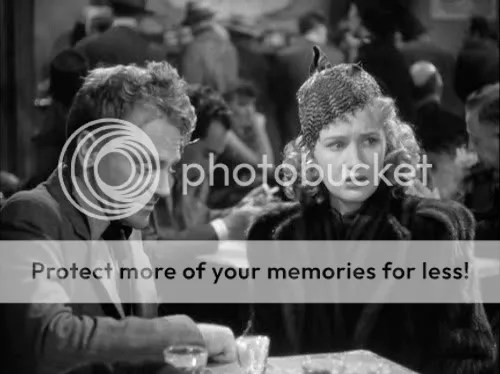
The Roaring Twenties (1939)

30 05 2009

A truly epic film. Sure, it only clocks in under 110 minutes but it has this wide-ranging and grand tone to it. Maybe its because it documents a whole decade? Maybe because Cagney, as usual, is such a joy to watch? It just has this very long feel to it, but at the same time, the story just flies by. It’s another remarkable accomplishment by Raoul Walsh, perhaps second only in his own filmography to They Drive By Night. On the other hand, this might be my favorite “gangster” film from the Warner Brothers cycle of the 1930s, and I don’t think it is a coincidence that it is one of the last.

I’ve never really favored narratives that are spread out over multiple years, as they tend to document the simplistic tone of a “rise and fall” story, and The Roaring Twenties is not any different. Returning from the first world war, James Cagney finds that things have changed in America while he was fighting. He can’t get his old job back. He depends on his friend, a taxi driver, to help him get his career moving, which inadvertently leads him into the underworld of bootlegging. While Cagney’s character (and ego) continue to grow, so does the chaos and pressures of American society.

Third-person voice overs are almost always a bad technical move, but here, the narration is so bland, dull, and unemotional that it completely works. The words seem to have come directly from a contemporary news blimp about America in the 1920s, which works perfectly with Walsh’s documentary-esque montages. It isn’t the most original idea to document a character’s development underneath something bigger (in this case, the development of pre-war America) but it is done so gracefully by Walsh. It seems like there’s so many times that he could have taken his film in the wrong direction, but somehow, everything works.

It’s probably worth noting that this is one of the first gangster films from the WB cycle of the 1930s that doesn’t even attempt to present itself as some sort of social warning. In fact, the opening titles, written by Mark Hellinger, forthrightly declare the story as a fondly remembered point in time. Hellinger’s introduction isn’t necessary, but there’s something very poignant (and poetic) in his words. This is the only instance I can think of such a thing happening in a pre-war Hollywood movie.

It is very difficult, at least for me, to describe any element of Walsh’s masterpiece without beginning to overuse words like “poignant” and “poetic” because there’s this sincerity dripping off the screen. It is instantly noticeable and instantly lovable. There’s many brilliant sequences, but I am particularly fond of the one in which Cagney’s character is talking with Jean Sherman, who has developed into a beautiful woman; she was still a girl during their first encounter. To escape from his crime life, he questions her own lifestyle. He has a cliche-filled, idyllic vision of her life – “I bet you spend a bunch of time in the garden.”

This, as Sherman points out in her response, couldn’t be further from the truth. Cagney’s personal and emotional sacrifices for Sherman are so endearing not because he loves her, but because he has fallen in love with a character he has created on his own. Before the final, brilliantly staged shoot-out, Cagney stops at a piano and just stares longingly at  nothing. Possibly, he has realized his mistake in characterizing Sherman, but he doesn’t seem to care, and that is just proof that Walsh’s gangster classic is also an observant character study.


I Know Where I’m Going! (1945)

25 05 2009

Another very impressive effort from the Archers, although this one is a lot less dark and complicated than The Small Back Room. The cinematography, on the other hand, is just as excellent, if not better. If The Small Back Room excelled in presenting a claustrophobic arena pushing down on its protagonist, I Know Where I’m Going! excels in placing a overly organized character in an environment that is both literally and emotionally, too open for her. While the nearly fantastical depiction of a romance does show some similarities with Frank Borzage’s work, I found that this had more in common with the cinema of Hiroshi Shimizu.

Like Shimizu, the story here isn’t all remarkable. The characters aren’t observed, or developed in a extensive or attentive manner. Instead, the story here plays out like a poem, which perfectly underscores the poetry of the Archers’ images. The characters of Joan Webster (Wendy Hiller) and Torquil MacNeil (Roger Livesey) are full and complex characters, but this isn’t an Ozu film, we aren’t going to get complete portraits of them or anybody else in the film. Like Shimizu’s work, the audience is often left to fill in some of the details, as the main intention is depicting the far from objective event of falling in love.

Actually, there’s more than a few similarities between this and Gremillon’s Maldone. The Archers aren’t trying to make a straight-forward, or even realistic picture, because the fact remains that their content isn’t exactly ordinary. This, however, does not cheapen their sentiments or observations in the least. If anything, it makes them slightly more accessible. On the other hand, this does mean the film is a little far from being the “truth” (if that makes sense) but again, the intentions of the filmmakers does not lie in finding the profound in the simple, but perhaps in finding the simplistic in the profound.

If you can follow me then you can agree that the latter approach is very common in conventional, modern filmmaking. This doesn’t mean the Archers or even Shimizu are forerunners to Joe Wright, or whoever else makes “romance” films these days. Shimizu and the Archers are operating on a level that acknowledges the limits of their dramatized scenarios, and by turn, then transcends such limits. I Know Where I’m Going! doesn’t overwhelmingly move me lik Shimizu’s best work does, but it tries awfully hard to do so in a similar way. I think my words have sold the Archers (and even Shimizu) short as merely variations of conventional depictions of love stories, but there is something in the work of all three directors that elevates itself beyond simple wish fulfillment or a way to kill time. I can’t put my finger on it, but that is exactly why one should see their films.


Green for Danger (1946)

25 05 2009

This, on the other hand, is purely escapist entertainment, but it’s so hard to criticize it when it unfolds in such a fascinating way. It’s not going to move anybody beyond the simplicity of their manipulated reflexes, but it is a nearly perfect, twisting narrative wrapped up in some gorgeous high-contrast visuals. To make things simple, it is a blast to watch.

It is much of a surprise to learn that the film’s director and screenwriter, Sidney Gilliat, worked on more than a few scripts with Hitchcock. Like many of Hitchcock’s earlier British efforts, Gilliat’s film manages to effortlessly thrown in elements of any genre he chooses to explore. There’s comedy in the form of Alastair Sim’s wonderful performance as Inspector Cockrill. There’s romance in the form of Mr. Eden and Nurse Linley. There’s dysfunctional relationships in the form of, well, everyone, but Dr. Barnes and Nurse Linley specifically. The script, which is based on a Christianna Brand novel, unfolds like a “how-to” in pulling the audience into a situation that is not the least bit likely to cause personal reflection.

When I say stuff like this about Gilliat’s film, or even some of Hitchcock’s, I am, by no means, trying to downplay the accomplishment of entertaining, nay, engrossing a mass audience. I’ve mentioned before that Gilliat’s screenplay throws in so many genre elements, and he makes it look easy. At the same time, however, if one reflects back on all the progression of the story, not to mention the clues that subtly come afloat in the beginning, it becomes apparent how extremely difficult it is to write a story that is so concerned with the behavior of every character as well as every little action they perform. It’s a remarkable achievement, albeit one in a field that has been completely exhausted by modern filmmaking.


The Small Back Room (1949)

25 05 2009

I’ve only seen a few films from Michael Powell and Emeric Pressburger and coincidentally, each has been in black and white. This isn’t the smartest plan on my part, as it seems the Archers became famous for lavish technicolor epics like Black Narcissus and The Red Shoes, but I have some (perhaps bizarre?) aversion to early Technicolor. So far I’ve managed to dodge all of their bright and vibrantly photographed pictures for ones that are, perhaps only on the surface, gritty and more realistic. The Small Back Room, made right after one of their most of colorful pictures, is a perfect example of this.

While I still believe this is a very realistic picture, I have to confess that it is undeniably melodramatic and well, not very realistic. While I usually see the heightening of dramatic events as a negative, they’re not much of a problem here. The Archers never really depend on physical events to carry their narrative. Instead, a majority of development comes from the psychological strain on the film’s protagonist, Sammy Rice, an alcoholic bomb expert is called in to diagnose a new German weapon. Sammy’s fall from sanity is depicted in a rather silly manner. In one of the few call backs to the Archers’ previous fantasy endeavors, Sammy’s whiskey bottle physically towers over him.

There’s a few other dubious and awkward instances of symbolic imagery, but it never really derails the tone from its main track. Its not exactly an downbeat or downplayed drama, but it manages to maintain a simplistic and believable atmosphere. The problems between Sammy and his girlfriend / secretary, Susan, aren’t exactly explored to the point of making this a “complicated relationship” film, but there’s enough tension between the two to add to Sammy’s ever-growing stress level.

In this sense, the story plays out not unlike a western from Anthony Mann. It’s definitely a work of “genre” and/or “populist” cinema but there’s enough care and attention devoted to the character(s) that it manages to come off just as much as a true work of art. It probably helps a good deal that the film is astonishingly beautiful, probably even more so than A Canterbury Tale, which gets a lot more praise. Sure, this isn’t exactly a bank-busting, career sacrifice work of personal expression, but it is probably more effective (to the public, at least) as an escapist film that has bursts of personal emotions.