Some recent viewings…

28 09 2009

School is going wonderfully for those who are curious and now that I’ve finally settled down into a pace, I can catch up here. My post will still be less extensive and probing, but I will still find time to write moderately sized capsules.

Ningen no jôken I (Masaki Kobayashi, 1959) DEFINITELY NOT AWESOME
Image

It’s okay for what it is. Nakadai is great (as usual) and the cinematography is really wonderful, but other than that, it really is a lazy movie. It really upsets me that everyone considers this (rather tame) epic to be some big, serious, daring political statement when time had actually made Kobayashi completely safe to express his personal views. The same can not be said for Tomu Uchida, Tadashi Imai, or even Sadao Yamanaka — all three of whom have yet to be recognized in the west. In addition, they expressed their far more radical political sentiments with far greater subtlety than Kobayashi could ever dream. The “bad guys” are so obvious to identify and they represent nothing more than a narrow-minded symbol of what Nakadai is fighting against. Say what you will about bad guys in westerns, but at least their relationship with the main character is usually interesting. Take Lee Marvin in Seven Men From Now as an example. He’s the “bad guy” but he doesn’t have a big neon sign declaring that you’re not suppose to like him. In fact, he’s a brilliant and full breathing character. Meanwhile, the villians here are so dramatic and simple it makes the characterizations feel like a cartoon. There is seriously a sequence in which an official demonstrates the new security by throwing a dog into a electrical fence. Well, that doesn’t leave much for that character to operate with. I can see Kobayashi sitting in his writing room worrying that the audience might not fully comprehend what’s going on and saying to himself, “why don’t they kill dogs. That will remind them who we’re rooting for!”

Can I just mention again that Uchida, Imai, and Yamanaka (among others) were dealing with similarly heavy material, but in a far less operatic fashion. I mean, this movie is three and half hours long, and that’s just part one of three! Humanity and Paper Balloons says more, risks more, and just flat out works more with two hours less. The concept of complexity seems to be one completely missing from Kobayashi’s cinematic vocabulary. One only needs to look at the never-ending series of bitch slaps and needless fights that take place. If he really is an action director, then he is the worst action director of all-time and if he’s in “art” director than he is one of the most obnoxiously obvious ones. This makes Mizoguchi look like a peaceful director. Hell, it makes The Shawshank Redemption feel almost like Ozu. There are some good things about it. I mean it does look pretty good. The widescreen + b/w cinematography is gorgeous and I already mentioned, Nakadai even the most ham-fisted sequences come alive. Overall, though, it’s not enough make up for a truly silly film.

Fiona (Amos Kollek, 1998) NOW THIS IS AWESOME
Image

Perhaps it’s the amount of more, shall I say, conventional movies that I’ve been watching lately, but this really hit me hard. In all honesty, it doesn’t really do anything, at least not on a superficial level, that I hadn’t already seen in Paul Morrissey’s trilogy (which it shares many elements with) but it still pretty much blew my mind. Like Morrissey, and unlike Cassavetes, Kollek manages to capture these moments that are so bizarre and surreal yet are oddly intimate and touching. A perfect example would be the extended sequence in the crack house, which is like just a montage of crazy (but amazing) people laying around telling silly stories and stupid jokes. I know that sounds simple, but that’s the sort of stuff that made me fall in love with film in the first place. In all honesty, I wish all movies had sections like this, in which the characters just goof around and do nothing to advance any sort of typical narrative. More moments with an emphasis on the atmosphere, which this film has plenty of. It helps that Kollek is just brutally honest and objective about everything. This is probably the most accurate prostitute movie of all-time. At the very least, it’s the least dramatic. Don’t get me wrong, I’m certainly a fan of Mizoguchi and Fassbinder but both of their prostitute dramas are oozing with tragic notes. That’s not to say that there isn’t any sort of emotional thrust here, quite the contrary actually. The mushy subplot about the titular character finding her mother could easily have been some Hallmark / Lifetime movie of the week, but instead of some sentimental get-together, they encounter each other by circumstance. The end result is that Fiona eats out her mother’s pussy. The film definitely earns points for putting its protagonist through plenty of transgressive situations as the one previously mentioned. Obviously, said sequence work perfectly with Kollek’s documentary like execution. Something should also be said about the voiceover here, which is a hundred times more touching, poetic, and heartbreaking than anything David Gordon Green could write. My most favorite line comes when Fiona meets a woman not unlike her, “She got hit in the face with a pole or something. I just wanted to hold her in my arms and tell everything was going to be okay.” It’s moments like these that make me want to overlook some amateurish flourishes and call this movie an all-time favorite. For now, it’s pretty close.

S.V.D – Soyuz velikogo dela (Grigori Kozintsev and Leonid Trauberg, 1927) REALLY GOOD
Image

Like with The New Babylon, I’m not sure what exactly is going on here but Kozintsev and Trauberg are so great at capturing these simple, fleeting, beautiful, and poetic moments that just inexplicably get to me. Ultimately, these moments are too few and far between, which makes them more precious but also makes the movie a little tedious at times. Probably in my Soviet top ten.

Hitler – ein Film aus Deutschland (Hans-Jürgen Syberberg, 1977) NOT SURE, BUT IT IS GOOD
Image

So, what is this exactly? I mean, it’s not really a movie, at least not in the conventional sense. It’s like some odd artifact, or maybe even a document (but not a documentary) covering Hitler’s career in the most idiosyncratic way possible. I kind of want to call it a masterpiece just because it is unlike anything I’ve ever seen before. Really, I haven’t had such a “unique” and potentially eye-opening cinematic experience since I first saw Gummo a couple years back. On the other hand, though, calling this cinematic is a little bit of a reach. Sure, there’s some nice Marker-esque freeze-frame montages, but most of it is people talking into a camera on a stage. Every film that has crushed my expectations of cinema’s possibilities did so because it was able to express things without words, while the opposite is true here. Again, it doesn’t even feel like a movie at all. Instead, it’s some weird middle ground between performance art and poetry. It sounds terrible on paper, and in theory, it should be unwatchable (which it sort of is until one adjusts to Syderberg’s odd aesthetic) but there’s something so goddamn fascinating about it. Maybe it’s the voice overs. Sure, in modern cinema the technique has become pretty much a tool for lesser directors to channel Malick, but Syderberg manages to maintain the same type of poignancy but producing images that are nothing like Malick’s, or Green’s, or whoever else is comforted by poetic narration. I don’t mean to be attacking Malick or his disciples, as I still do like his means of expression, but one has to admit that the “poetic voiceover” has become something of an art film cliche, closely reaching a level of parody. Syderberg’s words all the more riveting because they connect to us on a level untapped by an filmmaker. This doesn’t make him a genius, though he might be, but it does at least produce a very interesting experience. Honestly, I have no idea what to think of this movie. It didn’t blow my mind, but maybe it did? Does that make sense? Probably not, but I’m having a difficult time making sense of this oddly touching seven hour experience.

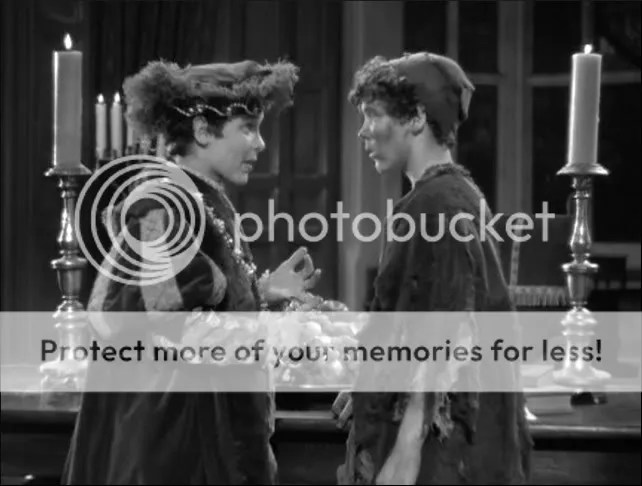
The Prince and the Pauper (William Keighley, 1937) ENJOYABLE
Image

I wasn’t expecting anything all from this, which is probably why I was moderately impressed. Sure, the story has been death (or maybe it just seems that way to me because I watched the Mickey Mouse version hundreds of times as a child?) but it is handled very well here. What little drama is present is kind of toned down by the really great cinematography, courtesy of Sol Polito. Between this and Sergeant York, I’m more than convinced that he was one of the most talented DoPs in the classic Hollywood system. It’s nothing much different from Alton, Lawton Jr, or anybody else you want to throw in but I think there’s something slightly “grittier.” It might just be because the work I’ve seen from him requires characters to have faces covered in mud. Combine that with the shaky, primitive yet beautiful Vidor-esque tracking shots and you have enough ingredients for this to pass as a “glue-sniffing” movie. Of course, there’s plenty of formalist stuff involving the 16th century, which is foreign and a little awkward to me, but I think that Keighley manages to place his personality over the work. Manny Farber probably wasn’t thinking of this movie when he called Keighley one of the greatest action film directors, but I can see how this aesthetic could easily be transferred to something a bit more …chaotic? Bullets or Ballots and Each Dawn I Die are definitely high priorities, anyone recommend anything specific?

I also read this last week…

Image
Nippon Modern (Mitsuyo Wada-Marciano, 2008)

Very, very good. Absolutely essential for anyone remotely interested in the history of Japanese cinema. There’s lot of academic stuff regarding modernity that doesn’t fascinate me that much, but its information of pre-war Japanese cinema is indispensable. It’s still one of the fastest readings film-related reading I can think of, but that’s because the subject (which I am so fascinated by) has very little critical writings. Not only did this make me want to see countless films, but it also enhanced my appreciation of many films from the time period. Nothing could really make me love I Was Born But… more than I already do, but there’s a few selections that remind me exactly why it is so great.


Hôtel du Nord (1938)

19 08 2009

Another excellent pre-war effort from the dependable Marcel Carne. He doesn’t have Jacques Prevert’s pen to accompany his sophisticated style, but the story itself is pretty great anyway. In its own special way, this is sort of like the French equivalent to King Vidor’s Street Scene. Like Vidor, Carne places the drama in a centralized location (the titular hotel) and then proceeds to dive into a series of characters. Overall, I’d say Vidor’s film is the better one since it is so straight-forward and perfect in its own theatrical way, but Carne, as I expected, does deliver another powerful portrait of humanity.

The main story, if there is one, concerns a young girl by the name of Renee. Played by the beautiful and far too overlooked, Annabella, Renee barely escapes from the suicide pact that she makes with her boyfriend, Pierre. Pierre is sent to prison for the attempted murder of Renee, who, perhaps unable to move on from the incident, becomes a trustworthy employee at the hotel where the would-be tragedy should have occurred. There are many tiny story lines that Carne’s camera (almost literally) weaves through, and he able to capture these intimate and beautiful moments that do nothing to advance the plot, but do wonders in enriching the atmosphere.

As I have come to expect from Carne, there is a certain visual elegance on display here. There’s no particular shots that brings attention to itself, there are no frames rigorously planned to look beautiful. All the wonderful images that the camera captures (by the way, Louis Nee, an uncredited assistant on Dreyer’s Vampyr and Armand Thirard, a frequent collaborator with Julien Duvivier, are both credited as cinematographers here) seem almost incidental. There’s nothing overwhelmingly picturesque about this film, but I don’t think Carne was ever really that “poetic” (at least visually speaking) of  a director. His strengths instead lie in the attention he devotes to his characters.

This film is no exception to said attentiveness, in fact it is one of Carne’s most strictly observant pictures, with little to no real conventional narrative drive. Things happen, sure, but they don’t happen on the tragic scale of a film like say, Daybreak. No disrespect intended towards that film, as it is absolutely one of my all-time favorites, but where as that film vividly documenting the rise and fall of a romance, this one depicts a period of time in a particular location. The camera swoops into the situation, and then literally, at the very end, tracks back from its origin. It’s a small little touch, but its one of the many things that add up to a universe that is so richly detailed.


Jenny (1936)

13 08 2009

This early Marcel Carne film is, perhaps, best known for being the directors first collaboration with the great screenwriter, Jacques Prevert. The duo would go on to create at least two other masterworks in Le jour se leve and Le quai des brumes. While this was the first time the two teamed up, it is hardly noticeable. The confidence in Prevert’s writing, and the eloquent, never intrusive way Carne executes said writing is so apparent in all three films (there is another collaboration — Drole de drame, which I haven’t seen yet) that it only takes a few minutes for one to realize that they are watching a Carne-Prevert picture.

This story, based on a novel by Pierre Rocher, depicts a mother-daughter relationship. The emotional bond between Jenny (the mother, played by Francoise Rosay) and Danielle (the daughter, played by Lisette Lanvin) is not so stable. Danielle has been on a tour (she’s a pianist) for the past six years, and she has not spoken with her mother within that time frame. Meanwhile, in a move unknown to her daughter, Jenny has taken up a career at a local night club as something of a bar hostess, think Hideko Takamine in When a Woman Ascends the Stairs. There are some melodramatic events, such as the two women becoming interested in the same man (something that anticipates Julien Duvivier’s Voici le temps des assassins by exactly twenty years) but for the most part, things are played out on a very subtle and mature level.

Carne’s ever so impressive camera movements do help downplay this drama, but I think most of this should credited to the performer. Lisette Lanvin, whose most famous role is in Sacha Guitry’s Pearls of a Crown, is excellent as Jenny’s daughter. The opening sequence, in which Danielle breaks off an engagement to a gentleman we know nothing about is heartbreaking in its realism and it gives the narrative a starting point that has to slowly crawl into the main frame of the narrative.

Following this break-up, Danielle returns home from London with hopes of reconnecting with her mother. Things go smoothly, as Jenny’s balances her daughters needs with her secret occupation, but of course, no one can expect a lie to ever last very long. It is worth mentioning here that the club Jenny works at was once a house where she brought up her daughter. When Jenny’s patrons wave to her in the street and reference the club’s address, Danielle begins to develop some suspicions.

Acting on said suspicions, Danielle decides to visit a local club advertised in a city paper. She asks for Jenny, the nickname her mother is addressed by on the street (as opposed to Jeanne, what Danielle calls her) but while she waits, a sad, pathetic, yet extremely wealthy man approaches her and clumsily begins to seduce her. Like many of the male peripheral characters in Carne’s work, this man is part of a not so flattering portrait of male egoism. The central male characters like Lucien, the love interest of both mother and daughter, and Benoit (played by Charles Varnel last seen in Duvivier’s They Were Five), a manipulative man infatuated with Jenny, are portrayed in a much more positive light.

Lucien, played by Albert Prejean (who can be seen in some of Rene Clair’s earliest work as well as the French version of The Three Penny Opera) is a character whose importance is romanticized a great deal. No doubt, he is seen as something of a hero, but a hero that still has flaws. Benoit, on the other hand, can easily be interpreted as the bad guy and yet he is viewed with such respect. His actions are seldom noble, but it is not difficult to see why he is such a scheming fellow. Varnel’s character is a “fancy/wealthy fat cat” — a type of stock character usually intended to provide an audience the opportunity to laugh at the hypocrisy and crude nature of the upper class.  Benoit, however, is not comic relief.

If it seems like I’ve gotten a bit bogged down in describing the moral compass of the characters, then that’s a credit to Carne’s vision. His portraits of odd, idiosyncratic relationships are always so vivid and rich, one can nearly taste them. Jenny is no exception. While these people are far from saints, they are still “complete” — living, breathing, emotion-filled characters that offer more than just human flesh brought on to carry a narrative. Some are detestable, but I can easily see myself wanting to spend more time in Carne’s world, and I definitely plan to do so.


De la guerre (2008)

10 08 2009

While I think this movie is sort of perfect in its own special little way, I also have a hard time saying I loved it. It certainly is an enjoyable experience, and it is interesting to watch, but maybe the sheer perfection, from an objective level, overwhelms any sense of love. It looks amazing, that’s for sure, and it has the best cast one could assemble at the moment, but it almost feels too weird and unique for its own good. It was fascinating, on an almost novelty level, to see something that was obviously over my head and so beyond my usual understanding of movies.

In addition to a lovely visual style and a stellar cast, Bertrand Bonello also has the benefit of expressing something deeply personal here. I haven’t see either of his other two movies, but I’d still say this serves as something of his own 81/2 in that it is so deeply connected to his own life that it feels like as a retelling of his experiences. Mathieu Amalric plays a guy named Bertand, who is wait for it…a struggling film director. He accidentally locks himself in a casket at night, which provides some sort of a revelation. He is then invited, by Guillaume Depardieu (in one of his very last roles) to some sort of refugee camp whose foundation is a mansion in the middle of a forest.

Amalric’s initial experiences at this camp is actually the best part of the movie, at least from a superficial “entertainment” standpoint. His eager attempts to stay open-minded to the new age progressive philosophers he is surrounded by is kind of hilarious. There’s one particularly brilliant sequence in which he points out a crack in the ceiling and attempts to make a profound observation by comparing it to a dinosaur. Depardieu, however, grounds him to reality: “I just see a house that needs renovation.” These are the movie’s best moments because, like Amalric, we cannot make sense of everything that is going on. It is a perverse fascination, but we still want to understand it.

Unfortunately, Amalric joins the ranks alongside Asia Argento, who serves as something of a ring leader to all the madness. He leaves the audience behind by sinking completely into the awkward philosophy of this pseudo-cult. His wife, played by an excellent (and excellent-looking) Clotilde Hesme, arrives and settles down in the makeshift community as well.

This is where Bonello completely loses me. The movie continues to look good, and the performers maintain their charm, but at the same time, they kind of stop acting, things stop happening. People spout philosophical statements like its nobody’s business, but everything the film has established up to this point indicates something far more subtle and deep than just some Tarkovsky-esque monologues. What’s left at the end is a very well-made movie that is just completely confusing to me. It presents something intriguing, a man who experiments with a completely new lifestyle, but it all goes over my head. I mean, this probably makes the film really great but I’m not sure if I can get it — even if the comprehension is intended to be instinctual and not cerebral.


Street Scene (1931)

10 08 2009

King Vidor accomplished many cinematic feats throughout his career, this, however, is not one of them. At the same time, this actually is one of my favorite film of his. It’s just that Vidor does little to nothing to hide the screenplay’s roots as a theatrical production. The entire thing takes place in one location (outside an apartment complex) with almost entirely the same angle, but the script is good enough and the performances are riveting enough for the whole thing to work. It’s a success in the same way as Mike Leigh’s Abigail’s Party or Akira Kurosawa’s The Lower Depths.

The connection with Kurosawa’s film doesn’t even end at the superficial theatrical setup. The stories are pretty similar too. Both take place within some sort of living quarter and both document the many colorful characters that inhabit these housing situations. Vidor’s film has the benefit of being a lot shorter and boasting some much better performances. While this is certainly a “theatrical” movie, the acting is actually quite good. Sure, a lot of the roles are heightened, but not to the point of feeling particularly frustrating.

Beulah Bondi, in her first screen role, introduces a brutally bitter women, a persona that she would reprise in Wellman’s excellent Track of the Cat some twenty years later. For a good twenty minutes (or maybe more, the film, if anything, goes by fast) she is the center of a gossiping group of tenants. Eventually, she becomes something of a background character as Sylvia Sidney is thrown into the spotlight as becomes the closest thing to a central protagonist. Overall, though, Vidor devotes his attention to the entire apartment complex. Maybe he doesn’t dive deeply into every character, but he does give his camera time to observe just about everyone.

Unsurprisingly, the narrative has to toss in some drama, and it comes from a jealous husband slaying his wife and her lover. It seems rather unnecessary at first, but it doesn’t really “raise” the movie into a sense of something substantial. One could still describe the movie as pointless, but that’s why I like it so much. It doesn’t really force anything else, just takes it time and allows the viewer to get in tune with the street. These are some of the worst neighbors one can hope for, but they are s0 vivid and fascinating to watch. Vidor, perhaps more than anyone, is great at creating specific sequences. The one in which a newspaper boy tries to sell Sylvia Sidney the paper that has her mother’s death on the front page is one of the most memorable from this film, but there’s plenty of others.