Il Grido (1957)

28 02 2008

After a short string of consistent, but fairly unremarkable melodramas, Michelangelo Antonioni crafts one of the most important transition pieces in the history of cinema. Finally, we begin seeing him shying away from a typical plot structure, and the much-talked about themes of his later work are thrown into play as well. It’s far from perfect, but amazing considering what Antonioni made before in comparison to what he made after.

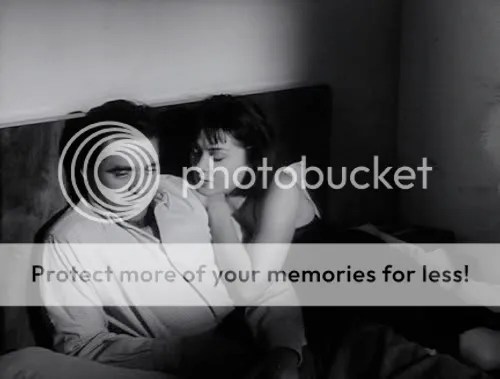
Aldo has just been informed by his lover that her husband is dead. To him, this is great news as it ends a seven year period of secretive love. His lover, Irma, is surprsingly far less optimistic and turns down his marriage proposal, latter admitting to another affair. Stunned, he leaves town and begins to wander aimlessly (with his daughter) from town to town, reigniting past flames. His many flings leave him unsatisfied and lead him back to his feelings of perpetual loneliness.

As mentioned before, this is Antonioni’s first real attempt at his own style and the results are not as technically established as his later films but his insight into the human relationships is as profound as ever. It’s impossible to not see this films influence on stuff like The Brown Bunny and Broken Flowers, both of which pretty much follow the exact same narrative structure. Unfortunately, this film is told a bit more “straightforwardly” and is about as plot-driven as Antonioni would get, excluding his earlier films.

“That” Antonioni aesthetic is setup against a much more gritty environment, reflective of the neo-realist films of the time and the result looks a bit like a Bela Tarr film. I have always brushed off Antonioni-Tarr comparison; Where as Antonioni is perspective and attentive (not to mention real…) Tarr is overly-philosophical and feels artificial. They couldn’t be more different in my mind, but the gritty Italian homes of this film do bring to mind Tarr’s film, at least more than Antonioni’s usual picturesque landscapes. That’s not a criticism as I still see this film dealing with real human problems. Through all the turmoil, Aldo returns to Irma (or at least attempts to), as his feelings for her continue to reoccur, so does the poignantly-layered score. The ending is abrupt and silly, but the events leading up to it are bizarre and ambigious as the ending of L’Eclisse. Not Antonioni’s best, but a great film in any case.


Wife! Be Like a Rose! (1935)

24 02 2008

Mikio Naruse’s most famous pre-war picture is a preview for the themes that would dominate his much more famous post-war period. Again, we see Naruse specifying his focus on underprivileged women, this time a mother and daughter that have been abandoned by the family’s patriarch. While it is covered in lots of fancy camera work and other stylistic devices that Naruse would later eliminate, it feels quite comfortable along with his personal and accomplished work.

Kimiko is ready for marriage, but she’s more focused on reuniting her own parents. Her father left years ago, and they’ve heard nothing from him since, except for money orders. Her mother has become somewhat of a recluse since then, passing the time by writing poems inspired by the loss of her love. Kimiko goes to visit her father living in the mountains, but finds that he has established another family. He has another lover and two children. Contrary to Kimiko’s (and the audience’s) expectations, her father’s new spouse feels very sorry about the situation Kimiko and her mother are in. The importance of the new family as well as their kindness, convince Kimiko that she doesn’t need to force her father back home.

As shocking as the film’s anti-dramatic climax is, it’s the mother reaction to the father’s return that makes this one. Certainly, it’s a great film without her poetry over lover, but I think such a stance represents a theme not apparent in Naruse’s later works. Perhaps I am approaching iton the surface as a mixing of priorities where as it’s simply as decision ofn the mother’s part to not bother rekindling an old flame. In that case, it eludes to memories, something Naruse will explore with a bit more depth in Floating Clouds. I am almost positive that I am reading a lot of this wrong as I didn’t connect to it immediately as much of Naruse’s post-war work. I will definitely need to make a priority of rewatching this, but until then I can say it’s a great (early) step in the right direction by one of cinema’s greatest figures.


Sudden Rain (1956)

23 02 2008

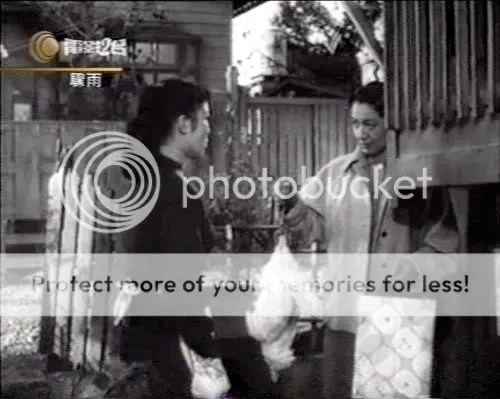
Setsuko Hara plays Fumiko, whose unsuccessful marriage has made her become more and more cynical. When her niece, Ayako visits and complains about her own marriage, she is unsurprised. Meanwhile, a new couple, whose marriage is similarly unblissful, moves in next door. The two couples create a very awkward bond that could ruin both marriages, but everyone seems to be aware and nobody cares either way.

A bit of a departure here for Naruse. Certainly he’s touched on the subject of dysfunctional marriages in the past, but not quite in the cynical and literal way he does in this film. At times, it’s a perfect example of just how funny he can be (Fumiko dogs: “Better than a human, being at least.”) but I suppose he also sacrifices some of his usual observational qualities. In truth, this feels a bit like a silly old Hollywood screwball with Todd Solondz-esque humor. It’s fast, it’s witty, it’s fun, and so on but it never really begins to go beyond the surface of “jeez, married life really blows!”

The thing with Naruse’s humor in his other films from the 50s, is that there is always an emotional context, so to speak. The humor in this film is more pronounced but far less poignant: it’s sort of sugarcoating real emotional trouble as oppose to finding the humor inside of it. The humor found in films like Lightning and Flowing come from showing the truth. I suppose there’s no outright examples of this, but I kept thinking of this theory while watching Sudden Rain. Every once in awhile, it’ll feel like a Raymond Carver book, what with people dissecting their own relationships. As great as Naruse was at writing dialogue, he did go a little bit over the top in this case. You can’t make too many compotent criticism against the film, though, as it seems like Naruse just wanted to do a very cynical but very funny film, if only to show his comedic boundaries.


Love of Sumako the Actress (1947)

22 02 2008

Kenji Mizoguchi, once again, shows his ability to create compelling characters and photographing them with a supreme level of visual beauty. It sounds simple, but his balance of character relations and technical innovation is something that only a select few of directors can accomplish. If it wasn’t obvious enough, I’m becoming a bigger fan of his with each new viewing experience. As good as something like Ugetsu is (and it is good) I feel that some may get the wrong impression of the rest of Mizoguchi’s work. It’s film like this that show that he can tragic with some reservations and observations, as well as static compositions that will make Tsai Ming-Liang envious! (Corny, I know…)

Shimamura risks his career and decides to bring Western theater to Japan. The risk pays off, though, but a large part is due to the leading actress, Sumako Matsui. Eventually, they fall in love, but such a marriage is unacceptable in society. Shimamura gives up everything in his life, including his family to begin a new life with Sumako and to hopefully revolutionize the Japanese theater scene his Art Theater company.

This is one of Kinuyo Tanaka’s first collaborations with Mizoguchi and in case, both are on top of their game. Tanaka, who eventually became characterized as a motherly cinematic figure, is fairly young here. It’s quite interesting to see her as the modern, outspoken young women as opposed to the wise, battered matriarch she became in many films later on. No question, though, she’s really fantastic here playing some “live” stage performances, predating Gena Rowlands’ similar (but far less bleak) role in John Cassavetes’ Opening Night.

The cinematography, as always with Mizoguchi, is fantastic. It’s funny, I consider his earlier style to be a bit “rougher” but it’s ultimately much more contemplative. This could be a result of mishandled prints and the inherent dating that goes with film stock, but in a film like this and Sisters of the Gion, he seems to be making decisions as he goes. Some scenes will feature ridiculously long static shots, while another will be a fast tracking shot. It creates a very jarring, but in my opinion, effective aesthetic. It’s sort of “rough” minimalism, while Mizoguchi’s films from the 50s couldn’t possibly be smoother. In any case, I like both approaches. Since the condition of Sisters of the Gion is so poor, it was neat to see what that film probably looks like in a print where you can actually see people’s faces.

While not without it’s tragic moments (would it be a Mizoguchi film without them?) this still comes off as observant and true-to-life as any film exploring the subject. It doesn’t hurt for Mizoguchi to have his trademark technical virtuosity written all over the film, but the great performances are what boost this up into his top-tier of films. Not a “perfect” film per se, but definitely essential for those interested in Mizoguchi.


In a Ring of Mountains (1962)

22 02 2008

This is a much more gentle and deliberately paced film than one may expect from something featuring Raizo Ichikawa. Nakayama Shichiri, despite its fair share of sensationalist moments, belongs with more mature work like Bloody Spear at Mount Fuji. Unfortunately, director Kazuo Ikehiro faded into nothing, building his career around many inconsequential Zaitochi films. This early effort showcases his personal vision which seems to never build up to its highest possibility.

Lumber worker Masakichi meets and falls in love with Oshima, and they quickly make plans to marry. The plans fall through, though when Oshima is raped and later commits suicide. Masakichi avenges her rape and then flees town and becomes a prominent figure in the gambling scene. He befriends a man named Toku. Toku is very unlucky when it comes to gambling but he must continue to do so in order to meet the family’s standards. Masakichi is introduced to Toku’s wife, Onaka, who looks exactly like Oshima. Masakichi, still heartbroken from the loss of a lover, feels obligated to protect Onaka and Toku as they flee from law. Gradually, Onaka falls for Masakichi, which causes a drift in the three’s runaway plan.

Built upon a plethora of melodramatic turns, Ikehiro’s films never feels the slightest bit unnatural. The wonderful performance certainly help downplay a lot of overly-dramatic sequences, but I think it’s Ikehiro’s economic cinematography (done by Senkichiro Takeda) that plays the biggest role in delivering a very natural, almost Narusian vibe. Certainly, there are limitations that any ninkyo eiga film will contain, but all things considered, there’s very little to improve on.

As mentioned before, signs of a more reserved style are prominent for the film’s first half. At times, it recalls anything and everything The Sun’s Burial to Yamanaka’s Tange Sazen. Little has been written about Ikehiro, but I’d jump to the conclusion that he had a fair knowledge of Japanese cinema during that time period. Towards the end, our characters take a detour through Mizoguchi style poetics. Visually, one is reminded of Sansho the Bailiff while narratively, there is somewhat of a connection with Chikamatsu Monogatari. It seems lazy on my part to simply compare every tangible aspect of the film to the work of other directors, but the influence seems overwhelmingly apparent to me. This is not a criticism of Ikehiro in the least. He has taken what he’s learned from the best and streamlined it into his own personal aesthetic. The result is one of the very best films of it’s kind.