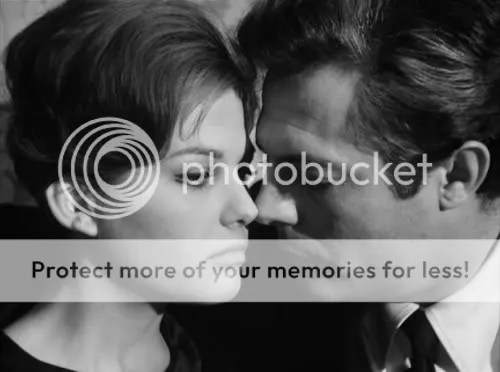
Il Bell’Antonio (1960)

12 04 2008

While certainly tied down by some conventions of the time period, this does come off as a very good, albeit very flawed example of post Neo-realist Italy cinema. While it certainly doesn’t live up to Antonioni or Olmi (who I personally regard as the greatest directors of the period) it doesn’t seem that far off. A lot of the plot development is a bit soap-operaish but on the technical side of things, it’s a bit more polished, which makes for a very pleasing experience, regardless of the many problems.

Antonio has returned home to Cantania after a three year period in Rome, and with him, comes a wide variety of sexual rumors. At parties, women giggle behind his back and imagine being with him. He remains oddly passive, though, at least until he encounters a picture of Barbara, who his parents wish to marry. He joyfully agrees but after they wed, they have nothing to look forward to. Both attempt to show their love for one another but the result always feels awkward. It is eventually revealed that Antonio is impotent, which leads to an annulment from the church.

The tongue-in-cheek twist threatens to destroy the passive tone that haunts the lovers’ happier moments from earlier on in the film. The complexity of Antonio is attempted to be “explained” by this silly plot twist. Thankfully, the tone is never shifted to a carefree Italian comedy, which it easily could have done. Instead it gracefully attempts to pry into the reactions of Antonio’s family. Here is where I would have preferred some slightly more personal moments. The protagonist seems to disappear every now and then just so the local reaction can be observed. This is unneeded and frankly, uninteresting. In one of the more embarrassing stretches, Antonio’s cousin, played by Tomas Milian, attempts to provide solace to his neglected relative. The overly-expressive dialogue does bog down the pace as well, and makes for some laughable monologues.

Overall, though, this is still a really nice movie even though I can’t completely love it. Perhaps it’s a personal interest in 60s Italy that makes me want to try to like movies that I could easily dismiss. This is not L’Avventura, this is not Il Posto, but one gets the feelings that it’s on the way there. The enjoyment of this film comes out of a greater love for those films. If you don’t like Antonioni, there’s no reason to watch a watered-down version, but if you do, you’ll still have to overlook some things to like this.


A Man Asleep (1974)

11 04 2008

Bernard Oueysanne’s adaptation of Georges Perec’s 1967 novel Un homme qui dort constantly tip-toes on a line of cold and intellectual pretentious nothingness. The constant narration and never-ending montage style restrict the film from being connected to the “contemplative” cinematic sensibility. When I call this unique, I really mean it, there isn’t any other film out there that is quite like it. Perhaps Chris Marker’s oeuvre is on the same wavelength but other than that, nothing is close. If this is a failure because of it’s ambitions than it’s admirable and necessary one. Through the most unlikely of directions, Oueysanne and Perec have created something to display just how delicate every bit of our human existence is. For that alone, a viewing should be a necessity.

Our unnamed protagonist lives in a small apartment and after some deliberation and exposition, attempts to cut himself off from the rest of the world. He will only participate in the essential, sleeping, eating, and smoking. However, he is not so quick to welcome such a secluded world and begins to fill time with many other fleeting activities. Some months, he makes a habit to go to the movies. Other times, he plays solitaire or spends the night at a bar. For the entire running time, he does not say word but instead his thoughts are eloquently articulated by an ever present voiceover.

It’s important to note that this not a precursor to Chantal Akerman, nor is it similar to Tati, or Tsai, or anyone else who falls underneath the usual “minimalistic” category. Instead, the film is a montage, a constant montage. An overwhelming amount of poetic images flood our minds, in a feverish fashion. The thoughts of our unnamed protagonist are anticipated by such images and make the film as interesting as it is. Without these images, the observation of the world’s appearance and textures seem useless. Despite the obvious literary influence, the “story” (so to speak) needs its images or else it would be the cold, dead, unemotional art that it occasionally appears to be.

The self-reflexive nature is detaching, just like it should be, but I can’t help but think that the film’s undying coldness does almost make it too bleak for its own good. On the other hand, if our unnamed protagonist fell in love with a girl, the narrative’s purpose would be tainted. The ending, which outrightly states that the man’s seclusion led him to no deep answers, could probably have ended with him meeting people, too. But again, this is merely some post-viewing pondering brought on by a mind that is unfamiliar with this strictly loner aesthetic. It’s the lack of changes that the character’s deliberate loneliness brings that makes the film profound. Perhaps his fictional experiment in isolation gives hope to loners across the world, or maybe it just illustrates how much we humans need other humans to interact with. Maybe the film does all of this, or maybe not, but all I know is, it certainly has invoked hours of thought in me and created an experience that will be difficult to forget.


La Notte (1961)

7 04 2008

The least affecting of Antonioni’s trilogy, but probably the most accessible as well. It plays out somewhat like a series of vignettes, all of course crafted with Antonioni’s usual mastery. But I’d be lying if I said the film felt as “complete” as L’Avventura or L’Eclisse. It’s more than fascinating to watch unfold but doesn’t invoke the deep post-viewing pondering that the rest of the trilogy does. Even though it might always be overshadowed by the other two films, it does provide more than enough memorable sequences to exist on it’s own.

Tension between a married couple comes to the surface when one night, they attend an all-night party. The husband, Giovanni, has recently published a novel and developed a public image as an intellectual. His wife, Lydia, is going through a personal and internal crisis which frustrates her and makes her husband suspicious. At the party the two openly flirt with others, occasionally attempting to factor in their one-time love for one another. At the dawn of day, their efforts seem to become more and more useless.

While certainly providing an insightful look into a crumbling relationship, most of the two-hour running time is supported by many “irrelevant” scenes that come and go quite quickly. These are okay with me, though, because they definitely lend the film a type of deadpan sensibility. It’s also the main reason why one can get away with calling this Antonioni’s most accessible film. Of course, it is most likely slow to an inexperienced audience but not more so than the rest of his work. There also seems to be more convincingly dramatic performances, which sacrifices a lot of nuance heavily located throughout the rest of the trilogy. Of course, this is all in comparison to Antonioni’s standards and considering the fact that he is one of the best (and most influential) directors of all-time. Calling this one of his lesser works, doesn’t really mean much. If one wants to experience more “Antonioni-ness” (or more Vitti-ness) but has already rewatched his other films countless times, this is certainly worth viewing but at the same time, not the greatest representation of his mastery.


Black Girl (1966)

6 04 2008

It sounds a little mean, but I have a hard time believing that some people genuinely love this movie. Don’t get me wrong, it certainly left an impression on me, but still, not only is it fifty-five minutes long, it’s also plagued by really irritating good-vs-evil type characterization. Perhaps Sembene has some historical evidence to back-up how evil the main character’s employers are, but still, it’s done in the sloppiest manner, but somehow that eventually becomes part of the film’s charm.

Diouana is bored with her life in Darkar, it’s unremarkable but also financially unfit. She goes to look for a job as a maid, and a French women eventually hires her to take care of her children. Babysitting in Darkar is okay, but then the family relocates back to France and Diouana’s employer now expects more and more of her. Eventually, she becomes a slave to the family’s psuedo-cultured intellectual chit-chats. Fed up with her job, she begins to rebel.

Unsubtle would be a good way to describe this, it becomes pretty apparent within the first five minutes that the film is ultimately about racial tension in France, which I have to say isn’t quite engaging on its own, let alone when it is presented in the most heavy-handed of ways, as it is here. Fifty five minutes of how awful white people are, but Sembenne gets his point across within the first couple of minutes making the rest of the film’s narrative dull and repetitive. To make matters worse, the acting is pretty embarrassing. As a longtime MST3K fan, I’ve seen plenty of bad acting, but really there is not much of a difference between the performance here compared to the performance in any number of old, campy b-movies that I couldn’t be bothered to name-drop. Campy points have to be added for the film’s use of a postcard as a balcony shot.

The only redeemable factor for the film is more than likely, unintentional. Sembene crafts his film in the most straight-forward, basic, “bland” way that is too melodramatic to be truly considered minimalism. On the other hand, the really boring camera work is somewhat effective. I would be more eager to credit this as Sembene’s “style” but instances of fades and rotating angles disprove such a theory. If one jumps at the sight of s Regardless of how unintentionally good most of the film is, the finally sequence of a little boy running around with a mask on is genuinely amazing and definitely gives some hope for Sembene’s other films.


Silence and Cry (1967)

2 04 2008

The last of  Miklós Jancsó’s black-and-white, cinemascope films and probably, in overall terms, my favorite film of his. It goes without saying that he makes some of the most technically accomplished films. Through all of the films I’ve managed to see from him, I’ve been amazed with his use of space, the long tracking shots, and overall just how he crafts his films in a way that is completely unique. At the same time, I find his films, all of which (with a few exceptions) focus on Hungary’s political history, to be emotionally unremarkable. There’s no denying that an aesthetic can build into something that deeply affects a person, but Jancsó’s content is so boring, for lack of a better. Despite claiming Antonioni as an influence, he seems to have no deep interest in human emotions, but in Silence and Cry, he comes pretty close.

A love triangle (or perhaps square) of some sorts taking place in post-World War I Hungary, the film tells the story of a fleeing soldier who is sheltered in a farm run by two women. The previously mentioned love triangle isn’t deeply explored and perhaps it’s a misreading on my part, but in any case, the film functions on a collection of sequences that range from poetic and heartbreaking to Herzog-esque surrealism, all relating to these relationships.

The shoddy reading on my part pretty much points to my few, minor problems with the film. Certainly this is all-around, the best film I’ve seen from Jancsó, but the narrative is still inaccessible. Michael Brooke (thankfully) makes a far more knowledgeable reading of the film on his blog but perhaps time needs to be taken to appreciate this type of brevity. As I seem to mention countless times on this site, I do indeed like plotless, slow films but I think Jancsó’s narratives fall under a different category: confusing, to make matters simple. Not in a self-consciously “surreal” type of way a la Lynch, but I feel something is missing. Not a “plot-arch” but a “character-arch.” As much as I want to praise Jancsó for his beautiful, unorthodox style, I can’t help but wanting to know something more about his characters.

With all that said, Silence and Cry tries quite admirably to correct all these faults. It’s definitely Jancsó’s most humanistic work. For once we seem to have characters that are more than just mouthpieces or visual props. In fact, there’s even a few cases of arguing and yelling! It’s to the film’s credit that it seems to be filled with some extremely touching moments. Even if they don’t completely work in context, they certainly are breathtaking outside of context. I think at this very moment, that’s generally how I feel about Jancsó. I can admire his filmmaking just by how innovative it is, even if there is nothing (from what I’ve experienced) that is fully-formed and competent enough to provide some resonance. Certainly, there was no one in 1967 doing the things he was doing. Even now, his films seem somewhat different to Angelopolous and Tarr, both of whom are usually considered his stylistic disciples. Whatever the case, he’s brilliant with the camera.