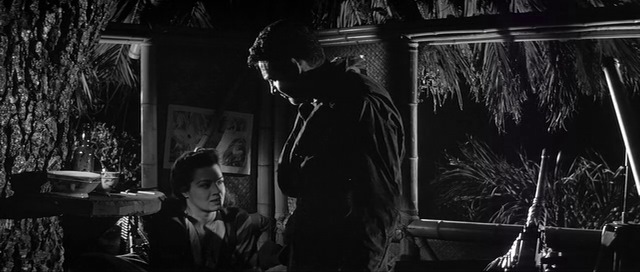
Underworld U.S.A. (1961)

18 05 2014

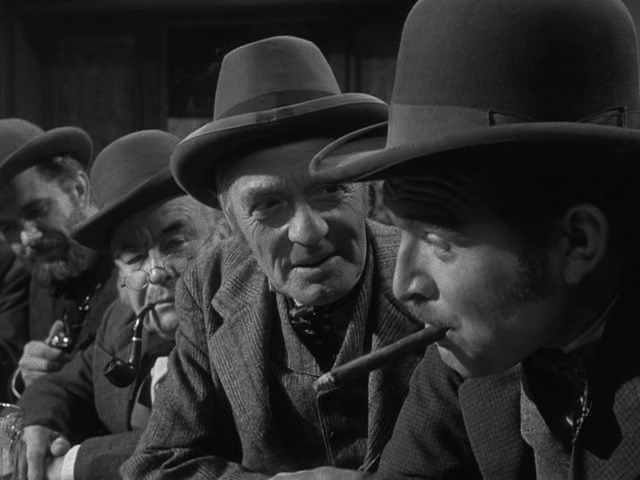
Samuel Fuller’s reputation is cemented, it’s far too late to challenge it. The conventional wisdom suggests that he might not have made the most perfect films, but he instead fueled the ones he did make with a passion and fervor that it indemnified anything that would conventionally be read as “bad” filmmaking. Fuller’s reputation is immensely entertaining because, while outside of Hollywood, he wasn’t working in complete opposition to Hollywood filmmaking. His films then become a study of the small things that are conventionally diagnosed as “good” and “bad” in American cinema. Underworld U.S.A. is unique in the Fuller filmography, its one of the few films (of which I’ve seen) that seems to fit most closely in the mainstream mold. Even as it feels more perfected, it has one of Fuller’s most riveting political observations. It feels closer to Hollywood, but what it says couldn’t be further away from it.
1

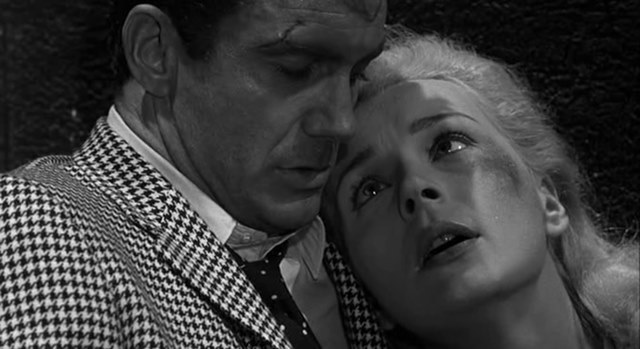
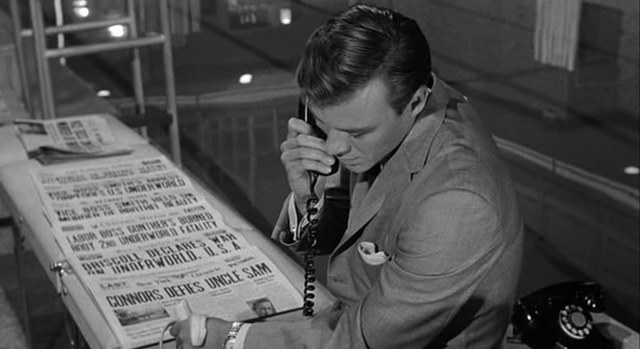
On New Year’s Eve, Tolly Devlin witnesses the death of his father at the hands of four men. The trauma of the situation leads him down a lifestyle of crime, where he ends up in prison. There, he becomes a model prisoner. Volunteering at the hospital, and closely listening to the doctors. His motivation is for revenge. He’s trying to find Vic Farrar, a dying man who may have been responsible for his father’s death. He gets Farrar alone and asks him for the names of the other three men. Since the murder of Tolly’s father, the remaining three murderers have climbed to the stop of the crime syndicate. Out to get his revenge, Tolly decides to work for both sides, all while living with his mother-figure, Sandy.

2

After a disappointing revisit with The Naked Kiss (I find the film’s attitude towards sex work rather paternalistic), I was afraid of exhausting myself on Fuller. Underworld U.S.A. is kind of the perfect film for someone who admires him, but who might also grow impatient with the filmmaker’s didactic and simplistic approach. Here, he’s a bit more reserved, and the energy that he usually uses to plow his hamfisted and simplistic politics through a film’s core, is instead used for something refreshing here. There’s part of this film that feel remarkably typical for the noir genre, but then one takes a step back and realizes that the protagonist is a grown man trying to solve a crime while living with his mother. He actually touches upon something far more interesting, politically speaking, then he does in his work that I’ve seen. It’s the idea that the American criminal justice system is not just corrupt, but that it is intentionally structured to benefit the people at top, and keep those at the bottom down.

3

At the surface, Underworld U.S.A. is, in addition to a revenge film, one of just countless films that depicts corruption within the police force. While many of these films get praised for being “daring” they are actually the opposite. The “crooked cops” motif actually reaffirms the idea that cops, generally speaking, are working with our best interests in mind. This sounds like conflicting ideas, but the crime drama that depicts corrupt police usually involves either downfall or a suggestion that they’re in the wrong. They are positioned as abnormal versions of the moral upstanding officer, and they usually see their justice. I mention all this because Underworld U.S.A. gets right what so many of these films get wrong: it does not suggest that there’s anything unusual about this kind of behavior. It recognizes the crooked cop as almost a cliche, something inevitable, which is the truth.

4

Perhaps more important than this attitude, is Fuller’s idea that the system itself is entirely corrupt. This sounds like the waxings of a teenage rebel, but there’s no denying that the criminalization of certain bodies over others does not come from a “mistake” by the authorities, instead it is a conscious hegemonic move. Underworld U.S.A. is almost completely white, which doesn’t provide Fuller to come all the way around on these musings and make a more typically Fullerian insight that is more pointed. However, it might not need to be there. The bureaucracy of the justice system is presented as both impenetrable, yet easy to influence. In Dolly’s case, it helps to be a schmoozer and to be a white male, and also to be in a dramatic movie. That sounds like I’m writing him off and the movie off, but these opposing ideas do exist in America’s crime system. It can be influenced easily by the powers that be, all if it serves the purpose to make them richer (see the War on Drugs) and maintain control of those at the bottom. Fuller maybe didn’t realize he was illustrating this complex within America, but maybe the fact that here, he finally seems comfortable and less eager. He seems to have something more interesting to say when he’s not entirely sure of what there is to say.
5


Park Row (1952)

5 05 2014

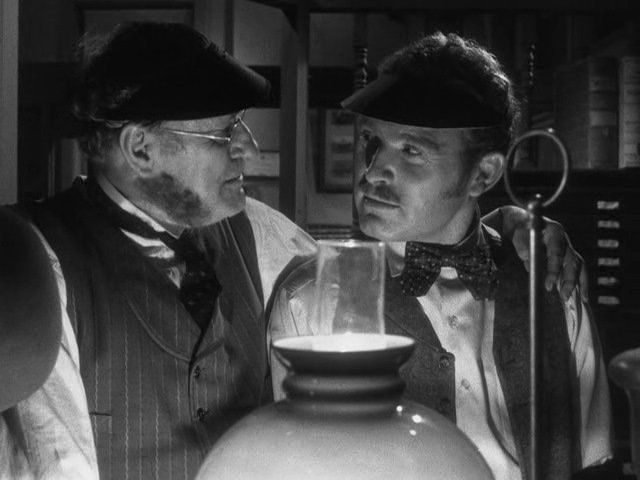
Much has already been written about director Samuel Fuller’s own admiration for his 1952 effort Park Row. The film, a personal love letter to the very newspaper world he worked his way through as a youth, was a fiscal failure, which almost seems to deepen its bond with its filmmaker. Fuller’s style of filmmaking always suggests that he’s going 100 miles per hour, and that he believes every bit of his film is crucial and urgent. The comparison seems forced but through this idealism Fuller finds his closest colleague in Pier Paolo Pasolini. Sure, they worked towards a different ideology, but both did so with such passion and earnestness that what one could call “amatuerish” about their work (ie the potentially hamfisted nature way their politics manifest) ends up becoming part of its charm. Though “charm” seems to be a disservice to both men, it’s almost the ethos of their energy energy, and it becomes more and more contagious in every moment.

1

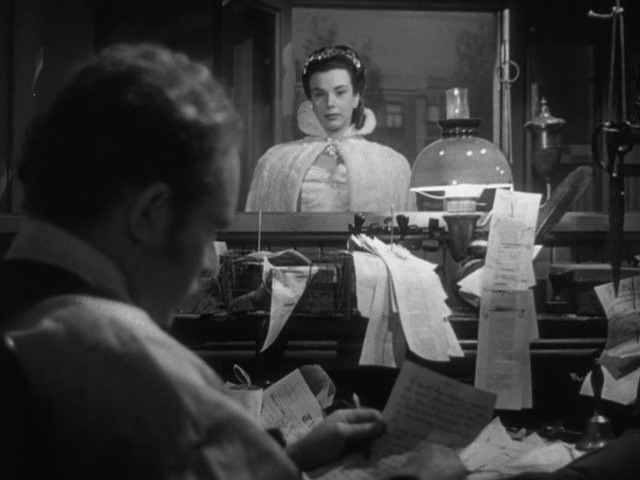
Phineas Mitchell is a great journalist at The Star, but the paper’s involvement in a recent trial has left him disillusioned. At a local dive bar, he tells off the paper’s proprietor, Mary Hackett. The other Star journalists at the bar are similarly dismissed, which leads Mitchell to wishfully entertain ideas of making his own paper. Someone listens and gives him an old office right next to The Star. The Globe is born over night and it quickly becomes a success. However, this success is much to Hackett’s chagrin, who seems devoted to quickly ending The Globe’s successful run. Undeterred by some shady efforts from his rival, Mitchell seeks to grow The Globe’s readership by having a drive to complete the Statue of Liberty. With every new innovation, however, Mitchell opens himself for a new opportunity to be taken apart.

2

Fuller’s energy and drive is commendable and it’s something I’ll go into later, but I find it more important to begin with a narrative that manages to be both simplistic but complicated. The actual arc isn’t difficult to follow, but rather the complications come from the Mary Hackett character. She is drawn rather broadly, at times appearing more like Cruella De Vil than an actual woman with fears, dreams, expectations, and disappointments. Her relationship with Mitchell is where things get sort of interesting, since the film ultimately redeems her from this basic character template. The film shows an interest in elevating her from this unremarkable and equally unflattering trope, but it doesn’t quite work. At one point, she gives Mitchell a knowing wink and he returns it before the two embrace. Although the intimacy achieved in this moment is later revealed to be another manipulative tool of Hackett’s (sigh) the glance in the sequence suggests that both Fuller and Mary Welch (who portrays Hackett) understands how stifling such a character type can be. The fact that their romance ends up working out suggests that their animosity comes almost of convenience to the story, at that Fuller is winking along with the couple the entire time.

3

Park Row from a social perspective, is probably best read as Fuller’s love letter to journalism. It’s been described as such before, and I don’t think there’s anything wrong with agreeing with the film’s accepted reading. The marvel of Fuller’s film does not come from its subtext, but instead from the filmmaker’s technical virtuosity. There’s an energy in every composition, even the ones that are completely static. Sure, the tracking shot at the one hour mark is amazing all on its own, but just as impressive is how much Fuller’s gets out of his less flashy moments. Jonathan Rosenbaum describes the film as “cozy”  which seems like the perfect description for those compositions where Fuller squeezes everyone into the frames, much like how the characters themselves seem to squeeze into a seedy dive bar during off-hours. It’s this kind of love that one can read from Fuller in every frame. The way Mitchell gets excited for starting a new kind of paper in The Globe mirrors the way Fuller gets excited about making a new kind of movie.

5


China Gate (1957)

3 05 2014

An American film dealing with French-Indochina never sounds particularly promising. Even today, where most of our war films are “gritty” survival tales that carefully recycle nationalist sentiments, it sounds troubling. For the 1950s, it sounds like it could be either extremely aggressive or potentially so backwards and problematic that it would sooner be forgotten. Parts of Samuel Fuller’s China Gate haven’t aged well. The film’s casually anti-communist rhetoric is tame in comparison to much of what was being expressed in Hollywood at the same time, but it does suggest the dedication to capitalism had bleed into Fuller’s brain. Weirdly, the context of the film doesn’t take away from what its truly about. Fuller has in his own passionate and hamfisted way sculpted a film that sure, comments on race relations in a superficial way, but it provides something deeper and more satisfying than the triumphant tales of color-blindness that populated the multiplex.

1

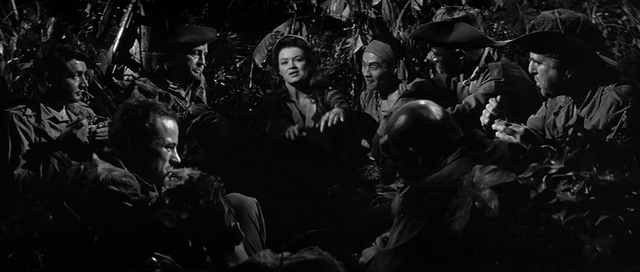
Sergeant Brock has been asked to lead a group of men into Chinese border, infiltrate enemy territory, and blow up their base. Brock, who we are to assume has no other options, is on board with the mission. However, the group’s secret weapon is his Eurasian ex-wife, Lucky Legs. Though never formally divorced, he separated from her once her son was born and looked more traditionally Asian. Lucky agrees to the mission with the reward that her son gets sent to America. She tries to reconnect with Brock, and while he still has feelings for her, he remains uncomfortable about his son. He can’t get over his feelings for the woman he loved, but at the same time he can’t get over his racism.

2

Now, I can see someone reading the previous description and seeing the film easily going the route of Brock unlearning his prejudice in classic, condescending and simplistic Hollywood style. That doesn’t quite happen, though. By the film’s conclusion, he confesses that he wants a family with Lucky, even if that includes his son. However, earlier in the film, following a tender but misread moment he says that he could patch up their relationship by lying. He could say he cares about their son, but he doesn’t want to lie. With this scene in mind, its difficult to read their reconciliation as a performance. He’s actually only concerned about Lucky.

3

While the film dives into Brock’s psyche and he tries to work through his racism, I would argue that the film’s real hero in Lucky Legs. There’s something awkward about a Eurasian woman being played by Angie Dickinson, who is of exclusively European descent. The biggest problem could be that the film suggests something resembling colorblindness – that Lucky’s background obviously didn’t matter to Brock until the manifestation of their sexual relationship produced something troubling to him. I think the film suggests sort of the opposite, and hints at what passing as white implies. Lucky herself is in a unique position, she’s beloved all over Asia (“she lived like a prostitute” the film not so gracefully tells us) and this is obviously an extension of her perceived whiteness. Her plight is summed up quite wonderfully at the film’s beginning, “I’m a little bit of everything, and a lot of nothing.” Sure, it sounds maudlin, but Fuller’s constant centering of Dickinson means her performance, while surrounded by potentially melodramatic trappings, registers as something both empowering and grounded.

4

I’m sure not all audience members see Dickinson as the film’s true lead. Maybe that’s because of some social conditioning or maybe because Gene Barry, as Brock, has just as much screen time. On the other hand, he is the  far weaker character. A man whose racism isn’t perceived as the “interesting” anti-hero trait that it would be viewed as in a lesser film. Instead, it’s a problem that Fuller expects him to fucking deal with as soon as possible and the rest of us aren’t going wait around for him to have his “aha!” moment of peace and clarity. Dickinson’s seduction-and-destruction technique is amazing to watch, not to mention perhaps a distant link to Jonathan Glazer’s recent Under the Skin. While Glazer’s film mystified people, Fuller is more direct. Dickinson needs to do this to save her son. Her death at the end of the film seems tragic, but it is almost inevitable. The things that influence society – poverty and war here – are the things used, fittingly enough, to keep a racist patriarchal capitalist society alive. Dickinson’s existence is thus, in opposition to the society that her and the rest of the film’s heroes superficially claim to be fighting in defense of.

6