La Caza (1966)

20 09 2008

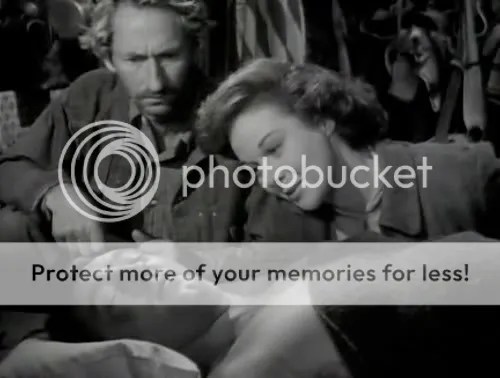
Not at all like Carlos Saura’s much more acclaimed Cria Cuervos, which is fine by me as I never really cared much for that film anyway. Really, the only aspect of that film that I would have liked to see here is the very gentle humanistic approach. Cria Cuervos probably felt a bit too fragile, if anything, but La Caza could have benefited from a similar attention and care for its characters. Instead, it’s a vaguely transgressive Antonioni-esque action film that comes out on the positive side of the scales in spite of the fact that it completely abandones the mature “contemplative” vibe for a laughably violent climax. For the most part, though, this is a very good film, another unrecognized work with a strong Antonioni influence.

A group of old friends, Don José, Paco, and Luis reunite after years of seperation for a day of rabbit hunting. Paco’s son in-law, Enrique, tags along, but even he suspects an alterior motive for being invited. The event’s host, Don José, plans to reunite his closet friends for the purpose of recieving financial aid. Paco is a wealthy self-employed business man, and Luis is fairly pessimistic, recently divorced, and devotes most of his time to literature. Both turn down Don José’s call for help, which infuriates everyone involved. The day progresses, and tensions reach a high point – something is bound to happen.

To call reference to something I recently viewed, this does share a lot in common with Jancsó’s Cantata. The obvious reason being the very apparent Antonioni influence present in both films. Overall, Jancsó comes much closer to making a film more in touch with Antonioni’s thematic interests. Alienation and lonliness are only subtly hinted at in Saura’s film, though it’s worth noting that his interests clearly lie elsewhere. It may be a result of watching a lot of westerns as of late, but the way in which the past of every character plays makes up a bulk of the film’s core definitely reminds me of something Boetticher or Mann would do.

Most of the Antonioni similarities lie in the technical rather than in the thematic. Setting a film in a barren, relatively isolated landscape will almost inherently invite comparisons to L’Avventura but the deliberate pace that Saura uses only deepens the similarities. There is a very unassuming vibe going on for an extended amount of time, that is unfortunately destroyed in the film’s final seconds. Still, the lack of drama within the first hour is particularly impressive. The calm landscapes contrast beautifully with the very intimate and textured close-ups on individuals, which brings to mind Teshigahara’s Women in the Dunes, a film that Saura (almost) visually references towards the end. That definitely made me want to reconsider my opinion of Carlos Saura, even though I’d still say that he ended this film in a rather hokey fashion.




7 Men From Now (1956)

16 09 2008

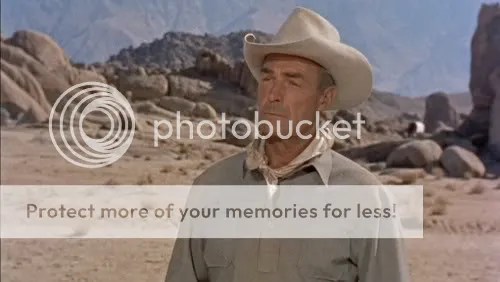
My second encounter with Boetticher and Scott’s “ranown” series, and it is just as great as the first. I missed the very clever narrative set-up of Decision at Sundown – this film is a bit more straightforward, and probably better because of it. The visuals are great, as expected, but it is really Randolph Scott turn as Ben Stride that makes this one so special. I understand that this will give the impression to many people that his performance, since it is so important, is probably really over the top and energetic, but it is the exact opposite. This is classical western protagonist type passiveness and Scott totally nails it.

Providing support is Lee Marvin as Masters, a villain, of sort, but one that is on remotely friendly terms with Stride. The film’s romantic thrust is courtesy of Gail Russell as Annie Greer, the wife of a naive and much less masculine (at least in comparison to Stride or Masters) man, John Greer. The Greer couples happens upon Ben Stride in the middle of the dessert while they’re on their way to California to take advantage of a job opening. Stride helps get the Greers out of a mud puddle, and they respond by inviting him on their journey. This all happens within the scope of about ten minutes, which provides a perfection explanation of Boetticher’s pace. Perhaps equating his sense of pacing to Antonioni would make film buffs scoff, but he definitely seems to be in the same ballpark.

Also in the first ten minutes, is one of the most brilliant moments in the entire film. As Stride and John Greer wash up their respective horses, Annie takes a swim some distance away. She begins to sing, and her song begins to eclipse the awkward and clumsy attempts by her husband to make conversation with Stride. To inadvertently quote the back of the DVD box, Stride is a no-nonsense character, and yet he constantly finds himself stuck with people filled with nonsense. Only Stride’s nemesis, Masters, seems to be on the same (emotional) page.

Oddly enough, the emotional sensibility of every western protagonist is called in to question only a couple minutes later in the film when Masters grills John on how he was able to end up with Annie. He mentions how he and Stride are tough, simple mind with no time for fancy concepts like love, while John, being sensitive, does. Obviously, Stride and Masters are the more superficially masculine men, but the implication (from screenwriter Burt Kennedy) is that they are just as soft. This isn’t a groundbreaking hypothesis, but it is one of the few times I can personally recall a western presently the topic so openly. There’s all the usual great Boetticher goodness in this movie, too, which also contributes a good deal to its greatness.


The Lusty Men (1952)

14 09 2008

It seems I forgot just how great Nicholas Ray is when he actually does “serious” movies. It’s been two years since I’ve anything from him other than Bigger than Life, which is certainly a good movie, but probably one that gets too much credit for being (intentionally) over-the-top and ridiclous. The Nicholas Ray here is the one that I first saw in The Savage Innocents and Rebel Without a Cause. He is perfectly capable of handeling human interactions in a completely realistic manner, which makes Bigger than Life seem all the more overrated. But it is the way that Ray juxtaposes the tension of human relations with the dramatic tension of the “action” genre, represented by rodeos in this case.

Robert Mitchum plays Jeff McCloud, a seemingly washed-up rodeo performer. Between his performance here and the one in Raoul Walsh’s Pursued, Mitchum is anything but the scenery-chewing monster that I made him out to be in The Night of the Hunter. Instead, he perfectly embodies the mysterious and painful past that the best performers of the decade specialized in. At this point, I can’t say I admire him quite as much as Henry Fonda, or even Randolph Scott but it is good to know that not everything Mitchum did was grounded in theatrical territory.

The other performances are fine, I suppose, but not nearly as important. It probably speaks to Ray’s overall talent as a director that he can make his film centered so much on Jeff McCloud, a character who he occassionaly abadons to display the response of the characters with whom he interacts. The second most important performance is probably Susan Hayward’s as Louise Merritt, the wife of Wes Merrit who McCloud breeds into a full-time rodeo superstar. Her character type – the concerned wife – isn’t entirely original, but there is something intriguing about her emotional responses to her husbands successes and failures. When he succeeds, she is thrilled and almost supportive but when he fails, she begins to voice her lack of faith in the “profession.” It is a small touch in the script, but it is such an important one as it displays the flaws in McCloud’s romantic interest.

Around this time, every female character in a Hollywood production was either a sultry, worldly back-stabbing vixen or a naive and incompetent safety blanket. Louise is neither, she is not “experienced” nor is she clueless. Her performance is such more convincing as a feminist statement than anything else that came out of 1950s Hollywood, which isn’t saying much considering how phony most femine statements were. Contrary to most “women power” films of the time period, Ray probably wasn’t looking to impress people with his progressiveness with this character. The sequences in which Wes begins to display the power going to his head are particularly impressive. As he becomes the man to flirt with, his wife shows a resilence as great as any of Mikio Naruse’s female protagonists. Louise is not made of steel, but she’s not made of toothpicks, either. She will fight (and later on, physically does!) but she will still be hurt by the many passes her husband receives.

Of course, it is also worth mentioning just how superbly crafted the film is, in that very technical way. Unfortunately, this has never gotten a DVD release, but if it did, I can only imagine how much it would enhance the experience. So much of Ray’s cinema seems to depend on the visual, so much so that even an alright TCM print doesn’t seem to do it justice. It is pretty bizarre too, that a film of this caliber hasn’t recieved more attention. Ray collaborating with Mitchum would be enough, but they are also at their very best here. Whatever the case, this is definitely one of those movies that a lot more people should know about, as it would likely be appreciated by almost everyone who gives it a chance.


Cantata (1963)

13 09 2008

Essentially, this is just Jancsó trying his hardest to emulate Antonioni, which is fine by me. It actually works as a key point in Jancsó’s career as it is here where we can see how Antonioni’s influence lead him to create his own idiosyncratic style. This is not nearly as cold and methodical as Jancsó’s later films, but it does showcase his usual technical grace. As always, his camera is constantly tracking, almost to the point that it seems to have a mind of it’s own. Similarly, this style tends to overrun much of the content. While there are some nice “complicated relationship” sequences, something seems to be missing.

Even some of the most superficial aspect of Cantata resemble Antonioni’s La Notte. The film is structured in three parts. First, we are introduced to the protagonist, Dr. Ambrus Járom, a young(ish) adult comfortable with his profession. Yet, he is deeply affected by the cardial operation that takes place before him. An old professor successfully performs the procedure, but the patient stops breathing. The professor, despite being the ripe age of 70, literally pumps life back into the patient. These early sequences clearly display the birth of Jancsó’s unique cinematography. Perhaps a simple way to describe his camera’s movement is “flowing” as there is something so graceful and smooth about these tracking shots. On the other hand, there’s also some pretty nice shakycam visuals present in the operation room. This probably was just a circumstance and not a stylistic choice, but it still looks great.

The pace picks up in the second act, which is coincidently, the best thing I’ve seen from Jancsó so far. This is definitely where Antonioni’s influence begins to shine. Ambrus attends a sort of “intellectual party” with an exclusive group of friends. It is here that the passivity, alienation, and longing of Antonioni’s cinema meshes into Jancsó’s own sensibilities. Ambrus shows little interest in the activities of the group, which include the projection of a hilariously pretentious short film about dead geese. His failure to blend in leads him to Martá, perhaps the group’s only other social (and emotional) outcast. The would-be romance of two passive individuals is certainly present in many of my most favorite films, but it seems slightly disconnected from Jancsó’s cinematic world. It is probably my favorite part of any Jancsó film, but it is also the least Jancsó-esque part of any of his films, at least from a narrative point of view.

To redeem this, the film’s final act shifts tone and location, putting us in the (assumed) farm of Ambrus’ family. This is definitely the section of the film that shares the greatest resemblance to Jancsó’s later films. This is for a number of reason, an obvious one being that the farm is the exact same one in Silence and Cry. Another reason is the shift in Ambrus’ manner. There is still a sense of detatchment from the rest of the world, but it is a sense of detatchment that is different from the Antonioni sort present in the previous act. Here, we see Jancsó beginning to become, well, himself. It’s a fitting conclusion to the film and a perfect lead-in to My Way Home.


Le Pont du Nord (1981)

9 09 2008

A total masterpiece that not only rivals, but also surpasses the greatness of Merry-Go-Round, which was my favorite Rivette film until now. Basically everything that I love about Rivette’s bizarre cinematic world is brought to the forefront here. Plenty of odd unsolvable mysteries executed in an ultra-kinetic and spontaneous way. Even with the very grainy stock, William Lubtchansky brings some of the most wonderful images I’ve ever seen in any Rivette film. Considering how consistent Lubtchansky is, this is a ridiculously big claim, but that only reinforces what an accomplishment this is. It manages to capture the spontaneity of Celine and Julie with the visual beauty of Love on the Ground. In other words, this is Rivette at his very, very best.

Two women, Marie and Baptiste, bump into to each other three times in the course of one day and almost by default, form a tight bond. Marie has her mind on other things, though, the most obvious one being her lover, Julien, who she plans to reunite with following her stay in prison. Baptiste, seemingly skilled in some sort of martial art, follows her around and notices that Julien’s briefcase was switched by the film’s four character, Max. The two women reunite and gain access to the briefcase which features a map that seems to turn the city of Paris into a board game.

I’ve said before and I’ll probably say it sometime in a future, but describing all the chaos present in Rivette’s film, especially this one, is nearly impossible. Like many of his films from this time period, there’s plenty of conventional mystery aspects thrown in, but they are all just another intelligently designed contribution to complete craziness. As with Merry-Go-Round and Celine and Julie Go Boating, it is the unmatched sense of spontaneity that Rivette creates (and maintains) that heightens said craziness. Perhaps I’m stressing the overall “bizarre” factor of the film and not focusing enough on just how fascinating and wonderful all the performances are. Bulle Ogier, as usual, is beautiful and captivating. Her daughter is goofy, but charming as hell. The weight that both of them carry cannot be stressed enough and yet, both performance are absolutely flawless.

The cinematography here is a bit more grainy than in both Merry-Go-Round and Celine and Julie, which make up something of a personal trilogy for myself, if only for the fact that they are by far my three favorite Rivette films. But anyway, the stock here is not the best, but somehow the ultra-grainess begins to blend into one’s subconcious, which leads to a whole different kind of cinematic beauty. Calling it “documentary-esque” seems almost like an understatement. I’ve never seen any one film be as kinetic and viscerally experienced as this, except for maybe Herzog’s Even Dwarfs Started Small, which would make up a bizarre yet fitting double-bill. Like Herzog’s Dwarf-filled masterpiece, Le Pont du Nord is the sort of film that words can’t do justice for. In other words, go out and watch it right now!

I feel obligated to add in one more tidbit about this wonderful film: it perfectly unites almost all of Rivette’s work. The lovers here are named Marie and Julien, which obviously brings to mind Rivette’s much later (and much more different) masterpiece. It’s almost as though the characters are being fleshed out through a completely different movie, which seems to be the perfect way to define an “autuer.” This not only enriches the actual experience of watching Le Pont du Nord but also my opinion of Rivette’s other films, even The Nun.