Haut bas fragile (1995)

12 10 2008

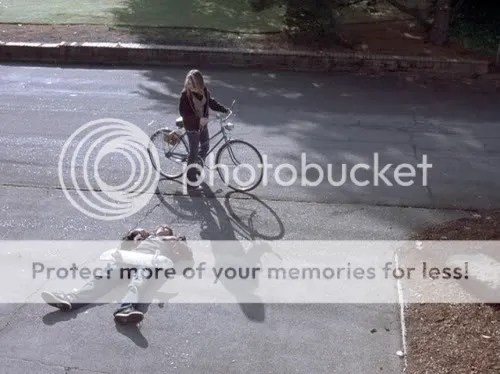
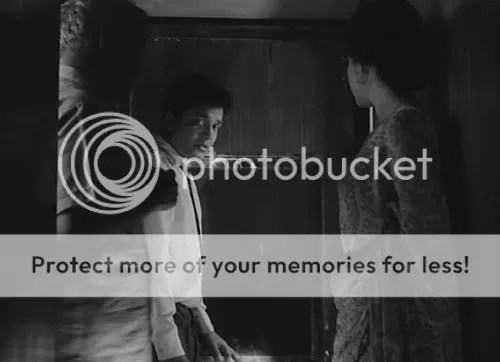
This film is a sprawling, multi-character, senseless piece of cinematic beauty, or in other words, a typical Rivette movie. There’s so much stuff going on here, yet so little of it makes sense. Not a problem with me, as I’ve come to expect this sense of mystery from Rivette. There is one particularly unique (in comparison to the rest of Rivette’s work, that is) element here and that is the 1950s Hollywood musical sensibility that elegantly drifts in and out of the three main stories. It’s jarring, no doubt, but it’s something to separate the film from Rivette’s other efforts.

There are three stories here, and each follows a woman that is either trying to separate from her past and come in touch with it. Two of the women, Ninon and Louise, cross paths on occasion but it never amounts to anything substantial. The stories all share supporting characters, but not in a “converging lives” structure that has dominated Hollywood in recent years. Somehow, it’s almost as though Rivette is deconstructing the narrative structure while simultaneously anticipating it. I realize how laughably pretentious this all sounds, but its not as though Rivette does this in a cerebral manner. After all, musicals are anything but intellectual.

While Godard does (and has done) “deconstructions” his approach is the polar opposite. Godard, in his infinite wisdom, poses questions in the most academic of ways. Rivette, though, almost makes his questions fun. If Godard’s essays are advanced learning than Rivette’s are introductions for toddlers. That sounds a bit like an insult, but I guess it is just another way of pointing out Rivette’s playfulness, which is very prominent here. In this film in particular, it’s as though Rivette has taken the advice from a screenwriting teacher and has performed all the technical things, such as having a structure. But, he has also cynically neglected what screenwriting lessons imply. Saying Rivette’s films are plotless isn’t entirely true, but they aren’t carried, driven, or even built around a story.

So instead, we have many sequences here of characters carrying out seemingly irrelevant tasks and displaying gestures devoid of drama. I guess plenty of other “minimalists” do this, but no one does it like Rivette. This isn’t even implying that he is the best, though he may very well be, but he is most unique in doing so. For example, no one makes sequences of characters walking as exciting as Rivette does. In my mind, it is our human nature to constantly assess meaningless gestures as being something deeper. I’m not entirely sure why that makes Rivette’s unique form of cinema such a joy to watch, but it still is.

This desire to constantly “understand” the meaningless or simple plays a large part in this film in particular, as many of the characters deal with the same exact problem. In Le Pont du Nord, for example, there are characters trying to make sense of a crudely drawn map but it is a bit different in this film. The issues seem a bit more personal and even more complex. Take Ida, for example, who is haunted by a song that she has known since her childhood but she cannot find any information about it. The thing is, the song’s singer, Sarah, may or may not be Ida’s mother. Melodramatic on paper (there’s even a scene where Ida suggests she heard the song in the womb) but it nothing becomes of it. The ending, which is one of most purely Rivette-ian moments of his entire career, shows Ida holding a conversation with Sarah, but nothing happens, and the film ends on Ida walking into the streets.

I personally haven’t had the time to put the pieces together, but I honestly don’t want to, in this case. The joy of Rivette’s film, no matter which film it is, comes from what we don’t know. Characters interact, and they seem to have a history, but we are never told to what extent these people know each other. As a result, character psychology comes from one’s own subconscious, developed not only from characters in other Rivette films, but characters from our own life. For as gimmicky as this film seems, it is one of the most purely self-reflexive things I’ve ever seen, which is a great accomplishment since it probably wasn’t Rivette’s intention to begin with.


The River (1951)

11 10 2008

There are a lot of admirable missteps here and overall, the film is far from Renoir’s best, but it is still pretty good. The nice, early technicolor cinematography definitely goes a long way to making the film as enjoyable as it is, though I have to admit that it tends to lapse into a level of garishness. The story is simple and straight-forward enough, but most of the characters end up being not only unlikable, but also pretty irritating. The ever-looming voiceover is anything but flattering and tends to interrupt potentially great sequences. To round things out, there is some terribly obvious and embarrassing symbolism. In spite of all of this, the film, as a whole, does indeed work.

A large part of this is due to the aforementioned technicolor visuals, which are brilliant at times, and dreadfully lush at times. I suppose the latter isn’t the result of anything Renoir or his crew could have done, but rather an inherent trade-off that comes with early technicolor film stock. The good does outweigh the bad and it would be pretty crazy to say that the film would be better off in black-and-white, but still, some of the high-contrast, ultra-bright shots tend to cloud the overall visual brilliance that is present here.

The story is on a similar wavelength, occasionally coming off as a very tender and perceptive observation of life in India, while at other times being a crude melodramatic mess. The voiceover, which is still definitely annoying, does quickly “set things up” which does make it easier to concentrate more on the characters’ feelings as well as Renoir’s aesthetic. I guess that compliments my overall feelings of the film: some elements are irksome, but they sometimes create some of the most wonderful moments. Indeed, the annoying voiceover is more exposition than it is poetic, but it does reach a Chris Marker level of brilliance a few times. There aren’t enough for the voiceover to justify itself, unfortunately.

The casting is another example of the film’s two-sidedness. I admire Renoir’s decision to include non-actors and actors alike, but they simply don’t work all that well together in this case. Thomas E. Breen, a non-professional and definitely the most natural performer in the film, is almost like a Bresson-ian model surrounded by a trope of Shakespeare-ian trained actors. Needless to say, when he’s together with most of the cast, it is a bit awkward. His sequences with Radha are the best acted sequences in the whole movie, and are so by a significantly large margin. I might even go as far as to say that the relationship between Melanie and Captain John saves the film from falling into mediocrity all-together.

I guess this does paint the picture of a film that is only a mild success, but it is actually a great accomplishment. At this point in his career, Renoir could be considered an “American director” (not literally, mind you) and the fact that he was able to shot a movie completely on location in India is pretty remarkable. On a historical level, the film apparently helped paved the way for Satyajit Ray, who worked as an assitant, as well as his cinematographer Subrata Mitra so it definitely can be appreciated for that. While it comes up short of its potential, it does have some of the most fascinating and beautiful moments in Renoir’s entire career.


Paranoid Park (2007)

8 10 2008

Every now and then I see a film that I cannot even begin to wrap my head around. This is such a film. Now, obviously, Gus Van Sant has been working towards something like this with his “death” trilogy, but those films, as good as they are, are clearly Tarr tributes/homages. This, on the other hand, is something completely new, not only for Van Sant, but for cinema in general. Of course there are many cinematic reference points (which I’ll bring up later in this review) but overall, this is one of the most original and exciting movies I’ve seen in a long time. It’s too early to tell, but it is quite possible that this will become the defining movie for the next generation of cinema.

Okay, so all of this sounds a bit preposterous, but that seems accurate, the film is sort of preposterous in its own way. The story line, which isn’t all that essential, elliptically illustrates a small couple of months in the life of the 16 year old Alex. The superficial plot point is provided when he accidentally kills a security guard, something he chooses to hide from the rest of the world. Of course, the guilt begins to eat away at him. This sounds a bit unremarkable, but the outline of the film’s story makes up very little of its substance.

So far, all I’ve established is that this is indeed a “minimalistic” movie and indeed it is, but not simply that. Van Sant has taken ques from Tarr and even Tsai for sure, but he also eloquently (not to mention brilliantly) mixes this aesthetic with grainy 8mm footage (a nod to his friend Korine?) and French ambient music. Perhaps this all sounds like some sort of “art film” parody on paper, but on celluloid, it’s nothing short of amazing. I would compliment Van Sant on his ability to capture a certain atmosphere, but that sounds like an understatement. It helps a good deal that I’m still in high school, but aside from certain technicalities, this mostly rings true in a way very few coming-of-age films do, let alone most high school movies.

There’s not too many art film-fueled high schoolers out there (trust me) but I suppose being one certainly helps in this instance. I’d imagine that the entire film would feel extremely uncomfortable and awkward for anyone outside of the generational gap, or at least to those not interested in this generation. At first, I was even a little turned off. There’s quite a lot of underacting here for starters and even lead Gabe Nevins doesn’t come out untouched. The awkward feeling, though, is 100% reflective of the content in a way that most mumblecore films only hope to be. In Mutual Appreciation, which is certainly a fine film, there is a sense of consciousness in the characters’ interactions, there is anything but here. Young adults might be a little bit more forgiving about conversations with the shy and alienated, but teenagers aren’t. The thing is, it’s not exactly the character who are feeling uncomfortable with one and other, but instead, their whole generation alienating everyone else.

Maybe it would be good to come back down to Van Sant’s atmosphere rather than continue on with the sociological issues presented by the current generation of teenagers, but the latter is what I want to do while watching this. Again, it’s not like the technical choices are completely new, but they are blended together to max something that feels so in-tone with present day. In other words, the best visual style to compliment the unaltered way in which Van Sant presents modern life. A perfect example of “unaltered” would be the previously mentioned “awkward” scenes. It’s presented as is with the usual poetic flair of Christopher Doyle and not one part of the film seems remotely exaggerated. Every single scene rings true – emotionally AND visually. The latter sounds odd, but there is something so beautiful about Doyle’s super-sensory-driven visuals when they are placed with Van Sant’s observational style. To make things simple, it feels accurate in a way that seems completely new.


Ride in the Whirlwind (1965)

5 10 2008

I ended up liking this a bit more than Hellman’s The Shooting but that’s probably because I knew nothing at all about westerns when I first saw that. About a year ago, I was just really interested in Hellman as a director and I proceeded in watching the atrocious R1 DVD of the aforementioned film. Obviously, the circumstances for this viewing were a lot better, but I still can’t say I was exactly blown away. Looking at Hellman’s career, it seems to be a case where the public actually got it right. I’m not saying he’s really famous (though he does have a cult following it seems) but his best-known film is also his best film by a pretty large margin. In all honesty, I’d say that both this and The Shooting are warm-ups to Hellman’s masterpiece, Two-Lane Blacktop.

This film does have some noticeable charm of its own, however. The lack of Warren Oates definitely doesn’t work in favor of the film but there are a large number of familiar faces to at least somewhat make up for him. Jack Nicholson, like in The Shooting, is pretty amazing here. It’s all the more amazing that only a couple years later he would be doing that shtick that plagued the rest of his career. In one of the most bizarre transitions in the universe of acting, Nicholson went from a Bresson-level passive actor to one of Hollywood’s most “charismatic” (or theatrical) actors.

There’s some other familiar and nice to-see faces in the mix as well. Rupert Crosse, perhaps more well-known as the character in John Cassavetes’ Shadows with the same name. His appearance is quick and not all that amazing, but like Ben Carruther’s cameo in Lilith, there is something odd about seeing him in another movie. Millie Perkins, accounted for in Hellman’s The Shooting, is also here though her character seems to have been added in at the last minute. Hellman and Nicholson probably wanted a pretty girl amidst all the gritty masculinity. Even though she feels like an afterthought, she is involved in most of the film’s best moments.

I guess that’s part of the charm of this movie. It’s very obviously attempting to be arty, but it also maintains that low-budget quick production sensibility from many of Roger Corman’s productions in the 50s and 60s. I guess this sounds potentially unwatchable, but it all, for lack of a better word, works. It helps a great deal that Hellman, as always, ends his film in the most open-ended way possible. Even though this is far from a masterpiece, it is fascinating to watch one of the would-be great directors at work.


Nayak (1966)

4 10 2008

Here’s another example of a director who I’ve been greatly impressed with, but for whatever reason, I’ve generally avoided for a long time now. It’s been more than a couple months now since I first saw Pather Panchali and as a result, became deeply interested in Satyajit Ray’s work. Only now have I been following up on that viewing and while the excitement from that film has worn off, it didn’t really affect what I thought of this one. For the most part, it is a completely different type of movie. Not the naturalistic and sensory-driven, lower class family drama that I fell in love with but instead a neat character study type production with a few unsavory lapses into attempted surrealism.

The first half of the film suggests that Ray is going the route of a multiple and interconnecting storylines structure. The nayak (hero) that the title refers to is Arindam Mukherjee, a successful young actor headed to Delhi by train to collect an actor award. Across from him is the Bose family, whose daughter Bulbul is an enormous fan of Arindam’s. Pritish Sarkar is a marketer planning to gain sponsorship from one of the train’s passengers. His wife, Molly, seems to be of great importance in this potentially illegal plan. The final but perhaps most important character is Aditi, the editor of a popular “modern” woman’s magazine.

For a good forty-five minutes or so, it seems as though the film is planning to connect all these plots and subplots together at the very end. However, only one of them becomes important for the remainder of the film. Unfortunately, one of the most embarrassingly unsubtle dream sequences in all of cinema signals in this shift in structure. I’m speaking of the sequence in which Arindam dreams he is running through mountains of cash, but then he falls and starts to sink. A very obvious and cringe-inducing attempt at symbolism that is without a doubt, the film’s low-point.

Even though it takes almost half of its running time to establish the whole “point” for lack of a better term. I wouldn’t go as far to say that there’s two completely different movies in here, but the first half, which I liked a great deal, seems like it could have easily been cut a bit, if not completely. Of course, the early little sequence side plots produce some of the best sequences in the film. Meanwhile, the second half: Arindam’s conversation with Aditi is almost too conventional to be believed. Essentially their conversation only serves the purpose of prompting (and sometimes even narrating) flashbacks that predictably reveal that in spite of his fame, Arindam is lonely and unhappy. Yes, not entirely like an Indian Citizen Kane, I suppose, which sort of plays in with the painfully symbolic dream sequence I mentioned earlier.

It all does come together to work, though, probably due in large part the performances of both Uttam Komar and Sharmila Tagore. Their meeting and then departure plays into Ray’s film-saving bittersweet backbone that is reflected in the final sequence: Arindam is greeted with a crowd of fans and Aditi is escorted off by what her father. It’s one of those short, unfulfilled would-be romances that is just quick enough to ring true but still be genuinely sad. While this doesn’t reflect the genius of Pather Panchali, it is a very nice movie in a completely different direction.