Maria Chapdelaine (1934)

13 06 2009

At last, a Julien Duvivier film that works for me. I suppose one out of three isn’t bad, especially since I moderately enjoyed both Pepe Le Moko and Au bonheur des dames, but there’s definitely something special going on here that must be absent in those films, unless I just forgot to notice. Perhaps the limited running time (of 73 minutes) helps since I think Duvivier’s other films struggle to reach their conclusions, but overall, I’d say this is a much more impressive effort technically and a far more enjoyable one as well.

Jean Gabin plays one of three men who fall hopelessly in love with the titular character, a young woman living in rural Canada. She is pursued by a respectable aristocrat from France, as well as another lumberjack, one that is far less charming than Gabin’s. Chapdelaine herself seems to only share these romantic longings with Gabin’s character, but needless to say, things don’t come out ideally – do they ever? Thus, Maria finds herself settling for a less attractive option, which possibly means living a life in the big city, far away from her close-knit family.

Duvivier uses a lot of rear projection here, to say the least. Nearly every close-up of every character is obviously shot with a fake video backdrop. Duvivier seems to embrace this archaic technology, and almost turns it in to some form of genuine expression. The scene with Gabin marching through the snow storm is a perfect example. The backdrop here is inexplicably rotating around, perhaps intended to be a very simplistic attempt at reflecting the character’s internal struggle. The sequence also works as being bizarrely kinetic. Clearly fake, but extremely visceral all the same. It helps a great deal that Duvivier’s editing, in this sequence in particular, seems as refined as any modern montage-heavy film. Needless to say, it is quite a sight to behold.

While Duvivier has unquestionably made a technically competent film here, he does begin to lose his footing when he starts to deal with his characters. His characters aren’t fully-developed or what not, but that’s a improbable task to complete within 73 minutes. Perhaps I make this comparison more often than I should, but I couldn’t help but think of Hiroshi Shimizu’s best work here. While Shimizu thrived shooting on-location, Duvivier made a good deal of this film in a studio. In the simplicity of the characters, though, there is a poetry. It’s a dreamy retelling of a realistic and tragic myth. It’s not something that many people can specifically relate to, but the narrative ultimately works because of the skill of the filmmaker. No doubt, one of the most impressive French films of the 1930s.


Man Hunt (1941)

10 06 2009

A few mis-steps here and there in this, one of Lang’s most (personally) important efforts. While he had already established himself as a very competent genre picture director with You Only Live Once and Fury, he shows here that he is worthy to be mentioned alongside American giants like Ford, Walsh, and Hawks. Sure, it’s not the most thrilling film that Lang himself would ever make, but it is one of his most technically refined. He makes this well-known from the very beginning with a perfectly-executed sequence of Walter Pidgeon seemingly stumbling upon a free shot at Hitler.

The quiet yet precisely edited introduction seems to anticipate, both in the bleakness and simplicity, the cinema of Michael Haneke. Yet, at the very same time, it seems like a text book reflection of early 1940s genre cinema in America. John Ford’s The Long Voyage Home begins with a similarly downplayed opening. Like Ford, Lang’s films becomes a bit more conventional there after, but that doesn’t cancel out the tonal sample that has been set before us. Sure, there’s more dialogue in the rest of the film, but the opening doesn’t seem to be from another technical or even literal world.

Following his escape from the German government, Walter Pidgeon is on the run, which is a theme that is not entirely new to Lang. If there is one unifying element of his work, it’s the concept that his protagonist always seemed to be looking over their shoulders. Pidgeon’s character returns to England, his homeland, and somehow, he is more suspicious of the citizens in his native land than the ones he encountered in Germany. It sounds like complete nonsense and well, it is, but Lang’s sophisticated command of the art form makes the dramatic turn seem completely natural and fitting.

It seems a little superflous to mention that Lang calls back, at least visually, his earlier German films. There is a very expressionistic tone in Man Hunt and it does not seem the slightest bit forced. There’s no over-emphasizing of shadows, or darkness. Lang and cinematographer Arthur Miller find the perfect balance in the contrast of their compositions. Simply stated, the movie looks beautiful. Perhaps there is a subconcious influence, but the visuals seem to reflect Lang’s past cinematic achievements (personal note: I need to see more of these) and anticipate the visual style that would be prevalent in the golden years of Hollywood genre cinema.


Intentions of Murder (1964)

2 06 2009

I might need to rewatch it to be sure, but I have a good feeling that this makes three full-on masterpieces from Imamura. Unfortunately, I was a little sleepy during my viewing, but if anything, my state of my mind only enhanced what is already a dream-like, surreal, and sensory experience. Not only does this film build off of Imamura’s previous two films, Pigs & Battleships and The Insect Woman, it plays off the Japanese New Wave as a whole, perhaps bonding into my personal ideal JNW film. If there’s anything that Imamura has forgotten to expand upon in this masterpiece, it is his usually exquisite trademark humor.

In his defense, Imamura is treading some dark(er) waters here. I think it’s great that Criterion has released these three specific Imamura titles in one box set, as they serve a perfect sample of Imamura’s progression – both as a filmmaker and as a dramatist. Pigs & Battleships is just as wonderfully, at least technically speaking, as anything Imamura has made, but it feels a bit more “classy” and a lot less experimental. Also, the story is just a deeper version of a sun tribe film. To think that Oshima was still dabbling in this faux-genre a year before Imamura emotionally revised it is somewhat staggering. It’s more proof that Imamura is, in all likelihood, the very best of the Japanese New Wave.

I hope the hyperbolic statement doesn’t throw anybody off, but the past two experiences I’ve had with Imamura were more than enough to push him to the top. I’ve seen nearly three times the amount of films from Oshima and Yoshida, but nothing they have done seems to come close to Imamura. In fact, Yoshida’s masterpiece The Affair seems completely useless now as Imamura was basically doing the exact same thing (only better) a full three years earlier. Although Imamura humor is, as I’ve already mentioned, almost absent from this particular film, he does make up for it in a lot of ways.

For one thing, I think Imamura is, at the risk of sounding remarkably dull, a much greater humanist than any of his peers. He’s certainly more so than Oshima, who during the later parts of his career seemed decidedly “anti-Humanist.” He’s got to be more than Yoshida because his characters are always killing themselves, having sex, or discussing the potential for such actions. In Wakamatsu’s films, the two are often connected to everything happening on screen. Let’s not even bother bringing up Kobayashi. The exception, perhaps, is Masahiro Shinoda, but one thing is for sure, Imamura has dodged all the potential pitfalls placed by the “Japanese New Wave aesthetic” – whatever that is exactly.

Intentions of Murder is, quite possibly, Imamura’s most “New Wave-esque” film. It’s got a lot more violence (rape is always a key JNW element) and it’s got sharp musical cues, not to mention some half-baked symbolism. But all these things never come close to overwhelming the material in his picture. When Sadako is raped, Imamura is not placing his camera right next to his characters. He is not emphasizing the passion and emotion of the action. Instead, his camera remains static and we watch Sadako struggle with her rapist to gain the upper hand. Their “fight” is pathetic and difficult to watch, but it is accurate. It’s accurate where almost every other film from the J New Wave is wrong.

This is not to say that Imamura is coy or modest, he does display a great deal of sweaty, sensual close-ups throughout the film, but never do his visuals reach a level of desensitization. Pardon a generalization, but a good deal of Imamura’s peers would eliminate the concept of “first person filmmaking” (an idea I raised in my review of Gremillon’s Maldone) and focus on not the mental context of a narrative event, but simply the narrative event itself. This is why Imamura is so great. While he apparently was rebelling from his master, Ozu, he never lost that similar humanistic instinct. There’s never any disconnect between Imamura and his characters. He never is condescending and he never uses them as chess pieces. Instead, he presents them, warts and scars and all. And that is an extremely great accomplishment.


The Crowd (1928)

2 06 2009

Pretty great for the most part. There’s a few slight dramatic touches here and there that are inevitable, but still not all that flattering for Vidor. It’s not quite up there with his greatest achievement, 1931’s The Champ, but it is the closest I’ve seen him come. Even if I find some of Vidor’s dramatic turns to be a little too convenient, I still find it nearly impossible to exaggerate the influence of this particular film. Not only was Vittorio De Sica watching, so was Yasujiro Ozu. Simply stated, this is the root for a good deal of my favorite films, and if I didn’t love it on its own, I’d still feel obligated to appreciate it.

While The Crowd now stands as a towering achievement in the Hollywood system as an observation and critical depiction of Americana, it actually has a good deal of melodramatic tones that come in throughout. The story follows the life of John Sims, a man born on July 4th, 1900. There is a hint of a “rise and fall” arc, but in all honesty, Sims never exactly rises. Vidor is to credit here, as he is, perhaps inadvertently, subverting the expectations of the audience. While there are emotional outbursts that are inevitable for a film from 1928, the plot itself is fairly (and remarkably) uneventful.

The narrative plays out like this: John gets a job, gets married, he and his wife, Mary, face complications, they have kids, one of them dies, and as a result, John quits his job. From there on, Vidor’s protagonists are caught in a world of what seems to be limitless doom. This feeling is all the more powerful because it isn’t actually accurate. John is offered a job from Mary’s critical brothers, but he turns it down. He leaves his house, ponders suicide, and returns home with a new job: a city advertising clown. This is what Vidor wants the audience to believe is a “happy ending” and he is damn convincing. John and Mary, headed surely for separation, suddenly reconnect and everything is fine.

The problem, for the characters, is that everything isn’t fine. The final two minutes of the film are a perfect example of how a filmmaker can manipulate the audience. It works in Vidor’s case, because he seems to going the opposite route that one would conventionally take with such an ending. It’s another example of the narrative, contrary to one’s intial reaction, isn’t fueled by events. For that sheer element alone (i.e the element of observation vs. drama), Vidor’s masterpiece is to be seen. He would indirectly influence everyone from Wellman to Hou. Did I mention the amazing cinematography or the beauty of Eleanor Boardman yet? Vidor has too many good things in his favor that the few minor hiccups in his film can be disregarded entirely.


The Roaring Twenties (1939)

30 05 2009

A truly epic film. Sure, it only clocks in under 110 minutes but it has this wide-ranging and grand tone to it. Maybe its because it documents a whole decade? Maybe because Cagney, as usual, is such a joy to watch? It just has this very long feel to it, but at the same time, the story just flies by. It’s another remarkable accomplishment by Raoul Walsh, perhaps second only in his own filmography to They Drive By Night. On the other hand, this might be my favorite “gangster” film from the Warner Brothers cycle of the 1930s, and I don’t think it is a coincidence that it is one of the last.

I’ve never really favored narratives that are spread out over multiple years, as they tend to document the simplistic tone of a “rise and fall” story, and The Roaring Twenties is not any different. Returning from the first world war, James Cagney finds that things have changed in America while he was fighting. He can’t get his old job back. He depends on his friend, a taxi driver, to help him get his career moving, which inadvertently leads him into the underworld of bootlegging. While Cagney’s character (and ego) continue to grow, so does the chaos and pressures of American society.

Third-person voice overs are almost always a bad technical move, but here, the narration is so bland, dull, and unemotional that it completely works. The words seem to have come directly from a contemporary news blimp about America in the 1920s, which works perfectly with Walsh’s documentary-esque montages. It isn’t the most original idea to document a character’s development underneath something bigger (in this case, the development of pre-war America) but it is done so gracefully by Walsh. It seems like there’s so many times that he could have taken his film in the wrong direction, but somehow, everything works.

It’s probably worth noting that this is one of the first gangster films from the WB cycle of the 1930s that doesn’t even attempt to present itself as some sort of social warning. In fact, the opening titles, written by Mark Hellinger, forthrightly declare the story as a fondly remembered point in time. Hellinger’s introduction isn’t necessary, but there’s something very poignant (and poetic) in his words. This is the only instance I can think of such a thing happening in a pre-war Hollywood movie.

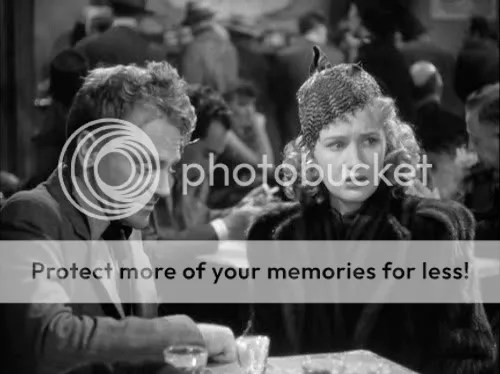
It is very difficult, at least for me, to describe any element of Walsh’s masterpiece without beginning to overuse words like “poignant” and “poetic” because there’s this sincerity dripping off the screen. It is instantly noticeable and instantly lovable. There’s many brilliant sequences, but I am particularly fond of the one in which Cagney’s character is talking with Jean Sherman, who has developed into a beautiful woman; she was still a girl during their first encounter. To escape from his crime life, he questions her own lifestyle. He has a cliche-filled, idyllic vision of her life – “I bet you spend a bunch of time in the garden.”

This, as Sherman points out in her response, couldn’t be further from the truth. Cagney’s personal and emotional sacrifices for Sherman are so endearing not because he loves her, but because he has fallen in love with a character he has created on his own. Before the final, brilliantly staged shoot-out, Cagney stops at a piano and just stares longingly at  nothing. Possibly, he has realized his mistake in characterizing Sherman, but he doesn’t seem to care, and that is just proof that Walsh’s gangster classic is also an observant character study.