Sono yo no tsuma / That Night’s Wife (1930)

11 11 2013

There is a pull to evaluate Ozu’s pre-war works for their differences from his post-war films. This is probably of the 1950s being his most successful and celebrated period of work,but the unfamiliarity with his silent films in particular is telling in most evaluations. Sure, That Night’s Wife is remarkably different in an aesthetic sense from something like Tokyo Story but this emphasis on differences devalues Ozu’s progression as a filmmaker during his early years. Here we have a film that is actually reflective of the filmmaker’s overall social concerns. It’s biggest difference from the later films would be that he is more explicit about these concerns here. The result is something more sentimental than one would expect from Ozu, but he still feels like the artist in charge here.

1

Shuji is in desperate need of some cash to pay for the medical expenses of his daughter, Michiko. Her condition is critical, but the family’s doctor says that she’ll be through the worst part of her sickness if she makes it through the night. That night is the one where Shuji robs a bank, and with the police hot on his tail, it becomes a struggle for him to make it home. He eventually takes a cab back, but the driver turns out to be an undercover detective who follows him into the apartment. There, he pleads with the detective to let him be free for the night so he can keep his daughter company. The result is a night long standoff involving Shuji and his wife, Mayumi against the detective.

2

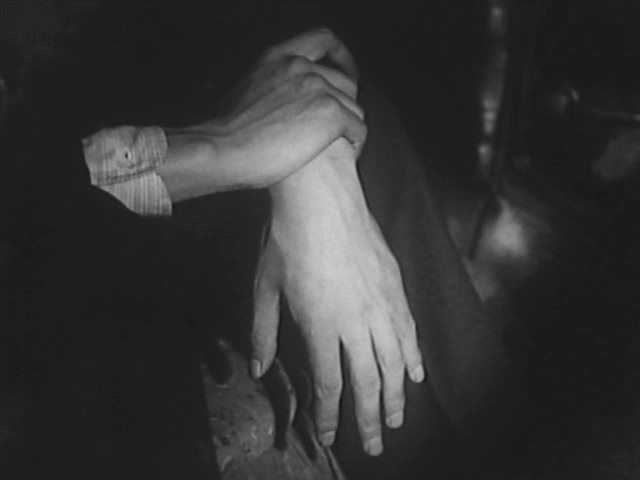
The script here is a Kogo Noda adaptation of a novel written by corporate historian, Oscar Schisgall. The situation seems like it could pass for being from Ozu’s pen, particularly because of its “socially conscious” nature. The conventional wisdom (which I feel no need to debate) is that Ozu’s characters worked their way up, in terms of social class with each new film. At this early stage in his career, his films can be categorized as shomin-geki because we have a struggling, working-class family. The families in his works from the 1950s (save perhaps Tokyo Twilight) are absolutely above the small family here. The struggles in later films are still that of the one here: trying to escape the feeling of being imprisoned by the conditions of society. Money and thus capitalism are always crucial barriers in Ozu’s world, but never has this been explicit than it is in this film.
3

It’s Shuji’s class status that makes him resort to crime in the first place. The film’s ending might superficially suggest that “crime” (as it’s constructed in the eyes of the state) must still go punished, but that the state itself might be sensitive in such measures. To me, this is the most conservative and boring reading of the film. Shuji is not redeemed by submitting to the state because he has done nothing wrong. He’s taken money, sure, but the context is the well-being of his only child. Ozu’s suggestion is one that although the state prefers we become the heteronormative family, such a life is not conducive to the model of capitalism. The ideas that are seen to be so intertwined from a political perspective, our ones that are incompatible. Of course, the reality is society prefers the middle-class family that Ozu would depict in later films, but there he would also show that such institutions to still be oppressive, even if the subjects had money.

4

This is why I think it’s important to stress the similarities between these early films and Ozu’s later and more beloved work. To me, he was always a filmmaker concerned with social problems, though I realize that such a statement can be read in a variety of ways. Ozu was always a critic at large, the fact that he’s challenging society doesn’t make his dramas less human or whatever. A film like That Night’s Wife isn’t populated with characters as rich and dense as those in his other films, but it does show that even from the start, he had a solid ideological foundation.

5


La collectionneuse (1967)

4 11 2013

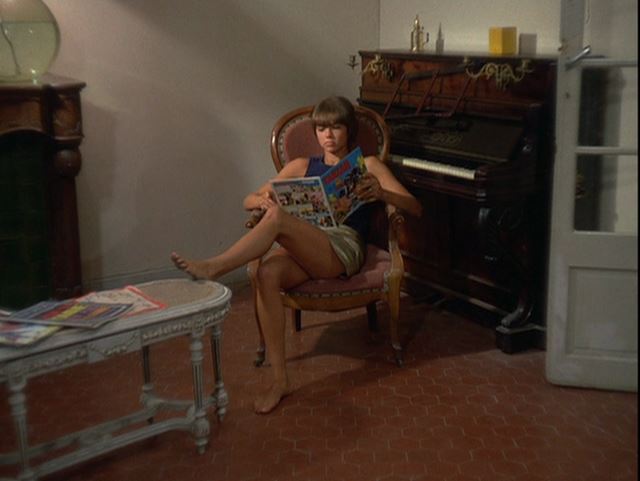
Supposedly, this is a bit of a transition film for Rohmer. Perhaps it’s more of a geographic thing, though. This was the first time that he took himself away from the streets of Paris to a remote vacation spot. This is where most of his best films are set, and indeed, the characters here refer to themselves as “on vacation” much like the protagonist in later masterpieces like A Summer Tale or The Green Ray. With nothing happen to the characters in terms of events, we’re once again treated to a story involved in one’s neurosis. As he showed throughout his career, there is the idea here that love is complicated. Or maybe we’re just too dumb to care.

1

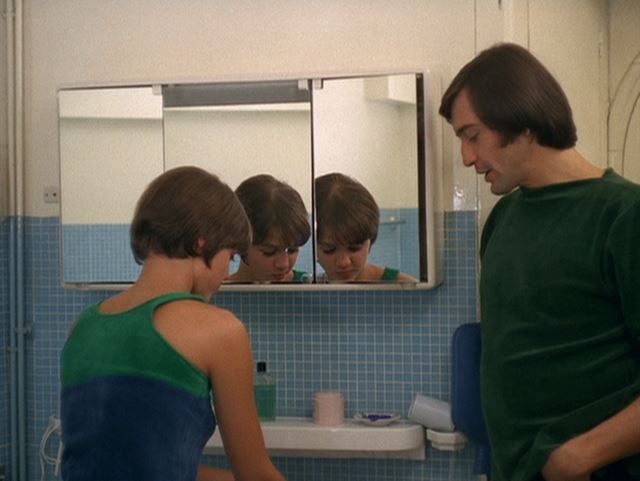
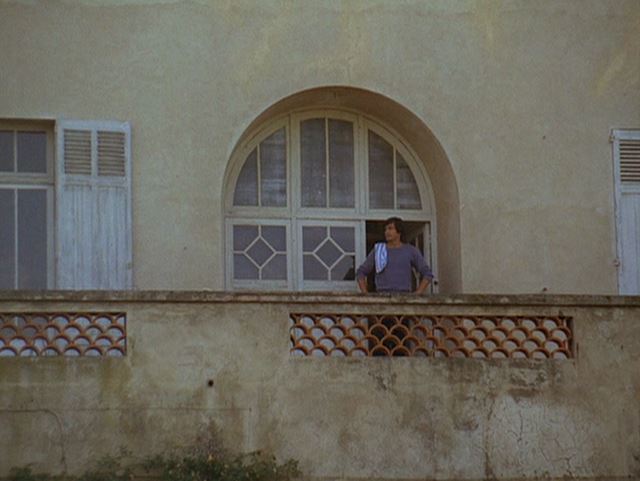
Adrien takes a vacation in the French Riviera. He hopes for a peaceful and quiet stay, and plans his days accordingly: he’ll get up early every morning to swim, he’ll keep to himself, go to bed early. His bedroom is a reflection of his almost ascetic nature: it’s entirely bare but for a bed and a window. He’s still bothered, most notably by the presence of Haydee and less so by the presence of Daniel. He and Daniel see themselves as intellectuals and they both position the younger Haydee as being a frivolous and far too loose girl. While Adrien reminds us frequently that Haydee is below him, he begins developing a crush in spite of his own words.

2

Admittedly, I find a lot of what Rohmer is trying to say here is actually not all that profound or amazing. Yes, the wise men are actually bumbling fools who try to justify their assumed superiority over a less intelligent and more sexually active girl. This isn’t the most revolutionary statement on heterosexual relations. Men today, after all, still have a problem with a woman being sexually active. Rohmer paints this in a clever way, though. We never see Haydee’s “immoral behavior” except for when Adrien first meets her. Sure, a first impression being powerful isn’t something new, but it is a crucial decision on the filmmaker’s part. Because Adrien instinctually sees all women through their sexual potential. In Haydee’s case, Adrien has already seen this potential fulfilled as soon as he meets her. Sure, it’s not between them, but the fact that she’s so open about herself sexually is what makes him disinterested. At least, this is what he tells himself.

3

It’s sort of inevitable that Adrien falls for Haydee. Again, it’s Rohmer’s framing of this that makes such a predictable development work. Never does Adrien, despite having the benefit of a first person voiceover, mention anything about desiring Haydee in a serious way. Instead, he speaks of wanting to “have” her and referring to her feelings as a game. Since he assumes she’ll hop in bed with anyone, he makes the leap to also assume she’ll hop in bed with him. In his most revealing moment, he gently touches her leg and says “it’s wrong to caress a girl one dislikes.” For all his equivocating about Haydee’s “confusing” sexual expression, Adrien himself seems to be just as, if not more, unclear about his motivations. We see him aspire for tenderness with Haydee, but his dialogue seems to be written with the intention of disguising such feelings.

4

I feel like it’s necessary to explain that Adrien is just a villain. He’s frustrating, hypocritical, and nearly impossible to like. In finding him fascinating, I by no means want to insinuate that there’s something positive in his behavior. However, I still do find him interesting. He  sees himself isolated (if not above) society, as evidenced by the vacation he takes. His attitude towards Haydee’s lifestyle is still reflective of the society he claims to  have rejected. Adrien is not all that different from most of my peers. An intelligent and sensitive dude who, at the very same time, seems dubious and disinterested in the feelings of women, or at least Haydee in particular. He’d protest that it has nothing to do with her being woman, but when the root of his critique is founded in her sexual activity, it has everything to do with her being a woman.

5

In focusing on Adrien’s hypocrisy, I’ve overlooked other dynamics. Haydee is the perfect foil for him, but in a way, she fails to gain the depth of most of the other women I’ve seen in Rohmer’s films. It could be intentional, this film is about Adrien and his temptation. While she has her moments, the film’s prologue suggests that it’s not her movie. The audience is treated to three prologues introducing Haydee, Adrien, and Daniel. Haydee is photographed walking around the beach, with a jarring cut to her feet gently rubbing against pebbles in the water. It’s a male gaze scene if I’ve ever seen one, but it is intentional and crucial. It establishes the roles of the characters. Haydee is photographed as if Adrien, which is a fitting introduction for the film’s power lays in how Adrien frames Haydee. The attitude he brings towards the relationship is informed by this sequence. The camera limits itself to viewing Haydee’s sexuality, which is all Adrien  can see. The fact that this is the film’s most sensual scene is telling: her sexuality is a controlling image constructed by society.

6

A year following its release, most of La collectionneuse‘s staff were heavily involved in political activism. The events of May 1968 seem a world away from the lives of three or four bourgeois on vacation in the French Riviera. While their social status would mark their struggles as inconsequential and silly, it would be a mistake to characterize Rohmer’s film as apolitical. Here, Adrien has constructed an image of a woman, one made up of found pieces from the dominant discourse and his own heart. The two sources influence each other, of course, but Adrien’s misunderstanding of women is a political conceit. He is not unlike most men, which is what makes Rohmer’s portrait of him more piercing. Late in the film, he’s driving back to the resort with Haydee. The voiceover hints that something physical may happen between them. Then, they’re stopped by an oncoming car driven by a friend of Haydee. This friend is trying to get her to go with him. Meanwhile, Adrien is holding traffic up. Eventually, he gives up waiting for Haydee and drives off. The connection might be reductive but Adrien gives up on this relationship because of the pressures of society, which are embodied by the impatient drivers behind him. He convinces himself he’s made the right decision. He returns to a safer life. Perhaps Haydee could have liberated him, but isn’t it also sort of fucked up to put such an expectation on a person? It’s not that uncommon.

7


The Zone (2011)

23 09 2013

There’s a scene in Kentucker Audley’s Open Five 2 (2012) where two characters sit down and edit footage from the first film, Open Five. It’s clever, self-reflexive, but perhaps a bit too inside the head of the filmmaker. Joe Swanberg’s The Zone, which fittingly enough stars Kentucker Audley, runs into the same sort of problem as the previously described scene. Both filmmakers wanted to achieve something personal and arrive on something meaningful about why they themselves make films. However, the process at times feels too self-serving, too aware of its own intended transparency, that I find myself rolling my eyes more than not.

1

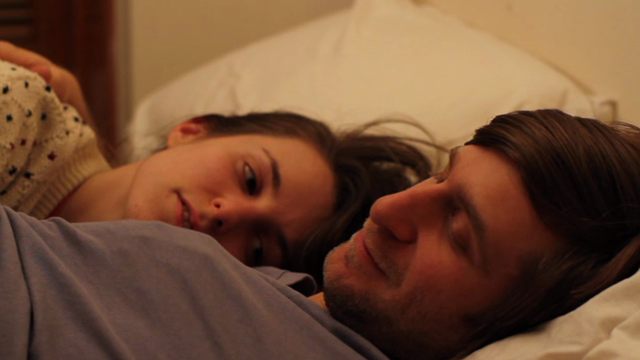
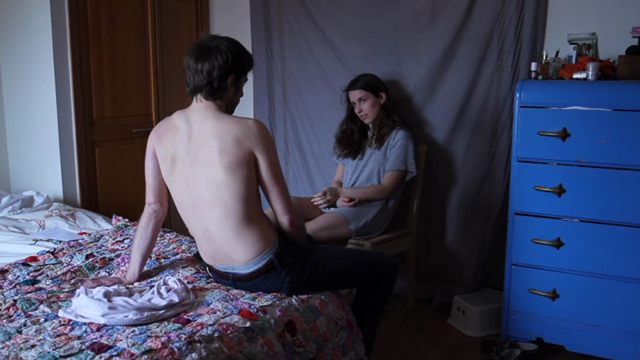
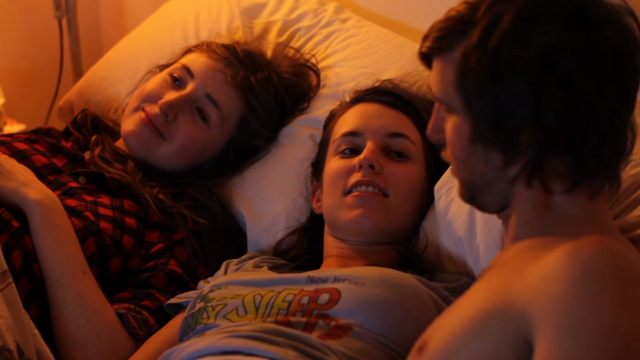
A stranger visits a house, then photographs and sleeps with all three of its inhabitants. This is all just the filmmaker’s (Swanberg) work, though. He wants to produce something passionate and meaningful but in the process, he’s afraid that it will have a negative impact on the relationship between two of his performers, Sophia and Lawrence. His concerns are justified as the centerpiece of his film calls for the two of them to be a part of a threesome with Kate. The tensions between shows up in the scenes for their films, but it boils over into their reality as well. With the scene taking such importance, it becomes a struggle for the filmmaker and the cast to keep their cool.

2

The first thirty minutes plays out like an update of Teorema without Pasolini’s (tired) commentary on organized religion. Instead, it’s just sort of forced mysteriousness, though once we discover that it’s a film within a film, it’s possible that the forced feeling is intentional. Perhaps the most frustrating element of this whole exercise is that Swanberg does play it out like a twist. We think we’re getting a film about a stranger sleeping with a bunch of people, and we do get that, but then there’s an entirely different film about the process of filming said film. In perhaps the most eye-rolling of all moves, Swanberg ends the film with another reveal. The film was also a film within a film, thus making the original story we watch a film within a film within a film. That sounds so stupid to write out and watching these twists is similarly enraging.

3

This isn’t a complete disaster of a movie, though. I actually like quite a bit. Swanberg does manage to capture something resembling the great important truth he’s looking for. The aesthetic issues with the filmmaker are perhaps over-documented, but parts of this film look absolutely wonderful. If only he would just make a straight-forward movie with this aesthetic and not the glossy, but casually one found in Drinking Buddies. There is something to at least think about in the shots that are setup to be a part of the film within the film, but then breakdown when one of the actor starts laughing. I’m not sure what there is to be said, except that it’s another example of the filmmaker trying to breakdown the walls built upon between fiction and reality.

4

Swanberg’s interest don’t just lie in this division between fiction and reality, but also in the division between live performance and filmed one. They’re sort of all interrelated concepts, but I do think he’s trying something more than just replicating Cassavetes’ dramatic realities or even Rohmer’s observational studies. This film, more so than any of his other ones, tries to capture the essence of a performance when it actually occurs and does this by not always differentiating between what Swanberg’s character has filmed or what he himself is filming. To paraphrase Walter Benjamin, a filmed performance is a reproduction and thus, loses the spontaneity felt when seen in reality. I get the impression that Swanberg is trying to navigate between the reproduction of the performance and the performance itself. I’m not sure I can say he is entirely successful, but I give him plenty of credit for trying.

5

The Zone is also a movie about sex, which I actually think perfectly relates the previous idea of filmed performance vs live performance. Sex is, in a way, something of a performance. Perhaps the conditioning of other films (be they porn or not) has influenced some of these performative elements and Swanberg quietly captures this in a wonderful way. The sex scenes in the film within a film are artfully directed, but almost obnoxiously serious. In contrast, when Sophia films Lawrence jerking off, it’s playful, fun, and even funny. The couple never films themselves having sex explicitly (that would be too on the nose, I think) but their foreplay does feel more accurate than the filmed sex scenes. Additionally, it’s observed that Swanberg (the character) has devoted more time to the two heterosexual scenes because duh, he’s into girls. Thus, so is the camera. The aforementioned filmed jerkoff session is being filmed by Sophia. The camera is into guys now.

6

For someone who is often accused of just filming people talk about their relationships, Swanberg is actually quite heady here. It doesn’t all work and parts of it feel like it’s trying too hard but there is an actually interesting, if not good, meditation on the influence of film as means of reproduction. One could and has accused Swanberg of basically just being horny and spoiled, but he takes this criticism head on. He achingly confesses that he makes film so people will feel less alone. This feels real when he says it, but looking back, he’s playing a character. He’s still looking for truth but he’s doing more than just capturing the mundane. He’s exploring how the mundane functions in relationship to film as medium. I can’t say he’s broken through with a complete masterpiece, but this feels like the most mature, complex, and sincere thing he’s ever done.

7


Conte d’automne / Autumn Tale (1998)

17 09 2013

One has to wonder if Eric Rohmer worked himself into a corner. After this film, he would not return to his usual territory, at least not superficially. This is the last film of his to all into one of his cycles, and it’s the last film that isn’t influenced by period or overt-genre nods. In a sense, it’s the last film he made that features the iconography that people associate with the director and that’s a bunch of people talking about their relationships or their non-relationships. Rohmer’s consistency and perceived repetitious nature are strengths to me, and the familiarity of Autumn Tale is just as important to my appreciation of it as its uniqueness.

1

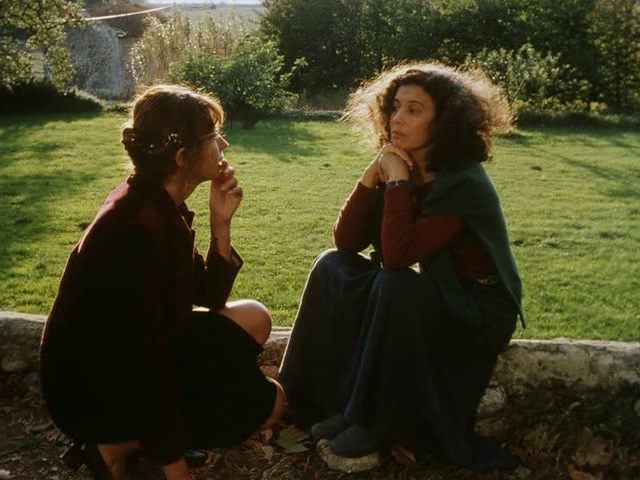
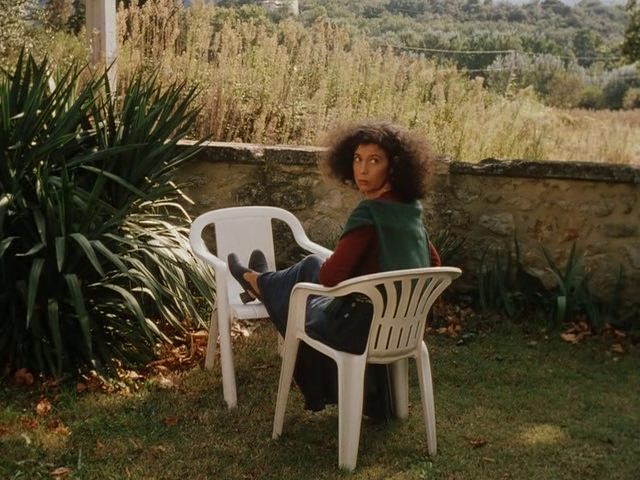
Magali, a winemaker, lives alone on her vineyard in southern France. Her friend, Isabelle is trying to get her to come to her daughter’s wedding but Magali is less than enthusiastic. After all, she doesn’t go out much anymore and she’s not exactly comfortable being around a large group of people. Her son, Leo is involved with Rosine if only in technical terms. Rosine is still in the process of closing off a relationship with a former professor, Etienne. Rosine takes a liking to Magali and sees the chance to play matchmaker with Etienne and Magali. Meanwhile, Isabelle herself is busy trying to find Magali a suitor in time for her daughter’s wedding.

2

The film opens in a quiet and remarkable fashion. A series of static shots are placed in between the credit cards in a fashion that does suggest a nod to Ozu’s pillow shots. I’ve hinted at the filmmaker’s connection in the past, but it never felt like one that was exactly visual. Here, though, it is and fittingly, this is easily Rohmer’s best photographed film. It’s visual quality is almost jarring in a way, because breathtaking visuals are not a hallmark of the man’s work. In fact, they’re intentionally uncommon. The poetic potential of cinema risks Rohmer’s insights losing their power. This might seem like a pretty big claim, but the man himself said so as much. Personally, I don’t think anything in lost here, but I wouldn’t argue that this film is one of his most dense works. Sure, it’s loaded with plenty more than most other films, but it’s about par for the course for Rohmer.

3

There is a specificity present in Rohmer’s best films and it is present here, though I guess I connect with it less on a gut level. A Summer Tale and The Green Ray are masterpieces, but I’ll admit that they absolutely benefit from parallels I can form between them and my own life. It’s unfair for Rohmer to be penalized for simply shifting his focus to someone a little older, but perhaps I’ll always be more partial to the those mentioned above. Magali does have something in common with the 20somethings that populate the two aforementioned films: it’s that they’re all alone. Much like Delphine in The Green Ray, Magali is not alone because she wants to be, but instead because conditions are not ideal for her to meet someone. Delphine’s problem is more immediate because it comes from her heart and Magali comes from the fact that she’s exiled herself from most of the world.

4

Magali’s loneliness is the film’s center but the most interesting developments are the ones that happen outside of her isolated vineyard. The most intriguing is the relationship between Rosine and Etienne. They’re no longer together, but that is only because Rosine says so. She is apprehensive to show this in body language. She allows Etienne to touch her passionately, and only pushes him away when he attempts to undress her. She’s “with” Leo now, but she makes it quite clear that she is not interested in him in the long term. Indeed, we seldom see the two doing anything that would suggest an intimate partnership. Rosine wants Magali, who is Leo’s mother, to be with Etienne. This would hypothetically create the weird scenario where her ex could be her father-in-law.

5

Rosine is playful around all men, almost to the point that it’s enraging. Alexia Portal is pretty brilliant here, and it’s easy to see why Etienne would be hung up on her and why Leo would frustrated by her. Her business with the former seems to be unfinished, which would explain why she wants to see him with Magali. She explains that she’ll never be able to love Etienne again once he loves another women, but then also looks forward to the idea of hanging out with both of them. Etienne never really works out with Magali, mostly because she’s too old, but his presence in the film is significant because of how it relates to Rosine. She never admits she still has feelings for her former lover and her upbeat attitude doesn’t allow us to read into her intentionally remaining quiet on these desires. It’s her actions alone that suggest she might be confused about her feelings for Etienne. So often in film the audience is required to read an actor’s body language or notice technical choices to grant access into the character’s true feelings. Rohmer, of course, never allows us such access. That would be too easy.

6

With everything there is to write about Rosine (and there could plenty more beyond the above paragraph) she is nothing more than a supporting character. She gets plenty of screen time, sure, but this is a film ultimately about Magali’s isolation. On the other hand, Isabelle is just as busy finding a suitor for Magali. Thus, Isabelle and Rosine play as parallel storylines and their success and failures in playing the role of matchmaker are different. Isabelle’s intentions seem a bit more honest and transparent, she definitely wants Magali to find a man. However, she makes quite an elaborate construction to get to this point. She puts out an ad, which gets a response from Gerald. The two go on a few dates and Gerald is (understandably) under the impression that he’s dating Isabelle. It’s all just a test run to make sure he’s suitable for Magali. It seems cruel, but things end up rather nice. One moment suggests that Isabelle actually is interested in Gerald, but obviously keeps herself from feeling this because she herself is already married. Like Rosine with Etienne, we never get any lingering shots of Isabelle punctuated with longing music so we really don’t know if she’s upset that she can’t be with Gerald. Again, her confidence doesn’t give us hints into her psyche, we can only observe her actions and try to draw conclusions from that. It sounds corny to say, but the process is not only one of the most rewarding things about watching a Rohmer film but it’s also a lot of fun.

7

For once, I feel the criticism of Rohmer’s lightness actually resonating. I mean, the film “hits” (for lack of a better word) several times and it feels right in all of its observations and it has this type of sting that I associate with the filmmaker. But, on the other hand, it might be a little too unassuming. Unassuming can be used to describe a lot of Rohmer’s work and I would view it mostly as a positive, but in this case, there is something missing that prevents this film from being the amazing experience of a film like The Green Ray or A Summer Tale. If I’ve learned anything about the man, though, it’s that the endings of his films can greatly alter my feelings towards them and again, the ending has great flexibility in how you read it. The quiet sorrow of Rohmer can be viewed long after one has completed the film. That, to me, is a sign of not just a filmmaker but an artist who has left behind something very vital.

8


Drinking Buddies (2013)

16 09 2013

Joe Swanberg is something of a divisive figure in cinema. My reactions to his films have fallen somewhere in the middle of this divide, but I guess I lean more towards the negative side than the positive one. I find the man about as fascinating as I find him frustrating. Certainly, there was a time when the harrowing “emotional truth” drama spoke with me, but I’ve found most of his films to be forcing the point. Drinking Buddies is a departure in many ways. Superficially, it finally gives Swanberg’s film a professional sheen, but just as noticeable is the specificity missing from his characters. He’s gone for something more broad. While both of these would seem to be improvements, they actually work as problems here, yet this is still probably the best movie he’s ever made.

1

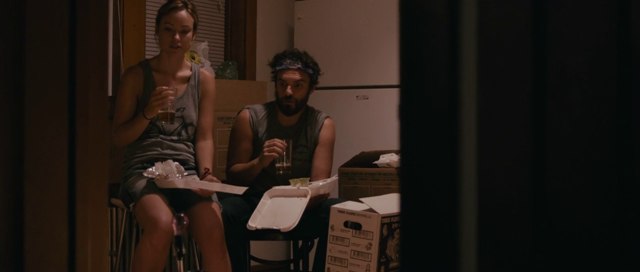
Kate and Luke are coworkers at a brewery and the two maintain an innocent yet flirty relationship. This isn’t much of an issue even as both are attached, Luke to Jill and Kate, less convincingly, to Chris. Kate and Luke finally introduce their significant others to each other, and the quartet goes on a weekend camping trip. There, Jill kisses Chris when the two are finally alone, almost devoid of any sentiment. Kate and Luke continue to flirt, but she arrives for work the next day proudly broadcasting the news that she’s single. Jill, meanwhile, leaves for Costa Rica, opening a door for Kate and Luke to finally express the feelings they’ve playfully masked.

2

At the risk of reducing some of characters here, I would argue that Jill and Chris are mostly periphery. Make no mistake, their presence is important because it is their ties to Kate and Luke that provide another obstacle. Like Rohmer, who Swanberg is most close to (not Cassavetes), the tragedy here lies in the sort of societal strings that bind heterosexual relationships from happening and not happening. Kate and Luke would be and should be in love, but that’s never how these work out so instead they playfully work out around their feelings until the point that become unbearable. Their interactions are pleasant enough on the surface (until the end, which I’ll get to shortly) but there’s an aching uneasiness in how perfectly they gel together because they’ll probably never be together.

3

It feels hypocritical to criticize Swanberg for his film looking “too nice” since the aesthetics of his past work has so frequently been viewed as a negative. There’s a generic cleanliness in his frames here, though. He was slowly becoming a minimalist director (perhaps getting closer to Rohmer, again) but he’s hard to separate from say, Judd Apatow here. The artistry in the images is not really the point so I’d argue it isn’t a gigantic demerit but the best moments here are when the camera can rest and do without a worthless steadicam float. Again, I feel like an idiot criticizing Swanberg for the opposite thing I might criticize him for in another film. On the other hand, I think it’s worth noting that this film isn’t better than his earlier work just because it looks a lot nicer.

4

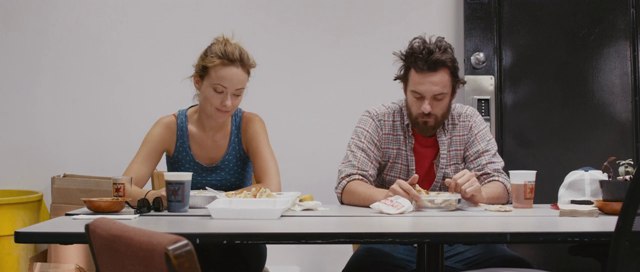
The other big common criticism he is able to get away from here is that his films are too specific, which I think again, might be a problem. Something like Uncle Kent is annoying to me because I feel the rhetoric of Ray Carney and “truth” flowing through every confession about sexual kinks. There’s nothing like that here and I’d argue that Swanberg perfectly captures the interactions of American 20somethings. In doing so, though, his brush is remarkably broad. It ultimately works, but Olivia Wilde reminds me of so many girls she could be any of them and Jake Johnson, equipped with a “cool beard” and everything, can be any dude I know. It’s not these characters feel a lot like people I know, it’s instead that they’re so lacking in anything specific that they probably could be anyone. Considering Swanberg ends the film in a way that is so willfully “open-ended” it might all be intentional. Maybe he knows the audience would want more, and then he’s gone for something a bit more opaque.

5

Swanberg grants us a little more into Kate and Luke towards the end. Luke agrees to help Kate move out of her old apartment and into her new one. Of course, the process is a total disaster because moving is almost always a total disaster. It’s a sequence that feels fresh, if only because it’s such a frustrating exercise that tends to be ignored. However, it’s a perfect point for Luke’s emotions to spill over into the open. Some have said that the scene feels forced, but I’d argue the film builds entirely into his frustration with Kate’s openness. It is part masculine bullshit (he wants to control Kate and prevent her from hanging out with anyone other than him) but the other part of it is he’s in love with Kate. The boundaries of his own relationship make this impossible to communicate in a way that fits into the realm of “reasonable” human interaction.

6

I hesitate to even call this film “good” but it’s definitely Swanberg’s biggest success. He has cleverly constructed a film that is ultimately about just two people who can’t be together, and he has formed it in the mold of a dumb romantic comedy. Chris and Jill aren’t important but their interaction is crucial. They share little to no feelings for each other but act physically on an impulse. They are the antithesis to Kate and Luke who are pretty much in love with each other but their feelings never manifested in the triumphant way we want relationships to play out. There’s problems here, but it does work as a reminder that the perfect romantic relationships that do happen are not only difficult, but are actually minor miracles. Kate and Luke’s non-relationships is, by the same logic, a minor tragedy.

7