Love and Death On Long Island (1997)

4 05 2014

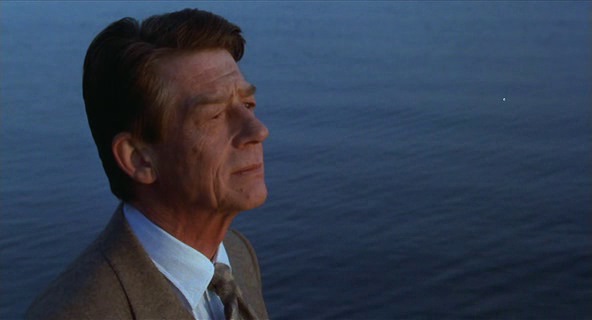
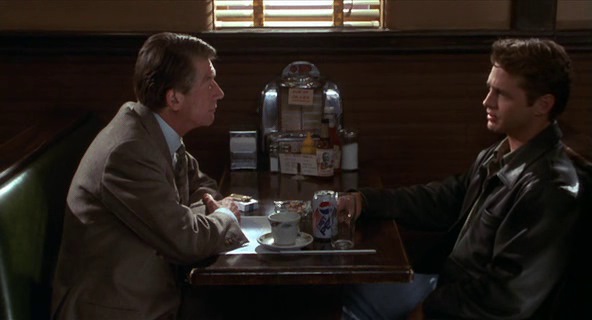
Early on in Richard Kwietniowski’s Love and Death on Long Island, Giles De’Ath tells one of his similarly stuffy, highbrow colleagues that he’s interested in finding beauty where no one has looked. His idea is genuine, but we, the audience, know that he’s artfully describing his new found infatuation with Ronnie Bostock, a young American actor stuck in lowbrow teen flicks. There’s two relationships at play here: Giles’ own personal obsession with Ronnie and the justification he provides for said obsession. While the film’s heart is the tragedy of the former, the rhetoric Giles himself uses in the latter speak to a complex rarely accepted. The idea that the high and the low art aren’t exactly inseparable.

1

Giles De’Ath is a beloved writer in England. He lives by himself in London, rarely ventures outside, and only holds conversation with his assistant. On a whim, he accepts a radio interview, where he learns that his defiant stance against new technology is a battle that is slowly being lost. Even E.M Forster’s work has been adapted to be projected on the silver screen. Giles chooses to investigate said adaptation, but ends up in the wrong theater. There, he sees a goofy teen comedy titled “Hotpants College II” which he is repulsed by until one Ronnie Bostock emerges onto the screen. He’s instantly fascinated by Ronnie, and investigates the actor’s life. His stubborn feelings towards technology are reversed. He buys a television and VCR to digest and study all of Ronnie’s work, which is of course, crass and commercial productions. Noticing his change in personality, a friend of Giles suggests he takes a vacation.  Choosing a destination is easy, Long Island, where Ronnie lives.

2

While filmmaker Richard Kwietniowski doesn’t particularly dazzle with any of his filmmaking decisions, he does deserve some credit for making a film about obsession and not turning the film into a reductive study in which Giles is nothing more than a creep. Giles himself knows that there is something quite ridiculous about his feelings for Ronnie and the fact that he goes so far out of his way to meet him. Calling his situation an “obsession” feels like an insult to begin with, if only because that word immediately brings to mind something that is not only unhealthy but something that we cannot possibly identify with. It is unhealthy and it might indeed be a problem, but by centering on Giles, the audience feels his process. He’s not some bizarre villain out to wreck Ronnie’s life.
3

The positive reviews I’ve read of Kwietniowski’s film have a habit of suggesting that Giles’ infatuation with Ronnie is not even romantic necessarily. I’m inclined to disagree, but I see why this suggestion is constantly made. It goes in line with sympathizing with Giles’ obsession and not making him out to be a creep. In reality, he is a little weird, which is exactly what ends up frustrating Ronnie towards the film’s conclusion. However, if the film were to be any more pointed about Giles’ feelings, it would risk making him out to be pitiful. To me, he does want to hold and caress Ronnie and be with him in all the ways that would conventionally imply. The relationships we frequently want to see in a film and perhaps in life generally, tend to be composed of young, white, attractive, heterosexuals. Giles’ age does him in, as does his profession. How silly that a respected author would even consider spending time with a lowly Hollwood actor in his 20s, let alone entertain ideas of loving him.

4

What can we make of Giles’ plight, then? Who is he but a rather silly old man whose dreams are far too unrealistic? Frankly, shouldn’t he know better at his age? He reminds me a great deal of Delphine in Eric Rohmer’s Le rayon vert. Despite his sophisticated personality, Giles is also ruled by his emotions. He too, feels his feelings too hard but the tragedy here is that unlike Delphine, he doesn’t have the rest of his life to look forward to. Perhaps because of his public persona he’s had to downplay his emotions for his entire life, and we actually catch a glimpse of him performing this facade. Maybe there’s something inspirational in him finally being “true” to himself. Giles himself would consider such an arc to be quite trite, but it all unfolds organically enough here that his heartbreak (not just from Ronnie but from the world) registers.
5


China Gate (1957)

3 05 2014

An American film dealing with French-Indochina never sounds particularly promising. Even today, where most of our war films are “gritty” survival tales that carefully recycle nationalist sentiments, it sounds troubling. For the 1950s, it sounds like it could be either extremely aggressive or potentially so backwards and problematic that it would sooner be forgotten. Parts of Samuel Fuller’s China Gate haven’t aged well. The film’s casually anti-communist rhetoric is tame in comparison to much of what was being expressed in Hollywood at the same time, but it does suggest the dedication to capitalism had bleed into Fuller’s brain. Weirdly, the context of the film doesn’t take away from what its truly about. Fuller has in his own passionate and hamfisted way sculpted a film that sure, comments on race relations in a superficial way, but it provides something deeper and more satisfying than the triumphant tales of color-blindness that populated the multiplex.

1

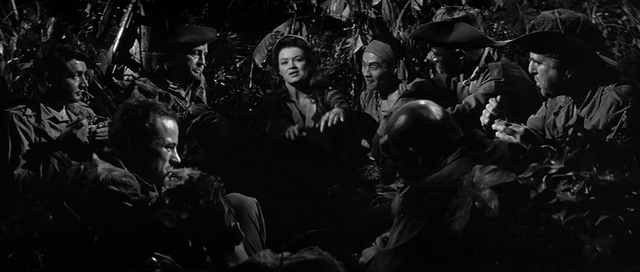
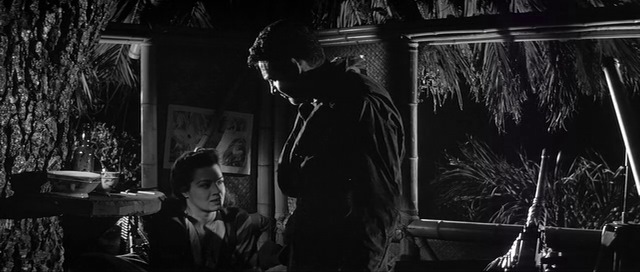
Sergeant Brock has been asked to lead a group of men into Chinese border, infiltrate enemy territory, and blow up their base. Brock, who we are to assume has no other options, is on board with the mission. However, the group’s secret weapon is his Eurasian ex-wife, Lucky Legs. Though never formally divorced, he separated from her once her son was born and looked more traditionally Asian. Lucky agrees to the mission with the reward that her son gets sent to America. She tries to reconnect with Brock, and while he still has feelings for her, he remains uncomfortable about his son. He can’t get over his feelings for the woman he loved, but at the same time he can’t get over his racism.

2

Now, I can see someone reading the previous description and seeing the film easily going the route of Brock unlearning his prejudice in classic, condescending and simplistic Hollywood style. That doesn’t quite happen, though. By the film’s conclusion, he confesses that he wants a family with Lucky, even if that includes his son. However, earlier in the film, following a tender but misread moment he says that he could patch up their relationship by lying. He could say he cares about their son, but he doesn’t want to lie. With this scene in mind, its difficult to read their reconciliation as a performance. He’s actually only concerned about Lucky.

3

While the film dives into Brock’s psyche and he tries to work through his racism, I would argue that the film’s real hero in Lucky Legs. There’s something awkward about a Eurasian woman being played by Angie Dickinson, who is of exclusively European descent. The biggest problem could be that the film suggests something resembling colorblindness – that Lucky’s background obviously didn’t matter to Brock until the manifestation of their sexual relationship produced something troubling to him. I think the film suggests sort of the opposite, and hints at what passing as white implies. Lucky herself is in a unique position, she’s beloved all over Asia (“she lived like a prostitute” the film not so gracefully tells us) and this is obviously an extension of her perceived whiteness. Her plight is summed up quite wonderfully at the film’s beginning, “I’m a little bit of everything, and a lot of nothing.” Sure, it sounds maudlin, but Fuller’s constant centering of Dickinson means her performance, while surrounded by potentially melodramatic trappings, registers as something both empowering and grounded.

4

I’m sure not all audience members see Dickinson as the film’s true lead. Maybe that’s because of some social conditioning or maybe because Gene Barry, as Brock, has just as much screen time. On the other hand, he is the  far weaker character. A man whose racism isn’t perceived as the “interesting” anti-hero trait that it would be viewed as in a lesser film. Instead, it’s a problem that Fuller expects him to fucking deal with as soon as possible and the rest of us aren’t going wait around for him to have his “aha!” moment of peace and clarity. Dickinson’s seduction-and-destruction technique is amazing to watch, not to mention perhaps a distant link to Jonathan Glazer’s recent Under the Skin. While Glazer’s film mystified people, Fuller is more direct. Dickinson needs to do this to save her son. Her death at the end of the film seems tragic, but it is almost inevitable. The things that influence society – poverty and war here – are the things used, fittingly enough, to keep a racist patriarchal capitalist society alive. Dickinson’s existence is thus, in opposition to the society that her and the rest of the film’s heroes superficially claim to be fighting in defense of.

6


The Breaking Point (1950)

30 04 2014

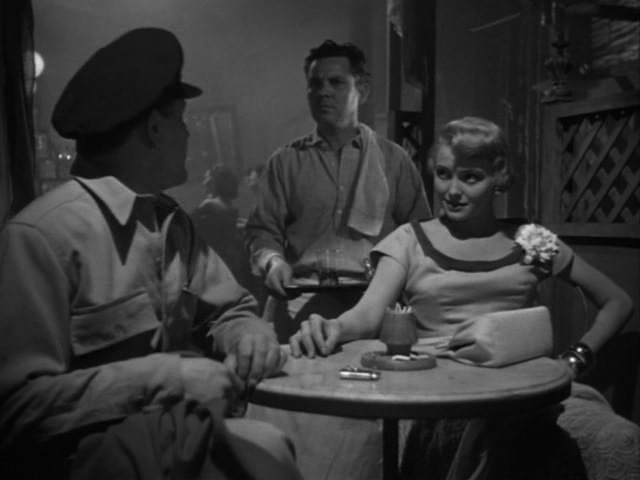
To non-cinephiles, the name Michael Curtiz might not mean much. Yet, he’s responsible for some of the biggest and most iconic pillars of classic Hollywood film – Casablanca being the most obvious one, but The Adventures of Robin Hood and Mildred Pierce also spring to mind. I find it necessary to introduce Curtiz as a big name director because The Breaking Point suggests something different. Here, his compositions are economical yet displaying flashes of artistic grace suggest something out of a B-film. A faithful adaptation of an Ernest Hemingway novel from one of Hollywood’s biggest names points to a film that might overwhelm the viewer with its importance, crushing them under the weight of its artistic aspirations, but Curtiz keeps his material in check and delivers the best kind of genre film: one that doesn’t get bogged down in overly pointed pathos, but still isn’t slight.

1

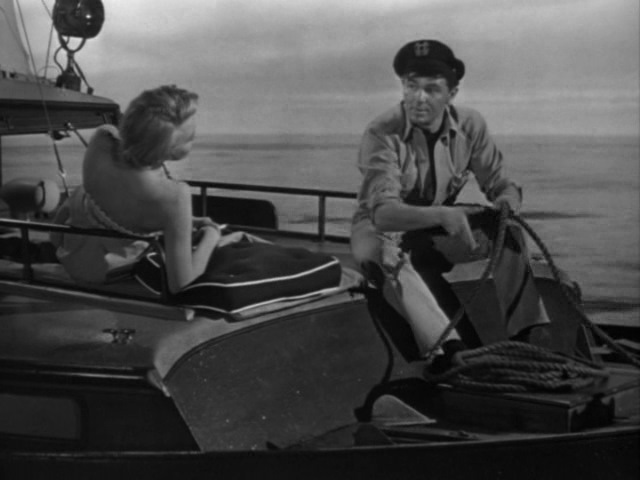
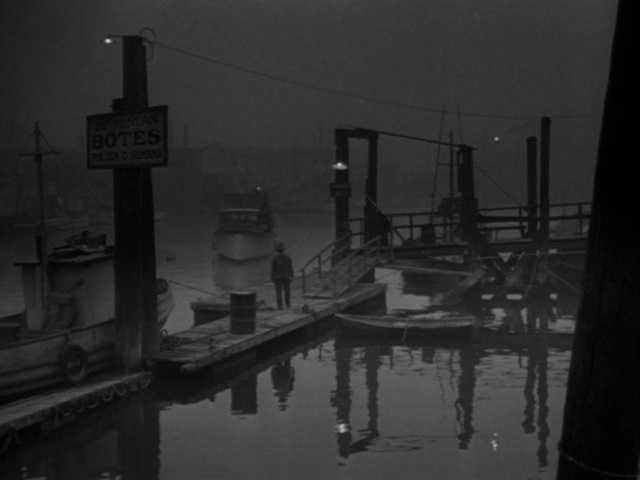
Captain Harry Morgan doesn’t have the most luxurious life, but he does seem to have things pretty good. He has his own boat, which he maintains with his best friend, Wesley. He lives in a nice house right by the water with his wife and two daughters. Money, however, is still an issue and he decides to accept a risky proposition. He’s to transport a group of immigrants into San Diego. The task sounds simple enough, but Harry decides to not tell Wesley, and the addition of the seductive Leona Charles into the situation only further complicates matter. Harry flakes out at the deal at the last moment, but it’s still too late. He’s lost his boat. He resorts to alcohol and begins to take an interest in Leona.

2

The Breaking Point, despite not soaking in an urban landscape, is still unmistakably a film noir. Unlike Howard Hawks’ adaptation of the same text, To Have and To Have Not, Hemingway’s text is not translated into a witty and clever romance. It’s something far more dreary here, perhaps a better cinematic comparison would be Docks of New York, though the “edgy” ammoral nature of the protagonist here is not hit as squarely on the nose. Instead, we have a heartbreaking performance from John Garfield, one that could have easily gone the route of being too maudlin and self-consciously tragic. He’s a deplorable human being, the kind that Hemingway excelled at writing, but that alone is not what makes a character complex or interesting. Morgan’s heart always seems to be stuck in between two places, and he seems to struggle with the fact these opposing positions aren’t polar opposites.

3

These opposing positions sound vague, but the idea seems to be supported by Morgan’s consistent indecisiveness. One moment, he’s ready to do something illegal to improve his standing, but once faced with the reality of his actions, he becomes unglued. The irony of course is that he backs out of these dealings without actually helping himself. His first mission ends with his boat being taken away from him, and the next one ends with his best friend dying. Curtiz deserves credit for visualizing this relationship: the tightness of his compositions is unique in his filmography. He’s able to maintain a sense of unease by contrasting these closely composed sequences with ones where the camera seems to almost needlessly linger on. It’s half way to adopting the momentum of a B-film, but they wonderfully clash with his more artful and deliberate shots, ending in something entirely new.

4

This “halfway between two places” idea (which I wish I could express more eloquently) resurfaces again in Morgan’s romantic relationships. Hemingway’s brooding, alcohol-fueled prose has often labeled him as either casually misogynist or just a sad man caught in wish fufillment. It’s hard to elevate the women here beyond that, but Patricia Neal and Phyllis Thaxter certainly try their hardest. Thaxter’s performance as Lucy Morgan is the more immediately noticeable and one could argue that her story is actually more tragic and dire than that of her husband. She fights to keep her husband, which sounds retrograde but her ambivalence is this fight suggests that her pride is also on her mind. She’s skeptical of all of her own moves made to ensure their relationship, half of her wants to fight and other half just wants to give up entirely.

5

Patricia Neal’s performance as Leona Charles seems, at the surface, to be disposable. She’s Morgan’s temptation and as such, one might expect that her character is only framed in relation to Morgan. This is true to an extent, but like Lucy, she is well aware of her position in this love triangle and how pitiful that position is. At first glance, we understand her as the one who is seducing Morgan, but weirdly enough, he doesn’t budge. Well, not entirely. Making something out of her blonde hair seems like a reach, but so frequently femme fatales are brunettes, perhaps a signifier that they’re the dark and evil forces that are trying to tear conservative, conventional families apart. Curtiz seems to be saying something about these signs and their arbitrarily assigned meanings, the faithful brunette, Lucy, bleaches her hair as a tactic to keep her husband interested. She’s visibly jealous of his interactions with Leona so she tries to physically transform herself into something that closely simulates his ideal of beauty, the one that makes his eyes wander to Leona in the first place.

6

Of course, all of this falls apart when Leona fails to live up to the femme fatale trope. One could criticize her characterization as she too easily falls in love with Morgan, who isn’t exactly the most charming individual. Still, her more sympathetic background suggests that the “femme fatales” who are so often viewed as manipulative and calculating are still just women and more importantly, still human. As so often in genre films, the conditions of the narrative are based on the moral failings of one character and while we may get a male bad guy, his villainy suggests nothing about his gender when the hero is, of course, a man himself. I hesitate calling a film based on a Ernest Hemingway book “feminist” but Curtiz squeezes as much humanity out of Hemingway’s projections of women as one possibly can. If they fail to achieve complete agency, Curtiz may not to be the one to blame. Rather, it’s the source text.

7


Le camion / The Truck (1977)

29 04 2014

There is an impulse in watching Le camion to conclude that  filmmaker and writer Marguerite Duras is simply phoning it in – giving us less than the minimum of what is accepted as a narrative film, something so slight that it should be comical or maybe it’s just thoroughly postmodern? On the other hand, does that justify a film that merely teases us with glimpses of what we would consider to be “real cinema” and even then, we’re really only treated to shots of cars on a rural, empty highway. One could call Duras’ film an experiment but doing so would suggest that the filmmaker herself doesn’t have an absolute confidence in the way her images and words interact.

1

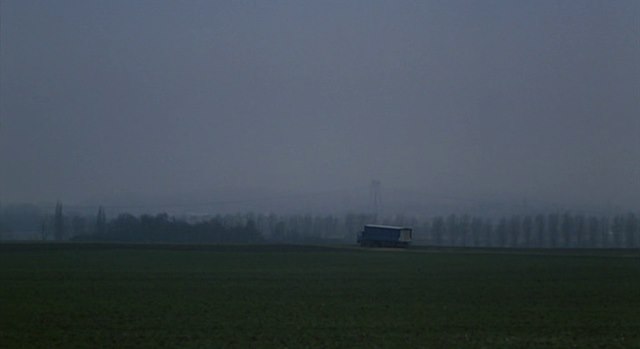
Following the opening credits, which are projected over shots of the French countryside, the camera frames Duras herself sitting at a table with Gerard Depardieu. The two are looking over a piece of a paper, Depardieu looks up at Duras and asks her “Is this a film?” and almost immediately we have an obvious self-reflexive moment. The film is centered on the conversation the two have regarding the script, but the camera occasionally cuts away and fixes it attention towards a truck briefly described in the script. The script being read hints towards a love story, one meditating on memories (as one might expect from Duras) but we’re never given an image, beyond the truck, to further contextualize the words of script.

2

For as self-indulgent and tiring as the film itself sounds, the experience of watching it can actually be, well, fun. That sounds strange, especially since I’ll be the first to admit that it’s slight nature does make one feel like Duras is stretching her thin material. However, there is a sensation felt there that is entirely unique: because Duras asks us only to imagine this film, we not only begin to think of it in our own heads but we also begin to crave images from this film. It’s almost as though the absence of the scenes described in the script grants some “lost film” mythos here. When we are granted images from outside of their conversation, they seem revolutionary, even though they offer us nothing but the figure of a truck.

3

Thinking “what could have been” is not the end of Duras’ intentions, though. If Casual Relations (which I just reviewed, hence why it’s fresh on my mind) asks us to relate art and popular culture with characters to give us a context, then Duras is asking us to provide the context all on our own here. Sure, she fleshes her characters out by talking about them, but the lack of their image kind of argues how necessary it is. Again, the impetus is on us, the viewer to care enough to work our brains enough to see the clever way Duras has left us to determine the meanings. In a way, that’s always the task of the viewer, but we’re given less things to consider and weigh here. The experiment is a success, Duras has simultaneously constructed and deconstructed a movie that we’ll never see, but we may think of it with the belief that we experienced it all the same.

4


Casual Relations (1974)

28 04 2014

There’s a New York Times stub for Mark Rappaport’s debut, Casual Relations, written around the time of the film’s limited run in 1974. The position of the author is not entirely surprising. They demonstrate some attention devoted to the film, but then quickly arrive at the conclusion that the film is not much more than a self-indulgent, amateurish disaster. There are certainly parts of Rappaport’s debut that would strike the more cynical and less open-minded viewer as arthouse self-parody, a film so aggressively high brow that it doesn’t even allow for a more curious audience member to step up. The irony of all of this is that Rappaport’s debut, while suggesting an analysis of the structures that influence our daily lives, is about how we relate ourselves to “low” or popular culture. It is a film about something we all experience, yet it unfortunately illustrates this in a way that is superficially mystifying.

1

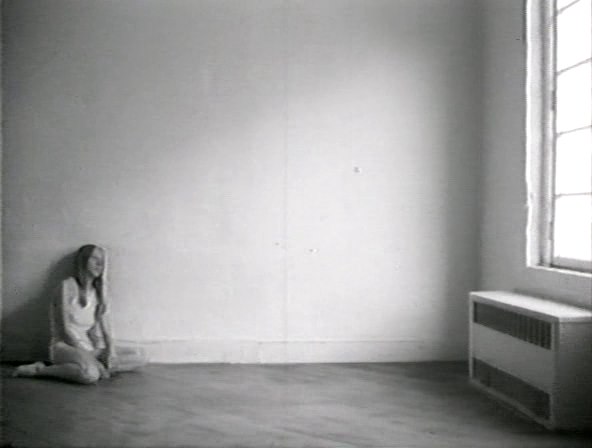
Following a collection of stuttering, shaky stock images of a sky and a beach, Rappaport introduces us to a woman suffering from a severe case of insomnia. Through voice over, she tells us that she doesn’t fall asleep until 7 (presumably, am) and even then, she’s haunted by terrifying nightmares. These nightmares are visualized to us as blown-up, faded, and heavily pixelated images of Murnau’s Nosferatu. The woman then tells us that even though her nightmares haunted her after she woke up, she still struggled to remember what exactly she dreamt. Following an addict (whose addiction is unexplained, but necessary) begging some deity for another chance, we’re introduced to Susan. Rappaport’s camera observes Susan watching television, which is exactly what the film’s title card describes before the shot itself appears.

2

There’s something candid about Rappaport’s commitment to just observing his characters. It’s nothing new for someone whose watched a film by Chantal Akerman or Tsai Ming-Liang, but unlike those filmmakers, Rappaport’s vignettes seem to speak a bit more directly to his ideas. If Akerman or Tsai are more pragmatic, and dare I use the dreaded word, “realistic” then Rappaport is more interested in having setups that flesh out and illustrate something about his characters quite literally. Early on in the film, we’re introduced to Susan, a woman watching TV. She watches Johnny Guitar, and Rappaport chooses to include the scene in which Sterling Hayden asks Joan Crawford to act like she loves him. She complies, which is just one sequence from that particular film that offers subtext about identity. We encounter Susan only through the media she herself is experiencing, which seems mundane, but the shot’s length emphasizes its importance. Here, the film gives us our first instance of pop culture’s significance in our lives. Our idea of Susan is related to how she herself has related to a scene in a classic western, perhaps a recognized “classic” sure, but not “important, high art.”

3

The next vignette concerns two old flames reuniting. Again, the audience is given the setup through voice over: “we decided to drive around.” While in the car, the radio plays The Rolling Stones’ “Under My Thumb” a song almost explicitly about a desire to possess a woman. It might be cynical to suggest that Rappaport sees something inherently possessive (and thus, abusive) about men seeking heterosexual relationships, but the film repeats this possessive nature in the film’s most impressive scene. Two lovers walking in tall grass begin being intimate, but that intimacy quickly turns to violence with the woman killing the man. The sequence is repeated with slight variations in both the image and the woman’s voiceover. There is one constant in every voice over, though: she’s uncomfortable with how he’s touching her and she’s acting in self-defensive. We finally get a voiceover from the male figure, but his explanation of the situation, given the perspective that’s been repeated to us for the last several minutes, seems comical in its inaccuracy and stupidly selfish.

4

I watched Casual Relations just days after seeing Jim Jarmusch’s charming enough Only Lovers Left Alive. It’s an enjoyable film that tries to explore, among many other things, the importance of how we digest art and culture. Like Rappaport’s film, Jarmusch is interested in how his characters respond to art, particularly music in this case, but his film ends up falling short of what Rappaport’s film accomplishes. Jarmusch doesn’t illustrate the link and instead, the film, while quite funny does nothing more than feel like a collection of cultural references used to further the alienation felt by their aging hipster vampire protagonists. Rappaport, on the other hand, has used art and popular culture to help contextualize his protagonist’s feelings. We never really “know” much about them, but that’s kind of the film’s point. Their opaque characterization give us something of a clean piece of paper, and the art and culture we seem them experiencing is used to project and even express their anxiety. Like Stuart Hall, Rapapport has argued on behalf of taking pop culture as the serious, vital phenomenon that it is. Hall himself said that pop culture is “where we discover and play with the identifications of ourselves, where we are imagined, where we are represented, not only to our audiences but to ourselves.” Rappaport’s character are seeking themselves out through popular culture and the arts. This is why the film ends on a character, who we know very little about, intensely studying a painting.

5