Lucky Star (1929)

21 02 2009

Now this, on the other hand, is a full out masterpiece. I’ll admit immediately that there are a few sequences that are more than a little bit ridiculous (the ending in particular) but for the most part, it’s an extremely moving tragic would-be romance, the kind that became almost a genre in early American cinema. Thankfully, this is closer to being a Murnau film along the lines of Sunrise or Tabu than to Griffith’s poetic yet oh-so-dated True Heart Susie. Outside of our protagonists, the characters are drawn rather crudely and one-dimensionally, but such elements should go with out saying for a film like this.

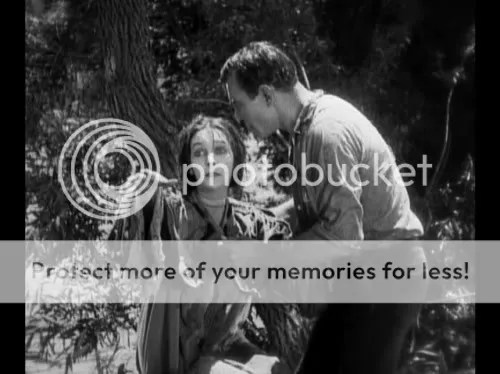
It’s the sort of thing that really shouldn’t have an impact on my overall impression of a film, but man, Janet Gaynor is extremely cute here. She’s charming enough to make you break down and fall on the floor, which is exactly what Charles Farrell does. Gaynor plays Mary Tucker, a poor farm girl. She appears to be the oldest child in her family, only her strict mother acts as her superior. Farrell plays Timothy Osborne, who has an encounter with Mary the day before war is declared. He, like his friends, enlists almost instantly. Unfortunately, he returns home in a wheelchair, incapable of using his legs. He begins to pursue a relationship with Mary, but there’s something physically and emotionally in the way.

The two maintain a friendship, but both are conscious of the fact that something romantic can exist between them. One night, Mary meets Sgt. Martin Wreen at a local dance. He’s the man indirectly responsible for Tim’s injury, and the stud of the town. He immediately takes a liking to Mary, who is a little bit indifferent. He takes her home and makes a convincingly charming case to her mother, who wants the two to get married as soon as possible.

Even though a lot (if not all) of the film was made in a studio, it does have a very laidback and natural small town feel to it, not unlike the tone of John Ford’s Judge Priest. Borzage manages to pull more than a few really impressive sequences. The look isn’t consistently expressionistic, but the frequency of gorgeous shots is greater than it is in Lazybones. I can’t quite but my finger on why this is true, but the visual tone perfectly compliments the tragedy of the story, as well as Janet Gaynor’s own physical beauty. Watching the whole thing unfold is rather remarkable, if occassionaly silly. The ending is pretty, well, goofy, but I can’t criticize the relentless romanticism of this picture. It’s not always realistic, but it always manages to illustrate the intimacy of the events.




Lazybones (1925)

21 02 2009

It might just be the presence of the charming Buck Jones, but this small-scaled early Borzage picture plays out a little bit like a continuation of Ford’s own Jones production, Just Pals. This is 85 minutes of funny, yet bittersweet moments featuring Jones constantly getting his heart broken. It’s not a big artistic achievement for Borzage, but it doesn’t seem like he wanted it to be in the first place. Instead, it’s a nice way to spend a little less than an hour and a half.

While the content here is viewed in a very “light” manner, it doesn’t really dilute the overall sadness of the scenario. Jones plays the title character, a lazy young man in the middle of a relationship with Agnes. Unfortunately, her mother does not approve of him. Meanwhile, Agnes’ sister, Ruth, is set to marry a man of her mother’s choosing. However, her mother is unaware of the relationship she shared with a recently deceased fisherman and their child. She dumps the child in a nearby river and attempts suicide. Lazybones manages to rescue both Ruth and her child, who he adopts and names Kit. Time passes quickly (as it often does in these sort of films) and Kit is already an attractive young woman. Lazybones returns from the war and falls in love with his adopted daughter.

Buck Jones channels Buster Keaton a lot here. Fortunately, for my sake, there is very little of that physical comedy that defines Keaton’s work, and more realistic situational comedy. The whole story would be pretty heartbreaking if Borzage hadn’t handled it in such a downbeat, deadpan manner. Borzage also manages to add some of his (eventually) trademark expressionistic touches. No one should approach this film and expect a breathtakingly visual experience, but with that said, the film does look very nice. If there’s any problem, it’s that it feels too nice and insignificant, but that’s a big part of its charm.


Era notte a Roma (1960)

8 02 2009

Well, it seems like Rossellini indulged himself into his original World War 2-era interests one last time before he completely began his “educational” television productions. For at least an hour and a half, this is a very political yet very intimate retelling of three concentration camp runaways (one from Britian, one from Russia, and one from the USA) hiding in the attic of a young Italian woman. These sequences recall Rossellini in his cinematic prime, yet are painted in an aesthetic that is a bit more modern. It’s not nearly up to the technical level of L’Avventura (which of course came out the same year) but it definitely has a little Antonioni-ness to it. Things get messy, as they often tend to with Rossellini, towards the end, but it is an interesting endeavor, if not an entirely successful one.

At 136 minutes, this certainly begins to drift away from what pulled me to Rossellini in the first place. The running time of The Flowers of St. Francis and Germany Year Zero are both under 90 minutes. This isn’t to say that I get tired of Rossellini’s shtick after awhile, but instead, his films fare better as concise, straight-forward documents that unfold in real time. This film does give that impression for a good part of its length. The sequences that take place in Esperia’s attic have an effortlessly languid pace to them. Even when the discussions among the three men turn to ramblings on communism, and/or fascism, a sense of realism is indeed maintained. The tension between the three runaway protagonists certainly helps this case.

Oddly enough, Rossellini’s focus isn’t limited to these three men. Although Mr. Pemberton’s opening narration gives that impression off, Rossellini scope also includes Esperia, the women who reluctantly hides them in her attic and her boyfriend, Renato. In a slightly tongue-in-cheek bit of writing, Esperia finds out about the possible consequences for her actions from Renato, who advised her to shelter escapees in the first place. She is shocked to learn that she could be killed by firing squad if she is found out. Despite the danger involved, Renato can’t help but giggle at his lover’s naivety. It’s a charming little moment in a film is desperate need of more.

Towards the end, Rossellini himself escapes (lame pun, indeed…) the tone of his WWII works, and goes into uncharted territory. Characters are thrown out, and new ones appear almost seamlessly. This is awkward, to say the least, but definitely reaffirms my own idea that the film is an extremely interesting development for Rossellini as a filmmaker. It is a bit bizarre, and maybe unsettling for some, to think that he would make The Rise of Louis XIV only six years later. In a way, it also kind of makes sense. This is, after all, somewhat of a transition piece. The positives from both of Rossellini’s stylistic eras are present, but so are the negatives, I suppose.


The Children are Watching Us (1944)

8 02 2009

Probably the best film I’ve seen from Vittorio De Sica, though rewatches of Umberto D and Shoeshine are definitely in order. While I don’t think this film is as achingly personal as the recent Rossellini efforts I’ve watched, it does have the advantaged of being more polished and formally pleasing. That doesn’t mean this is any more or less “light” than Germany Year Zero, it just feels like the person behind the camera has greater understanding of cinema’s technical possibilities. I’d say De Sica is a much better filmmaker than Rossellini, where as Rossellini was just better at coming across something that hits me deeper.

It is probably worth mentioning that the physical state of this film is much better than any Rossellini film I’ve seen. Once someone restores Rossellini’s war-time efforts, I might have to amend this statement, but until then, I’ll say that De Sica seems to have a better concept of visual compositions. There are some legitimately virtuoso moments here, such as the tracking shot that follows the protagonist’s nearly-fatal walk along a railroad, or the  low-angle shot that beautifully closes the film. The imagery from De Sica’s catalog seems much more memorable than the imagery in Rossellini’s. He’s a bit more vivid of a storyteller, which is obviously a plus, as is the fact that his films are less socially conscious.

Even though it was made in 1942, and was held for release until 1944, there is no mention of war for the entire film. I doubt I will ever be able to say the same for a Rossellini movie. Personally, a film like Germany Year Zero still works because it is about feelings that are not exclusive to decaying of a post-war city. Here, on the other hand, feelings related to war are not even referenced. Instead, all of the drama comes from the internal, which leads to more interesting characters.

Another point in De Sica’s court is for his setup: a mother leaves her family for an ex-lover, comes back, and then leaves again. It has melodrama written all over, but does stay rather subtle for a majority of the film’s length. I really love the touch De Sica adds to the structure by having the mother being somewhat reasonably undescisive. While it was interesting that De Sica maintained his interest in a naive child, I can’t help but feel like he was a little undescisive as well. At times, he seems willing to explore the tension between the parents and their doomed relationship, but at other times, he just wants it to be the backdrop in a coming of age story. The characters are not really alloted enough time for me to consider this to be in the same vein as Naruse, or Ozu. It probably doesn’t help that the ending is rather schmaltzy, either. Overall, though, this is pretty much fantastic.


When Willie Comes Marching Home (1950)

7 02 2009

It seems that most people see this as a failed attempt on Ford’s part to make something of a war-driven, Preston Sturges movie. Indeed, it does have some “screwball” touches to it, and I find it legitimately funny, but it never really comes close to having the substantial feel of a Sturges picture. This is a pretty light affair, which obviously contrasts with the whole concept of enlisting in the army. It is very enjoyable for what it is, but of course it isn’t going to convince anybody of Ford’s genius all by itself. It is pretty hokey, almost embarrassingly old-fashioned, but I’d also be lying if I said I didn’t have a good time watching it. It’s not high art, but it is popcorn entertainment seen through the eyes of an artist.

It is a little bit difficult to critically analyze a film that clearly feels like a studio-driven project. Based on the deleted scenes from the DVD, this was originally intended to be a musical. Being the man he was, though, Ford opposed this idea. He seems to have won this particular battle, as only one musical sequence is present in the final cut, but that doesn’t really stop the film from feeling extremely inconsequential. Another statement that completely contradicts the subject matter.

There is plenty “Ford-ness” to enjoy here, though. His depiction of small town lifestyle(s) is unparalleled. It’s not as vivid of a community as the one in say, Judge Priest, but it is fascinating none the less. Even with a very friendly tone, Ford’s cynicism shows up on a occasion, and sort of gives the film a positive attribute beyond just escapist entertainment. Even though the “suburban” era hasn’t quite developed into a nation-wide phenomenon yet, one can still see Ford planting seeds of criticism. The townsfolk, as they are in earlier in Ford pictures, tend to be gossipy housewives, devoid of perspective. That intimate community tone, in which news travels by mouth and not by a publication, is 100% Ford. This is obviously  important as the film itself is rather unFord-ian.

Ford has always saved potentially empty productions by injecting his personal interests and themes into the content. The story here, revolving around a young adult who is the first to enlist in his small town following Japan’s attack of Pearl Harbor, but ends up stationed in his home town as an instructor, does have a lot of potential. It’s a bit like one of those “wrongly accused” films, except instead of murder, the protagonist is accused of being a slacker. This could have worked had the part been played by someone that looks like they’re in their twenties. Instead, it’s played by Dan Dailey, who looks about thirty years older. He’s charming sometimes, but not nearly enough to lift the film beyond its studio inforced mold.