Le plaisir (1952)

26 05 2010

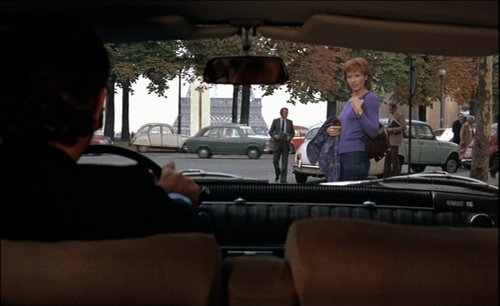
This is pretty much more of the same from Max Ophuls, but for whatever reason (which I’ll try to get into with this review) I was completely overwhelmed by this whereas my reactions to La Ronde and The Earrings of Madame De were only lukewarm. I’d like to think some of it has to do with the stories being based on the work of Guy de Maupassant who is responsible for the story in Renoir’s amazing A Day in the Country as well as Ford’s Stagecoach. To call the man’s writing credits impressive would be an understatement but still, his contributions to the world of film seemed to be under-appreciated.

Much like La Ronde, Ophuls is juggling multiple stories here. Only three this time and his way of transitioning is much less elaborate and not nearly as smooth, but the content of the stories themselves is far more interesting to me. It probably helps to have two of the greatest performers of the time period featured in some. Throw Jean Gabin in anything from the early thirties to the late fifties and he’s almost a lock to improve the writing. Simone Simon, if only for her unorthodox beauty, is a thrill to watch in anything and her performance here is absolutely heartbreaking.

I suppose Gabin is the better performer here, but Simon’s story is the one that takes the cake. It’s shorter, perhaps even the shortest of the three, but its short length only contributes to that vague beauty that alludes to “poetic” – it’s the sort of opacity that makes the work of some of my favorite directors – perhaps most notably, Hiroshi Shimizu, so memorable. The characters here aren’t rich, detailed, or deeply layered. They’re simplistic and lacking in description but again, there’s something so fascinating about such a setup.

It’s hard to describe how the last story here gets to me and why it cuts so deeply since it exists somewhere nowhere close to my real life experience. Basically, it’s an artist and his model falling in and out of love. It might be the virtuoso camera work of Ophuls (which is absolutely jaw-dropping here) but it might also be that exaggerated tragic tone that I’ve come to expect from Frank Borzage. Of course, Borzage lingers (and thus, I suppose, “meditates”) on his couples for a longer period, but within a short twenty minutes or so, Ophuls is able to capture the same heart-swelling tone within a more frantic and chaotic frame. These adjectives all sound like a verbose writer but to get an idea of what I mean just look at the final sequence in which Simon threatens to kill herself and her ex doesn’t even flinch. It begins with a simplistic static shot but when the action is initiated, it seamlessly turns into a stylistic point of view shot. It’s a perfect example of Ophuls’ cinematic talent – being a mastermind behind the camera but trying to be quiet about it.



Paris, Texas (1984)

23 05 2010

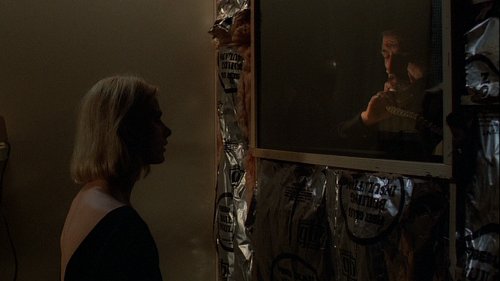
I’m accused movies of “cheating” before and I usually mean that in the sense that they are too close to my ideal vision of cinema. This is one of those movies. It’s a weird phenomenon and I can never quite put my finger on it, but films like these are perfect in my eyes yet still can’t provide the same emotional response as some of my more “flawed” favorite films. I’ll particularly throw out Two-Lane Blacktop and The Wayward Cloud since this film is of the same ilk and, in all likelihood, it’s probably aware of the former. It seems a little too simplistic, not to mention illogical, just to downplay a film like just because it doesn’t have any transgression or something, but there’s definitely something missing here.

If there’s one flaw in the film that I can immediately pinpoint, it’s the weird overly-bright, almost cartoony color scheme that is easy to find towards the start, but tones down before eventually arriving in Wenders’s usual visual territory. The film of his it is most like is probably The American Friend but the opening landscapes look a bit more commercial than anything in that film. It’s a really small gripe because looking at the film is almost completely a wonderful experience. I guess I just expect more from the usually aesthetically pleasing Wenders? Again, this is just small stuff.

The story concerns itself with Travis Henderson, a man lost in the desert who has obviously experienced something extremely traumatic in the past. He slowly becomes part of functioning society with the help of his brother, Walt and his wife, Anne who have been taking care of Travis’s son, Hunter ever since Travis vanished many years ago. There’s some nice bonding scenes that feel real even though the content is obviously bordering on being something out of a mushy Hallmark card.

In the last twenty minutes or so, the film (somewhat abruptly) shifts into territory that is more familiar for works of this style. Travis tries to hunt down his wife, the women who (we are to presume) played a integral role in his emotional collapse. Basically any scene with Nastassja Kinski is enormously sad and moving, but probably just a bit too dialogue-driven for their own good. It really goes against the grain, especially if one takes into account that a majority of the film’s opening is without any dialogue at all. It all works, but again, it might play some part in my inability to truly embrace this film like the two comparisons I mentioned in the first paragraph. Everything works well here: it just works too well, I suppose. Still, a great film that I enjoyed a lot more than this review probably implies. Pardon that, I’m still a bit rusty.


Juventude Em Marcha (2006)

13 05 2010

While I can certainly see and understand why this film has received such a dedicated following, I can’t buy into the idea that it’s a complete masterpiece or anything. I like Pedro Costa a lot and consider Ossos a near-perfect film, but I guess his inventiveness gets the best of him here. The former film is definitely unique though it can be filed away in the slow-burning minimalist folder that houses Tsai Ming-Liang, Jia Zhang-ke, and everyone else of that ilk. This film still maintains the element of long static shots but it’s less exotic looking (shot on digital?) and a lot more dialogue-driven than the rest of the group.

Apparently, this film is something of a fusion between narrative filmmaking and documentary filmmaking, but this doesn’t supply the “self-conscious” wall-breaker that similarly described films might. This is not the meta fodder of Godard’s latter period, but just a film, staged by beautiful static shots featuring people talking. That’s really all it is, and for what it is, it’s pretty amazing. The idea of a displaced individual wandering around ruined landscapes and reuniting with his children is nice and easy to watch, at least for me, but the problems come when too many of the sequences depend on characters describing these extremely long stories that leaves it up to us to imagine the situations.

I can’t knock Costa for simply photographing people talking (not to mention doing so without moving the camera) because that’s essentially what he set out to do, but I’d be lying if I didn’t admit that some of the stories the characters tell are either too boring to worry about or are semi-fascinating and then run of momentum because of length. It’s probably worth mentioning that there’s not much energy or spontaneity in their dialect, but again, this is not a false or an oversight. Bresson comparisons are boring because every critic uses him as a stand-by but the de-familiarization of character movement, along with the deconstruction of surrounding images definitely gives off that feel. I’m reminded of The Devil, Probably in particular.

Ultimately, this is film I like a lot but it doesn’t seem to carry itself for an entire two and half hours. I seldom feel impatient with Costa (those others might feel differently) but there are times when I’m about to ready to “move on” even though you have to anticipate such movement is going to be deliberately minuscule. Basically, I think this movie is very interesting and a very personal for Costa, but I suppose it doesn’t work as much for me as his more polished work, particularly Ossos, but I can definitely appreciate it on a similar wavelength.


As you may or may not have noticed…

12 03 2010

All of my images have been replaced by photobucket’s advertisements for their “pro accounts” which is just a way to encourage me to give them money. I’m a cheapskate, no doubt, so I’ll just be switching to a different host. I fear that if I speed things up then I’ll make use of all the bandwidth that WordPress provides for their image files, but it will have to suffice for now. In the mean time, remember not to hotlink any of the images I’ve uploaded. I think it eats away at the bandwidth Photobucket provides (which is already quite small at 10GB a month) far more quickly than if the images were just viewed from their respective posts. The images should be back by next month, but I just wanted to give a heads up to any curious parties and apologize for any inconvenience it may have caused anyone.


Nous ne vieillirons pas ensemble (1972)

12 03 2010

When an artist is referred to as someone who “wears their feelings on their sleeves” it usually means that their work rather overtly manages to express the sentiment that they intended. However, in Pialat’s case (lame symbolism ahead, warning) he doesn’t wear sleeves in the first place. He’s one of the few directors who is able to be completely transparent when it came to his personal life and the cinematic representations he created. This film, only his second full length feature, is perhaps the most obvious example of this quality. Based on his own highly personal novel, Pialat almost effortlessly balances the ever-delicate relationship between reality and fiction.

It’s important to mention that Pialat’s cinema is not balancing said relationship by playing with one’s idea of what constitutes “film world” and “real world” as Godard did countless times in the 60s. He achieves the balance by being completely transparent (this is in danger of becoming a personal buzz word in describing not just this film, but Pialat’s work in general) and achingly personal. I mean achingly in the most literal way. One has to think that if Pialat showed this film (or the book, I suppose) to any of his close friends, that they would feel enormously uncomfortable. No, it’s not like I haven’t seen an “honest” of “piercing” type of movie before, but there’s something in Pialat’s manner of observation that just encourages the audience to cringe.

I haven’t been keeping up the critical re-evaluation of Pialat in English-speaking countries, but I’m hoping people can begin to drop the “French Cassavetes” description as it as uncreative as it is wrong. On what basis was this claim even developed? The camera shakes? The fact that both make relationship movies? Don’t get me wrong, I love Cassavetes, but try comparing stacking A Woman Under the Influence up to this makes Gena Rowlands look like the most ham-fisted performer of all-time. In trying to think of the difference between the two filmmakers (and there definitely is one, by the way) the first thing that comes to mind is charisma. There’s plenty of it in Cassavetes’ work. Rowlands’ aforementioned performance (which I don’t mean to hate on) has the subtlety of a kabuki performance when compared to the performers in Pialat’s film. While Cassavetes’ film has dramatic action that is on par with a fistfight (literally, towards the ends) where as Pialat, though arguably more violent (literally speaking again) has the gentle observation of someone like Ozu or Leigh.

Unlike Ozu or Leigh, though, is Pialat’s trademark cynicism which shines through the character he based on himself, but is flowing throughout the film’s entire running time. It’s cynicism from a cynic who is too apathetic to proclaim himself as being a part of any movement. It’s something that’s evident not only in Pialat’s film but in his often humorous interviews. There’s a constant conflict between sentiments of indifference and sincerity which are not opposites, but just colliding feelings. In this since, it comes as no surprise that the late Manny Farber was such a big fan of Pialat’s work. While they aren’t operating within the same art form, they both beautifully create brevity in a world that requires clarity in both fiction and analysis.

I suppose it is somewhat ironic then that I feel very unsure of where to begin even talking about this movie. It’s heartbreaking, but not that in the way that builds and builds into a poignant climax but instead something that constantly builds and gets more and more upsetting along the way. There’s a line in the film that serves as a perfect symbol for the experience of watching Pialat’s work. Catherine tells Jean that she loves him less than before, and he asks when this happened. She replies, “It just did, bit by bit.” – a perfect description for the film itself. It pokes at your most sensitive area with an iron and pours salt into your wounds, yes even the ones that were masked by Cassavetes and countless others. In other words, this is absolutely a masterpiece.