Shara (2003)

30 01 2008

I was trying to think up a shortlist of female directors from Japan not too long ago and outside of Kinuyo Tanaka, who of course is famous for other things, I could only think of Naomi Kawase. Unfortunately, she got little attention when she won the Grand Prix at Cannes for The Mourning Forest (Mogari no mori) last year. She’s written two novels and directed ten films (her latest is in post-production) but only now, is she getting attention in the west. I’ve felt like I’ve written “only now getting attention in the west” about one hundred times in this blog already. America is just so far behind in Asian cinema. Enough whining, Shara (Sharasojyu) definitely represents the work of a promising talent.

The films opens with a prolonged and rather awkward sequence of Shun and his brother running through alleyways. For better or worse, Kawase’s shakycam tracks the traveling of characters in a way that is as immediately striking as the steadicam tracking shots in Alan Clarke’s films. Shun’s brother disappears and this setups the rest of the film, which takes place seven years after and reflects the family’s inability to move on from their trauma. Shun is now seventeen, exteremly alienated, and falling for Yu. Their respective families have much bottled in leading up to the “Shara festival.”

I always see it as being short-sighted when saying any films is like “so and so but with something else” but this just be an Ozu film with the unfortunately overused shakycam. The first is particularly Ozu-esque, as Kawase simply observes the everyday rituals of the film’s characters. The similarities in living conditions certainly doesn’t hurt this comparison, either. Seeing as how this is a delicate film, it takes place away from the bright lights and modernization of the big city. I’m also reminded of Hou Hsiao-Hsien’s films from the 80s but placing Kawase on the same plateau as my two very favorite directors is a bit premature.

Even though this is a remarkably observant and neutral slice-of-life, the otherwise sparse narrative is plagued by a very silly exposition that ends up taking fifteen minutes of screen time. The film is about Shun, his family, Yu and her step-mom and that’s why the bit about the disappearing brother is unnecessary and frankly, a little silly. It’s bad enough that Shun never really “looks” for his brother but it’s even worse that Kawase felt such an explanation was needed to order to understand the tension of the family. It would be much more interesting, at least to me, had none of that information been given and the audience would be left to study the nuance of the present episodes.

Mrs. Kawase’s aesthetic deserves a word or two, as well. As I said, this is a very low-key drama, the type that I watch at an almost obsessive level. This is one of the first that seems to be keen on using the shakycam handheld look. Certainly the more kinetic approach can strike a chord with me (WKW, Fruit Chan, Cassavetes, and hundreds more) but it tends to be used for much more consequential films. The clash of somber pacing and anti-attention span camera work is very awkward at times, particularly the far too long opening sequence. This leads me to my final very small compliant and that’s that Kawase should have spent a little more time in the editing room. The opening sequence which is basically ten minutes of slow-motion footage of two kids running in a street feels sort of cool at first but goes on for an uncomfortable length of time. The opening festival sequence is a blast in face from the restrained mood the film had built itself upon and yet, the festival sequence ends up feeling even more mundane if only for the fact that it goes on way too long.

Even though I am vocal about my very small problems with the film, it is still pretty much a masterpiece. It’s refreshing to see that not everyone follows the long-held traditions/beliefs about minimalistic films in Asia. This is more akin to the social dramas coming out of South America, the “gluesniffing” genre as I like to call it, but with more focus on characters and their relationships. The people who would like Shara know who they are, and they shouldn’t waste anymore time not seeing it.


Endless Desire (1958)

29 01 2008

My feelings towards this are a lot like the feelings I have towards Masahiro Shinoda’s Pale Flower. Fittingly enough, both films were my introduction into directors that I should have been familiar with already. I can’t say either film left a considerable impression on me, but they both felt sort of inconsequential and not a big deal when stacked up against the rest of their filmography. Of course, the appeal of those other films being the fact that I haven’t actually seen them yet. To reiterate my thoughts on Pale Flower: this is a wonderfully shot film, exceptionally framing but fairly conventional in every other aspect. There’s some refreshing slapstick humor that’s sort of nice to see in contrast to all the older “slice-of-life” minimalist films I’ve been watching lately. At the same time, there’s also the ever-dreaded over-arcing plot. In all honesty, this setup feels like something from the Twilight Zone (to be specific, “Four Characters in Search of an Exit” – no twist, thankfully) by trying to engage the audience with superficial character development. This really isn’t quite as bad as it sounds because for what it is, it is quite entertaining but I am expecting much more from my next Imamura experience. I wasn’t expecting much from this and I pretty much got what I bargained for. There’s far worse ways to spend 100 minutes.


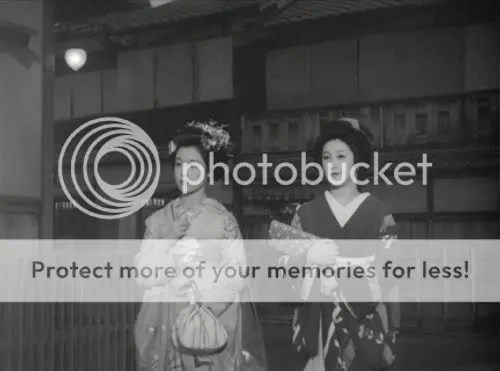
Gion Bayashi (1953)

27 01 2008

Kenji Mizoguchi is best known in the West as the mind behind Sansho the Bailiff and Ugetsu, both very fine films but both films where the dreamy vibe begins to engulf itself. Perhaps it’s the fairy tale like structure of both films, but in my opinion, they come off as too magical instead of poetic. The Malick comparisons make sense, especially since he attempted a stage adaptation of Sansho but it feels like Mizoguchi is escaping to another world instead of focusing on the beauty within this one. Gion Bayashi is a bit more realistic than Mizoguchi’s more highly-regarded films and for my money, a lot better too.

Eiko (Ayako Wakao) is a naive teenager attempting to start a new life. She travels to the Gion district in hopes of following in her mother’s footsteps by becoming a geisha. She meets one of her mother’s geisha “sisters”: Miyoharu (Michiyo Kogure) is far less idealistic but she takes in Eiko anyway, despite the financial difficulties that the training will bring to her. A year pases, Eiko is now Miyoe, and Miyoe is ready to make her geisha debut. Miyoharu and Miyoe are invited to entertain at a business meeting between Kusuda (Seizaburo Kawazu) and Kanzaki (Kanji Koshiba) – Kusuda falls for Miyoe and Kanzaki falls for Miyoharu. Kusuda wants to give Miyoharu to Kanzaki to help close a business deal but both geisha are against it and this leads to more financial turmoil.

A delicate, slice-of-lice film that Mizoguchi made in-between his two most famous epics, Sansho and Ugetsu. This is a bit closer to the films that Naruse started making in the 50s, which is ironic considering that Mizoguchi was very upfront about his distaste for Naruse. As I mentioned in the opening, the film still has Mizoguchi’s distinct style stamped all over it. I can see Mizoguchi attempting this type of narrative in one of his earlier films, Women of the Night, which I also liked quite a bit. However, that film amounts to an almost Seijun Suzuki-esque exploitation film with very dubious attempts as coming off as true to life. There’s some equally melodramatic flairs here, but not enough to deride this perfectly downplayed tragedy.


Death Row Woman (1960)

26 01 2008

Nobuo Nakagawa is often considered the father of J-horror. This tag makes complete sense since Jigoku and Ghost Story of Yotsuya are early examples of the type of cinema that Japan is now putting out at a nauseating rate. Yet, with both of those films, I see truly personal films. Perhaps it’s the nostalgic value that both of those films hold, but I really think they’re just as truthfully, at least in an emotional sense, as any film I’ve ever seen. Death Row Woman, released in 1960, does little to back up this theory. Instead, it’s just a fairly interesting and sort of funny, Hitchcock-esque thriller.

Kyoko is accused of the murder of her father after engaging in an intense argument with him. She hasn’t done it, though. So she breaks out of prison and reunites with the man that her father had arranged for her to marry. There’s a lot of plot development that I don’t fully comprehend because it’s too “intricate” or whatever. I suppose I look too much for character development even in something rather mindless like this. Anyway, she ends up with this guy in a very happy (but confusing) ending!

Pretty much any problem I have with this film is a result of the “genre” it’s suppose to be confined to. Without getting deep into my cinematic principles, I’m not a big fan of plot-heavy film noir type things. I definitely prefer films to be relatively plotless and to focus more on the characters and so on. For what it is, this is pretty good. Nice cinematography, well-composed shots, and some really neat music to create some genuinely suspenseful stuff. On the other hand, most of the suspense comes in the first twenty minutes which is really just a rip-off of the final 15 minutes in Bresson’s A Man Escaped.

The only particularly memorable aspect of the film is Yoichi Numata’s performance as the inspector. I have always had a distaste for his performance as Tamura in Jigoku. It’s never good when a character comes off a villain and in that film, he does. In retrospect, it has more to do with the actual writing than his performance. I can see from this film that he could transfer his on-screen charisma to much more interesting roles. I wouldn’t go as far as to say that this film is a hoot or anything, but it is kind of funny.

I posted some more screen shots from the Beam/Eclipse DVD here.


A Distant Cry From Spring (1980)

26 01 2008

Tamiko Kizami (played by the always wonderful Chieko Baisho) is a widowed farmer who lives with her only son. She’s constantly working on the farm almost as though it’s an outlet for her to free her emotions. One night, a man named Tajima stops by asking for shelter. She welcomes him in and he leaves the next day. The following spring, he comes back asking only for a job and a place to rest. Tamiko is slow to give her trust to him but when she falls ill, he is left to take care of the house as well as Tamiko’s son, Takeshi. Tajima’s friendship with her son grows which finally allows Tamiko to feel at ease in his presence. Around the same time, we find out Tajima’s secret: he killed a man and he’s been running from the law for two years. He eventually surrenders to the police. This is followed by a very emotional finale in which Tamiko finally articulates her feelings for Tajima, while he is on his way to prison.

Yes, I know. It sounds terrible. It’s very obvious right from the start where the narrative is going, but even the conventional structure is approached with care from Yamada. All the plot points, as melodramatic as they are, come off in a very natural way. This is a true testament to Yamada’s talent as a filmmaker. It is deliberately paced enough that the Hollywood-esque emotional scenes come off as genuinely heartbreaking. In any other context, the final sequence would be hokey but it somehow rings true when juxtaposed with the rest of the film. Of course, the terribly intrusive score doesn’t make matters better but I don’t think these things detract from the film in any significant way.

When compared to Tora-san, this is a much more distinct early Yamada feature, both in style and emotional resonance. Accusations against it as being predictable are justified but man, if it isn’t one of the most beautiful composed films I’ve ever seen. The few conventional cinematic traits of the film never feel too bad when they’re photographed like they are here. There’s undeniably a Malick-vibe going on. After all, we are on a farm and much of it occurs during either, sunrise or sunset. In every other case, though, it’s very different. His work on Ozu films have definitely left an impression. This probably some of the most meticulous framing I’ve seen for a film shot in cinema scope. It reminds me even a little bit of Nagisa Oshima’s The Sun’s Burial but again, this is more on the contemplative side as opposed to the kinetic one.

Since the visuals are so important to this film, it’s also important to watch the right DVD. The Panorama disc says it’s widescreen but it isn’t. It’s cropped and looks like VHS, which destroys two of the film’s more important strengths: the framing and the visuals. Shochiku released a correctly formatted and well-restored version of the film in Japan, but the copy doesn’t have English subtitles. I have to give thanks to AliceFrye for transferring Panorama’s subtitles to the Shochiku copy.