Cry of the City (1948)

22 01 2025

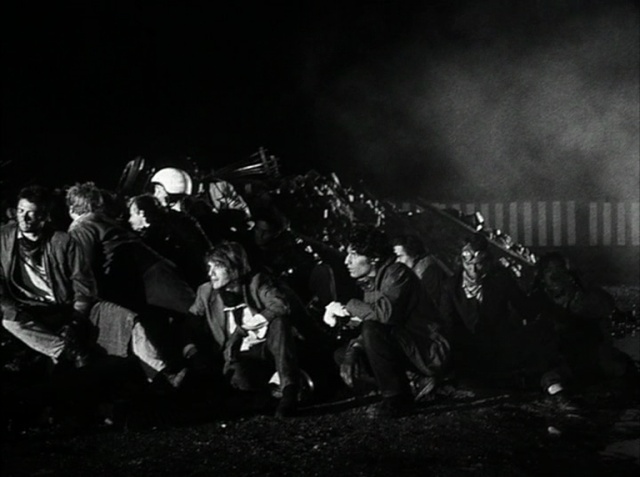
Compared to the rest of Robert Siodmak’s filmography, little ink has been spilled over Cry of the City. The most oft-repeated anecdote about the film is that Siodmak himself, while tasked to film a not insignificant amount of the film on location in New York, felt somewhat out of his element. Such discomfort is hard to trace, as even within in the on-location photography, Siodmak’s much more characteristic stylized expressionism is evident. It’s as pleasing to the eye here as it is in his more celebrated efforts, if not moreso in that it is used to depict a noir that carefully withholds the (quasi) genre’s more schematic conventions. Devoid of elements like a seductress, a big score, and a pat moral conclusion, Siodmak punches well above his weight.

Martin Rome awaits pensively in his hospital bed for surgery following his murder of a policeman. He recieves a series of visits, first from a priest, then briefly by his girlfriend Teena. Detectives Candella and Collins follow through with a litany of questions. Bringing up the rear is W.A. Niles, a crooked lawyer, who uses Rome’s compromised position to convince him to confess a jewel robbery that will absolve a client of his. Rome, essentially left for dead, sets out to escape and reconnect with his family – including his devoted Mama Roma and his younger brother, Tony, who sees him as a hero. Detective Candella, considered a family friend by the Rome family matriarch and a pig cop by the rest of the family, uses his emotional proximity to track Martin’s next move.

Just a few months ago, when my own personal Noirvember was in full swing, I spent some time with Joseph H. Lewis’ The Big Combo. A perennial favorite of noir enthusiasts, I found it to be less than the sum of its part. While I admire filmmaker Lewis for efforts like Gun Crazy and My Name is Julia Ross and am always a fan of John Alton’s photography, I found it a sort of a middling affair. I think Cornel Wilde’s short-tempered milquetoast hero played a large part in this. Wilde channels an irritable blandness in the film that relies on the lineage of the genre’s history to do the heavy lifting. He comes especially unpleasant in that film because he acts the hero to Richard Conte’s delightfully sleazy villain. I bring all this up because Conte once again delivers the good here, but in this case, he’s given a much more fascinating and rich role to bite into. While superficially he’s the villain again, Siodmak much more convincingly blurs the binary between him and the would-be hero, Detective Candella played by Victor Mature.
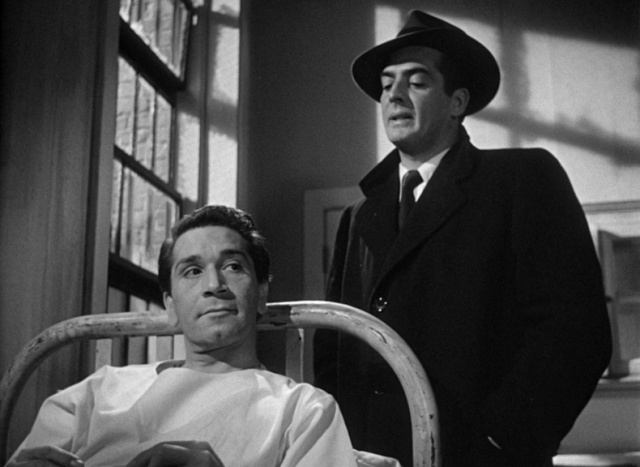
Mature gives one of his most subdued performances here as Detective Candella, a role which could easily have benefitted from a certain level of cigar-chomping. As it is, Conte’s Martin Rome tends to steal the show, but Mature has a brilliant understatedness here that brilliantly plays off of Conte. While film noir often provides us with “morally amibigious” heroes, Siodmak does us a further layer of deception, and tries his best to muddle just which of these men are our protagonists. Neither of them are deliberately brought down the rabbit hole of hard luck by a femme fatale. If anything, it’s Conte himself who is the schmoozer, who is often able to talk his way into women supporting him rather than the other way around. For someone who has seen their fair share of noirs, it’s sort of refreshing how the most prominent women here are two burly and middle-aged strongwomen – Betty Garde and Hope Emerson.

The understated dramatic nature of the narrative is refreshing enough on its own, but of course Siodmak provides a robust dynamic energy in each frame. With all the on-location shooting and the mild poetic evocation of Italian-American family life, it feels as though Fox brought Siodmak over from Universal to make a “gritty and realistic street film” which he successfully turned in, but he did of course with his own type of controlled set-bound artifice. The result is the best of both worlds, he captures some of the street-level authenticity that Jules Dassin sought with The Naked City released the same year. Yet, he doesn’t have to sacrifice any of the visual splendor in doing so. The film’s closing sequence of a cold, damp street is one of the most stunning visual sequences in Siodmak’s entire career. It’s clearly the product of studio work and yet, within that, Siodmak captures his own tactile piece of street poetry. It’s a fitting description for Cry of the City as a whole, as well.




Mùi du du xanh / The Scent of Green Papaya (1993)

8 05 2024

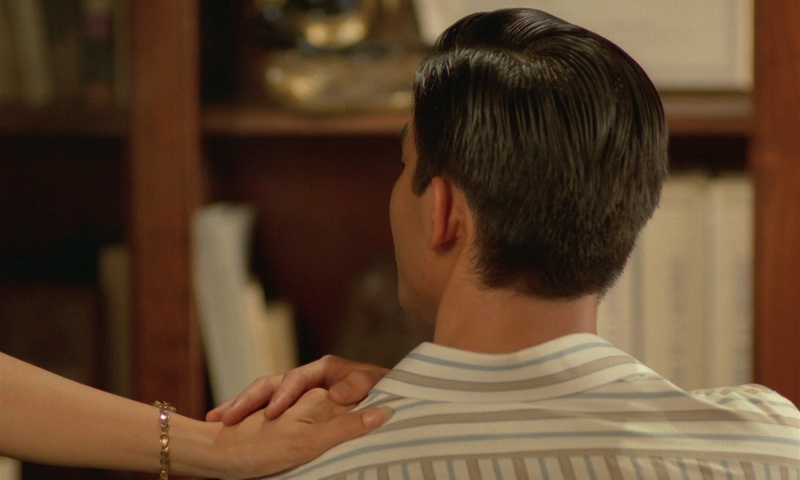
Not sure if I can put my finger on why but Tran Nu Yen Khne washing her hair is probably one of most profoundly beautiful things ever captured in cinema…

It’s been a good ten years since I’ve last seen this and I think my lingering stance on this was that of a lot of film’s naysayers: insanely beautiful, but nothing happens. Even someone well-reared in arthouse classics is going to find the narrative (or lack thereof) in Tran Anh Hung’s debut to be trying. Admittedly, it takes a little time, but once one gets in tune with the film’s unique rhythms, it becomes difficult to tear oneself away from it. Sure, on a very literal level, this is 100 minutes of watching someone performs chores, but the tactical pleasure Tran takes in something as simple as a elderly person’s wrinkled hand makes all the superficially mundane things in this film feel utterly transcendent.

This has to go down as one of the all time greatest “artificial” cinematic experiences. Yet Tran isn’t exactly working in the same tradition as say, Powell & Pressburger, or for a more contemporary reference, Wes Anderson. Instead of embracing the artifice of his soundstage, Tran takes the opposite approach – breathing an organic ecosystem into his very controlled environment. The emphasis on intimate textures — everything from the water dripping off of plants to insects to scars are rendered with a nearly erotic level of intimacy. The effect is that the film, despite being made under controlled and “fake” circumstances, is an utmost celebration of all of life’s senses. Surely if any film could evoke “smell” this is it.

With a theatrical viewing of Floating Weeds fresh in my mind, it’s difficult for me to avoid the Ozu comparison. It’s a simple and reductive one for many modern “minimalist” Asian filmmakers, but I honestly think Tran here comes closest to fulfilling the old master’s aesthetic promises, while building something else that is entirely his own. Especially with having just seen a color Ozu film, it is striking to see how the two used their sound stages to perfect their compositions within. The elaborate vases here feel like a direct lineage to Ozu’s red teapot, in that they are art objects that help make up the total composition. They serve no narrative purpose (though I guess one can reach and read something into the family’s descent into genteel poverty through it) but instead are part of the complete mise-en-scene.

I don’t want this comparison to stifle the complexity and uniqueness of the film’s experience, though. It should be said that while there are shades of Ozu, Tran’s vision is something else all together. There’s criticisms on this website that the film is simply about nothing and most amusingly, to me at least, that the film never says anything meaningful about Mui’s labor. For me, it is never a requirement that art must radicalize us, and films don’t need to be political to be “important.” There is something equally important and profound to be discovered in this film, and it’s found in the details that Tran lingers on. These details become easier and easier for us to pass over in our modern world, but they are the things that draw us back to the fact we are indeed alive and living on planet Earth. Sometimes that’s more important than turning us all into leftists.


Les amants réguliers / Regular Lovers (2005)

12 04 2023

“Just wait. Things may change.” “They won’t change.” There are many refrains in Les amants réguliers that threaten to synthesize the film’s 183 minutes of ideas into one line of dialogue. I wanted to resist buying into the impulse of picking one of these refrains as the film’s massive canvas alone suggests the enormous density of its pull. This is an enormous film. In its length, obviously, but more importantly in its approach. Garrel’s lack of concision could strike some a detriment, but the enormity of his texts give us space and time to be introduced to the specifically human phenomenons that his films depict. The film is structured by an initial idealism, then comes the disillusionment, and finally the disheartening takes from. We need time with these moments to punctuate their power as lived experiences. Despite being a film depicting 20 year olds, it perhaps take someone older to appreciate the processes that everyone, but specifically its titular lovers, François and Lilie, endure.

“I was given a molotov cocktail. All I had to do with throw it” This is what François tells us within the film’s first fifteen minutes. The ostensible protagonist is introduced to us an idealistic poet, a true romantic if there ever was one. His circumstances have offered him a swelling sense of purpose. It’s 1968 in Paris and revolutionary fervor is high. François doesn’t make a living, but he does make poetry and his well-off would-be comrade Antoine can house him in his opulent mansion. The initial enthusiasm of the uprising fizzles out, the revolutionary pre-tense of gathering gives way to parties at said mansion. During one such party, François meets and falls for Lilie. Lilie is a sculptor, which gives the couple a shared artistic vision, but her work is physical, tactile, and more importantly Lilie also has to work to make a living. The two fall in love, and although they’re both in their early twenties the enormity of their feelings for one another is authentic. We believe François when he says he loves Lilie. We believe Lilie when she says she loves François. As it tends to be in Philippe Garrel’s world, the relationship does not work out.

I very distinctly remember sitting in a bar with my friend the day after the 2016 election. At the end, it seemed like a epoch-level event and our presence in a Lower Manhattan protest earlier in the evening felt like us living up to the moment. It felt important, and more importantly justified and right. Protests proliferated during the fallout of the election. It seemed that every protest eventually concluded with someone admitting their exhaustion and suggesting the inevitable nightcap. Many of people I met at these protests became friends, and eventually the social impulse got to the point where the protest was deemed superfluous. The chants were skipped in lieu of the pints and socializing which was the thing everyone had genuinely craved in the first place. All this seems quaint and silly to me in 2023. That year’s election weighs little in my brain these days, as far more personally upsetting events have since taken place. But this recent rewatch of Regular Lovers resurrected those feelings. The initial revolutionary impulse (no matter how pathetic it seems now), the disillusionment that follows, and the burnout into unrestricted Bohemia. The power of Garrel’s film is that his nostalgia plays the part for one’s own. Perhaps we all have our own May 1968.

There is, of course, a collective cultural nostalgia for May 1968. Perhaps it was the first modern revolution, and perhaps it was the last to happen in a specific time and place, whereas all contemporary “uprising” are prone to postmodernism’s globally homogenized numb. Paris in May ’68 immediately conures up something romantic – even to those of us who weren’t even alive at the time. Garrel’s depiction of it, though, is tellingly a-romantic. The “revolutionary fervor” section that opens the film is not one where we are caught up in the middle of the unrest with our protagonist. Instead, we observe from a distance. These scenes resemble newsreel footage without the contextualizing force of a newscaster’s narration. The sequence goes on and on, uneventfully, which is enough to offer the more skeptical viewer the pretense of ridiculing Garrel’s vision of being bloated and overdrawn. There are those of us, though, who find this approach captivating. The “glacial” pace lends the romance that follows an incomparable sense of authenticity.

The romance of François and Lilie is the film’s most salient point. Their first meeting, the courting, the hours spent laying in bed post-coitus — these are the things that happen naturally in Garrel’s vast canvas. They don’t feel like the reason for the text’s existence in the first place, but a spontaneous sensation that crops within a near docudrama fashion. This further emphasizes the delicate balance of melancholy and naturalism that the film achieves. One feels something enormous in a film that is mostly a collection of “small” moments. Love is something that is just as beautiful as it is painful. There are million of films about being in love, but there are very few fictional romances that feel as authentic and lived-in as the one depicted in Regular Lovers.


Una vita difficile (1961)

8 02 2023

In my recent review of The Conformist, I reflected on the way aging has altered my perception of “selling out.” There’s a bit more ambivalence in the present day for me, as some of my ideals (both political and otherwise) have fallen out of balance with the simple everyday matter of fact issue of continuing to exist in comfort. Living is difficult, and fittingly, it’s this same tension that is at the heart of Dino Risi’s aptly titled Una vita difficile. Risi’s touch, while sometimes understanding the aching nature of everyday life, is buoyant and cheerful, even as we follow our unlucky protagonist down the rabbit hole of disappointment after disappointment. Strangely, the film celebrates the downward trajectory our lives often take as being of the whole chaotic and beautiful whole of living. The tone is remarkably different from Bertolucci’s film.

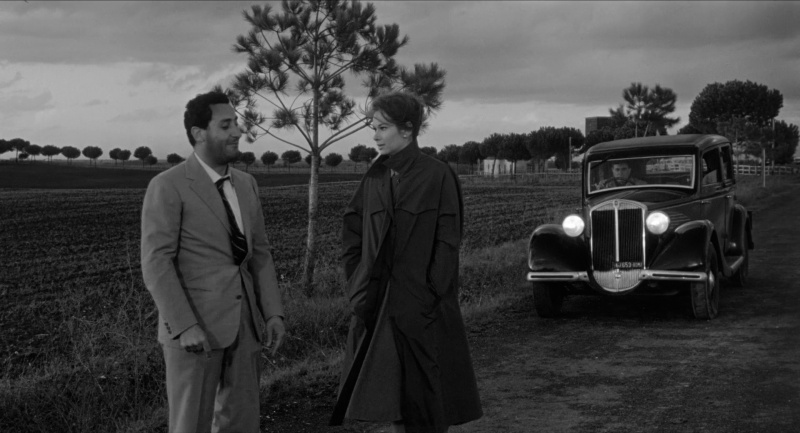
At the tail end of the Second World War, partisan Silvio is on the run from Nazi forces occupying near Lake Como. He is taken in by innkeeper’s daughter, Elena, after she manages to rescue him from a near-death confrontation with a Nazi. The two spend three months together in a shack located near the inn, and during that time develop a relationship of pseudo matrimony. When Silvio’s partisan comrades arrive, he abandons Elena. Years pass, Silvio is now a reporter for a fledging Roman leftwing rag Il Lavoratore. A story brings him back to Lake Como where he reunites with Elena, who he takes back to Rome to start a life of marital bliss. Silvio’s lack of income throws a wrench into these plans.

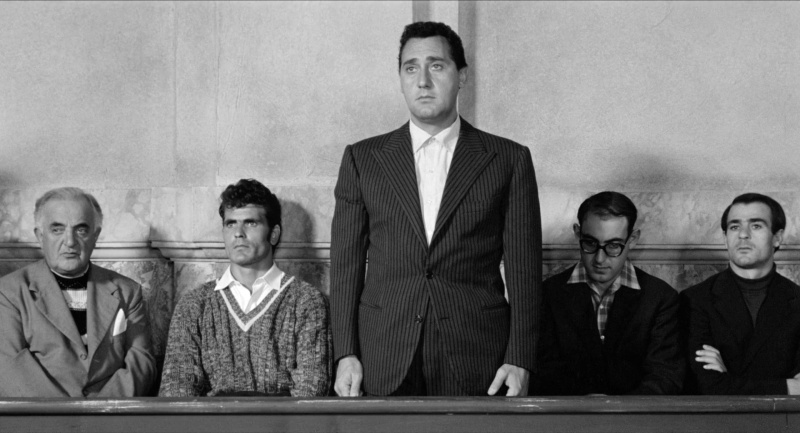
The face of Risi’s picture is Silvio, a hard luck idealist embodied by Alberto Sordi. Sordi himself was synonymous with Commedia all’italiana, the genre in which Una vita difficile can be classified. My understanding of the genre is limited – I’d experienced Sordi once before in Alberto Lattuada’s Mafioso which made little to no impression on me at the time. I went into Risi’s film skeptical that I’d be in tune with his humor, expecting something more whimsical – but this about as sour and bitter as a comedy can be. Sordi manages to strike the perfect balance between tragic and pathetic, his Silvio is not a political martyr, but instead an idealistic schmuck whose vision of himself never quite lines up with actions. He is something of a scoundrel, but not an irredeemable one.

In a stroke of luck, my screening of Una vita difficile came a day after a viewing of Mauro Bolognini’s Senilità, released a year later. In that film, the protagonist falls hopeless in love with a woman until it consumes his personal life. Bolognini’s film is brilliantly shot but its protagonist, whose desperation bears some similarities to Silvio’s, is an insufferable bore. The film does not fail because its protagonist is unlikable but instead because it presents his vision of a world as a stifling one dictated only by a romantic interest. Silvio is similarly pathetic, but the anguish found in the film’s humor resonates because even as Silvio overcompensates for his ideals, he at least has those ideals to begin with. He is more than just a seduced target.

Silvio’s plight is accessible because it brilliantly showcases a fundamental flaw in many humans. He sees himself as a dedicated leftist. When he abandons Elena in the film’s first act, he explains it is because of a fighter, but it seems just as likely that he’s doing so for fear of commitment. When he is finally released from two years in prison, he berates his friend and coworker Franco for not standing by his side during the arrests. “The revolution was happening, and you were getting a cappuccino!” Meanwhile, an earlier sequence depicting the arrest shows Silvio himself abandoning his pregnant wife – a move of cowardice that is never referenced again. His vision of himself does not exactly line up with how he is depicted, but Silvio is also not overly self-conscious. As the film’s finale shows, despite his inconsistency, his decision-making is ultimately dictated by his pride.


Christmas in July (1940)

1 02 2023

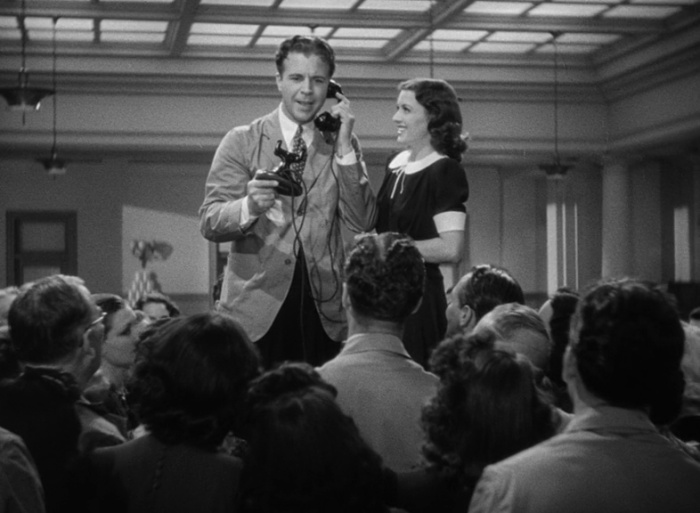
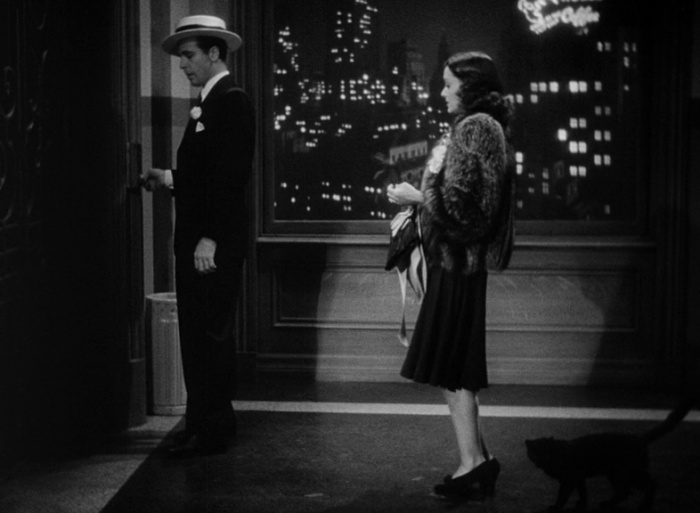
As I’ve aged into adulthood, one thing I’ve become more secure about is my insecurity. It sounds strange I know, but I’m now more aware that I’m not alone in this insecurity and instead that most of people’s waking lives are dominated by doubt, anxiety, and a level of self-consciousness. Even in returning to writing this blog, I’ve endured some stress at my personal expectations involving the responses of my peers. I, like anyone else, desire some form of validation. Dick Powell’s Jimmy MacDonald synthesizes this desire in Christmas in July when he says “I always thought I had good ideas. Now, I know I have good ideas.” This line comes after he falsely believes to have won the Maxford House Coffee slogan contest. The chaos that follows is one of the most concise distillations of the American Dream and all the agony it false promises can bring. Positioned by some as a minor effort, Christmas in July presents Preston Sturges at both his funniest and most moving.

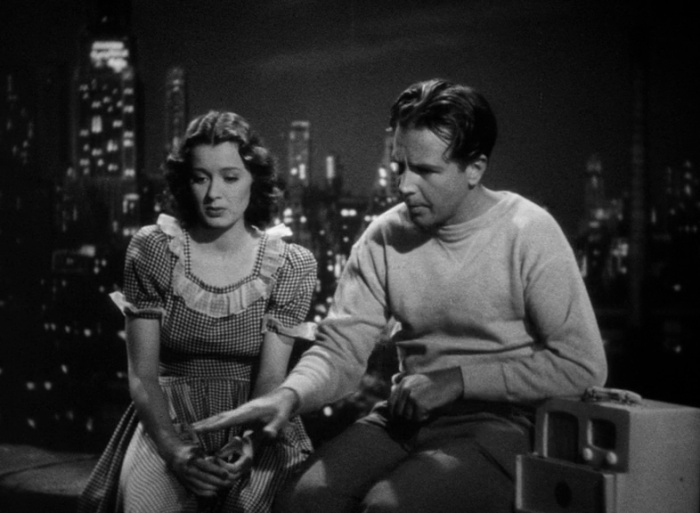
Jimmy MacDonald sits on the roof of his apartment with his girlfriend and coworker Betty Casey. The two dream of a better life, lamenting the life of struggle that was paved out by their parents. Jimmy has a treatment for their economic ailment: he plans to win a slogan contest for Maxford House Coffee. He believes he has an unbeatable motto: “If you can’t sleep at night, it’s not the coffee, it’s the bunk.” Betty is less impressed with the plan, and not at all on board with the slogan. The next day at work, Jimmy is stunned to find a telegram declaring him the winner of the contest, but the telegram is a prank from his coworkers. The ruse is never admitted, though, and Jimmy and Betty enjoy an afternoon planning their now prosperous future.

 Christmas in July clocks in at a brisk 67 minutes. Maybe the optics of the short run time has led to limited critical evaluation, it seems many of my peers consider this to be a “minor Sturges.” Much of the critical rhetoric suggests that it is a light and fluffy affair. I can understand how one might feel this way, especially in comparison to the far more socially pointed Sullivan’s Travels (which only came out a year later!) but I think more of a punch is packed here than in the longer, more celebrated film. It’s the sort of film where if one blinks, they might miss something that launches pages worth of discourse.

When Jimmy first strides into work, he is greeted by a workspace that resembles a machine. Rows of desk all in perfect symmetry, with the humans occupying them acting as automatons laboring away. Sturges quotes and evokes King Vidor’s The Crowd and in a few quick seconds manages to convey the same weight of that film within a fraction of the time. Like Vidor, Sturges captures the anxiety of the working class – the feeling of being replaceable, a cog in the machine. Yet, Sturges film supports this sensation with humor. When Jimmy’s (false) win leads to a promotion at work, his boss at work astutely states, “Now that you’re a capitalist, I don’t know how you feel about working for a living.”

Jimmy’s working-class ennui is not pointed at, like the self-pitying liberalism of Joel McCrea in Sullivan’s Travels, but instead something in which Sturges manages to draw in the margins. That’s film very explicit message of the importance of making people laugh seems to register better in this earlier effort, strictly on the basis of (and this is of course a personal opinion) it being immensely funnier. But most impressively to me, is the fact that Sturges pulls his best punches in the film’s rare but completely earned moments of tender emotion. Upon discovering that the telegram declaring the victory is a hoax, Jimmy and Betty return to their place of employment. A painter is putting the finishing touches on Jimmy’s new desk. The promise of a better future is slipping away and taunting them. Jimmy’s boss enters to re-congratulate him on his recent success, his promotion, his new office. Jimmy feels the need to come clean, but he does so obliquely. He suggests that his ideas he had earlier are still great, no matter if he won the contest or not. Winning the contest should be irrelevant. His boss replies that it does matter, “It’s what you might call commercial insurance as when a horse wins the Derby, you back him for the Preakness.” In the film’s most emotionally stirring moment, Jimmy confesses. “Well, I didn’t win.” To which his boss replies, “The Preakness?” Only Sturges could pack such a humorous uppercut in the middle of an emotional gut punch.