Die Unerzogenen / The Unpolished (2007)

9 05 2014

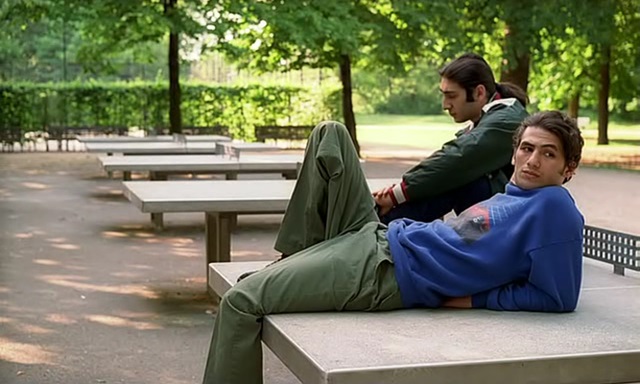
Within the first five minutes of Pia Marais’ debut, young Stevie is told by her mother, Lily, that they need to mentally prepare for the return of her father, Axel. While this suggests we might need to be afraid of Axel (his name is menacing enough, if not comically overzealous), Lily herself quickly finds herself back in his arm. Stevie is unimpressed, though, and she’s rather break away from the control of her parents. Marais’ debut is one of the all-time great films about being a teenager, it seems very much in step with The State I Am In, directed by Marais’ fellow countrymen, Christian Petzold. Marais might have more in common with Maurice Pialat, though oddly enough her debut seems like the antithesis of his most celebrated work, A nos amours. The problem here is not teenagers having the freedom to confront their approaching adult and being alienated by it, but instead one who is trapped in that tragically liminal state, but willing to do everything to break out of it.

1

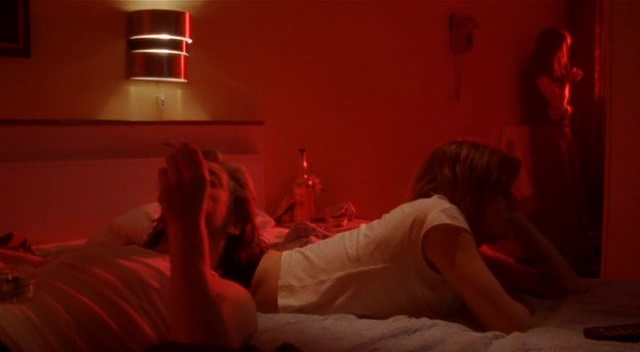
With Axel back in the family picture, Lily and Stevie move into his deserted house. There’s two other men there, and it would be presumptuous and unfair to label them as drug addicts, but they are there because they’ve been weathered down by the conditions of conventional society, and the living plans that go with that. One of them, Ingmar, shows an interest in Stevie. She is repulsed by the men around her, and instead their constant references to her budding sexuality. She teases him, but the only attention she is able to receive from anyone comes from his gaze. Stevie makes some friends her age, but they are still cold around her, perhaps simply having her around to benefit from her drug-dealing parents. Even with some companionship, she struggles to shake the feeling that she’s alone.
2

There’s an uncomfortable feeling one gets in watching Stevie do pretty much anything in this film. Perhaps that’s because everything she does involves her in close physical proximity to her parents. One wouldn’t describe them as “helicopter parents” in fact they are the parents that such individuals who fit the label fear. They’re irresponsible, care-free, and financially dependent on Axel dealing drugs. This might seem overwhelmingly bleak, perhaps approaching the fatalism of someone like Lars Von Trier, but Marais’ eye observes everything as if under the control of the bewildered fourteen year old girl who is experiencing all of this. Sure, it’s bad to be hanging around exclusively with junkies, but it is the only existence she knows. Instead of overwhelming the audience with how terrible and miserable Stevie’s family life is, Marais’ camera almost suggests we get comfortable with the reality, just as Stevie herself has had to do. So many of us are fascinated by the “transgressive” nature of poverty, especially in film (see GummoLos Olvidados, Pixote – all films I would consider favorites, by the way) but Stevie herself is bored with it. She is constantly looking for what she finds fascinating, but what many of us would call banal: the well-dressed family staying in same hotel, a group of girls her age gossiping about boys, and so on.

3

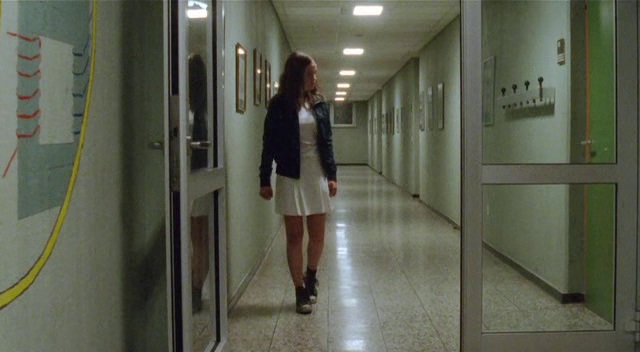
More important than this idea of “normalcy” which is obviously a construct. As a teenager, the rest of the world seems normal because we see only the performance of others in the public sphere. I hesitate to say “everyone is fucked up” because it sounds both trite and reductive, but it might be wise to express such a sentiment to Stevie. She doesn’t realize the idea of normal is completely false. Her more tragic learning moment comes in her interaction with men. She wakes up one day to find Ingmar in the kitchen. His body language, how he positions himself in the physical space of the kitchen is already sexual and intended to discourage to Stevie. To her credit, she beats him at his own game. She promises to perform fellatio on him, before recanting and adding “you could never afford me anyway.” It’s a powerful moment for Stevie because she’s won this sort of game, but alas, she’s going to spend the rest of her life dealing with similar bullshit from men.
4

She warms to the idea of Ingmar as a potential sexual partner, though and eventually throws herself at him. It’s easy to read all of this as the actions of a sad girl trying to communicate something with the rest of the world, but again, that’s too simplistic. As much as Stevie is repulsed by the sexuality that men around her impose on her body, she is fascinated with the idea of sexuality to herself. She sees a romantic relationship to achieve some agency, and distance herself from her parents. Throughout the film, Lily and Axel wield her around like carry-on luggage. Children can be a burden, sure, but they almost accept her as only this possibility. Not as a person worthy of their love and care. That’s why she seeks something else. The heartbreaking irony is that a romantic relationship will, in all likelihood, lead her down a similar path. As Hong Song-Soo has showed us, a patriarchal society limits a woman’s agency when she’s in a heterosexual relationship. This is not her fault, of course, but Stevie’s craving to be her own person is not likely to be fulfilled with the route she’s taking.

5

The beauty of the situation, if there is any to be found, is that Stevie does indeed have the time to fuck up and learn. So many of us do, whether it be with sex or the countless other exciting yet emotionally exhausting things we do as teenagers. I come back around to Pialat’s A nos amours. The anxiety felt in this film is the pressures of being your own person, and the struggle happens within an environment that is much less imposing than the one in Marais’ film. Suzanne’s situation seems brighter, she would be the type of girl that Stevie gazes at in jealousy. The experiences are always different, but if there is something universal in the teen condition, it’s the idea of being counted as a person. Both films are beautiful and bittersweet depictions of this struggle. It’s one we should all remember and be sympathetic towards.

6


Dealer (1999)

8 05 2014

There’s no one who has seen Thomas Arslan’s Dealer that wasn’t completely sure what they were getting themselves into before hand. Perhaps “Bressonian” is an overused description of style, but where cinema stands right now, Bresson’s aesthetic DNA is over a great deal of things. I mention this because I think it’s a fair description of Arslan’s film, but I mention it in passing because I think dwelling on this shared ethos will yield analytic results that are trying too hard and reaching too far. To clarify, there is something intriguing in where these filmmakers overlap and connect, but it would be a disservice to Arslan to focus solely on how his film works in step with a canonical classic like say, PickpocketDealer is cut from the same cloth, but its print is unique and worthy of our investment.

1

Can is a drug dealer, but not by choice. He lives with his girlfriend, Jale, in a cozy enough home with their daughter. Jale is constantly trying to get Can to find real work. He says he looks for it, but can’t find anything. She calls him on his bullshit. She’s not the only one giving him a hard time, though. Can is repeatedly visited by a cop that he knew in his youth. The cop gives him the option to work undercover for them, but the persistent act never wears him down. He dreams of something bigger, which is what his boss, Hakan, might offer him. He’s opening up a new bar and he wants Can in on the dealing, but again, he’s getting pressures from every angle.

2

As one would expect from Arslan and his Berliner Schule peers, everything here is played rather straight. There is no non-diegetic sound, and the things we do here are the unremarkable sounds that many of us are already familiar with. Arslan’s focus is not on the bustling streets of the city, but instead on the outskirts, where the soundscape is dominated by the hum of an air conditioner, or the scattered screams of schoolchildren off in the distant. While Can feels the pressure from his profession, it is not the conventional gritty hustle we so frequently see portrayed in America, or even the images we’re fed on the local news. Can’s environment is not another character itself, it’s something quite banal and unremarkable, but Arslan’s ability to illustrate its ethos is poetic. Sure, its not pointed and romantic, but it is loving in ability to step back and observe.

3

While Dealer is not a political film, it does reflect a reality that requires some political unpacking. Can, and most of his coworkers are of the Turkish diaspora. Without reading too hard into the  Turkish-German relationship that I don’t know enough about, it’s easy to see it translated to the Black-White relationship in America. The “war on drugs” was launched to criminalize the behavior of young, Black males. Their customers might be richer and white, but the design of such a program was intentional in criminalizing those who turned to drug dealing as a last resort. In America, the war on drugs is a hollow, rhetorical tool used to legitimate abuse impoverished and colored bodies. The same thing seems to be happening in Dealer, where the drug king isn’t hassled nor are the white buyers, but the Turkish dealers are, and they feel the brunt of the apparent “anti-drug” measures made by the law. Arslan’s film observes this, but like everything his camera captures, nothing is made of it. It’s the reality, and Arslan feels no need to point at like a more superficially “social problems” film would. He’s not aloof to the problems. The critique of the system being less pointed makes more biting at times.

4

What Dealer quietly observes is the reality that many of us face. Immobility might be a problematic term, but definitely the inability to move upwards in society. Can and Jale are ultimately stuck not by his drug profession, but instead the society that leaves him with no other options and then criminalizes his only means to living. As he himself points out late in the film, “They made it impossible to move.” He’s referring to the local police here, but this kind of manipulation, this trapping is something institutional. This kind of critique is not in the discourse of Dealer itself, but instead hidden away in the languid, empty shots of the protagonist looking on. Perhaps I articulate something similar far too often, but this is an effective political film precisely because it is not a political film.

5


Park Row (1952)

5 05 2014

Much has already been written about director Samuel Fuller’s own admiration for his 1952 effort Park Row. The film, a personal love letter to the very newspaper world he worked his way through as a youth, was a fiscal failure, which almost seems to deepen its bond with its filmmaker. Fuller’s style of filmmaking always suggests that he’s going 100 miles per hour, and that he believes every bit of his film is crucial and urgent. The comparison seems forced but through this idealism Fuller finds his closest colleague in Pier Paolo Pasolini. Sure, they worked towards a different ideology, but both did so with such passion and earnestness that what one could call “amatuerish” about their work (ie the potentially hamfisted nature way their politics manifest) ends up becoming part of its charm. Though “charm” seems to be a disservice to both men, it’s almost the ethos of their energy energy, and it becomes more and more contagious in every moment.

1

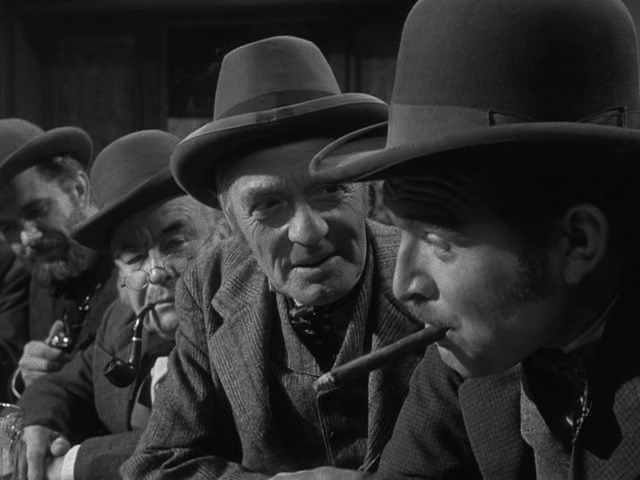
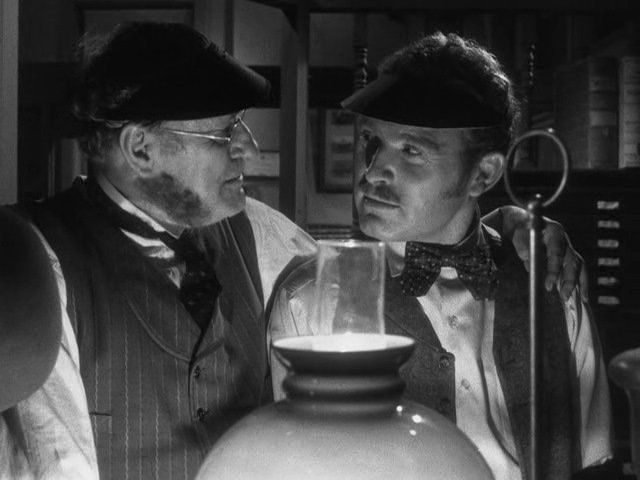
Phineas Mitchell is a great journalist at The Star, but the paper’s involvement in a recent trial has left him disillusioned. At a local dive bar, he tells off the paper’s proprietor, Mary Hackett. The other Star journalists at the bar are similarly dismissed, which leads Mitchell to wishfully entertain ideas of making his own paper. Someone listens and gives him an old office right next to The Star. The Globe is born over night and it quickly becomes a success. However, this success is much to Hackett’s chagrin, who seems devoted to quickly ending The Globe’s successful run. Undeterred by some shady efforts from his rival, Mitchell seeks to grow The Globe’s readership by having a drive to complete the Statue of Liberty. With every new innovation, however, Mitchell opens himself for a new opportunity to be taken apart.

2

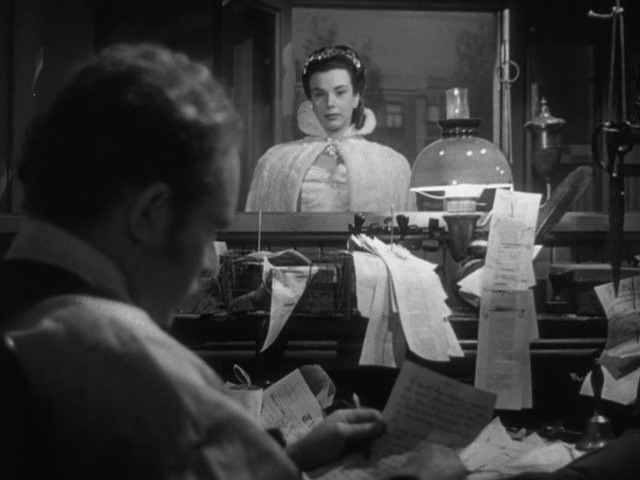
Fuller’s energy and drive is commendable and it’s something I’ll go into later, but I find it more important to begin with a narrative that manages to be both simplistic but complicated. The actual arc isn’t difficult to follow, but rather the complications come from the Mary Hackett character. She is drawn rather broadly, at times appearing more like Cruella De Vil than an actual woman with fears, dreams, expectations, and disappointments. Her relationship with Mitchell is where things get sort of interesting, since the film ultimately redeems her from this basic character template. The film shows an interest in elevating her from this unremarkable and equally unflattering trope, but it doesn’t quite work. At one point, she gives Mitchell a knowing wink and he returns it before the two embrace. Although the intimacy achieved in this moment is later revealed to be another manipulative tool of Hackett’s (sigh) the glance in the sequence suggests that both Fuller and Mary Welch (who portrays Hackett) understands how stifling such a character type can be. The fact that their romance ends up working out suggests that their animosity comes almost of convenience to the story, at that Fuller is winking along with the couple the entire time.

3

Park Row from a social perspective, is probably best read as Fuller’s love letter to journalism. It’s been described as such before, and I don’t think there’s anything wrong with agreeing with the film’s accepted reading. The marvel of Fuller’s film does not come from its subtext, but instead from the filmmaker’s technical virtuosity. There’s an energy in every composition, even the ones that are completely static. Sure, the tracking shot at the one hour mark is amazing all on its own, but just as impressive is how much Fuller’s gets out of his less flashy moments. Jonathan Rosenbaum describes the film as “cozy”  which seems like the perfect description for those compositions where Fuller squeezes everyone into the frames, much like how the characters themselves seem to squeeze into a seedy dive bar during off-hours. It’s this kind of love that one can read from Fuller in every frame. The way Mitchell gets excited for starting a new kind of paper in The Globe mirrors the way Fuller gets excited about making a new kind of movie.

5


Love and Death On Long Island (1997)

4 05 2014

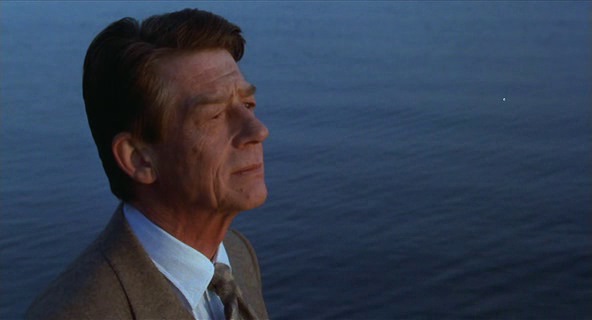
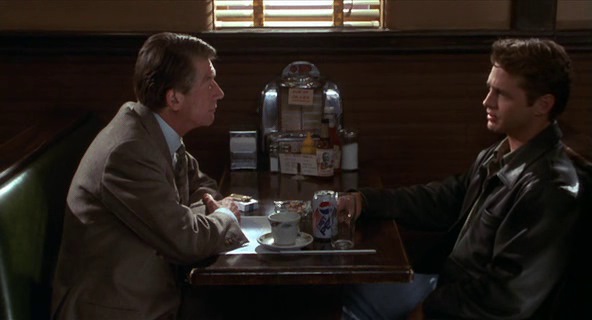
Early on in Richard Kwietniowski’s Love and Death on Long Island, Giles De’Ath tells one of his similarly stuffy, highbrow colleagues that he’s interested in finding beauty where no one has looked. His idea is genuine, but we, the audience, know that he’s artfully describing his new found infatuation with Ronnie Bostock, a young American actor stuck in lowbrow teen flicks. There’s two relationships at play here: Giles’ own personal obsession with Ronnie and the justification he provides for said obsession. While the film’s heart is the tragedy of the former, the rhetoric Giles himself uses in the latter speak to a complex rarely accepted. The idea that the high and the low art aren’t exactly inseparable.

1

Giles De’Ath is a beloved writer in England. He lives by himself in London, rarely ventures outside, and only holds conversation with his assistant. On a whim, he accepts a radio interview, where he learns that his defiant stance against new technology is a battle that is slowly being lost. Even E.M Forster’s work has been adapted to be projected on the silver screen. Giles chooses to investigate said adaptation, but ends up in the wrong theater. There, he sees a goofy teen comedy titled “Hotpants College II” which he is repulsed by until one Ronnie Bostock emerges onto the screen. He’s instantly fascinated by Ronnie, and investigates the actor’s life. His stubborn feelings towards technology are reversed. He buys a television and VCR to digest and study all of Ronnie’s work, which is of course, crass and commercial productions. Noticing his change in personality, a friend of Giles suggests he takes a vacation.  Choosing a destination is easy, Long Island, where Ronnie lives.

2

While filmmaker Richard Kwietniowski doesn’t particularly dazzle with any of his filmmaking decisions, he does deserve some credit for making a film about obsession and not turning the film into a reductive study in which Giles is nothing more than a creep. Giles himself knows that there is something quite ridiculous about his feelings for Ronnie and the fact that he goes so far out of his way to meet him. Calling his situation an “obsession” feels like an insult to begin with, if only because that word immediately brings to mind something that is not only unhealthy but something that we cannot possibly identify with. It is unhealthy and it might indeed be a problem, but by centering on Giles, the audience feels his process. He’s not some bizarre villain out to wreck Ronnie’s life.

3

The positive reviews I’ve read of Kwietniowski’s film have a habit of suggesting that Giles’ infatuation with Ronnie is not even romantic necessarily. I’m inclined to disagree, but I see why this suggestion is constantly made. It goes in line with sympathizing with Giles’ obsession and not making him out to be a creep. In reality, he is a little weird, which is exactly what ends up frustrating Ronnie towards the film’s conclusion. However, if the film were to be any more pointed about Giles’ feelings, it would risk making him out to be pitiful. To me, he does want to hold and caress Ronnie and be with him in all the ways that would conventionally imply. The relationships we frequently want to see in a film and perhaps in life generally, tend to be composed of young, white, attractive, heterosexuals. Giles’ age does him in, as does his profession. How silly that a respected author would even consider spending time with a lowly Hollwood actor in his 20s, let alone entertain ideas of loving him.

4

What can we make of Giles’ plight, then? Who is he but a rather silly old man whose dreams are far too unrealistic? Frankly, shouldn’t he know better at his age? He reminds me a great deal of Delphine in Eric Rohmer’s Le rayon vert. Despite his sophisticated personality, Giles is also ruled by his emotions. He too, feels his feelings too hard but the tragedy here is that unlike Delphine, he doesn’t have the rest of his life to look forward to. Perhaps because of his public persona he’s had to downplay his emotions for his entire life, and we actually catch a glimpse of him performing this facade. Maybe there’s something inspirational in him finally being “true” to himself. Giles himself would consider such an arc to be quite trite, but it all unfolds organically enough here that his heartbreak (not just from Ronnie but from the world) registers.

5


China Gate (1957)

3 05 2014

An American film dealing with French-Indochina never sounds particularly promising. Even today, where most of our war films are “gritty” survival tales that carefully recycle nationalist sentiments, it sounds troubling. For the 1950s, it sounds like it could be either extremely aggressive or potentially so backwards and problematic that it would sooner be forgotten. Parts of Samuel Fuller’s China Gate haven’t aged well. The film’s casually anti-communist rhetoric is tame in comparison to much of what was being expressed in Hollywood at the same time, but it does suggest the dedication to capitalism had bleed into Fuller’s brain. Weirdly, the context of the film doesn’t take away from what its truly about. Fuller has in his own passionate and hamfisted way sculpted a film that sure, comments on race relations in a superficial way, but it provides something deeper and more satisfying than the triumphant tales of color-blindness that populated the multiplex.

1

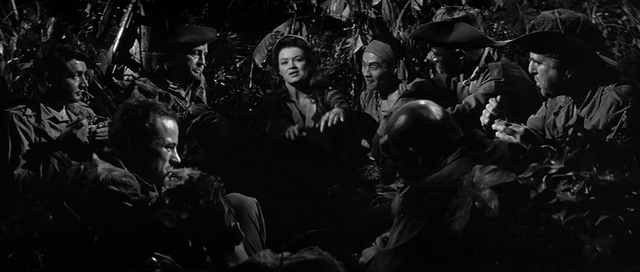
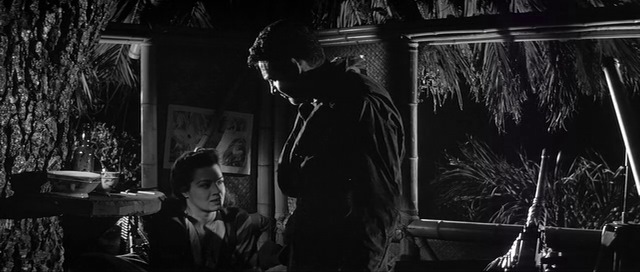
Sergeant Brock has been asked to lead a group of men into Chinese border, infiltrate enemy territory, and blow up their base. Brock, who we are to assume has no other options, is on board with the mission. However, the group’s secret weapon is his Eurasian ex-wife, Lucky Legs. Though never formally divorced, he separated from her once her son was born and looked more traditionally Asian. Lucky agrees to the mission with the reward that her son gets sent to America. She tries to reconnect with Brock, and while he still has feelings for her, he remains uncomfortable about his son. He can’t get over his feelings for the woman he loved, but at the same time he can’t get over his racism.

2

Now, I can see someone reading the previous description and seeing the film easily going the route of Brock unlearning his prejudice in classic, condescending and simplistic Hollywood style. That doesn’t quite happen, though. By the film’s conclusion, he confesses that he wants a family with Lucky, even if that includes his son. However, earlier in the film, following a tender but misread moment he says that he could patch up their relationship by lying. He could say he cares about their son, but he doesn’t want to lie. With this scene in mind, its difficult to read their reconciliation as a performance. He’s actually only concerned about Lucky.

3

While the film dives into Brock’s psyche and he tries to work through his racism, I would argue that the film’s real hero in Lucky Legs. There’s something awkward about a Eurasian woman being played by Angie Dickinson, who is of exclusively European descent. The biggest problem could be that the film suggests something resembling colorblindness – that Lucky’s background obviously didn’t matter to Brock until the manifestation of their sexual relationship produced something troubling to him. I think the film suggests sort of the opposite, and hints at what passing as white implies. Lucky herself is in a unique position, she’s beloved all over Asia (“she lived like a prostitute” the film not so gracefully tells us) and this is obviously an extension of her perceived whiteness. Her plight is summed up quite wonderfully at the film’s beginning, “I’m a little bit of everything, and a lot of nothing.” Sure, it sounds maudlin, but Fuller’s constant centering of Dickinson means her performance, while surrounded by potentially melodramatic trappings, registers as something both empowering and grounded.

4

I’m sure not all audience members see Dickinson as the film’s true lead. Maybe that’s because of some social conditioning or maybe because Gene Barry, as Brock, has just as much screen time. On the other hand, he is the  far weaker character. A man whose racism isn’t perceived as the “interesting” anti-hero trait that it would be viewed as in a lesser film. Instead, it’s a problem that Fuller expects him to fucking deal with as soon as possible and the rest of us aren’t going wait around for him to have his “aha!” moment of peace and clarity. Dickinson’s seduction-and-destruction technique is amazing to watch, not to mention perhaps a distant link to Jonathan Glazer’s recent Under the Skin. While Glazer’s film mystified people, Fuller is more direct. Dickinson needs to do this to save her son. Her death at the end of the film seems tragic, but it is almost inevitable. The things that influence society – poverty and war here – are the things used, fittingly enough, to keep a racist patriarchal capitalist society alive. Dickinson’s existence is thus, in opposition to the society that her and the rest of the film’s heroes superficially claim to be fighting in defense of.

6