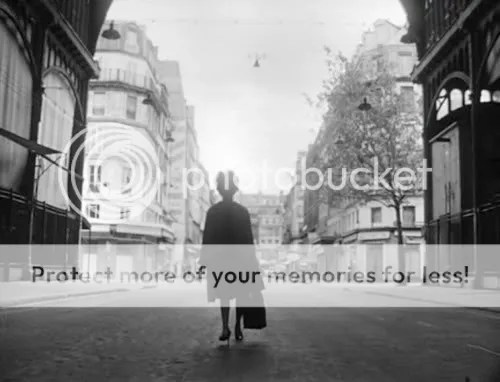
Eager Bodies (2003)

12 07 2008

Xavier Giannoli’s debut, Eager Bodies, is not the most unique or striking of films, but it is a very good entry in that shakycam relationship cinema mostly dominated by Ray Carney-championed American directors. Along with Jean-Paul Civeyrac’s Man’s Gentle Love, Giannoli’s film is one of the few French films of this ilk. Perhaps unfair, but the comparisons to Civeyrac’s aforementioned feature are inevitable. From a narrative assessment, they aren’t very similar but they are both relationship-driven French films made on a very low budget on digital. Eager Bodies has a shriller setup but it actually becomes the much less plot-driven of the two films. It lacks Civeyrac’s attempts at poetry, but on digital, those seem pretty awkward anyway. This is a much more straightforward film, but pretty good none the less.

Charlotte and Paul are in love, but their relationship hits a road bump when Charlotte has to undergo chemotherapy. Understandably, both are quite scared, but they begin to respond to the process differently. Charlotte becomes extremely depress, violent, and almost entirely passive-aggressive as Paul begins to spend less and less time with her, and more and more time with her cousin, Ninon. Charlotte anticipates and mentions the idea of Paul and her cousin having an affair before it actually happens, but once she accuses Paul, it begins to come true.

The events seem to have been taken straight out of a soap opera but they are handled quite naturally and never seem particularly over the top. It definitely helps that, like Civeyrac, Giannoli seems to have a fantastic sense of capturing intimacy. The, ahem “sex” scenes are much chaotic and spontaneous than they are in Civeyrac but equally poignant. Giannoli seems to be trying to do a Michael Winterbottom type of approach with jump cuts and close-ups but Giannoli’s scenes end up being a bit too fragmented to the point beyond comprehension. On the other hand, he does seem to give a lot more depth and attention to his characters than Winterbottom, or even Civeyrac for that matter. Perhaps this is just a result of the acting as it pretty fascinating. Some scenes are so intimate and believable that even Maurice Pialat would be proud.

Laura Smet’s character could have easily been reduced to the level of being disgusting and unlikable and only further her boyfriend temptation to have an affair but she comes off in a more realistic light. She is annoyingly passive-aggressive and manipulative, but in a way that is completely believable. In fact, most of her outbursts make no sense whatsoever. At times she does sway to the line of being a “bad” character but when one takes in to consideration everything else that has happened in the film, her whining seems understandable. The friction in Paul and Charlotte’s relationship is initially frustrating due to their inability to express how they obviously feel for each other but that is exactly what makes the film as great as it is. Such frustration is akin to the frustration that the characters themselves are likely feeling. The people here (not to mention people in real life) cannot provide monologues directly reflecting their thoughts like in a Eric Rohmer film.


Make Way for Tomorrow (1937)

12 07 2008

While it doesn’t live up to the ridiculous amount of hype it has produced, Leo McCarey’s legendary Make Way for Tomorrow does ultimately come off as being a fine film. Of course, it is nowhere near as profound and moving as the film that it famously influenced, Tokyo Story, but then again how could any Hollywood film? I’d argue that no Hollywood director could (or well ever in all likelihood) match the subtle tragedy of Ozu’s masterpiece. Not to ruin anyone’s expectations, but McCarey’s film doesn’t even end up being the Hollywood version of an Ozu film, but rather a great film in its own right.

An elderly couple is forced out of their home by the bank. The couple has produced five children, all of whom are fully grown adults with families of their own. At first the children are eager to adopt their parents into their households but circumstances lead to the parents living in separate houses. As time passes, the children quickly become bothered by the burden of their parents and realize that it is, perhaps, time for their folks to move on. The children plan for their father to take a trip to California while the mother will be sent to an old folks home. This gives the couple one last day to spend together and take in the sites and sounds of their past experiences.

The first hour isn’t anything really special, just a “character study” film in the Hollywood sense. In other words, very quick characterizations propelling plenty of side plots and trivial scenarios. There’s certainly nothing wrong with this, and McCarey does actually have a pretty decent comedic sensibility but these scenes, while much more easy-going and entertaining, are nowhere near as memorable as the final twenty minutes or so. It’s either ironic of completely fitting that the film’s most fascinating moments lie in the parts that seem the least attached with Ozu’s later and greater film.

Perhaps it would be a bit of an exaggeration to equate the final twenty minutes to something Wong Kar-Wai would do, considering that McCarey’s aesthetical qualities are so tame in comparison. At the very least, though, the final meeting between the two parents is just as great as what Alain Resnais did in the 60s. In fact, I would be willing to give McCarey more credit if only for his decision to not show any flashbacks but instead, have the characters reflect on their memories. Does this completely redeem the schmaltzy and manipulative sensibility? Hardly, but in all honesty almost all Hollywood films of the time period had such a style, if you can even call it that. Considering the circumstances, what McCarey pulls off is quite an accomplishment.


Sunflower (2005)

11 07 2008

This a half-decent family drama with good intentions, but it ultimately falls flat on its face due to a constantly present sense of sentimentality. Maybe it’s just the intrusive “sad” piano music that is played every five minutes, or maybe its just the silly symbolism shoved in the audience’s face during the really tacky epilogue. Whatever the case, this is most definitely a problematic movie with lots of Hollywoodish “pull at your heartstrings” tactics. At the same time, it is possible to overlook all the presentation-related faults considering that one, the film actually is pretty entertaining and two, most of it rings true.

Xiangyang’s father, Gengnian, is forced to spend six years in an reeducation camp. During this time, Xiangyang experiences the earliest stage of his life. When his father returns, he is skeptical and cold to his father’s intentions to create a bond. Gengnian’s parenting skills also creates problems as he doesn’t approve of many of Xiangyang’s activities. To keep him out of trouble, Gengnian teaches and later, forces, his son to draw.

In the second segment, the film depicts Xiangyang’s late teenage years. During the day, he skips college to illegally sell greeting cards with his friends. It is here that he first notices Xun Ho, who becomes his love interest. When his parents learn of his “business” and absence in school, they are outraged. Xiangyang’s reaction is to run away with Xun Ho, but his plans are thwarted and Gengnian goes to extreme measures to keep his son away from Xun Ho. The concluding segment features a now married Xiangyang being pressured by his parents once again, this time by their constant requests to obtain a grandson.

Following a similar but not identical setup as Hou Hsiao-Hsien’s Three Times, Zhang Yang attempts to paint a portrait of a man growing up within the backdrop of an ever-evolving China. That sounds a bit hyperbolic but such a description does align with Zhang’s lofty aspirations. It sounds good, but essentially it seems the interest of the filmmakers lie in more in the political than in the personal. There is plenty of relationship-driven content but it all feels very over-simplified almost to the point that Zhang himself comes off as someone with no insight whatsoever into human relations. Ironically enough, on the featurette that appears on the New Yorker DVD, everyone interviewed seems eager to proclaim Zhang as an observer and someone who inherently understands all the complexities of human interaction. This seems almost like a joke, especially when one compares Zhang to any other remotely popular director in China. It seems harsh to even compare him to a person like Jia Zhang-ke because Jia is on a completely different level, artistically. I guess that’s what Sunflower comes down to: it’s entertaining and charming but pales severely to the work of any other major director from China.


Chronicle of Summer (1961)

9 07 2008

Like Mister Chicken, this starts out extremely promising before ultimately losing its novelty and then, becomes a somewhat excruciating experience. It’s difficult to not admire Morin and Rouch’s intentions, but on the other hand, they execute it rather poorly. As I’ve come to expect from Rouch’s films, there’s plenty of wonderful moments but in this case, nothing ever really gels. Almost all of the people participating in the “experiment” are interesting, but not at the level that I want to hear their dull philosophical discussion. Even worse, said discussion never seem to never go beyond the rather predictable topics. Still, it is nicely filmed with plenty of great cinematic moments.

In 1960, Edgar Morin and Jean Rouch sent two young women into the streets of Paris to ask “Are you happy?” to as many people as possible. It was their intention, that through such an exercise, they would be able to capture something truthful about life, which eventually gave birth to the term “cinema verite.” In addition, Rouch and Morin also begin to document, on a more intimate scale, the lives (and thoughts) of an anxious generation. This includes a holocaust survivor, an African student, a factory worker, and a Italian immigrant. All confused and upset about the complications and abstractions that come from human interaction.

As appetizing as this all sounds, it is mostly just people discussing their philosophical concepts and telling anecdotes that are occassionaly interesting. Every once in awhile, the camera stumbles something that is truly heartbreaking but in all honesty, most of it is just people talking about issues that are far too abstract to be articulated in the form of speech. This is why so much of the film is rather dull: it does too much telling, not enough showing. Perhaps that is the point, but really, who cares about someone’s concerns about life’s repetitions. I mean, I personally relate to such a concern but when I have every person in the movie telling me the exact same idea, it begins to feel a bit like the filmmakers are just trying to expand the film’s running length.

One of Chronicle‘s great strengths, however, lies in its conclusion. The lights are turned on in a crowded theater. The audience: the characters in the film, who have attended a screening (most likely provided by Rouch and Morin) of the exact same film the audience has just finished. Some of the characters find the film too personal, while others find it far too constructed and fake. The very mixed response sparks the single most interesting discussion in the whole film; Rouch and Morin ponder on the ability of a camera to truly capture the truth. Overall, a worthwhile experiment, just not an entirely successful one.


Cockadoodledo Mister Chicken (1974)

8 07 2008

One of, if not the only, fictional feature from Jean Rouch is also one of the craziest films ever imaginable. Even though he’s influenced everyone from Werner Herzog to Jacques Rivette, his cinematic vision is still one of the most unique and relentless. Perhaps this is the only fault of Mister Chicken. For as crazy and spontaneous as it is, it might not have enough “there” to actually sustain itself for 90 minutes. There’s a great moment with every minute, but its possible that Rouch can’t get enough out of something so freewheeling. Still, he impressed me a great deal with this film and I’m certainly looking forward to future Rouch experiences.

Lam, a farmer, and his apprentice, Mallou take off in their makeshift automobile to start their chicken business. Along the way they pick up Damore, a priest, who is oblivious to likely long-term commitment of the trip. In their tiny automobile, which has been nicknamed “patience” in relation to its inconsistent functionality, tensions quickly begin to boil. The gang is stopped by a female hunter who is in search of her elephant. They, for whatever reason, suspect she is the devil. Mallou goes to retrieve a tire and when he returns, he finds Damore in a hysterical state.

The film continues to build upon occurrences such as the one described above. Damore becomes hysterical again, but this time is healed by an instrument, which is actually just a long pink plastic tube that Mallou vigorously rotates. Like Herzog’s Even Dwarfs Started Small, which actually predates this by a good four years, there is nothing to comprehend, to “get” in a sense. Like Herzog, Rouch interests (seemingly) lie in capturing undeniable images with a hyper-kinetic type of spontaneity. This pretty much accounts for my appreciation of Mister Chicken, which, after awhile, simply wears out its welcome. Essentially, the film runs out of gas and then drags itself to the finish line, but does so successfully.