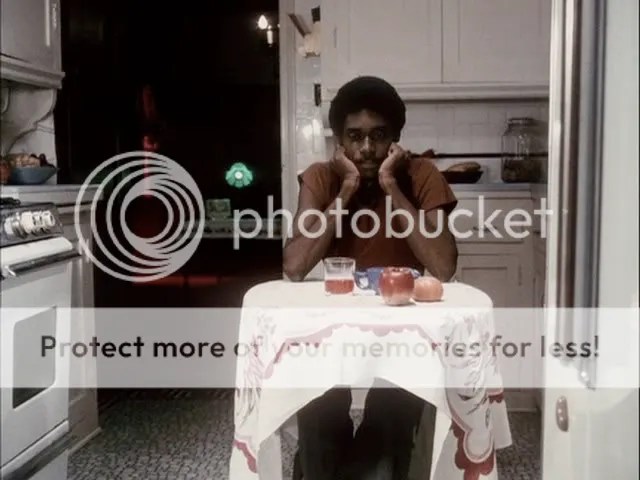
São Paulo, Sociedade Anônima (1965)

4 03 2008

It was not done on purpose, but this ended up fitting quite nicely alongside a lot of the recent “finding one’s self” type dramas that I’ve been watching lately. Unfortunately, unlike some of the aforementioned films, this still has yet to find an audience, which isn’t surprising since it seems like every Brazilian film made during this time period falls into a similar category. If judging only from this film, Luís Sérgio Person has everything it takes to become a big figure in the art film, but I guess he was just unlucky.

Carlos is 25 and working for the Volkswagon company right around the time of the auto industry boom in Brazil. He is successful, to a degree, but also extremely lonely. Told through a series of ellipses, we are introduced to his many romantic relationships all of which end up being problematic. The first girl is Ana who often lies about visiting her ill grandmother to get Carlos off her back. She definitely likes him, though, but he is unsure what he feels towards her mostly because she wants real life to be like a Mexican movie and Carlos hates Mexican movies. The next girl we’re introduced to is Luciana, who Carlos meets while attending an English class. They eventually marry, but in the mean time the final woman, Hilda, is thrown into the mix. It’s implied that she’s a prostitute but she still treats Carlos as a friend. Her death doesn’t shock him, but it does launch him into a marathon of memories which occupy most of the film’s time.

The main character, Carlos, takes awhile to warm up to. It’s easy to sympathize with his cause but within the first ten minutes we get a montage of him slapping Ana suspecting her participation in an affair. Not much later, he defends his awkward reactions as “being honest” which impress Luciana but eventually back fire on her at the end of film. All the characters have very impulsive way of responding to situations which seems realistic considering how reserved they are the rest of the time.

This isn’t the most original film in terms of overall aesthetic, in fact at times it seems like a lot of is lifted from Bertolucci’s great Before the Revolution but still it is really ahead of its time. The voiceover has that poetic gracefulness that I love and it seems like it is always used in the right places. The family dinner sequence is a perfect example of this, which sort of leads me into another really great thing – the humor. It’s been a long time since I’ve seen something with that type of awkward, messed-up situation humor that I tend to associate with Paul Morrissey’s films. There’s plenty of like-minded sequences here. The most memorable is when Carlos tries to inform Luciana’s father of their marriage while her younger brother is watching TV in the same room, or when Carlos starts talking to business partner while watching little kids throw rocks. These scenes sound simply silly on paper, but Person breathes this almost surreal type of life in them that make hilarious and poignant. This does run out of steam towards the end but still for the most part, this is perfect film making to me. A perfect introduction to Cinema Novo: I’m hooked now.


Life of Oharu (1952)

3 03 2008

It’s impossible, at this point, to read about Mizoguchi’s The Life of Oharu and not see some reference to the title character’s bleak life. That’s because, her suffering is the movie. I’m not one to argue in favor of optimism but this is just ridiculous. At first, it seems as though the film is going to simplybe very dreary but the misfortunes begin to pile up to the point where they lose any possible repercussion. A recent Mizoguchi devotee, I’m disappointed to see that his most critical lauded work is not completely representative of his true talents. In all honesty, this feels just a streamlined version of some of his best films, or perhaps more harshly, an okay imitation by someone misunderstanding his work. It makes sense that this was his dream project because it shows all the faults of the self-indulgent excess that only slightly taints his better films. This said, Oharu is indeed a great film. As over-the-top as it’s “tragedy” is intended to be, the graceful acting of the great Kinuyo Tanaka shines and for what it’s worth, this may be Mizoguchi’s most technically accomplished work.

Oharu opens with a startling long and elegant tracking shots. The location looks post-apocalyptic but Mizoguchi guides us through the ruins of the city. Oharu is old and to be frank, ugly but like the setting, there’s a poetic grace in her face. She enters a temple and begins to recall the tragedy leading up to the bleak point. We see her at a much younger age falling for a low-ranking page named Katsunosuke but eventually, their affair is uncovered. While he is executed, Oharu and her parents are sent into exile. Lord Matsudaira must find a new concubine and his attendant chooses Oharu. She is reluctant to go, but her parents (particularly her father) encourage her to go, in atonement for her affair. She makes an impression on Lord Mastudaira and she bears his child, but he’s spending too much time with her. She is sent back with her parents, who respond by selling her to a geisha house.

At this point in the narrative, I was absorbed by the film (to say the least) and despite it’s obvious overtly bleak outlook, seemed like the masterpiece it was cracked out to be. Extremly melodramatic/tragic events like this continue to reoccur, though, for another hour. The turning point for me is when Oharu marries a fan-maker, things begin to look good, but of course, he dies. He dies within fifteen minutes of his screen time. This is where the film becomes incredibly frustrating. Mizoguchi’s compassion for Oharu is deep, but he loses all focus on the world around her. People become mere props to make her life worse and worse. It’s almost as though the film is a series of the most pessimistic vignettes ever made. In fact, I’d like the film more if that were the case. Mizoguchi’s stylistic grace is apparent in every scene, but Oharu’s misfortunes are so dramatic. In fact, it’s desensitizing to the point where deaths just seem silly.

Perhaps the reason the film seems so bleak is because there are not enough “light” moments. The film just continues to spiral downwards into an abyss of despair. By far my favorite moments in the film are the most poignant ones: early on when Oharu jokes around with her prostitute pals and later on, when she gets the pilgrims to laugh. These are scenes that really are sad, to me at least. They definitely have the most emotional value and there’s not an ounce of superficial tragedy present. It’s the tragedy of the slight smile that shines from Tanaka’s otherwise shattered face that is truly heartbreaking. These moments are fleeting, but that’s why they are so great. The moments that pile onto Oharu’s laundry list of disappointment are only sad in a Hollywood way but thankfully Mizoguchi is smart enough to see that he couldn’t make his film completely depressing, though he certainly tried.

At the same time, I also want to pronounce this as one of the best movies ever. As mentioned earlier, this is one of Mizoguchi’s most technically established films – laying almost every technique he used in his career. The elegant tracking shots of his films made in 50s lead us into distant static shots found in his social dramas of the 30s. Must I even mention the cinematography? Calling it the most aestichally evolved film of all time is a bit much, but it’s probably the single most innovative film in Mizoguchi’s entire body of work. To continue on with positives, this does indeed boast amazing performances. I really can’t say enough about Tanaka here. I’ll just leave at this: she does everything right.

I guess…I totally love this film. Yes, it has a lot of problems in it’s dramatic thrust but it encompasses so much beauty underneath it’s bleak mask. Calling this “self-indulgent” would be an understatement: this is Mizoguchi putting himself on celluloid. The problems that plague his other films are magnified here, sure, but so are all the things that are great about him. In the end, it’s one of the most frustrating cinematic experiences I’ve encountered but probably one of the most emotionally involving. I’m hesitant to declare it as a masterpiece, but it is a great film.


My Brother’s Wedding (1983)

2 03 2008

In recent months, Charles Burnett’s work has gone under a bit of a critical evaluation. This is most likely due to Milestone’s (excellent) new DVD release. The praise of American independent filmmakers like Steven Soderbergh and David Gordon Green doesn’t hurt I suppose. Still, most of this new publicity focuses on Killer of Sheep, Burnett’s influential full feature debut, while his follow-up, My Brother’s Wedding, is written of as the “lesser” just like it was after it’s disastrous premiere in 1983. In my opinion, if it’s not masterpiece, it’s pretty damn close.

Pierce Mundy works with his parents at a local dry cleaner. He has no idea what he wants in life. Growing in a lower class neighborhood, he’s upset with his brother’s decision to marry a upper-class women. In the meantime, Soldier, an old friend of Pierce, is released from prison and old relationships are renewed. However, all is still not wellas Pierce continues to live his life without finding any glimpse of happiness.

Burnett’s film has plenty of rough spots, most notably the acting, which can range from very okay to mechanical. Technical limitations mare the film too, but are far less noticeable. Despite the film’s obvious amateur feel, it comes off truthful, funny, and with a poignant sting. The narrative, which admittedly, hits close to home, takes it’s cues from Ozu’s Early Spring and also anticipates many recent American “mumblecore” movies. The similarities with Ozu don’t end there, though. Even with Burnett’s reputation as a follower of Cassavetes, I still think this film, for better or worse, is the closet any American director has come to recreating the spirit of Ozu. Now, this probably was not a conscious decision on Burnett’s part but for an Ozu enthusiast like myself, it’s clear as day. Marriage plays a large role in both universes and in this film, the protagonist isn’t particularly keen on getting married. Also, he’s attached with his parents. Sound familiar? Yes, the specifics are a bit different: here, our “hero” never gets married and his relationship with his parents isn’t as close as the one between Noriko and Shukichi in Late Spring.

Stylistically speaking, it definitely belongs in the same category of now prominent “shakycam-relationship” films and outside of one dinner table sequence, shares no aesthetic qualities with Ozu. In all fairness, though, it’s unlikely to see any film technically resemblant of Ozu. The stilted acting does remind me a bit of his films, though. One could argue instead of smiling and nodding, these people cover things up with biblical monologues and “Kids these days…” type of rants. The acting, as mentioned before, is really quite bad but it’s easy to get use to. The Ozu comparisons aren’t really my way of selling the film because it’s great in it’s own way. I just felt the need to point out a (tiny) parallel between two great filmmakers.